
When we hear the phrase “indoor palm tree,” we often picture the familiar silhouettes of a hovea or dracaena. But the world of these plants is much richer and more surprising. There are many little-known but stunningly beautiful varieties that can turn your apartment into a real tropical corner.
Some of them are striking for their unusual leaf shapes, others for their miniature sizes, ideal for small spaces. Among them are truly exotic plants that you are unlikely to find in a standard flower shop. They will not only decorate the interior, but also become the pride of any collector.
Let's take a short journey through the world of rare indoor palms. You will discover plants with almost graphic leaves, species that resemble shrubs, and those that retain their compact shape for years. Ready to be amazed?
- What is so good about indoor palms?
- Varieties of indoor palms with photos and names
- Brahea
- Butia
- Washingtonia
- Gioforba
- Govea
- Caryota
- Livistona
- Rapis
- Rophalostylis
- Sabal
- Trachycarpus
- Date palm
- Chamaedorea
- Chamaerops
- How to care for indoor palms
- Optimal conditions for indoor palms
- Transplanting
- Propagation
- Pruning
- Pests and diseases
What is so good about indoor palms?
Once in your apartment, a house palm can become the main decoration. How did this houseplant earn its popularity?
-
A palm tree is an elegant single plant. You don't need to grow a whole nursery to decorate your interior with it. One such tree will fill the emptiness in the corner and become a full-fledged decoration in any room, on the balcony, or in the hallway.
-
The plant is not demanding in terms of growing conditions. You don't need to be an expert in botany to grow a beautiful indoor palm tree.
-
A large plant means more oxygen.
-
There are many varieties of this plant, among which you can choose the one that best suits your specific growing conditions. These are palms for warm, moderately warm, and cool rooms. If space allows, you can choose a larger and taller plant. If not, there are more modest sizes.

The indoor palm tree is suitable for growing and propagating in any climate zone. Even in winter, it does not need special conditions, only protection from dry air. It is shade-tolerant, so it is not necessary to place the pot with the flower only by the window.
Varieties of indoor palms with photos and names
Indoor plants – palms are native to the tropics, but they thrive in ordinary apartments when cared for properly. We invite you to familiarize yourself with the types of indoor palms: names and photos.
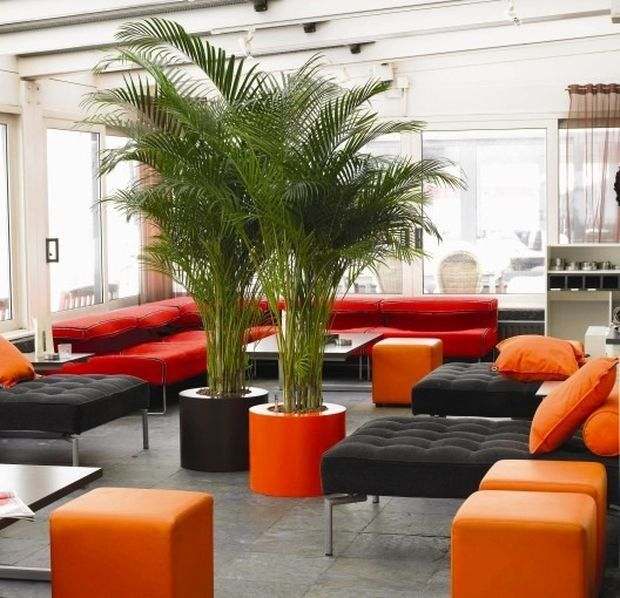
Brahea
It is often found in apartments or houses. It grows quickly, has beautiful fan-shaped leaves, and is easy to care for. Brahea likes sandy loam soil without excessive moisture.
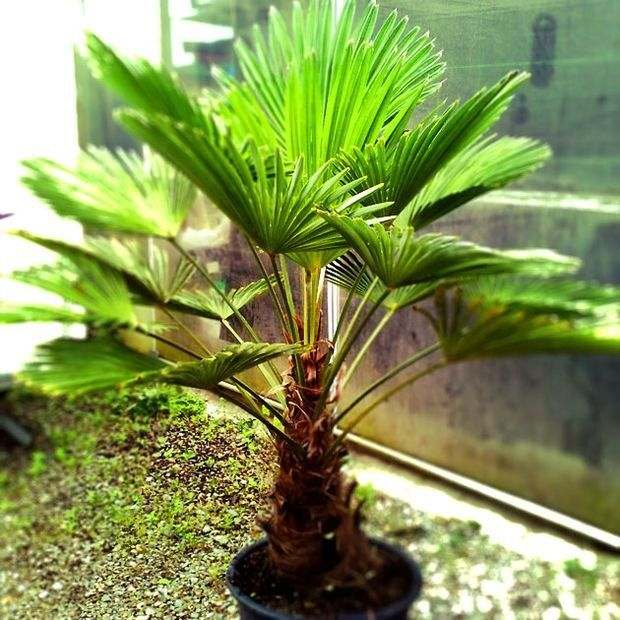
Butia
Houseplants are quite capricious: they grow slowly and are susceptible to drying out, overwatering, and insufficient lighting. They require frequent spraying and humid air. But with proper care, they will reward their owners with their exquisite beauty.
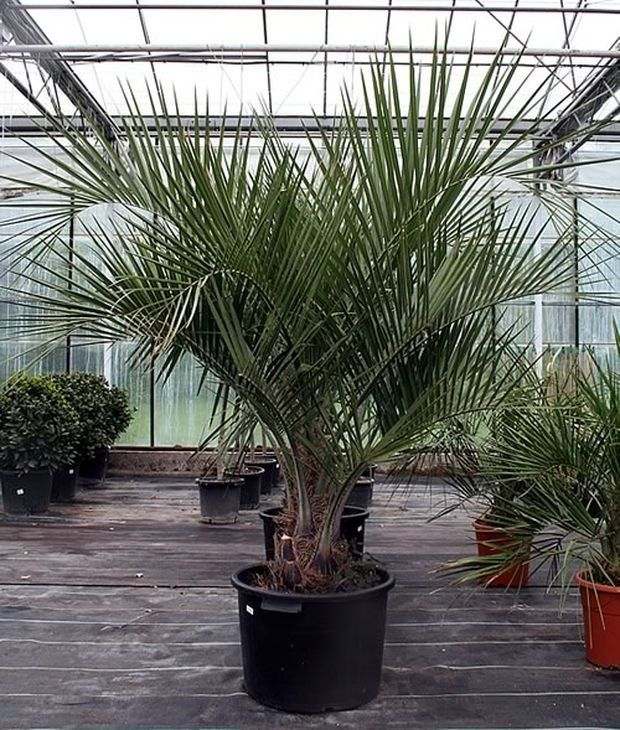
Washingtonia
It has a very beautiful fan-shaped crown. It likes bright light, warmth, and constant air humidity. It does not require frequent abundant watering.

Gioforba
A relatively small but very “prominent” indoor palm tree. It grows well in rooms with high humidity, bright light, and constant warmth, but cannot tolerate direct sunlight. Gyophorbus needs to be sprayed daily with water containing a small amount of lime.

Govea
This species is popular due to its beauty and undemanding nature. It needs to be watered once every few days, fed once a month, and kept at a temperature of 16-22°C.

Caryota
It does not grow very large and has an unusual appearance. It is one of the few species that flowers. However, this does not happen often – only once a year. Caryota tolerates bright light, sufficient moisture, and humus in the soil, but needs protection from direct sunlight.

Livistona
This species has gained popularity among interior designers of living rooms. Livistona will be pleasing to the eye if the following measures are observed: good watering, sufficient lighting, high humidity, a warm room, spraying and wiping the leaves.

Rapis
This is a small variety of indoor palm trees that easily tolerates low light and insufficient humidity in the room, but grows very slowly.

Rophalostylis
It has an intricate appearance. Abundant watering and annual feeding are necessary.

Sabal
A low plant that grows in the subtropics of the USA. To keep it, you need to follow all the general care tips.

Trachycarpus
It is very beautiful, making it ideal for decorating a room. Its distinctive feature is its fragrant yellow flowers that form inflorescences. Trachycarpus thrives when planted in open ground, but the temperature must not fall below 5-7°C.

Date palm
If you can't organize open shelves, it's better to admit it and close them with doors or curtains, or put the contents in closed storage. Open shelves are only beautiful when they are tidy, and tidiness requires effort. Don't try to apply all the tips at once. Choose two or three techniques that suit your bathroom and your taste. Sometimes even one large mirrored surface or correctly selected furniture can completely transform a small room.

It seems that only one or two palm trees look good in the house, but in fact, there are many unusual and undemanding species that will fit perfectly into any interior. From fluffy hovea to graceful cariota, from miniature bonsai palms to exotic trachycarina — each has its own character, appearance, and care requirements. Many of them grow slowly, do not require a lot of light, and are suitable even for beginners. Stop thinking that palm trees are just palm trees! Meet 14 unexpected indoor beauties that will liven up your home and surprise your guests.
Chamaedorea
A very popular species among houseplants. Easy to grow and care for, they pose no problems.

Chamaerops
It will grow very slowly, but it is unpretentious. When created in perfect conditions, it can reach 5 m in height. Chamaerops likes loose soil, moderate regular watering, sun, and periodically requires replanting.

How to care for indoor palms
Although the flower does not require special care, certain growing rules must be followed. If optimal conditions are created, the palm tree will be healthy, grow well, and delight you with its decorative appearance for a long time.

Optimal conditions for indoor palms
-
Temperature. The comfortable temperature for the plant is 16-22 °C. In winter, it should be even lower: 8-10 °C. Some heat-loving palm species (caryota, areca, coconut, chamedorea, acanthophoenix) prefer winter conditions at 14-16 °C.
-
Watering. Water the flower in a timely manner, often, preventing the soil from drying out. In winter, the frequency of watering is reduced to 2-3 times a week, in summer – daily. If the plant is in a cool room with an air temperature of 5-7 °C, it should be watered no more than 1.5-2 times a month, sometimes replacing watering with spraying. To prevent water from stagnating at the bottom of the pot, it is essential to lay drainage there. Water should be settled. After watering, the top layer of soil should be loosened periodically.
-
Air humidity humidity should be high, at least 40-50%. During dry summers, the plant should be sprayed daily with warm water, or even showered. The same conditions should be created in winter if the air in the room is too dry due to central heating. If the air is not humid enough in winter, there is no need to increase the frequency of watering, as this will not solve the problem. It is best to place a container of water next to the pot, install a humidifier, or cover the radiators with damp towels. Wipe the leaves with a damp cloth twice a month.
-
Lighting. The indoor palm tree is shade-tolerant, but that does not mean it loves shade. It needs good, diffused lighting, but without direct sunlight. With age, it becomes more shade-tolerant. However, some varieties of palm trees, such as neanta and hovea, thrive in constant partial shade.
-
Placement. The plant should be placed where there are no drafts or cold air currents. There should be enough free space around the pot so that nothing interferes with the growth of the flower. If the pot with the flower is near a window, it is better to cover it with light curtains to prevent the midday sun from shining on it. It can only be placed on a balcony if it is insulated. Do not place the pot on a cold floor, as the roots are very sensitive to cold.

Transplanting
Palms are transplanted in spring. For good growth, very nutritious soil is needed. Its composition should contain:
-
clay-loam soil (2 parts);
-
humus-leaf soil (2 parts);
-
peat soil (1 part);
-
rotted manure (1 part);
-
sand (1 part) and a small amount of charcoal.
Young palm varieties up to three years old are transplanted every year, older plants – once every 3-5 years.
Before transplanting, a layer of drainage mixed with charcoal should be poured onto the bottom of the pot. During the process, you need to be very careful with the roots. Sometimes, in order not to damage them during transplanting, you have to break the old pot to remove the plant. The container for the transplanted palm tree is chosen based on the size and shape of the rhizome; a tall pot is often required.
After transplanting, the flower is fed with organic fertilizers. This is necessary for its rooting and good growth.
Propagation
The flower is sown with seeds in February or March. It is not easy to propagate a domestic palm tree. But if you follow all the recommendations, you can achieve success:
-
Seeds are purchased from a specialist store. If they are fresh, the plants will sprout in 20-30 days. If not, germination will take 2-4 months.
-
Small seeds are poured with warm water and left for 3-4 days. Large seeds need to be cut.
-
Small pots with holes for excess moisture to escape are used for sowing seeds. Drainage is placed at the bottom and covered with fertile soil.
-
The seeds are buried 2-3 cm deep in the soil with a spacing of 3 cm. The containers with soil are moistened and covered with plastic wrap.
-
When the seedlings reach a height of 10 cm, they are transplanted again.
Germination should be carried out at a temperature of 20-22 °C (for subtropical varieties) or 28-30 °C (for tropical species).
Bush palm species (such as rapis and cariota) can be propagated by rooting. The flower is carefully removed from the soil, and a shoot with its own full-fledged roots is separated from it with a sharp knife. The cut site is treated with activated carbon. The offshoot is planted in a separate pot at the same depth as it was originally.

Pruning
The leaves of an indoor palm tree cannot be cut off, otherwise it will get sick. They are removed only if they have turned yellow and dried up. With natural growth of the flower, only the lower leaves turn yellow and dry up; in other cases, it may be a sign of improper care or the development of a disease.
Since almost all palm species have a single growth point, it is not recommended to cut the upper leaves or shape or shorten the crown in any way. These actions can lead to disease and death of the plant.
Pests and diseases
The indoor palm tree is sensitive to improper care, which can result in various diseases. Too little or too much water during watering affects the appearance of the flower: it turns yellow or brown. If the air is too dry, dry patches appear on the tips of the leaves. Conversely, excessive humidity provokes the appearance of fungal diseases, which manifest themselves as spots on the leaves. If they become larger, it is time to take action: remove all damaged parts, reduce the amount and number of waterings, and lower the temperature in the room. Sometimes the soil is infected with fungus. In this case, the flower will need to be repotted and treated with fungicides.
Another common disease is root rot. The flower begins to grow slowly, with virtually no development. It turns yellow, and some parts of the rhizome die off. The dead areas must be removed, and the rhizome placed in a special solution (e.g., Homecin). After 15 minutes, the affected areas are treated with activated charcoal powder, and the plant is replanted.
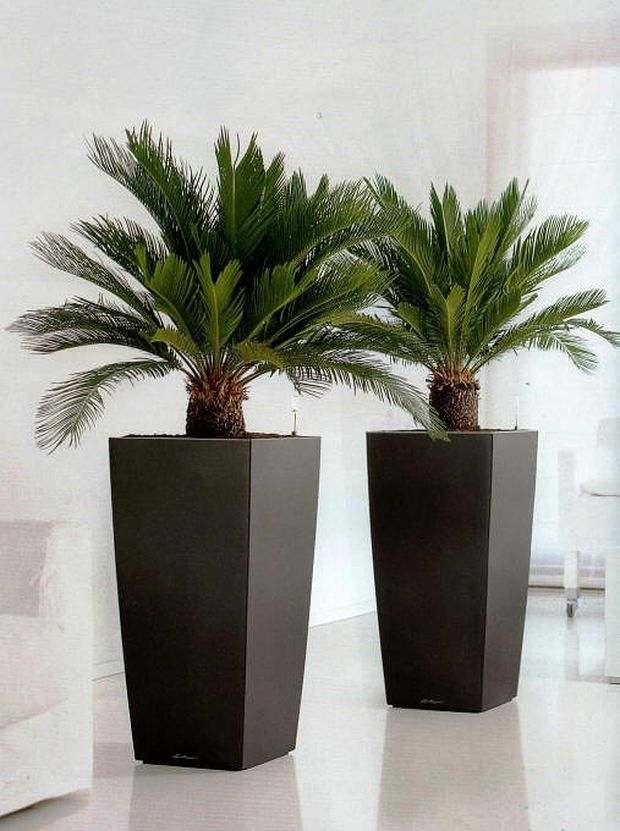
Among pests, indoor palms can be attacked by spider mites, scale insects, or mealybugs. The first occurs most often due to excessively dry air. To “cure” the flower, wipe it with a sponge dipped in soapy water, followed by regular spraying and a warm shower. Scale insects and mealybugs cause the shoots and leaves of the plant to dry out and fall off. To get rid of them, you can use the same methods as for spider mites. In addition, the soil and the plant itself can be treated with special insecticide solutions.
As you can see, the world of indoor palms is much richer and more interesting than it seems at first glance. Behind the familiar hoveas and dracaenas lie dozens of amazing species, each with its own character and history.
We hope this little excursion has inspired you to try new experiments. Perhaps now you will take a closer look at the elegant chamaedorea or decide to get your own “fishtail.” Each of these palms can bring a piece of the tropics into your home and become a truly unique green pet.
Don't be afraid to try something new. Choose a plant that appeals to you and enjoy the process of watching it grow. After all, the main thing is the pleasure of communicating with living nature, which is so easy to give yourself without leaving your home.


