
Are you considering improving the outside of your house? For many homeowners, a pebble blind area is an attractive and useful solution. This article examines the advantages and disadvantages of utilizing pebbles and provides important installation advice for them throughout your home.
To begin with, pebble blind areas have a number of benefits. They offer efficient drainage, avoiding the accumulation of water that could weaken foundations. Their organic appearance complements a variety of landscaping designs, enhancing the property’s aesthetic appeal. Compared to other materials, maintenance is usually minimal, requiring only the occasional weeding and leveling.
It’s crucial to balance these advantages against any potential drawbacks, though. Over time, pebbles may shift, necessitating periodic readjustments to keep the surface level. They might also provide obstacles to accessibility, making it harder for people in wheelchairs or with mobility problems. Moreover, weeds may occasionally grow in between the stones, requiring ongoing care.
To achieve the best results, take into account a few suggestions when designing your pebble blind area. Initially, make sure the ground is completely prepared, level, and sufficiently compacted to avoid uneven settling. Underneath the pebbles, use an appropriate landscape fabric to prevent weed growth while maintaining water drainage.
- What is the material?
- Requirements for raw materials for construction
- Layer laying rules
- What is required for work?
- DIY filling instructions
- Possible mistakes and how to avoid them
- Pros and cons of use
- Average prices for materials in the Russian Federation
- Video on the topic
- A new method of insulating a blind area without using concrete
- How to Make a Crushed Stone Blind Area 🏕Compare Types of Blind Areas August 25, 2026.
What is the material?
Pebbles are a naturally occurring material used for both decorative and construction purposes. These round stones range in size from 10 to 100 mm.
They are made of igneous or sedimentary rock. Large chunks of rock are mined and then brought to the business, where crushing machinery separates the pebbles into different fractions that are then sorted.
With the use of contemporary technologies, it is now feasible to create pebble material in any desired size, color, shade, or shape. This material has elements of sandstone, granite, marble, and so forth. P.
The pebble blind area’s primary function is to drain the foundation of extra moisture. Its additional insulation will help cut expenses during the heating season, which is its second purpose.
The blind area is completed first, but before the basement portion, right after the wall’s exterior is finished. This is to allow for the possibility of leaving a space between the blind area and the wall. You should never, ever leave a gap as this could cause the foundation to collapse too soon.
Requirements for raw materials for construction
The qualities, appearance, and color of the pebbles are directly influenced by their place of origin. Specific gravity: 2550–2670 kg per cubic meter; this impacts the material’s suitability for use.
The lighter one serves as a decorative element, and the heavier one is used for blind areas. There are various kinds of pebbles:
- maritime,
- river,
- marble,
- decorative.
Because of their great strength and durability, the first three types are used in the manufacturing of blind areas.
Requirements for construction supplies:

- high strength indicators;
- durability;
- frost resistance;
- good tolerance to temperature changes;
- color preservation under ultraviolet rays;
- uniformity of shape and size;
- heat retention;
- variety of colors;
- preservation of original properties over time;
- stylish appearance;
- affordable price.
10 to 30 mm stones are used to construct blind areas. This material has a striking, ornamental appearance that presents the space as well-kept and well-groomed.
Layer laying rules
The blind area is created from every side of the house because excess moisture is distributed throughout its entire perimeter. The width is chosen with consideration for the roof’s cornice overhang and the soil’s composition. It is typically made 20 centimeters longer than the roof. As per SNiP, the blind area width in normal soil is approximately 600 mm, whereas in subsidence soil it is approximately 1 m.
The blind area is a multi-layered "pie" where each layer serves a specific purpose. You can’t ignore them. Every layer needs to be compacted tightly and reach a specific height.
It is important to remember that the foundation has a 30 degree slope. It is necessary to make sure that water can drain freely into the livery network’s grooves. Depth of blind area: 15–20 cm.
All layers (concrete, sand, gravel, waterproofing) are covered with uniformly spaced, five centimeter-thick pebbles.
What is required for work?
Without consumables and tools, no construction project is complete, and the quality of these items dictates how long the built facility will last. To avoid having to start from scratch when setting up the blind area, you shouldn’t skimp on the materials you buy.
Required supplies:

- Waterproofing layer: PVC film, roofing felt, water-repellent polyethylene membrane film, etc.P.
- Geotextiles protect the drainage system and promote correct and uniform load distribution. The choice of material should be based on the composition of the soil where construction is taking place. Thermally bonded layers are laid on rocky ones, and needle-punched layers on clayey ones. Fabric material is not used in blind areas due to low waterproofing quality.
- Crushed stone of medium fraction.
- Dry sand.
- If additional insulation is necessary, a material with good thermal insulation properties is required. It prevents cold or heat from penetrating inside the house, which helps maintain a comfortable environment inside. Insulation is mandatory when arranging a basement under the house.
- When pouring concrete, cement is required.
Tools for efficient work:
- shovels;
- inclinometer (to set the desired angle);
- level;
- pegs for marking;
- rope;
- bucket for carrying sand, pebbles;
- construction stapler for securing the waterproofing layer;
- when mixing concrete mortar, you may need a concrete mixer or a mixing container.
DIY filling instructions
The waterproofing layer is the most important one when setting up a pebble blind area, so the material used to install it needs to be extremely strong and able to sustain heavy loads from different layers over an extended period of time.
Remember that geotextiles keep the finishing and drainage layers from combining. By covering the waterproofing layer with geotextile material, excess moisture will be quickly removed and the foundation won’t be destroyed.
- Preparatory. At this stage, measurements are taken, the required amount of materials is calculated, depending on the size of the site of the blind area of the house.
- Marking, soil preparation. The area where the blind area is planned is marked with pegs or posts. The area is fenced with a rope.
- Excavation work. The required amount of soil is selected, which is then leveled and compacted. Sand or crushed stone is added. If the soil is very loose, clay is used, which is leveled and compacted.
- Insulation installation. To prevent freezing and additional insulation of the foundation, an insulating layer is made with special materials. Usually, it is not additionally fixed.
- Waterproofing layer. The membrane is rolled out in a layer with an overlap on the walls. It is necessary that it completely covers the "pie". The layer is fixed, the seams are glued with double-sided tapes.
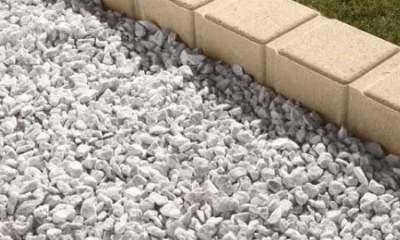
- Backfilling with pebbles. A layer of pebbles is poured onto the prepared area. The material is leveled so that its surface is the same over the entire area of the house.
This blind area arrangement technique, known as soft, is thought to be the most straightforward and cost-effective. Using concrete is more expensive and takes longer. Using waterproofing materials, pebbles are poured onto a surface that has been filled with concrete and dried.
This post discusses the benefits and drawbacks of installing a pebble blind area around your home and offers helpful installation advice. Pebble blind areas provide superior drainage, reducing the accumulation of water close to foundations and promoting soil stability. They also need little upkeep and enhance aesthetic appeal. The possibility of weed growth in between the pebbles and the requirement for regular replenishment to maintain the area’s neat appearance are drawbacks, though. Make sure the base is properly prepared for the installation, and select pebbles that complement your landscape in terms of size and color. By skillfully weighing the advantages and maintenance needs of pebble blind areas, this guide seeks to assist homeowners in making well-informed decisions.
Possible mistakes and how to avoid them
"A person who does nothing commits no errors." The most frequent flaws are listed below so that you can minimize mistakes and save time fixing them.
Typical error scenarios
- Incorrect calculations can lead to structural failure. Measurements and calculations should be taken with full responsibility.
- The width of the blind area is not taken into account, which should be greater than the roof overhang.
- No slope of 30. Water stagnates in the area, as a result of which the foundation quickly collapses.
- No insulation. The wall will collapse faster due to temperature fluctuations in the external environment from minus to plus.
- Lack of waterproofing layer.
- No water drainage system. The structure is filled with water, which leads to the destruction of the building.
Many attempt to economize on building costs by omitting one of the aforementioned layers, but this results in higher maintenance and replacement costs for the blind area. It is not appropriate to stray from SNiPs. Any deviation will cause the structure to become more fragile and require ongoing repairs.
Pros and cons of use

Advantages:
- no special repairs or maintenance required;
- frost resistance;
- withstands temperature fluctuations;
- resistant to destruction;
- many different options to choose from;
- saving money;
- doesn"t freeze.
Minuses:
- weeds grow through the soft covering;
- labor intensity of work;
- short service life due to lack of concrete.
Average prices for materials in the Russian Federation
The region and the area where the construction site is located will determine the price of pebbles across the nation. Let’s examine the going rates in a few Russian Federation cities:
- in Moscow, region – from 200 rubles. for 25 kg;
- in St. Petersburg – from 100 rubles. per 25 kg bag;
- in Kazan – from 150 rubles. for 25 kg;
- in Sochi – identical to Kazan.
Due to the rising demand for such a remarkable building material, the most expensive material in the capital.
The type of material, color, artificial or natural, and fraction of the pebbles all affect the price.
This section contains important and helpful information regarding materials for the construction and finishing of blind areas surrounding the house.
| Advantages | Disadvantages and Recommendations |
| 1. Improves drainage around the foundation. | 1. Requires regular maintenance to prevent weed growth and maintain appearance. |
| 2. Adds aesthetic appeal with natural look. | 2. Can be more expensive and labor-intensive compared to other options. |
| 3. Helps to prevent soil erosion. | 3. Careful planning needed to ensure proper slope and drainage. |
There are several benefits to setting up a pebble blind area around your home, but there are also some things to think about. Among its main advantages is its capacity to improve your property’s visual appeal. Because they are available in a variety of hues and sizes, pebbles let you design a visually beautiful border that goes well with your landscaping.
The ability of a pebble blind area to control water drainage is an additional benefit. Because pebbles are porous, they help keep water from building up near the foundation, which lowers the possibility of moisture-related problems like mold growth or structural damage.
But it’s important to take into account a few possible disadvantages. Maintenance can play a role because, in order to keep their effectiveness and appearance, pebbles may need to be replaced or leveled on occasion. Furthermore, occasionally weeds may grow in between the pebbles, requiring periodic weeding to maintain the area neat.
When building a pebble blind area, weed growth can be reduced by placing a weed barrier fabric underneath the pebbles for best results. Over time, proper edging can also aid in preserving the installation’s integrity. Your pebble blind area will continue to improve the curb appeal of your home and efficiently manage water drainage with regular inspections and maintenance.


