
Rubble concrete foundations are a common option for building a strong and long-lasting foundation for a home. This kind of foundation is made of concrete mixed with broken bricks or rubble stone, which creates a sturdy base that can support the weight of a building and distribute loads uniformly to the ground.
When compared to other foundation types, rubble concrete foundations are renowned for being reasonably priced and comparatively simple to construct. Since they can adapt well to changing ground conditions and offer sufficient stability, they are usually used in areas where the soil conditions may not be ideal.
Concrete is poured over a bed of bricks or rubble stones that have been laid inside a formwork during the construction process. By combining the mass and stability of rubble stones with the strength of concrete, this mixture produces a composite material that ensures a strong foundation capable of supporting the structure above it.
The ability of rubble concrete foundations to evenly distribute the weight of the building over a greater area lowers the likelihood of settling or uneven foundation issues over time, which is one of their main advantages. The longevity and structural integrity of the entire building depend on this stability.
- Total information
- Foundation materials
- Selection of rubble stone
- Plinting: preparing stone for construction
- Concrete mix
- Scope of application of rubble concrete
- Advantages and disadvantages
- Stages and installation technologies
- Determination of the type of soil, marking, trenches
- Design and characteristics of the base
- Installation of formwork
- Making a pillow
- Pouring concrete and laying stones
- Blind area device
- Foundation insulation
- Foundation installation in winter
- Video on the topic
- Stacking Booth
- Rubble foundation
- Foundation, plinth made of rubble. Simple installation technology
- rubble foundation. Laying the foundation.
- Rubble foundation – I won"t leave you alone.
- Foundation
- rubble concrete foundation
- Foundation – rubble stone. Video cast 6. Part 6
Total information
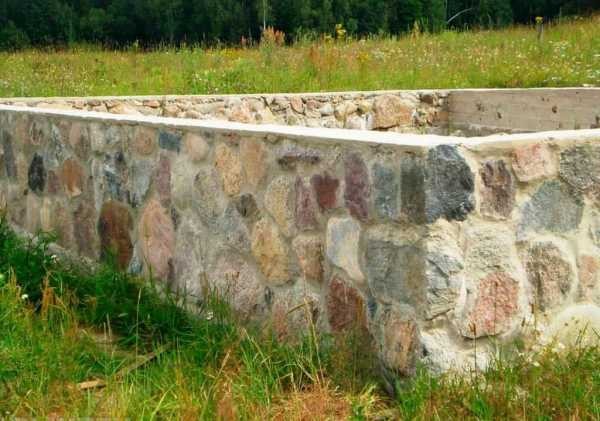
There are two types of natural stone foundations that are well-known: rubble and rubble concrete. The primary distinction between them is that a foundation made of rubble is created by submerging rubble stones in a concrete mixture. Consequently, the percentage of stones in the foundation’s thickness is limited to 20–25%, whereas in a rubble foundation, it can reach 40–70%.
Foundation materials
The two primary components of a rubble concrete foundation are concrete mixture and rubble stones, as reinforcement is not utilized in this type of foundation.
Selection of rubble stone
In nature, there are lots of rocks. The following kinds of stones are considered rubble stones:
- sandstone;
- basalt;
- limestone;
- dolomite;
- granite;
- dense shell rock;
- diorite.
Each mineral has a different physical and financial availability based on where the future foundation will be built.
Not all dolomite, basalt, or limestone is appropriate for building. It is essential to assess the stone’s quality:
- Hit it hard with a hammer. It shouldn"t split.
- It makes no sense to buy a flat finishing stone; it is inferior in strength to untreated specimens.
- Most stones should not have cracks. If they are present, there is a risk of stone crumbling in the thickness of the foundation.
Because you will need specimens that are no larger than 20 cm in diameter and no smaller than 10 cm in size in order to build a foundation, it is important to take processing ease into account when selecting rubble stones. This implies that specimens that are overly big could split or plint.

Plinting: preparing stone for construction
It’s possible to plint stone with your hands. A minimum of thirty kg of rubble stones are needed to build a foundation. Specimens with a diameter of 10–20 cm typically fall within this restriction.
The steps are as follows:

- A large stone tips over onto the most stable side.
- An attempt is made to split the stone with a sledgehammer weighing at least 5 kilograms.
- In case of failure, a mark is placed with a pencil through which the splitting plane will pass.
- A piece of rope is rubbed with chalk, positioned in the required plane and applied to the stone.
- The center of the rope is raised and suddenly released. A chalk line remains on the stone.
- The chisel, using a hammer, is driven into the middle of the line to a depth of at least 3-4 cm, after which it is removed from the resulting hole.
- Further blows are applied to a chisel set at an angle of 45 degrees to the surface of the stone.
- Cleaving is carried out along the intended chalk line.
One stone will require three to ten minutes of active labor with the right technique. If the stone has already cracked, it should be used as a plastering plane.
Concrete mix
The grade of concrete used determines the primary strengths of a concrete foundation made of rubble. Rubble stone fills the void left by the lack of reinforcement in the foundation design.
When different kinds of loads are applied to such a foundation, it is impossible to predict with any degree of accuracy how it will behave. In light of the aforementioned, it is typical to use concrete with a grade of no less than M400. This grade of concrete would be unnecessary for classically designed foundations, but not for a rubble concrete foundation.
The following is the recipe for concrete grade M400:
| Cement brand | Cement parts | Sand parts | Pieces of crushed stone | Parts of water |
| TsEM I 32.5H PC (M400) | 1 | 1.3 | 2.5 | 0.64 |
| TsEM I 32.5H PC (M500) | 1 | 1.7 | 3.3 | 0.64 |
For improved concrete penetration into the spaces between rubble stones, a minimum water-to-cement ratio of 0.64 is advised. Appropriate plasticizers that enhance the properties of high-mobility concrete should also be used. Finely crushed stone with a maximum diameter of 3 cm is required.
When building a solid foundation for a structure, especially one that is residential or small-scale, a concrete rubble foundation is a reliable and affordable choice. Large stones and concrete are combined in this kind of foundation to provide a strong support structure that evenly distributes weight and is resistant to cracking. Rubble concrete foundations are a great option for locations where natural stone is easily accessible. They are not only long-lasting but also eco-friendly, as they minimize the need for excessive concrete use. This post will go over the advantages, how-to, and important factors to take into account when utilizing rubble concrete foundations for your upcoming building project.
Scope of application of rubble concrete
The perfect foundation for a light-colored, wooden house is made of concrete rubble:
- beam;
- rounded log;
- log house;
- STK;
- SIP panels.
It is only partly recommended to use a foundation for household buildings due to the relationship between labor intensity, cost, and size. These consist of the following: pigsty, cowshed, chicken coop, barn, bathhouse, etc. d.
Even one-story brick and concrete buildings cannot be constructed on such foundations due to their extremely limited strength.
Advantages and disadvantages
The following are some benefits of using rubble concrete foundations:
- reduced cost compared to classic concrete construction. Rubble stone is cheaper than concrete;
- the durability of a properly constructed foundation is not much inferior to other types of foundations;
- the base of such a foundation looks very presentable;
- such a foundation can be erected on any foundation, except for soils that are highly saturated with water for most of the year;
- installation of the foundation does not require high qualifications or heavy equipment. Most of the works are performed manually;
- Button tolerates the freezing and thawing cycle well, which increases its service life in regions with a frequent transition of air temperature through "0".
The following are the drawbacks of this kind of foundation:
- high labor costs when arranging the foundation;
- Some types of bottled stone are very expensive;
- It is difficult to choose the optimal ratio of the number of bottled stones and the mobility of concrete, because of this it is necessary to knead it manually, and evaluate each stone separately;
Stages and installation technologies
Although it has its own subtleties, the technology behind creating a botman foundation is essentially the same as that of creating any other strip base.
Determination of the type of soil, marking, trenches
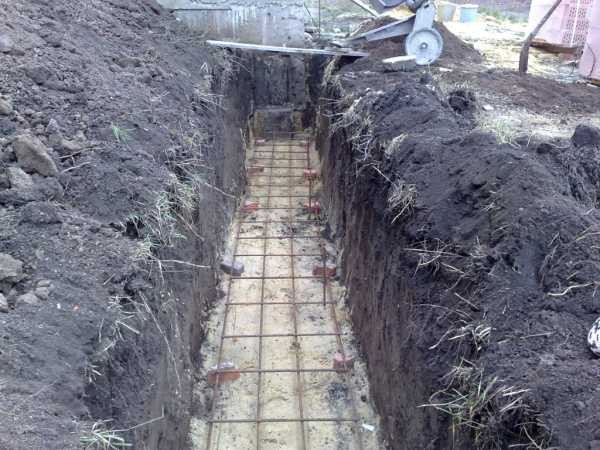
Assessing the soil type is the first step in building any foundation. Thus, dusty sand has a much lower bearing capacity than dry clay soil. The width of the foundation sole is directly impacted by the soil’s bearing capacity. The foundation should be wider the more moist and dusty the soil is. In addition to conducting geological surveys, which can be done in a variety of ways, folk methods can be used to identify the type of soil. Standard marking and trench digging are done in accordance with the design or calculation after the soil determination stage.
Design and characteristics of the base
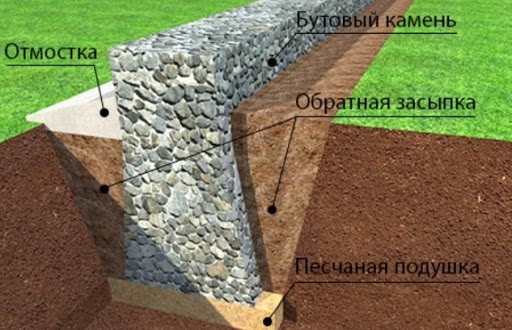
The depth of the rubble concrete foundation should be between 30 and 50 cm below ground level in order to reduce the impact of frost heaving forces, as it is not intended for the construction of heavy brick structures. The ideal plinth height is between 30 and 40 centimeters, which is decided by architectural solutions. Generally accepted standards state that the foundation’s thickness should be at least 10 centimeters wider than the load-bearing walls’ thickness, but not less than 30 centimeters.
The bottom of the trench should be 8–10 cm wider than its mouth, if the kind of soil and the level of surface water permit. This will boost the foundation’s load-bearing capability and make it easier to embed stones in concrete in the future.
Installation of formwork
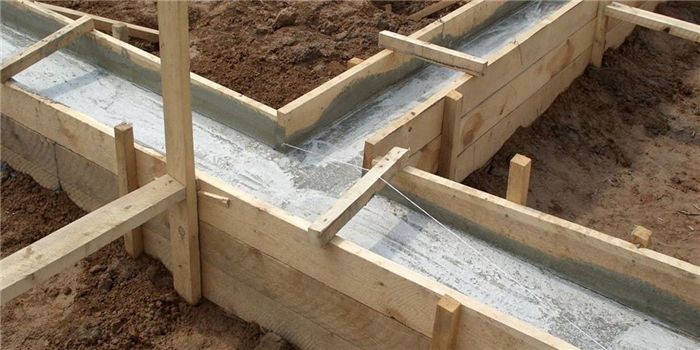
The formwork is installed either on top of or against the trench, depending on the type of soil. Formwork is placed inside the trench to stop the walls from collapsing if the soils are weak, such as sandy or sandy loam.
Making a pillow
It is advised to arrange a cushion at the bottom of the trench to reduce the forces of frost heaving that act on the foundation during the winter and to boost the soils’ bearing capacity. A minimum 20-cm layer of sand and crushed stone is spread out on the bottom and compacted by hand or with the use of a gas-tamping machine. On top of the completed cushion, a thin layer of lightweight concrete, grade M75–M100, is poured (2–5 cm).
Pouring concrete and laying stones
Sub-concrete layer hardening precedes the commencement of M400 concrete main pouring. Every layer has a thickness of about 20 cm. The stones are embedded in the concrete as soon as it is poured, leaving a minimum of 5 cm of space between them horizontally.
The next row of stones is only partially submerged and the thickness of the layers above it is changed to cover the previous layer of stones completely. You should repeatedly wait for the preceding layer to solidify—at least for a full day.
The stones are placed beforehand when pouring the final layer, enabling a clean pour the first time. In this manner, you can avoid estimating how much concrete will be required. Ultimately, when pouring concrete along the upper level and then inserting stones into it, Archimedean force will cause the concrete to overflow over the formwork’s edge.
Blind area device
When frost heaving forces are applied, a concrete rubble foundation is more quickly destroyed than other kinds of foundations. Any melt water that reaches the foundation wall and under its sole freezes and expands in volume during spring thaws or severe winter frosts. The resulting forces acting on the foundation can cause damage, in addition to the forces of frost heaving of the soil.
A concrete blind area, at least 80 cm wide, is installed around the outside perimeter of the foundation to keep rain and melting water from seeping underground. As a result, the rubble concrete foundation’s service life is greatly extended.

Foundation insulation
The wintertime rapid freezing of the rubble concrete foundation lessens the house’s ability to retain heat. It is advised to use waterproof insulation, such as extruded polystyrene foam, to insulate the plinth and foundation’s exterior in order to prevent this.
Foundation installation in winter
Wintertime construction of a rubble concrete foundation is allowed as long as the following criteria are met:
- work is carried out in clear weather, since the rubble stone must be cleared of snow and ice.
- concrete must contain special "winter" additives;
- the temperature of the concrete at the time of pouring should not be less than 5 degrees.
| Topic | Details |
| What is a rubble concrete foundation? | A rubble concrete foundation is a type of foundation made by combining rubble (broken stones or bricks) with concrete to create a solid base for buildings and structures. |
| Advantages | It is cost-effective, provides good drainage, and has high durability. It"s also suitable for uneven terrain and can handle heavy loads well. |
| Materials Needed | Rubble stones or bricks, cement, sand, gravel, water, and reinforcement materials like steel bars. |
| Construction Process | The process involves digging a trench, placing a layer of rubble, pouring concrete over it, and repeating the layers until the desired height is achieved. Reinforcement is added for extra strength. |
| Uses | Commonly used for residential buildings, retaining walls, and other structures where a strong and stable foundation is required. |
| Maintenance | Regular inspections for cracks or settling, proper drainage around the foundation, and repairs as needed to maintain its integrity. |
For many building projects, constructing a concrete rubble foundation is a sensible and long-lasting option. Its strength, affordability, and ease of use make it a desirable choice for a variety of building kinds. Large chunks of rubble are mixed with concrete to create a foundation that offers exceptional stability and support.
Using locally available materials can drastically lower construction costs, which is one of the main benefits of rubble concrete foundations. The technique is also eco-friendly because it frequently makes use of leftover or surplus stone materials. This reduces the negative effects of construction on the environment while simultaneously saving money.
The longevity and efficacy of a rubble concrete foundation are contingent upon the implementation of appropriate construction and preparation techniques. This entails picking a site with care, excavating it completely, and placing concrete and rubble precisely. Sufficient drainage and waterproofing techniques are also necessary to prevent water damage to the foundation and guarantee its long-term stability.
It’s crucial for anyone thinking about building a rubble concrete foundation to collaborate with knowledgeable builders who are aware of the particular specifications and industry best practices for this kind of construction. A rubble concrete foundation can offer a sturdy, dependable base for any building project, guaranteeing stability and safety for many years to come, with the correct method and attention to detail.


