
If you are looking for an apartment in an older building, you have probably come across the terms “Khrushchevka” and “Brezhnevka.” These are the two most common types of Soviet-era buildings, and there are important differences between them. Choosing between them often comes down to a compromise between location, square footage, and layout convenience.
Khrushchev-era apartments were built as a temporary but quick solution to the housing problem. Their main advantage is that they are often located in established areas, close to the metro. However, this comes at the cost of cramped conditions: tiny kitchens, low ceilings, walk-through rooms, and adjoining bathrooms were the norm. Here, every square meter counts.
Brezhnevkas were the next step. They are more spacious: kitchens are larger, ceilings are higher, rooms are mostly separate, and bathrooms are almost always separate. More convenient hallways and built-in wardrobes have appeared. These buildings feel more comfortable, but are often located a little further from the center, in residential neighborhoods.
So which layout is more convenient? The answer depends on your priorities. If location and budget are more important to you, and you can put up with the disadvantages of space or overcome them by redesigning, then take a look at Khrushchev-era apartments. If comfort for your family is your top priority, and you are willing to spend a little more and perhaps settle for a less desirable location, then a Brezhnev-era apartment will be a more convenient and predictable option for living.
- Historical context: why they are so different
- Space: every square meter counts
- Layout solutions: functionality versus economy
- Technical equipment: what is possible and what is not
- Sound insulation: when neighbors are too close
- Redesign options: where there is more freedom
- Infrastructure and location: the legacy of eras
- Economic aspects: what is more profitable
- Renovation prospects: what awaits the old housing stock
Historical context: why they are so different
Khrushchev-era apartments were built between 1957 and 1985 with one goal in mind: to quickly resettle communal apartments and barracks. Nikita Sergeyevich set the task of providing every family with a separate apartment by 1980. Architects were given strict guidelines: minimum costs, maximum apartments, speed above all else.
Brezhnevka apartments appeared in 1964-1982 as an attempt to correct the mistakes of Khrushchev's housing construction. New standards allowed for larger areas and improved layouts. But savings still had to be made — the country was building a million apartments a year.
These historical conditions explain all the peculiarities of the layouts. Khrushchevka is a compromise between communal apartments and normal housing. Brezhnevka is an attempt to make housing more comfortable without a drastic increase in construction costs.
Space: every square meter counts
The first thing that catches the eye when comparing the two is the square footage. Khrushchev-era one-room apartments start at 28 square meters, while Brezhnev-era ones start at 33. The difference is even greater in two-room apartments: 42-46 square meters versus 52-54.
But it's not just about the total square footage. Khrushchev-era apartments are sorely lacking in storage space. A storage room the size of a telephone booth, a built-in wardrobe 40 centimeters deep — and that's it. Brezhnev-era apartments have normal walk-in closets and mezzanines.
Kitchens in Khrushchev-era apartments are a separate pain. They are 5-6 square meters, barely enough space for a refrigerator and stove. In Brezhnev-era apartments, kitchens grew to 7-9 meters — enough space for a dishwasher and even a small sofa.
Ceiling height also matters. In Khrushchev-era buildings, the standard is 2.5 meters, while in Brezhnev-era buildings it is 2.7 meters. It may seem like a minor detail, but those 20 centimeters make a difference, especially in small rooms.

Layout solutions: functionality versus economy
The layouts of Khrushchev-era apartments are dictated by strict economy. Walk-through rooms, combined bathrooms, shoulder-width corridors—all for the sake of saving every square centimeter.
The most painful feature of Khrushchev-era apartments is the walk-through rooms. In a two-room apartment, one room inevitably becomes a walk-through, which creates problems for families with children. Privacy in such an apartment is a luxury.
Brezhnev-era buildings brought a revolution in layouts. Isolated rooms appeared, separate bathrooms became the norm, and corridors widened. Some series even included balconies and loggias in every room.
But even Brezhnev-era apartments have their oddities. Long corridors eat up usable space, and in some series, the bathroom is so narrow that the washing machine can only be placed above the toilet.
Khrushchev-era and Brezhnev-era buildings represent different eras of Soviet housing construction, and each has its own advantages. Khrushchev-era buildings are generally more cramped: low ceilings, narrow kitchens, thin walls, but their compactness sometimes results in a more convenient room layout. Brezhnevka buildings are slightly more spacious — larger kitchens, separate bathrooms, higher ceilings, but often with an inconvenient layout and empty, “passageway” corridors. Ultimately, which is more convenient depends on the specific apartment: Brezhnevka apartments are formally better in terms of parameters, but Khrushchevka apartments can be redesigned to make them more comfortable and practical if desired.
Technical equipment: what is possible and what is not
The electrical wiring in Khrushchev-era apartments is designed for 3-5 kilowatts — enough for a TV, refrigerator, and iron. Such a network cannot handle modern household appliances. Air conditioning, a dishwasher, and an electric stove all at once — and the circuit breakers will trip.
Brezhnevka apartments have higher electrical power—7-10 kilowatts. You can install an electric stove and connect an air conditioner without counting every watt. However, even here, the wiring may need to be replaced for full-fledged modern appliances.
Plumbing in Khrushchev-era buildings is a separate problem. Cast iron pipes with a diameter of 50 millimeters become clogged within 10-15 years. Water pressure is weak, especially on the upper floors. In Brezhnev-era buildings, the pipes are thicker and the system is better designed.
Heating in Khrushchev-era buildings is simple but effective. A single-pipe system with cast-iron radiators heats well, but it is impossible to regulate the temperature. Brezhnev-era buildings often had a two-pipe system with individual temperature control.
Sound insulation: when neighbors are too close
Sound insulation in Khrushchev-era buildings is a sore subject. The 18-centimeter-thick walls between apartments let all sounds through. You can hear your neighbors talking, watching TV, and going to the bathroom. The interior partitions are even thinner—8-10 centimeters.
Brezhnevka apartments are better in this regard, but not dramatically so. The walls are thicker—20-25 centimeters—but this still does not meet modern standards. However, there is a trend toward designing layouts so that bedrooms do not border on neighbors' kitchens and bathrooms.
A particular problem with panel houses is sound transmission through the floors. In Khrushchev-era buildings, this is critical: the footsteps of neighbors above can be heard like drumbeats. Brezhnev-era buildings, especially brick ones, are more comfortable in this regard.
Redesign options: where there is more freedom
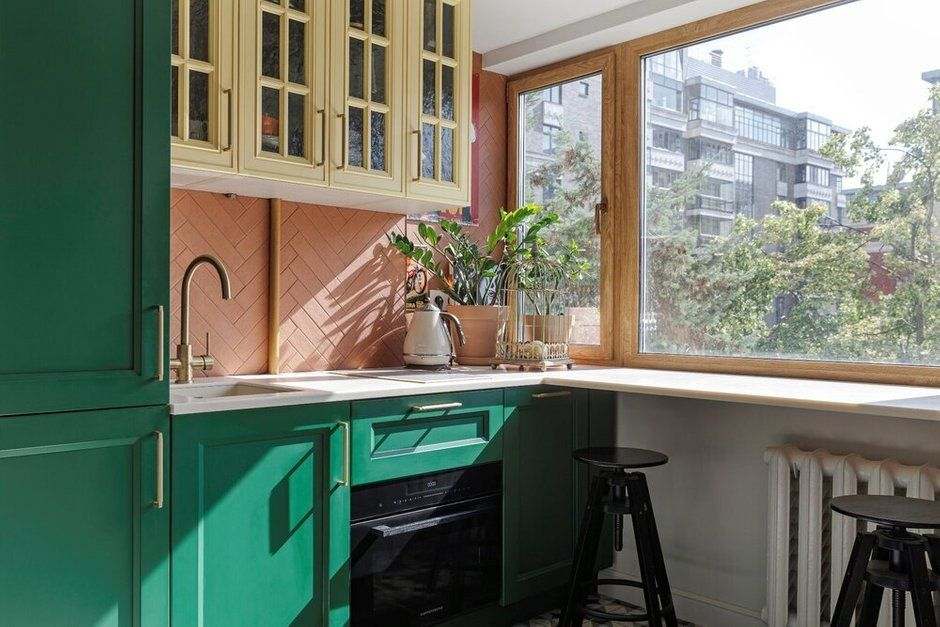
Khrushchev-era apartments offer more opportunities for radical redevelopment. Most of the interior walls are non-load-bearing and can be demolished without restriction. Popular options include combining the kitchen with the living room and expanding the bathroom at the expense of the hallway.
The main problem with Khrushchev-era apartments is the gas stove in the kitchen. Fire safety regulations prohibit combining such a kitchen with a living room. You have to move the stove or replace it with an electric stove.
Brezhnevka apartments are more conservative in terms of redevelopment. There are more load-bearing walls, so the possibilities are limited. On the other hand, the original layouts are more thoughtful and do not require major alterations.
The most promising for redevelopment are the late Khrushchev-era buildings of series 1-515 and 1-511. There, it is possible to create modern layouts that are on par with new buildings.
Infrastructure and location: the legacy of eras
Khrushchev-era buildings were constructed during a period of rapid urban development. Khrushchev-era neighborhoods are often located close to the city center and have well-developed infrastructure. Schools, clinics, and shops are all within walking distance.
Brezhnev-era buildings are more common on the outskirts, where there was more land available for large-scale construction. However, the microdistricts were planned comprehensively: kindergartens, schools, and shopping centers were built at the same time as housing.
Transport accessibility is usually better in Khrushchev-era buildings. Many areas built in the 1960s are within a 10-15 minute walk from the metro. Brezhnev-era areas from the 1970s and 1980s often require a bus ride.
The courtyards in Khrushchev-era neighborhoods are smaller and cozier. In Brezhnev-era neighborhoods, the courtyards are huge, but often drafty and uncomfortable.
Economic aspects: what is more profitable
On the secondary market, Khrushchev-era apartments are 10-20% cheaper than Brezhnev-era apartments with the same area and location. But this saving is deceptive — the cost of renovation and remodeling can be significant.
Utility bills in Khrushchev-era buildings are usually lower — the apartments are more compact and the heating is more efficient. In Brezhnev-era buildings, large areas and high ceilings increase heating costs.
Khrushchev-era buildings have higher liquidity — they sell and rent faster. Brezhnev-era buildings require a longer search for a buyer, but their prices are more stable.
Repairs in a Khrushchev-era building can be more expensive due to the need for complete replacement of utilities and possible redevelopment. In a Brezhnev-era building, cosmetic renovations are often sufficient.
Renovation prospects: what awaits the old housing stock
The renovation program in Moscow primarily affected Khrushchevka buildings, as they are more morally and physically outdated. This can be both an opportunity to get a new apartment and a source of long-term problems.
Brezhnevka buildings are less likely to be included in the renovation program. It is believed that their useful life has not yet been exhausted and that the buildings can stand for another 20-30 years without major repairs.
The situation is different in the regions. There, both Khrushchev-era and Brezhnev-era buildings will serve for a long time to come — there is no money for large-scale renovation.
So, which is more comfortable to live in — a Brezhnev-era building or a Khrushchev-era building? There is no clear answer here, because it all depends on what you value in your home. If compactness and low cost are critical for you, and you can put up with cramped rooms and thin walls, then a Khrushchev-era apartment is the right choice for you. This is housing for those who are willing to compromise for the sake of their first separate apartment.
Brezhnevka apartments offer a more comfortable but also more expensive format. They are better suited for families who value separate rooms, a little more space, and normal sound insulation. Although they are outdated by modern standards, their layout still leaves more opportunities for remodeling and creating a cozy space.
Ultimately, the choice between them is a matter of priorities. What is more important to you: budget and location or comfort and space? Assess your current capabilities and plans for the future, and then the decision will become obvious. Both Brezhnevka and Khrushchevka apartments have been providing people with a roof over their heads for many decades, each in its own way.


