
Good lighting in your office or library is not just a matter of brightness. It directly affects your productivity, well-being, and even your enjoyment of work or reading. Light that is too dim strains your eyes, while light that is too bright and cold tires your mind. The ideal light should help, not hinder.
Professionals — photographers, designers, architects — know this firsthand. They approach lighting consciously, combining different types and sources. Their experience can be easily adapted to any home or work space where you spend time reading, working on the computer, or working on important projects.
In this article, we have compiled practical tips to help you create a competent lighting plan. You will learn how to combine general and local lighting, what light temperature to choose for different tasks, and what to look for in order to create a truly comfortable and functional atmosphere.
Good lighting in an office or library is not about trendy lamps, but about convenience, concentration, and eye comfort. Too bright light is tiring, too dim light is stressful, and sharp shadows interfere with reading and working. To create the perfect lighting, you need to combine different sources: general lighting, local lighting above the desk, and shelf lighting. It is important to distribute the light evenly, avoid glare on the screen, and use warm tones for comfort. When the lighting is set up correctly, it becomes easier to work and read, and your eyes are not tired by the evening.
Lighting design: 6 useful tips
1. Use multi-level lighting. Having a single light source in the office is an unforgivable mistake. There should be at least two levels of lighting: general and local, above the desk.
2. Don't give up on lighting. If your office is decorated with paintings and your home library is the envy of many, lighting will come in handy, serving both a decorative and practical function.
3. Choose diffused light. Direct light highlights the work area more clearly, but quickly leads to fatigue, so diffused lighting is preferable for a home office. This can be achieved by choosing lamps with spherical or conical shades.
4. Avoid light fluctuations. Abrupt transitions from light to shadow in the office contribute to rapid eye fatigue, which will inevitably affect both well-being and the speed of information perception.
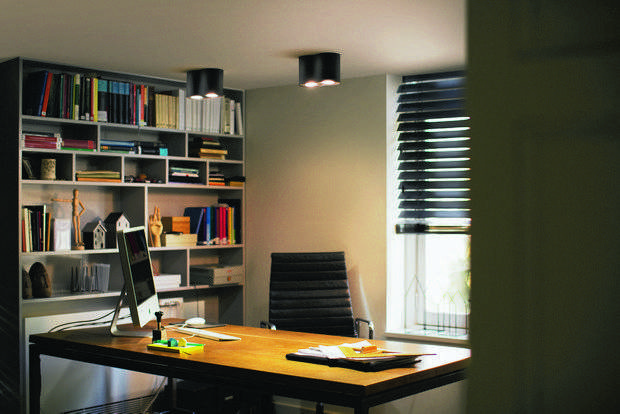
5. Don't forget about light controls. They can be used to set a comfortable level of lighting in your home office, adjusting to the time of day and your vision, as well as saving energy.
6. Don't leave any dark corners. As in other rooms, the main lighting in the office should be sufficient. Dark corners make the room uncomfortable and “eat up” space.
7. Choose the right color temperature. Scientific research has proven that bright, cool light increases productivity and concentration and puts you in the right frame of mind for work. It is best to use it in the first half of the day. Warm-colored lighting promotes relaxation and tranquility.

Office lighting: 5 important rules + infographics
1. Light your desk properly. For right-handed people, the correct position for a desk lamp is on the left, and for left-handed people, on the right. It is important that the lighting does not create sharp shadows on the table and that the lampshade is below eye level. Use a bulb of moderate brightness (no more than 60 watts).
2. Remember about the computer. It is impossible to imagine a modern office without a personal computer or laptop. When choosing lighting, it is important to ensure that the lamps do not cause glare on the screen. It is best to work at a PC with a desk lamp and main light turned on.

3. Position spotlights correctly. If you have opted for ceiling spotlights rather than a chandelier for general lighting, follow the rules for their correct positioning. The distance between the lamps should be at least 30-40 cm. At the same time, you need to leave at least 20 cm from the corner to the spotlight. Experts recommend installing one 20 W lamp per 1 square meter of ceiling.
4. Maybe it's time to give up your desk lamp? If there are wall cabinets or shelves above the table, you can install a row of spotlights in their lower part. They will provide uniform diffused light and save space on the work surface. A floor lamp, wall lamp, or LED linear lamp can also replace the usual table lamp.

5. Don't forget about local lighting. If there is a sofa or reading chair in the study, local lighting should be provided nearby, such as a floor lamp or sconce. The height from the floor to the light source should be at least 125–135 cm.

If you have a home library: 3 lighting rules
1. There should be no direct sunlight in the library – it is harmful to books. Position open cabinets so that light from the window falls at an angle or from above. Consider general lighting for the library area using built-in spotlights: they will create a comfortable atmosphere and are completely harmless to the preservation of valuable volumes.

2. Zoning is a must. To get comfortable with a book in an armchair, you will need a floor lamp or a lamp with directional light, but for more detailed work with documents, equip your workplace with a table lamp that reduces the likelihood of glare.

3. Decorative lighting is a must. Spot lighting on shelves and racks displaying various souvenirs, figurines, and other items will create a more relaxed atmosphere.

As you can see, proper lighting in a study or library is not rocket science. The main thing is to remember balance and comfort. The combination of general, task, and accent lighting works wonders, transforming an ordinary room into a place where it is pleasant to work and relax.
Don't be afraid to experiment with table lamps, floor lamps, and LED strips. Sometimes a small and inexpensive light source can radically change the atmosphere. Listen to your feelings: if your eyes get tired and your mood drops, it's a sign that the lighting needs to be adjusted.
Ultimately, your task is to create a space that will serve you, not the other way around. Use these tips as a starting point, adapting them to your needs and taste. After all, a perfectly lit room is one in which you feel truly comfortable.


