
A concrete floor can be made warm and inviting with parquet boards, giving your house a touch of elegance and usefulness at the same time. Parquet boards are designed to be stable and long-lasting, unlike traditional hardwood flooring, which means that they can be installed directly over concrete.
Preparation is essential when laying parquet flooring on a concrete floor. Make sure the concrete surface is level, clean, and dry before proceeding. The installation process and the finished flooring’s appearance may be impacted by any flaws in the concrete. To stop moisture from leaking through and causing long-term damage to the wood, use an appropriate moisture barrier.
Acclimate the parquet boards to the room’s humidity and temperature before laying them down. This procedure ensures a more stable and long-lasting floor by reducing the amount of expansion or contraction of the wood after installation. It’s also crucial to allow for natural expansion by leaving a tiny space between the boards and the walls.
Pay close attention to the manufacturer’s instructions when installing. Parquet boards are usually installed by gluing them directly to the concrete floor or by using a click-lock mechanism. To create a seamless appearance, each board should fit closely against the next one. In order to improve the floor’s structural soundness and visual appeal, be sure to space out the joints between rows.
Parquet flooring on a concrete floor has many advantages once installed. They offer superior insulation, which lowers energy expenses and helps to maintain a comfortable interior temperature. In addition, compared to solid hardwood, their engineered construction makes them less prone to warping or shrinking, guaranteeing a gorgeous floor for many years to come.
Find out how to use parquet boards to transform your concrete floors! This article provides helpful installation advice while examining the advantages and difficulties of using parquet on concrete. Discover the crucial actions to guarantee a long-lasting and gorgeous finish, from improving appearance to handling moisture issues. This guide will assist you in achieving a polished look that enhances your space, whether you’re a do-it-yourself enthusiast or prefer to hire a professional.
- Is the material suitable for concrete?
- Requirements for the base
- Pie designs with parquet
- Types of material and price
- Selection rules
- Is screed preparation necessary??
- Preliminary actions
- Required Tools
- How to lay it correctly?
- Floating method
- Adhesive
- Technology with fasteners
- Possible difficulties and errors
- How to lay on an uneven surface?
- Average price of work
- Advantages and disadvantages according to reviews
- Video on the topic
- 10 of the most important nuances of laying a parquet board (for example Barlinek)
- How to lay a floating parquet board on a concrete floor with your own hands
- Parquet board. Laying parquet boards using the floating method.
- Technology of laying parquet boards. Installation of thresholds and skirting boards.
- Methods for laying parquet! Technologies for laying parquet on a concrete floor, on a substrate and using the floating method
Is the material suitable for concrete?
Installing parquet flooring over a concrete screed is one of the best and longest-lasting methods. However, you must meticulously prepare the concrete base and decide on a decorative flooring installation technique.
Only if you arrange for a reasonably level base can you lay parquet boards on a screed. Variations in height of up to 2 mm are acceptable for every meter of screed.
Requirements for the base
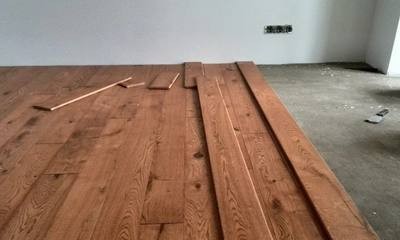
There shouldn’t be any noticeable flaws in the concrete base. It is crucial to guarantee that there are no significant variations in the coating and that there are no surface irregularities.
This is particularly valid for screeds that were laid a long time prior to parquet flooring installation.
Make surface adjustments and conduct a visual inspection beforehand. fixes chips and potholes. Elements that protrude are removed and raised to the height of the concrete base. If there are cracks, a cement mixture must be used to enlarge and seal them.
Pie designs with parquet
Use the following pie to install parquet flooring successfully::
- Prepared concrete base. An important requirement is increased strength and evenness of the coating. Differences of more than 2 mm per square meter are not allowed. meter.
- Substrate. It is possible to use waterproofing film, moisture-resistant plywood, polystyrene foam, polyethylene foam. Cork is also used as an environmentally friendly material.
- Parquet board. This is the final decorative layer, differing in thickness and external design.
Such a cake is arranged using a stable decorative coating that is free of flaws on the outside. There is protection against the formation of cracks because of the unique way that the boards are joined to one another and to form rows.
Types of material and price
Multilayer parquet is a popular type of natural wood flooring that has layers arranged perpendicularly. The material’s formation of a stable coating and ease of installation are its defining features. Most boards are composed of oak and ash. In addition, the average cost per square meter is between 2800 and 6500 rubles.
Solid boards make a suitable substitute. The material comes in a range of colors and patterns and can be used to create a high-quality coating. Mostly, oak and larch are used to make boards. An average of 2500–5300 rubles per square meter is spent.
Selection rules
Over time, solid boards may undergo geometric changes, particularly if the manufacturer does not apply chamber drying to the product. The material is still easily installable and accessible at the same time. The multilayer coating maintains its geometry well and has a stable shape and size.
The decision is based on individual preferences and skills. For those who enjoy superior coverage, both choices are appropriate. If you’re looking for a non-traditional color scheme and decor, a massive coating can be chosen, or a multi-layer board will create a lovely coating of natural tones.
Is screed preparation necessary??
Examine the concrete screed before making any selections about parquet boards and buying any necessary supplies. There shouldn’t be any chips, unevenness, or significant damage.
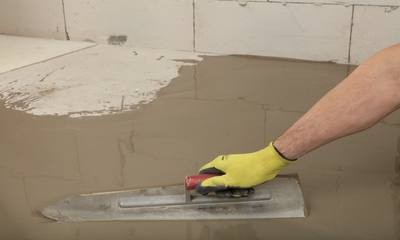
The following options for flooring preparation are available:
- Minor unevenness. Protruding elements are compared with the general surface. Chips and grooves are filled with cement composition. If there are
- A large number of irregularities. If the defects are shallow but there are many of them, grinding can be used. This will require special equipment and the participation of an experienced master. After processing, the surface is covered with a primer, after which you can proceed to laying the parquet. Low quality base. Only a lag device will help with a slight step up to 40 cm. Sheets of plywood or other similar coating are recorded directly on them.
It needs to be cleared of construction debris and cement dust if the coating is even or repaired. Although an industrial vacuum cleaner is preferable for this task, a regular mop slightly dampened with water will work just as well. Two coats of primer are applied to the surface.
It is essential to wait for the surface to completely dry before pouring a fresh layer of concrete screed. After the job is finished, the surface usually appears seven days later, at which point you can walk on the coating. However, it takes at least 28–30 days to fully recover and expel all moisture.
Preliminary actions
Preliminary measurements must be made in order to calculate the amount of material needed. In order to accomplish this, the floor is marked, particularly if lags are going to be laid. You can calculate the floor’s perimeter and total square footage in this manner.
You must know the number of boards in order to calculate. The computation example that follows is utilized:
- for simple installation using the direct method, a reserve of at least 3% of the total amount of material will be required;
- per package approx. 1.78 sq. m. material;
- the area of the premises is taken into account (for example, 18.6 sq. m.).
Add 3% reserve to the total area, and you have 19.16 square meters. The final amount is then divided by 1.78, which is the number of boards in a single package. You will require at least 11 packages of parquet boards if you round up.
Required Tools
The following minimal set of tools is required to complete installation work:
- construction tape;
- level;
- rubber mallet;
- pencil;
- hacksaw for cutting boards.
This toolkit will allow you to install a parquet floor on your own. No extra gear is needed.
How to lay it correctly?
Selecting the installation method is the first step in selecting parquet for concrete flooring. Parquet can only be installed in three ways:
- floating method;
- glue method;
- using fasteners.
The decision is based on your personal taste and level of comfort installing on a concrete foundation. They mostly consider the possibility of inviting an experienced team.
Floating method
The base is cleaned, leveled, and primed first. It is crucial to give it time to dry completely. Choose the underlay and place it directly on the floor at the following step.
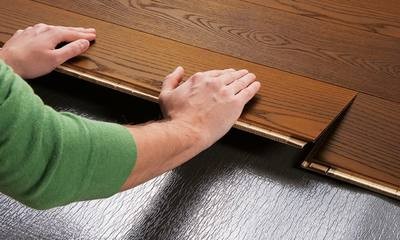
The following phase creates a floating floor:
- assemble the first row of planks along the length and lay them against one of the walls;
- the second and subsequent rows are simultaneously attached one plank to each other and to the boards of the previous row;
- at the final stage, the board is cut to length for a good fit with the wall.
In order to prevent the material from fitting flush with the wall, it is crucial to allow 8 to 10 mm for gaps. The entire perimeter of the space is left at this distance. By taking this action, issues arising from the technological growth of wood under the effect of moisture will be resolved. A decorative plinth can be used to close the space once the work is finished.
Adhesive
Initially, a level concrete screed is screwed to moisture-resistant plywood. The substrate should then be arranged with a minimum 5 mm gap. The adhesive firmly fixes the planks, which are also fastened to one another.
The future floor covering will be at its strongest with this method. In this situation, it will be challenging to repair some areas, as this always occurs when large or heavy objects fall.
Technology with fasteners
This technique involves fastening the planks to logs or a wooden base that is placed on top of them. In situations where the concrete base is uneven, this is a practical fix.
The logs ought to be placed no more than 30 to 40 centimeters apart from one another. The panel joints are positioned in the center in this instance. Dowels are used to secure the lags to the screed via the pre-laid insulation.
The planks are secured in place with self-tapping screws or nails. In this instance, the fasteners’ length ought to be two to three times greater than the planks’ thickness.
Additional details regarding the video’s glue installation guidelines:
Possible difficulties and errors
It is not recommended to lay parquet on an uneven surface. When selecting a floating installation method, this is particularly crucial because, in the event that the planks fail to connect with one another, the entire coating will be destroyed.
Prior to beginning any installation work, precise measurement taking is also crucial. The precise quantity of material must be chosen.
Additionally, you will require a reserve of five to ten percent in case any planks become damaged. It is difficult to find parquet in the same shade, and the material might not be offered for sale in the future.
How to lay on an uneven surface?
If you are unable to manually remove the unevenness from the floor, grind the surface. It is preferable to assign the task to a professional who has the necessary tools.
Plywood or cork material can be used to make up for minor discrepancies. This makes it possible to even out floor irregularities, creating a level surface that facilitates the solid joining of individual planks into a single structure.
If the desired height is marked with a level along the walls, a dry screed can also be arranged. Next, a dry substance like expanded clay is added. The plywood is fixed and the frame is installed in the following step. The parquet board is installed on top of this.
Average price of work
The average cost per square meter to install parquet flooring on a concrete base is:
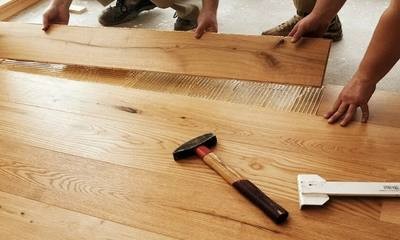
- floating installation – from 350 rubles;
- installation with screws and glue – from 750 rubles;
- priming the screed – from 70 rubles;
- installation of a cork compensator – from 350 rubles;
- screed polishing – from 250 rubles.
Consideration is given to the board-laying technique as well as the requirement to make intricate shapes and patterns. Consider the quantity and intricacy of the room’s natural barriers, such as columns or portals.
Advantages and disadvantages according to reviews
The advantages of installing parquet flooring on a concrete foundation are as follows:
- formation of a load-resistant coating;
- the ability to select the type of wood based on strength and appearance;
- variety of shades;
- interlocking joints help create a durable floor structure;
- environmental safety of the finished coating;
- It is possible to carry out installation work on your own.
There are a few drawbacks, though. The costly procedure is the primary drawback. It will require screed organization, substrate laying, or the selection of a premium adhesive composition. It is also possible to identify significant installation costs, particularly when installing a parquet floor in a large space.
On a warm floor, never lay parquet flooring. The tree may still be sigent even if the system’s temperature is maintained at +26 degrees. And further heating is generally not advised when selecting beech or maple boards.
Users advise against laying parquet boards directly on concrete foundations. Pre-pronouncing the surface and laying the substrate are essential. This option enables you to design a long-lasting and comfortable surface, but it takes a lot of work.
Reviews are available here.
Any room can be made to feel more elegant and warm by installing parquet flooring over a concrete floor. Making sure the surface is level and smooth is one of the most important factors to take into account and parquet on concrete. Because concrete frequently has flaws that can affect the finished product, preparation is essential.
It’s crucial to check the concrete’s moisture content before installation. Over-moisture can eventually cause warping or buckling in the wood. This problem can be lessened by applying a moisture barrier or sealant, guaranteeing that your parquet floor will look beautiful for many years to come.
Selecting the appropriate glue is an additional crucial measure. In addition to binding the parquet boards to the concrete, the adhesive offers some flexibility and cushioning to lessen noise and absorb shocks. A solid bond and a stable floor are ensured by correctly applying the adhesive in accordance with the manufacturer’s instructions.
Be mindful of the pattern and direction when installing the parquet flooring. In order to achieve a visually appealing effect and for aesthetic reasons, boards are typically laid perpendicular to the longest wall in the room. Meticulous planning and measurement guarantee few cuts and a harmonious overall appearance.
Lastly, give the adhesive enough time to cure after installation before putting large furniture or rugs on the floor. This curing time guarantees a strong and long-lasting parquet floor by assisting in preventing any shifting or movement of the boards.


