
Fiber-reinforced floor screed is a great option if you want to lay a strong foundation for your floors. This building material is essential to having level, strong, and long-lasting floors. Fiber-reinforced screeds use steel or synthetic fibers to increase strength and stop cracking, in contrast to regular screeds that can break over time. The present discourse delves into the advantages, uses, and pragmatic aspects of incorporating fiber-reinforced floor screed into construction and renovation endeavors.
The ingredients of fiber-reinforced floor screed are cement, sand, water, and fibers with specific engineering. These fibers are added to the screed to enhance its mechanical qualities; they are frequently made of steel or polypropylene. By adding fibers, the screed’s stress distribution is improved and impact resistance is increased while the risk of shrinkage cracks is decreased. Fiber-reinforced screed is therefore perfect for locations that require extra structural support or that see a lot of foot traffic.
The adaptability of fiber-reinforced floor screed is one of its main benefits. It has a wide range of uses in commercial, industrial, and residential contexts. Fiber-reinforced screed is a dependable option for any type of flooring installation, be it in a warehouse, a new office building, or a kitchen renovation. It can be used in a variety of construction scenarios due to its adaptability to various substrate conditions and thickness requirements.
It is essential to select the appropriate type of screed when organizing a construction or renovation project that involves floor screed. Compared to conventional screeds, fiber-reinforced screeds perform better, offering greater tensile strength and improved resistance to cracking. By doing this, you can extend the life of your floors and eventually save money on maintenance. Additionally, by offering improved thermal conductivity—a necessary component for underfloor heating systems—fiber-reinforced screed can help achieve energy efficiency goals.
- What is it and why is it needed
- Advantages of use and disadvantages
- Types of fiber fiber and their characteristics
- Fiberglass
- Steel fiber
- Basalt fiber
- Propylene fiber fiber
- Calculation of fiber consumption
- Do-it-yourself fiberscreed screed
- Required materials and tools
- Semi-dry screed
- Fiber cement or wet floor screed
- Tips for choosing reinforcing fiber
- Video on the topic
- Apartment renovation before and after. Floor leveling. Screed with fiber
- Fiber for screed.Screed for a warm water floor.
- Do-it-yourself floor screed in an apartment. Reinforcement with fiber
What is it and why is it needed
Fiber, also known as fiber fiber, is an additive used as reinforcement in a variety of building solutions and mixtures. By taking advantage of the unorganized structure within the concrete, it enhances its qualities, including strength and resistance to abrasion. Furthermore, fiber-fiber concrete is more resilient to tensile and bending loads. This is all crucial information for floor screed.
Fiber is made up of extremely strong, thin strands that are between 6 and 20 mm long. Because different sizes of reinforcing additives have different effects on the properties of concrete, the following is used:
- 6 mm – in mortars for cladding and masonry;
- 12 mm – screeds and various monolithic concrete products;
- 18-20 mm – in structures operated in extreme conditions, for example, dams.
Created by crumbling together glass, metal, basalt, and polypropylene. It starts to affect the screed during the solution-mixing stage; it simultaneously affects two different directions of the subsequent physical and chemical reactions that will take place after pouring.
Less water is needed for a solution containing reinforcing additives to fully mix. As a result, the screed will hydrate more quickly, gaining strength, and any excess moisture will not actively evaporate, creating a network of tiny cracks and microvoids.
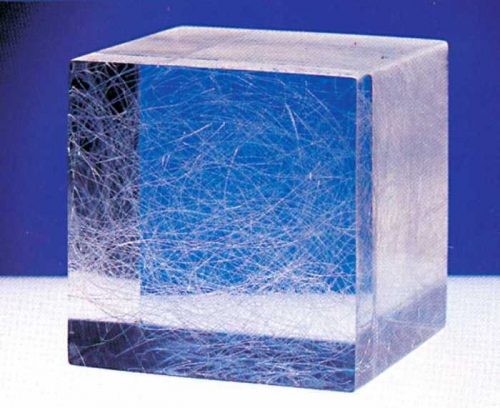
For the record, there are gaps in every solution. They are filled with water in a conventional cement and sand mixture; fibers are filled in a reinforced mixture. You therefore require up to 20% less water.
2. Fiber fiber stops the development of microcracks during the first five to seven hours of the solution setting by completely filling in all gaps left by pouring.
For information, note that during the first stage of hydration, micropores and varying rates of hardening cause internal stresses in the pouring body, which show up as a network of cracks on the surface of any concrete product. Reinforcing fibers are used in concrete to: (1) fill in voids; and (2) distribute moisture throughout the product evenly. This causes the hardening process to proceed evenly, which eliminates internal stresses.
The fiber fibers keep the screed in its original dimensions during the second stage of hydration, which is when regular concrete starts to shrink and cracks appear. As a result, cracks do not form. If they do show up, the resulting gaps between the cement particles are tightened because of the multidirectional effect of the reinforcing fibers on the concrete surface.
Advantages of use and disadvantages
The screed has several advantages over the traditional mortar due to the fiber fiber’s incorporation into the cement-sand mixture.
- In concrete, fiber acts as a reinforcing element, which increases its strength and elasticity. It withstands increased loads from above, both dynamic (impacts, resonant vibrations) and static (high specific pressure per 1 m2), and from below (shrinkage of the house, lifting of the soil under the influence of severe frosts).
- The random arrangement of fibers, in contrast to traditional reinforcement methods, keeps concrete from delamination. This is facilitated by the property of fiber to evenly distribute moisture throughout the entire screed layer during hydration – explosive spalling of concrete due to uneven setting and hardening is reduced.
- The resistance of concrete to freeze/thaw cycles increases, as a result of which it can be used in areas with frequent temperature changes, where the use of pure mixtures of cement and sand is not recommended.
- Increases the service life of the floor.
- The use of fiber in a wet screed prevents its shrinkage. There are two reasons:
- reinforcing fibers do not allow microvoids to form in the solution;
- the amount of water for the setting process is reduced (the level of moisture in the solution directly affects its sediment upon drying).
- During the strengthening process, the fiber relieves internal stress in the screed layer.
Superior quality fiber has no drawbacks. Only polypropylene fiber made in violation of technology can cause issues. It eventually starts to leak harmful chemicals that have an adverse effect on the residents’ health in the home or apartment. Make sure a certificate is available for the building material you buy in order to prevent this.
Types of fiber fiber and their characteristics
The industry produces a variety of fibers with varying costs and physical characteristics.
Fiberglass
Zinc is used to make fiberglass. With a thickness of 8–10 microns, it is a complex thread made up of multiple extremely thin fibers. reaches a maximum length of 12 mm. The material is safe for the environment because it won’t rot or corrode.
Primarily used for sound barriers, decorative architectural and sculpture products, wall finishing (plastering), gas and foam concrete reinforcement, and lightweight cladding slab production. Its unique quality, in contrast to other fiber kinds, is that cracks and delamination do not occur when reinforced mortar dries to a thickness of less than 3 cm.

Although it isn’t used as much, fiberglass is still utilized for floor screeds because it isn’t as strong as other types of fiber (concrete gains 3-5 times its tensile and bending strength and 10–12 times its impact strength). Plaster mixtures are its primary function.
Glass fiber falls into the middle price range (100–130 rubles/kg) because of its intricate manufacturing process and high cost of the raw material used to make it.
Be aware that glass fiber cannot be utilized in ready-made monolithic concrete products or masonry mortars due to its extreme fragility.
900 g is the ideal amount consumed per 1 m 3 of solution.
Steel fiber
Constructed from high-carbon wire measuring 5 mm to 15 cm in length and 0.2 to 1.2 mm in diameter. used primarily for bridge spans, airport buildings, runways, hydraulic structures, fortifications, and factory production of monolithic reinforced concrete structures.

It is utilized in seamless floors and self-leveling housing construction. Since it encourages the formation of local gaps of 1-3 microns due to different expansion coefficients with temperature changes, it is practically never used for screeds. These gaps eventually grow into microcracks in thin-layer concrete (up to 4 cm).
Using steel fiber for reinforcement enables:
- reduce labor intensity by 27%;
- reduce the total cost of products by 5-7%;
- increase bending strength by 2 times, tensile strength by 20 times.
Among the drawbacks is the high sound conductivity of the reinforcement elements, which lowers the screed’s noise absorption coefficient. One kilogram of metal fiber costs only 25–40 rubles, which is a very low price. Consumption: 25–50 kg per m^3.
Basalt fiber
It is made of short fibers that are heated to 1400 degrees and have a thickness of 20–500 microns and a length of 1–150 mm. Basalt rocks are used to create them. Of all the materials used in construction, this is the best reinforcing material. When used, concrete gains strength:
- impact – 5 times (this indicator characterizes the fragility of concrete and is estimated by the amount of work that is necessary to destroy it);
- for bending – 3 times;
- for splitting – 2 times;
- compression and stretching – 1.5 times.
- frost resistance – 2 times.
Furthermore, the following have been enhanced:
- water resistance – 1.5 times;
- abrasion resistance – up to 3 times.
Despite being significantly less expensive (145–200 rubles/kg) than the commonly used polypropylene fiber, it is typically not utilized in floor screed. Given that its usage per square meter is marginally greater than that of polypropylene fiber, each apartment’s final overpayment for basalt fiber will come to between 1.0 and 1.5 thousand rubles. It’s true that many of the benefits of basalt fiber are superfluous in that location.
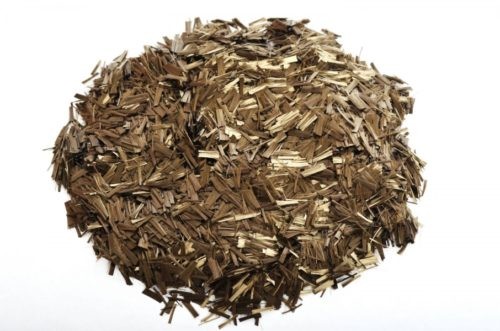
It is important to consider a consumption of 0.6-2.3 kg/m 3 when choosing a screed.
Propylene fiber fiber
A high-modulus thermoplastic polymer used to make granular reinforcing material in modern times. obtained by "extrusion," a technological process that involves pressing a viscous mass of polypropylene through the tiniest holes and then stretching it along (structural modification). White fibers range in diameter from 15-20 microns and length from 6 mm to 2.0 cm. It should be mentioned that the standard fiber sizes available for purchase in a single package are subject to change based on technological advancements.
The following concrete strength indicators are marginally improved by the addition of polypropylene fiber:
- for tension and compression – 0.6 times;
- for bending – coefficient 1.0.

Enhanced sound insulation is one of reinforced concrete’s benefits. Synthetic fiber consistently ranks last among all physical and chemical indicators when it comes to reinforcing materials. But this is more than sufficient for plastering and floor screeding.
Because the fibers deteriorate with age and lose strength, concrete products do not use it either. It falls into the high price range (220–240 rubles/kg) in the price segment. For every m3, 600–900 g are consumed. It is produced in 600 g bags, packed in bags containing 10, 20, or 30 pieces, to make calculations easier.
Calculation of fiber consumption
For some reason, when determining the fiber content of a floor screed, it is accepted wisdom that the weight of the reinforcing material determines the quality of the concrete. This is a very incorrect viewpoint. Two elements have an impact:
- number of fibers per m 3 of solution;
- quality characteristics of fiber for elasticity, stretching, etc.d.
Therefore, less reinforcing material is required the higher the density and elasticity. The process of crack formation on the screed’s surface is more heavily influenced by the number of fibers present; the more, the more tightly the fibers are woven during the concrete’s hydration.
It should be evident from the foregoing that the fiber consumption listed in construction reference books only pertains to polypropylene. Other species experience things entirely differently.
Per cubic meter of solution and per 1 m2 of screed, a table of fiber consumption can be created, but only for the first 1 cm of the fill’s thickness (you can easily do the rest of the calculation by multiplying the consumption rate per 1 m2 by the room’s area and the screed’s height in centimeters).
We started with the ideal fiber consumption for floor screed when creating the table. In this instance, we followed the findings of research on how the quantity of polypropylene fiber in a 1 m 3 solution affected the properties of concrete quality:
- 300 g – improves the plasticity (fluidity) of the solution, t.e. acts as a simple additive;
- 600 g – increases the strength of concrete, sufficient for screeding;
- 900 g – maximum possible resistance to bending, stretching and compression is achieved.
Table: Ideal fiber intake when spreading screed.
| Fiber consumption | Per 1 m3 of solution | Per 1 m2 area |
|---|---|---|
| Types of fiber in grams | ||
| Fiberglass | 900 | 9 |
| Metal fiber | 35000 | 350 |
| Basalt fiber | 1500 | 15 |
| Polypropylene fiber | 600 | 6 |
It is possible to determine the average cost of fiber per square meter using the table above. Fiber for floor screed, amount consumed in rubles per square meter:
- fiberglass – 1.08 rub.;
- metal fiber – 10.50 rub.;
- basalt fiber – 2.40 rubles.;
- polypropylene fiber – 1.38 rubles.
Glass fiber leads in terms of cost, but synthetic fiber is more widely used due to its challenges in use, particularly when agitating the solution.
Floor screeds with fiber reinforcement provide a long-lasting and economical solution for building and renovation projects. Fibers like steel or polypropylene are added to the screed mixture to improve the floor surface’s strength and resistance to cracking. This technique prolongs the life of the flooring system by strengthening the floor’s structural integrity and lowering the possibility of cracks developing over time. This article examines the advantages, uses, and safety concerns of fiber-reinforced floor screeds, offering builders and homeowners useful information for creating durable and resilient flooring in their buildings. Does this fulfill your search criteria?
Do-it-yourself fiberscreed screed
Installing a screed with reinforcing additives is a simple technological process that can be completed by hand.
Required materials and tools
The following supplies are required for pouring the screed, whether it is done wet or dry:
- Portland cement M400;
- sand, river or quarry (quarry sand must be sifted and washed to remove clay);
- fiberglass;
- plasticizer (can be replaced with liquid soap):
- water.
The following should be included in your toolkit and equipment:
To perform preliminary tasks:
- hydraulic or laser level;
- roulette;
- construction pencil;
- chop (construction) cord or simple twine (in this case you will need chalk or coal to rub the twine);
- beacon guides;
- rule.

In order to spread the screed:
- concrete mixer (required for semi-dry screed);
- mixer (replaces a concrete mixer with a wet screed);
- trowel (for semi-dry screed);
- bucket or large basin;
- trowel (trowel);
- putty knife;
- bubble level.
Semi-dry screed
The subfloor’s prepared surface is covered with a semi-dry floor screed that contains fiber fiber. Dust, construction debris, and remnants of old screed are removed. Patch mortar is used to seal concrete floor cracks. The wooden base’s rotted boards are replaced, and parquet putty is used to seal any gaps between the boards and any areas where branches have fallen.
Work on soundproofing and hydro-proofing the prepared floor base is completed. They also use thermal insulation in individual construction, which is essentially nonexistent in apartment buildings.
The next step involves determining the level at which the solution will be poured. This is accomplished by applying a zero line, at a height of 1.4 to 1.5 meters above the floor, to the wall around the whole perimeter of the space.
To find the highest point on the floor, measures of the distance between the floor and the horizon line (zero) are made along the walls using a tape measure. The thickness of the screed is determined by the method used to pour it. A screed line is created by adding the concrete layer’s thickness to the floor’s highest point (this is explained in more detail here).
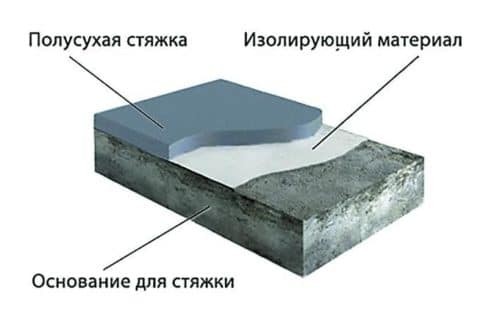
To get a smooth surface for the screed, lines of beacons are positioned along the screed line. Installing the damper tape is the last step.
The technology involved in applying a semi-dry fiber cement floor screed is straightforward and involves a number of sequential steps.

- A mixture of sand and cement in a ratio of 3 to 1, without water, is poured into a concrete mixer, mixed for 2-3 minutes.
- The amount of fiber per mixture in the concrete mixer is determined. The reinforcing fiber is fed into the concrete mixer in small portions and stirred after each filling (if you try to immediately add the entire volume of fiber to the concrete mixer, there is a high probability of getting thin lumps of fiber that will have to be carefully selected and discarded).


- A polyethylene film is laid overlapping on the surface of the screed, but the joints are not secured with tape.
- The next day, the surface of the concrete is sprayed with water from a spray bottle.
- After 10-12 days the film is removed.
- After 2-3 weeks you can lay laminate and ceramic floor tiles. It is advisable to install other types of flooring after 4 weeks, after the screed has fully gained strength.
Fiber cement or wet floor screed
Similar to semi-dry screed, wet floor screed is also applied on a surface that has been prepared. Simultaneously, the technology of semi-dry screed is nearly replicated in fiber cement floor screed.
- A mixture of cement and sand is prepared in a ratio of 1 to 3.
- Add fiber in small portions to the container where the mixture is mixed and knead.
- Add water and stir until it reaches the consistency of sour cream.
- The solution is being poured. Work starts from the far corner. After laying the screed along one row of beacons, the surface is usually leveled. Excess solution is removed. In areas of subsidence, the solution is added and leveled again using the rule.
- After pouring is completed, the surface of the screed is wetted. The procedure should be repeated once every 2 days for a week to prevent the formation of cracks due to the rapid evaporation of water.

After the screed has strengthened for 28 days, flooring work can start.
Tips for choosing reinforcing fiber
The cost factor influences builders’ selection of polypropylene fiber. Although it is not as good as other reinforcing materials, it is still good enough for floor screeds.
The service life is a different plane on which the problem needs to be viewed. You will need basalt fiber if you intend to later replace the floor covering without replacing the screed. A tiny financial loss now will add up to significant savings later.
Selecting a floor screed with fiber reinforcement for your building or remodeling project has a number of useful advantages. The strength and durability of the screed mixture are improved by adding fibers. As a result, the floor becomes more resilient to shrinkage and cracking, which are frequent problems with conventional screeds.
The enhanced workability of fiber-reinforced screeds is an additional benefit. The fibers lessen the possibility of uneven settling over time by helping to distribute loads more equally across the floor surface. This makes the base for your flooring materials—whether you’re installing carpet, wood, or tiles—smoother and more stable.
Practically speaking, utilizing fiber in your floor screed can expedite the building process. Because of the fibers’ reinforcement, screed layers can frequently be thinner while still maintaining structural integrity. This lessens the overall weight load on the building structure in addition to saving materials.
Fiber-reinforced screeds are also renowned for their adaptability. They are appropriate for both residential and commercial projects and can be applied in a variety of thicknesses. Fiber-reinforced screeds can adjust to various requirements and environments, whether you’re building a new office space, remodeling a kitchen, or installing underfloor heating.
In summary, using a floor screed with fiber reinforcement is a wise decision for contemporary building and remodeling projects. Combining strength, durability, and usability, it provides a dependable foundation that can withstand the various demands of today’s constructions. Selecting this cutting-edge method guarantees a long-lasting, high-quality flooring solution.


