
Insulating your roof is essential if you want to maintain a comfortable and energy-efficient home. Using mineral wool, a flexible and efficient insulating material, is one well-liked solution for this. When building a new home or remodeling an existing one, mineral wool roof insulation can help control indoor temperature and save energy expenditures.
Minerals, either synthetic or natural, are spun into fibers to create mineral wool insulation. These fibers form a thick mat that effectively traps air and offers superior acoustic and thermal insulation. Because it is non-flammable and moisture-resistant, mineral wool is a suitable insulation material for a variety of climates and roof types, unlike certain other materials.
When installing mineral wool insulation in your roof, make sure it fits snugly between the rafters or joists to reduce heat loss. It’s crucial to select the appropriate mineral wool thickness and density based on your home’s needs and the climate zone you live in. Installing it correctly improves your home’s overall energy efficiency and helps keep it effective over time.
In addition to providing thermal benefits, mineral wool helps to insulate against outside noise, such as rain or traffic, which can improve the quality of your living space. In addition to increasing comfort, choosing mineral wool for roof insulation is a sustainable move that lessens carbon emissions.
| Advantages of Mineral Wool Insulation: | 1. Good thermal insulation properties. 2. Fire-resistant. 3. Soundproofing qualities. 4. Resistant to moisture. 5. Long lifespan. |
| Considerations: | 1. Can be irritating to skin and respiratory system, so proper protection is crucial during installation. 2. Requires careful handling to maintain its effectiveness. 3. May settle over time, reducing insulation efficiency if not properly installed. 4. More expensive than some other insulation materials, but cost-effective in the long run due to energy savings. |
- Why mineral wool
- Characteristics, pros and cons of mineral wool
- Basalt wool
- Glass wool
- Slag
- How to choose the right mineral wool
- Required materials and tools
- Preparatory work
- Technology of roof insulation with mineral wool
- Insulation between rafters
- Insulation above the rafters
- Insulating a flat roof from the outside
- Video on the topic
- Insulation of walls and ceiling of the attic floor!
- Insulation of attic floors with mineral wool
- Mold and ceiling destruction. How to incorrectly insulate a ceiling with mineral wool.
Why mineral wool
Even highly experienced builders don’t consider selecting insulation for the roof. Glass wool was used by grandfathers; stone (basalt) wool was added by fathers; and sons and grandsons carried on the work. It is only today’s youth who, when building their own house, trawl through the depths of the Internet to find the best roofing material. Thankfully, there are enough theorists who discuss the use of different types of insulation for roofing with a serious air, including on credible construction portals.
And not one of them bothered to consider and then clarify to inexperienced builders why mineral wool is used for insulation in the great majority of cases. Think of flax, and more recently ecowool and polyurethane foam, as non-competitive materials for your roof. Yes, they are used, but new products cannot yet compete on an equal footing with traditional insulation due to technological challenges with ecowool and the high cost of polyurethane foam and flax.
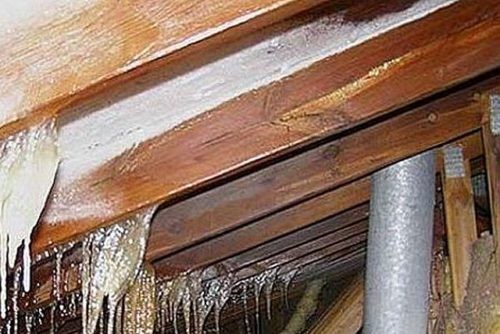
Why then is mineral wool roof insulation regarded as a classic? The surface holds the answer. Because technical drying is more expensive, takes longer, and requires the search for drying chambers, the rafter system is dried to 20–25% in natural conditions prior to installation. End-to-end rigid mat insulation, such as polystyrene foam or extruded polystyrene foam, is used, and polyurethane foam is used to fill in the spaces.
Because they are in a perfect drying environment, rafter beams gradually lose 8–10% of their moisture. In this instance, what happens to the timber’s linear dimensions? Yes, they do shrink dramatically and separate from the insulation. This causes the entire surface of the roof to form bridges of cold instead of bridges. The insulation project is all headed… well, you know where.
Randomly placed mineral wool is laid. This implies that the fibers will straighten and fill in the voids left by the rafters’ decreasing thickness.
Characteristics, pros and cons of mineral wool
There are various kinds of mineral insulation that go together under the term "mineral wool":
- basalt wool;
- glass wool;
- slag.
Basalt wool
The Hawaiian islanders discovered the use of basalt wool as insulation when, during a volcanic eruption, strong gusts of wind caused the basalt to transform into long, elastic fibers. These kinds of conditions could be manufactured artificially by the Americans. Everyone can see the obvious outcome: basalt wool is actively insulated in a large number of nations worldwide.
Insulation made of basalt is produced with basic technology:
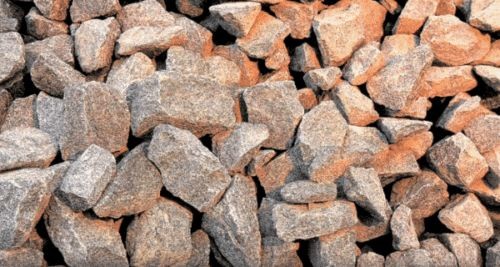
- the resulting crushed stone is loaded into a furnace and melted at a temperature of 1500 o C;
- the liquid mass is fed to a centrifuge, blown with a strong air flow;
- the resulting fibers are irrigated with formaldehyde resin (leading manufacturers have switched to arbolo-urea resin);
- moistened fibers are fed into a drying chamber, where they are cooled to 200 o C;
- during the process of polymerization of the resin, the fibers are covered with a thin layer of polymer;
- From the drying chamber, bulk wool is fed to a conveyor, where a continuous ribbon of basalt insulation is formed. At the same time, by adjusting the equipment, it is possible to obtain material of different densities;
- at the exit from the conveyor, the cotton wool is cut into mats or rolls.

Among the material’s primary attributes are:
- thermal conductivity coefficient – 0.035-0.042 W/(m K);
- density – 30-300 kg/m3;
- vapor permeability – 0.25-0.35 mg/m2 x h x Pa;
- average fiber dimensions: diameter – 5-15 microns, length – 2-5 cm;
- tensile strength of a single fiber – 2800-4800 MPa.
These insulation-related technical indicators define its advantages and disadvantages.
PROS relate:
- durability – the material lasts more than 50 years;
- very high level of thermal insulation properties (see. graphics);
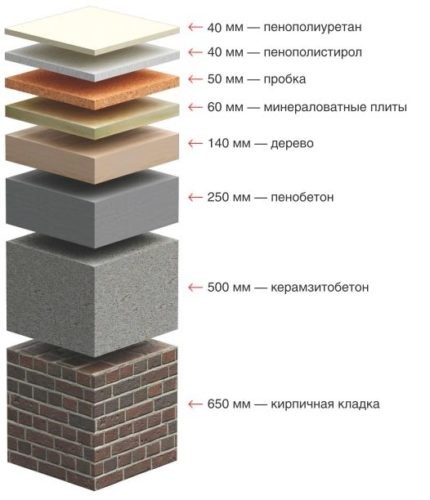
- lack of hygroscopicity – a mat immersed in water absorbs no more than 0.01% moisture in 24 hours;
- resistance to heat – destructive processes begin after +1000 o C;
- good sound insulation properties – absorbs up to 57 dB of airborne noise;
- versatility – used for insulation of all building structures;
- simple installation – installation work can be done with your own hands;
- elasticity – retains its dimensions throughout the entire period of operation;
- convenient delivery from the retail outlet to the work site.
Furthermore, basalt wool is disliked by rodents and microorganisms (mold and mildew). The high cost and the existence of heat-escape-causing seams should be emphasized as shortcomings.
Glass wool
The ingredients of glass wool are cullet (eighty percent), limestone, soda, quartz sand, dolomite flour, and borax (20 percent). You can get a fiber with predefined mechanical properties by varying the percentage of components. After the mixture is placed inside the oven, the temperature rises to 1400 degrees Celsius. Staple (short) fibers are created when the melt is forced through the grate.
Mats are made on a conveyor, where the loose mass is irrigated with a binder initially, and then compressed to a specific density during the polymerization process. Bright yellow rolls or mats are the result, depending on how the cutting is done at the conveyor’s exit.

Regarding thermal-insulating materials:
- thermal conductivity – 0.038-0.046 W/(m×°K);
- density – 11-200 kg/kg 3;
- vapor permeability – 0.4-0.7 mg/m2 x h x Pa;
- fiber dimensions: diameter – 3-15 microns, length 15-50 mm.
Among the attributes that appeal to customers are:
- budget (low) price;
- good thermal insulation properties;
- versatility;
- environmentally friendly – contains no allergens. When heated, no harmful substances are released;
- convenient transportation;
- simple installation;
- high level of fire safety (belongs to the class of non-combustible materials);
- low specific gravity, which is important when insulating the roof;
- high fire resistance – withstands temperatures up to 300 o C.
Fungus and mold cannot grow on the fibers, which is an additional benefit to the ones listed above.
Among the flaws are:
- high hygroscopicity, which excludes its use in rooms with high humidity;
- short service life – retains its original characteristics for about 10 years, after which natural destructive processes begin. After 30 years of operation, dust is removed instead of cotton wool. This includes personal experience and numerous reviews on various forums;
- dust and its causticity, which requires mandatory protection of the body, and especially the respiratory tract and eyes. Anyone who has worked with glass wool, especially on the roof, will understand what we are talking about;
- attractive to mice and rats – for them the material represents an ideal habitat: they love to make nests.
Slag
Blast furnace slag, a byproduct of the metallurgical industry, is used to make slag wool. The process is essentially the same as that used to produce other kinds of mineral wool: the raw material is heated to the point at which it melts into a liquid under air pressure, and then the resulting melt is sprayed into tiny fibers up to 60 mm long and incredibly thin—between 2 and 5 microns. Consequently, the following physical and technical indicators are present in our insulating mats:
- thermal conductivity coefficient – 0.046-0.048 W/(m K);
- density – 70-475 kg/m3;
Be aware that different sources may provide different density values. This can be explained by the fact that the raw material’s chemical composition is formed by the indicator’s digital value. Additionally, they can differ greatly from one another. As a result, the work offers the highest and lowest bound that is feasible.
- sound absorption coefficient – 0.75-0.82.

Slag fiber insulation offers benefits as well as drawbacks.
Advantages:
- can be used for insulation on vertical, inclined and round surfaces;
- good sound insulation properties. Just like basalt wool, it is used for soundproofing recording studios;
- the most affordable price among all types of insulation due to free raw materials;
- ease of installation, which is inherent in all types of mineral insulation;
- long service life in dry conditions – up to 90 years.
Cons a good deal of. Some of them are crucial, though. This:
- fairly low operating temperature – up to +250 o C. As a result, slag wool can be classified as a non-combustible material. But the problem of fire safety arises from a completely different side: the insulation quickly melts, spreading throughout the building;
- insufficiently high thermal insulation properties;
- high hygroscopicity – you need very, very good, not even hydro-, but vapor barrier;
- formation of hydrochloric acid when wet. The minus is critical, since hydrochloric acid corrodes all types of building materials;
- formation of unpleasant dust during installation.
How to choose the right mineral wool
There are certain considerations when choosing insulation for the roof. When selecting a heat insulator for other building structural elements, there are certain requirements that are not present here. The most significant ones are as follows:
- thermal insulation properties;
- density;
- thickness;
- durability;
- noise absorption level;
- price;
- manufacturer (brand).
Take note: you can insulate the roof with glass and basalt wool. Because slag wool is highly hygroscopic, it is not used. As a result, we will only assess the initial two insulation types.
Qualities of thermal insulation. The materials’ values are about equal in terms of thermal conductivity. Consequently, you are unable to focus when making a decision.
Density. Glass wool with a density of 15–30 kg/m3 works best for a heavy roof or a weak rafter system. However, this is where the insulation attachment gets tricky. It sags instead of remaining between the rafters because it cannot be fastened unexpectedly. This makes the insulation process extremely difficult. The ideal mats to use for attic insulation have a density of roughly 120 kg/m3. In the event that a flat roof is insulated from above, grade P-175, or density 175 kg/m 3, is required.
For roof insulation, mineral wool with a density of 30–50 kg/m3 for glass and 55–70 kg/m3 for basalt is ideal.
The thickness. The climate zone and whether or not the attic’s roof or attic space is insulated are the two main factors influencing the thickness of the roof insulation. Builders completely overlook a number of other minor factors that heating engineers consider.
Higher educated builders are not always able to master the complex thermodynamic formulas needed to calculate the thickness. Consequently, do-it-yourself artisans have two choices: either rely on years of experience and utilize 200 mm thick matting, or visit the website of any reputable company and utilize a free online calculator.
It is best to add 50 mm to the calculator values when using glass wool in order to account for caking.
Resilience. Only choose glass wool if the thermal insulation will be changed out within the next 15 to 20 years. Otherwise, the family budget will simply be lost in the future.
Insulating against sound. It is required to place 75–80 kg/m3 of dense basalt mats underneath the metal tiles. If not, you’ll have to live in a noisy room where you’ll wake up to the sound of raindrops drumming on glass. Furthermore, we must remember that thin metal has a high resonance, which increases outside noise. Even very dense glass wool is insufficient for this task.
Cost. When renovating on a tight budget, glass wool is the obvious choice. However, funding for basalt wool is required if funds are found for the metal tile roof’s finishing coat, as glass wool is completely inappropriate for this kind of roof.
In conclusion, it’s important to plan ahead and coordinate the type of mineral wool, the pitch of the installation, the size of the rafters, and the type of roof finish.
Producer. Both well-known brands and obscure manufacturers can be found on sale. It is advisable to choose well-known brands; nonetheless, this does not imply that recently established companies in the construction industry provide subpar goods. Conversely, this is frequently not the case because modern machinery is employed in production.
Buyers are in good demand for materials from the companies "IZOVOL," "TechnoNikol," "Isover," "KNAUF," and "URSA," as well as insulation from "Beltep" (Belarus), which offers the best value in terms of both price and quality.
Required materials and tools
The following supplies and equipment are needed to manually install mineral wool insulation on a private home’s roof (a comprehensive list of all available insulation options is provided):
- basalt wool or glass wool – the specific type depends on the criteria listed above;
- vapor barrier (windproof) membrane (type A or AM);
- vapor barrier film type B (preferably C);
- tape for sealing membrane and film seams;
- polymer twine – necessary for fastening sagging fiberglass;
- wooden slats for temporary fastening of sagging glass wool;
- hammer drill – required when insulating a flat roof from the inside;
- a plastic dowel-fungus with a plastic washer-rondole (diameter 60 mm) for fastening insulation – will be required for fixing mats when insulating a flat roof from the inside;
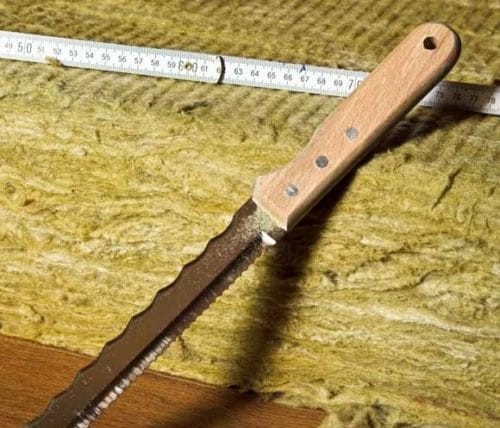
- construction knife for cutting glass wool;
- a sharpened wave-shaped knife or jigsaw for cutting basalt wool;
- nails or screws for wood;
- hammer for nails or screwdriver for self-tapping screws;
- stapler;
- at least 2 stepladders or ladders.
Preparatory work
One unique aspect of the pre-insulation work for roofs is that it primarily consists of installing a type A or AM one-sided vapor barrier membrane (also referred to as "waterproofing" by builders). The resource "Installing a vapor barrier with your own hands" demonstrates the necessity of this kind of work (vapor barrier).
It is vital to check the integrity of the wooden roof structures (replace any that are beginning to rot) and treat them with fire retardants and antiseptics before applying the windproof membrane.
When fixing the membrane, there are a few guidelines that need to be observed:
- there must be a ventilation gap between the membrane and the roofing finish. According to SNiP no less than 6 cm, in practice 4-5 cm;
- should be laid on the rafters, and not on the sheathing under the roof;
- air movement must be free over the entire surface of the roof slope. If ventilation is conditionally limited, then.e. exists for each gap between the rafters or slats (boards) separately, then in winter ice will necessarily appear in certain places. This can be easily verified by those who have carried out thermal insulation work on their own;
- between the rafters the membrane should sag by about 1 cm. If you pull it tightly, it can break under the influence of temperature fluctuations, like electrical wires during severe frost;
- fastened with a stapler. The staples must be taped;
- laid with an overlap (15-20 cm);
- the seams are sealed with construction tape;
- If a finished roof is being insulated, the membrane can be installed using two technologies:
- with an even sheet at the bottom of the rafters, after which insulation is carried out in stages along a two-layer sheathing, where the first row is packed horizontally, the second, along the first, vertically;
- along the rafters, but going inside the rafter system. In this case, the insulation is laid between the rafters, using the technology of insulation from the inside without a finished roof.
Technology of roof insulation with mineral wool
Pitched and flat roofs are the two different types. Two different technologies are used to insulate pitched roofs:
- between the rafters;
- above the rafters. Basically, it’s a gable roof. Mineral wool is used very rarely for insulation, rather as an exception. It is mainly used for insulation with rigid boards, such as extruded polystyrene foam. The method is complex and costly. With a large overhang that still needs to be properly covered.
Additionally, a flat roof can be insulated from the outside (from above) or the inside (from below), though bottom insulation defies all building science conventions and guidelines. However, it is still relevant and will be covered in-depth.
Insulation between rafters
The formula for insulating in between rafters is very straightforward:
- mats are cut to a width 2 cm greater than the distance between the rafters;
- insulation is installed between the rafters at random;
- the insulating layer is covered with a vapor barrier film (type B or C);
- interior finishing is mounted on top of the film if the roof slope is mansard.
The film attachment technology is fully compliant with the membrane attachment instructions.

There are a few subtleties present here, though.
1. The insulation sags when low-density glass wool is laid. The issue is resolved in this way:
- every meter, a temporary strip is attached to the rafters, which holds the wool between two beams;
- in this way the span is completely insulated;
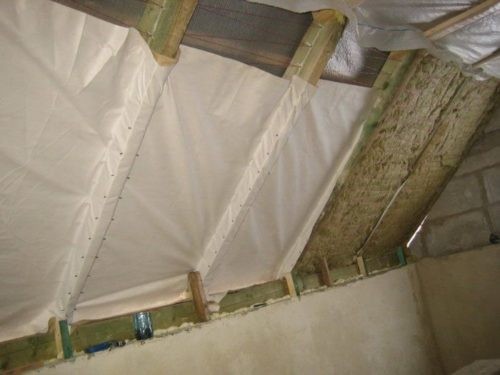
- using twine and a stapler, secure the first window between the bottom of the roof and the first batten. At the same time, the twine is constantly stretched between the rafters, rising up each time by 5-10 cm;
- the first strip is removed and work continues higher.
The picture shows what cotton wool fixed in this manner looks like.

2. The first layer of insulation, which is 10 cm thick, is attached, the lathing is filled, and the slabs of the second layer of insulation are inserted into it if the rafters’ width is insufficient to provide complete thermal insulation. The same technology is applied when insulating the attic roof. The completion of work above the insulating layer is the lone exception.
Insulation above the rafters
The following procedures make up the technology used to insulate the roof from the interior using mineral wool above the rafters:
- decking is laid on the rafters from boards 20 mm thick. For mineral wool, it may not be continuous, but with a gap between the boards of up to 5 cm;
- Type B or C vapor barrier film is rolled out onto the flooring, overlapping from top to bottom. In some places it is grabbed with a stapler, but the main fixation will be done with a sheathing beam;
- the first row of sheathing is filled with a beam width of 10 cm (sometimes they say: height). The pitch is equal to the width of the mats, but, ATTENTION, it is 2 cm narrower so that the insulation becomes out of place;
- the first layer of insulation is laid;
- the second one is packed perpendicular to the first lathing. Here you also need a beam 10 cm high. Sometimes you can find recommendations to use timber 12 cm wide so as not to fill the counter-lattice. It is better to abandon this idea, since the ventilation processes of the space between the windproof membrane and the roof are disrupted;
- the second layer of insulation is laid. Here it is important to avoid contact of the connecting seams with the beam of the lower sheathing;
- The thermal insulation layer is covered with a windproof membrane. How to lay it and fix it, see. in the section “Preparatory work”;
- a counter-lattice is placed over the membrane. For these purposes, you can use a square beam 30×30 mm or slats 30×40 mm.
Insulating a flat roof from the outside
Flat roof insulation from the outside is done on the upper stories of residential buildings, apartment complexes, and garages. The following is the work order:
- Type C vapor barrier film (2) is laid on reinforced concrete floors (indicated by number 1 in the diagram);
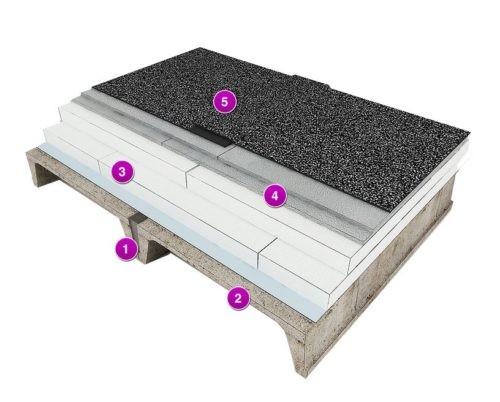
- mats of basalt wool grade P-175 (3) are laid on the film in two layers. The slabs of each row must be installed with a shift, according to the principle of brickwork. In this case, the seams of the top row should not coincide with the joints of the bottom;
- a two-layer flat slate screed (4) is mounted on top of the insulation;
- the entire structure is filled with bitumen-polymer insulating composition (5).
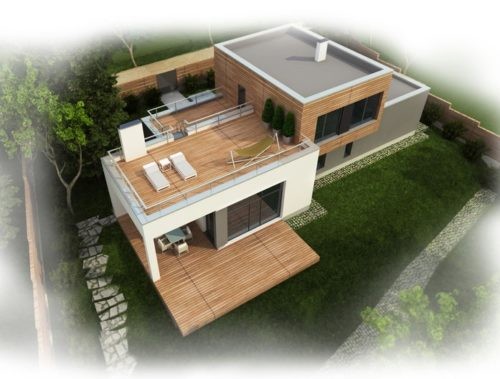
It’s very expensive, but it’s simple. But as the picture below shows, the appearance is well worth the cost.
Mineral wool roof insulation is a popular option among homeowners because it provides a number of advantages. First of all, mineral wool has superior thermal insulation that keeps your house cool in the summer and warm in the winter. Its ability to control temperature minimizes the need for heating and cooling, which not only improves comfort but also lowers energy costs.
Additionally, mineral wool is well-known for being fire-resistant, which raises the security level in your house. Because this material is non-combustible, homeowners who are worried about fire hazards can rest easy knowing that it can tolerate high temperatures without catching fire.
The ability of mineral wool to absorb sound is another benefit of using it as roof insulation. Mineral wool helps to create a quieter and more tranquil interior environment by blocking out external noise infiltration, such as sounds from nearby traffic or neighborhoods.
Durability is important to consider when choosing insulation materials. Mineral wool is an enduring solution for your roof because it is resistant to fungi, mold, and pests. Over time, this durability results in fewer maintenance needs and longer time between replacements, saving you money and effort.
In conclusion, using mineral wool to insulate the roof of your private home is a sensible decision that offers durability, fire safety, sound absorption, and thermal efficiency. Mineral wool provides an enduring way to raise comfort levels, lower energy expenditures, and improve your home’s overall quality of life, whether you’re building a new house or remodeling an old one.
In this article, we explore the practical aspects of insulating the roof of a private house using mineral wool. Mineral wool, known for its thermal insulation properties, offers an effective and affordable solution for maintaining comfortable indoor temperatures while reducing energy costs. We discuss the benefits of mineral wool insulation, such as its fire resistance and sound absorption capabilities, making it suitable for various climates and environments. Our guide covers the step-by-step process of installing mineral wool insulation, from preparation and safety considerations to practical tips for achieving optimal insulation efficiency. Whether you"re upgrading an existing roof or planning a new construction project, understanding how to properly install mineral wool insulation can significantly enhance the energy efficiency and comfort of your home.


