
When thinking about a concrete floor screed, damper tape fulfills a number of crucial functions. This tape, sometimes referred to as isolation tape or expansion joint tape, is essential for controlling the stresses and movements that the concrete experiences during the curing and settling processes. By offering a flexible barrier that allows for the concrete’s normal expansion and contraction in response to temperature changes and structural loads, it aids in the prevention of cracks.
Damper tapes come in a variety of varieties, each made to fulfill particular demands determined by the specifications of the project. Rubber, foam, and synthetic polymer tapes are examples of common varieties. Rubber tapes provide durability and moisture resistance, while foam tapes are perfect for filling larger gaps because of their excellent compressibility. Strong adhesive qualities and flexibility are frequently combined in synthetic polymer tapes, guaranteeing dependable performance over time.
The kind, quality, and quantity of damper tapes needed for the project will all affect how much they cost when it comes to concrete floor screeds. While high-performance synthetic polymer tapes may cost anywhere from $1 to $3 per linear foot, basic foam or rubber tapes typically cost between $0.50 and $1. It is imperative to select a tape that is appropriate for the particular requirements of your concrete installation in order to guarantee efficient defense against future damage and cracks.
- What it is?
- What is it for?
- Is it possible to do without it??
- Requirements
- Varieties
- By purpose of use
- Regional
- T-shaped
- L-shaped
- Universal
- Type
- Standard
- Self-adhesive
- With a skirt
- According to the material from which it is made
- Polyethylene
- Natural cork
- Polypropylene
- Is it possible to do it yourself??
- Advantages and disadvantages
- How to choose the right?
- Laying rules when pouring
- On the edge
- For expansion joints inside
- Bugs and difficulties
- Pros and cons of use
- Average price in the Russian Federation
- Video on the topic
- Laying damper tape for underfloor heating 8mm Sanpol
- Installation of DAMPER tape for concrete floor screed in the Profitable Garage PURPOSE COST TOOLS
- Damper tape. Why is it needed and why should it be glued?.
- Useless damper tape or floor screed in an apartment with your own hands, that is, poured screed
- Damper Heated Floor Tape (What is it, Types and Why is it needed??)
- All about damper tape for heated floors in 1 minute
- Why and how to use damper tape correctly when installing heated floors?
- Damper tape for screed and self-leveling floor – why is it needed?
What it is?
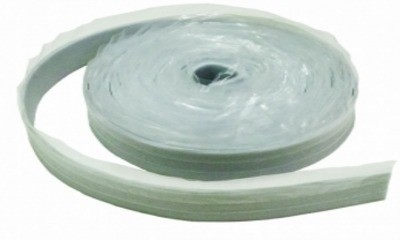
This type of roll polymer foam material, known as damper or compensation tape (cord) for concrete floor screed, is placed along a stone structure’s ends or in its expansion joints. This structural component compensates for any temperature changes or other movements within the concrete and stops loads from being transferred to nearby spans or the building frame’s vertical support elements.
What is it for?
When the following result needs to be achieved while the floor covering is in use, a damper tape for floor screeds is utilized:
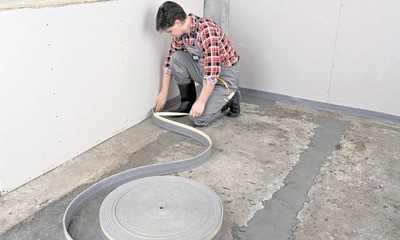
- Exclusion of load transfer to vertical structures of the building frame.
- Compensation for temperature expansions or compressions of concrete screed.
- Reliable elastic insert in expansion joints of the screed.
- Division of an extended structure into separate cards to eliminate stress concentration and crack formation with minor subsidence.
- Ease of sealing the joint of the screed with the wall structure.
- Possibility of installing a floating floor.
- Increased heat and sound insulation, preventing the transfer of vibration loads and structural noise to adjacent rooms.
- Formation of expansion folds in concrete floor screed.
The damper tape also makes it easier to repair concrete structures because, among other things, partial dismantling does not require cutting out concrete around the entire perimeter of the defect and, when replacing the screed, only one card needs to be removed to preserve the overall performance of the structure, whether it is indoors or outdoors.
Is it possible to do without it??
In the situations indicated below, you can install a concrete screed without using damper tape:
- If the area of the room does not exceed 15 – 20 m2 .
- In the event that the enclosing vertical structures are not connected by monolithic units to all parts of the building frame.
- If the screed is laid in technical rooms, basements, attics, underground spaces, storage rooms, which are not subject to increased requirements for sound insulation.
- If the operation of the floor covering does not imply the transfer of significant forces from external loads.
- If the screed is used in rooms with constant temperature and humidity conditions.
- In situations where a concrete floor screed is installed on top of an absolutely rigid base and elastic membranes or insulating materials are not laid under it.
In other situations, all experts strongly advise installing a damper tape made of foam materials if the screed is installed in a residential building of a private or apartment building, especially if the facility was recently put into operation. This will greatly increase the subfloor structure’s durability and dependability.
Requirements
When it comes to damper tapes, which are available in home retail stores and construction markets across the nation, the following stringent guidelines must be followed:

- Environmentally friendly composition – when heated or during operation, the material of the damper tape should not emit toxins and chemicals that cause allergies in dependent people.
- Elastic deformations – the compressibility of the material must be at least 50%, without the risk of destruction of the foam structure.
- Excellent thermal and sound insulation properties.
- Tensile strength – the material should not collapse when even increased tensile forces are applied.
- Flammability class is no less than G1, that is, the damper tape should not support the spread of open fire.
- Water absorption under pressure is no more than 3% – 5%, which also ensures frost resistance of the material.
- Ease of installation – most modern damper tapes are treated on one side with an adhesive composition, which greatly simplifies gluing the material to walls or other concrete surfaces.
- The width of the damper tape should be no less than the thickness of the screed, but it is recommended to purchase it with a margin of 1 – 2 cm from the nominal height mark, since excess material can always be cut off after the concrete structure has hardened.
- The thickness of the tape should be selected in such a way as to fully compensate for possible movements of the concrete or cement-sand mortar screed during its operation.
- The composition of the damper tape should be such that no ingredient supports the development of bacteria, the formation of mold or other processes of fermentation of the material.
Manufacturers can obtain an official certificate of conformity of the state sample, which guarantees complete safety, reliability, and durability during the material’s operation after it is installed in the seams of the subfloor’s concrete screed, indoors or outdoors, by meeting the aforementioned requirements. This certificate is based on the results of a series of tests.
Varieties
A variety of damper tapes are available on the market that are used to seal the joints when the subfloor’s concrete screed is being installed. These goods are separated into various groupings by:
- design;
- compound;
- scope and other partners.
The comprehensive categorization of these manufactured goods, along with manufacturer examples, a description of the attributes, benefits, and drawbacks, and an average cost, are provided below.
By purpose of use
All damper tapes that are sold are categorized into the following groups based on their intended use:.
Regional
The damper tape type that is most widely used. They are a strip that is at least 50 to 200 mm wide. On the reverse side, they can be fixed with sealants or adhesive building mixtures, or they can be fitted with an adhesive composition.
Properties: 50% compressible elastic material that regains its shape after the load is released.
Use:

- separation of the screed from other load-bearing or enclosing structures of the building frame;
- floating floor device.
Benefits
- low cost;
- ease of application;
- possibility of cutting in any direction;
- elasticity;
- reliability.
Drawbacks:
- the complexity of the device in the absence of adhesive on the reverse side;
- low mechanical tensile strength.
Producers:
Costs: 200–250 rubles for a single roll that is 20 m long and 80–100 mm wide.
T-shaped
An elastic insert is a convenient material that is used to seal expansion joints in screeds. It is composed of two parts: a vertical wall and a horizontal base. Generally speaking, the base’s measurements don’t go beyond 40 mm, and the wall’s height varies based on the screed’s thickness.
Qualities:
- are supplied both in rolls and in measured lengths;
- made of polyethylene with a foam structure;
- compressed up to 70%;
- laid on a concrete base under the screed before it is poured;
- can be combined with profile structures.
Application: adjusting a concrete screed’s individual parts for thermal expansion or contraction.
Benefits
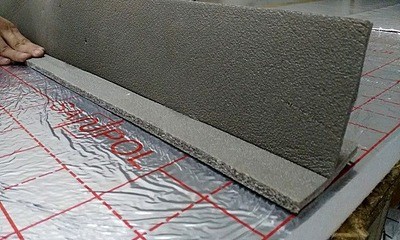
- ease of installation;
- operational efficiency, can be combined with almost any sealants;
- can be trimmed to height with simple scissors.
Drawbacks:
- the cost is higher than that of edging tape if the joining of the base and the wall is poor;
- the material may delaminate with subsequent loss of performance properties.
Producers:
- Oventrop
- "Energoizol".
- Wendl&Lung.
Costs: 25–50 rubles for one meter P.
L-shaped
It is composed of a single polyethylene or polypropylene sheet, as opposed to T-shaped contraction. The bend is created in the factory by plastically deforming the material with rolling rollers. simultaneously partially glued to both horizontal and vertical structures.
Qualities:
- provides sealing of the screed in wet areas;
- is arranged along the perimeter of the junction of the subfloor structure with the walls in the room.
Use:
- sealing the joint between the screed and the wall;
- preventing water from penetrating under the concrete structure;
- soundproofing cut-off of concrete floor.
Benefits
- increased tightness;
- mechanical strength;
- ease of bending;
- can be used like a regular edging tape when unfolded.
Drawbacks:
- increased risk of tape breaking at the factory fold;
- the complexity of the device on fillets, since it implies bending along a single line.
Producers:
- "Resource".
- SoundGuard.
- TECEfloor
Costs: 350–500 rubles for a single 20-meter roll.
Universal
The most useful polyethylene tape is one that, thanks to unique production technology, can be used to install both an insert between concrete edges and a seam between screed and wall structures at the same time.
Properties: the capacity to glue along the perimeter of the end face of a concrete screed slab in an L-shaped pattern or by using the full length.
Use:

- formation of an elastic layer of an expansion joint;
- sealing the gap between the partitions and the screed;
- installation of a floating floor in rooms with increased operational requirements.
Benefits
- the possibility of purchasing the same material to perform a full range of work on the installation of screed;
- The minimum waste when working with this product.
Drawbacks:
- It may not match the required dimensions, since when forming the angle, the total width of the screed changes;
- relatively high retail cost of the finished product;
- A small assortment of such damper tapes is presented on sale, which is why there is a difficulty in selecting its optimal thickness.
Producers:
- Stout
- WENDL & LUNG.
- Soundguard
Costs: 300–400 rubles for a single roll of canvas measuring 20 meters in length.
A portion of various dumping ribbon types are typically needed when installing a concrete or cement-sand screed in a large room. This depends on the overall configuration, design power, number of seams, and wall adjustment locations. This means that in order to purchase the entire volume of tape at a time with a small margin, the master must precisely specify the total amount of material intended for use.
Type
Tapes for adjusting internal forces and movements that arise in a concrete or cement-sand screed are also categorized based on their type and design.
Standard
The most basic and affordable type of damper tapes are rolls of foamed membrane that aren’t coated in adhesive substance on the reverse side. The most common tools needed for installation are epoxy glue, liquid nails, polyurethane foam, silicone or acrylic sealant.
Qualities:
- perception of horizontal loads due to linear deformations of the concrete screed;
- uniform distribution of the sound wave over the porous structure;
- ensuring increased resistance to heat transfer of the enclosing structure.
Use:
- filling expansion joints with a thickness of up to 10 mm;
- installation of a floating subfloor in residential apartments or offices with light operating loads.
Benefits
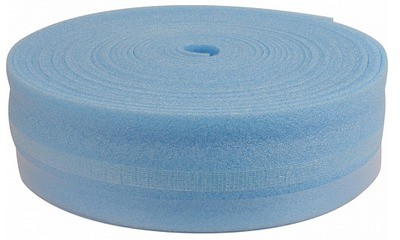
- low retail cost;
- possibility of cutting in any place;
- a wide range of products with different parameters on sale.
Drawbacks:
- complexity of installation;
- the need to use adhesives or sealants.
Producers:
Pricing: 200–220 rubles for a 20-meter length.
Self-adhesive
High-tech material, the back of which is factory-precoated with an adhesive mixture. This eliminates the need for additional adhesive mixtures when installing the tape on a wall or horizontal surface.
Qualities:
- gluing material along the perimeter of the walls of the room;
- compressibility under load with subsequent return to previous shapes and thickness, without disturbing the crystal lattice of the material.
Use:
- damper installation around the perimeter of the walls;
- cutting between foundations and floors along the ground;
- formation of sedimentary seams for filling with elastic material.
Benefits
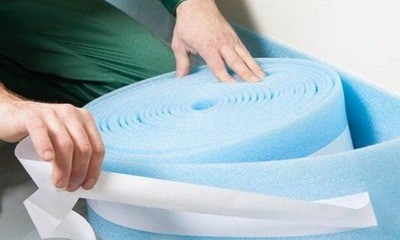
- high installation speed;
- no need to bring in professionals;
- simple trimming after hardening of the screed;
- quick overlap joining.
Drawbacks:
- the difficulty of carrying out work on an uneven surface;
- the need to clean and prepare the concrete surface before installing the tape.
Producers:
Costs: between 250 and 270 rubles for a 20 m.
With a skirt
Adaptable double pattern This type of damper tape is suitable for installation in expansion joints and for providing dependable water infiltration protection along the edge of a concrete screed. The tape has an adhesive coating on one side and a second layer that can be bent to a 90-degree angle to improve gap sealing and protection.
Properties: double protection against excessive internal forces, settling-related cracks, edge stresses, temperature fluctuations, and other aggressive influences or shock loads for the screed and nearby structures.
Use:

- installation of complex floating floors in rooms with increased operational requirements;
- foundation structures without a basement;
- protection of concrete from shrinkage and cracking.
Benefits
- increased protection of the screed from the occurrence of internal forces;
- ensuring complete sealing of the corner joint and expansion joint.
Drawbacks:
- one of the most expensive modifications of damper tapes;
- complexity of installation, the need to draw up a project and take measurements before purchasing, since there is an increased risk of choosing the wrong dimensions.
Producers:
- SoundGuard
- TECEfloor
- «Energoizol».
Costs: 300–600 rubles for 20 meters.
Purchasing tapes with a skirt is advised by experts, particularly when installing a screed in a small apartment or a private residence. In these circumstances, the tape can be cut to become any kind of damping product for a range of structural elements; no separate tapes need to be purchased for installation in different kinds of seams and junctions of concrete screed to walls in a room for any kind of purpose.
According to the material from which it is made
The majority of expansion tapes that are commonly found in the construction industry are composed of the following categories of man-made materials.
Polyethylene
The most basic, widely accessible material for damper tapes that can be found on the market. The thickness can range from 5 to 15–20 mm, and dependable elastic membranes between the supports prevent plastic deformation. It is foamed at the factory.
Properties include: ability to compress under load; ability to absorb sound waves and vibrations; ability to compensate for movements; and ability to sense shock loads from concrete structures. can have varying dimensions and be edge, universal, T-shaped, or L-shaped.
Use:
- damper tape around the perimeter of the edge of the screed;
- installation of a concrete floating floor, breakdown of a concrete structure in extended residential or public premises into maps with the formation of expansion joints and their subsequent filling with elastic materials.
Benefits
- the cheapest material for damper tapes;
- a wide selection of products with different dimensions and thickness, supplied in rolls or finished products of measured length;
- convenient joining of the edges of the material to each other to achieve continuity and complete tightness of each joint of the concrete floor screed.
Drawbacks:
- low mechanical strength, delamination of T-shaped composite products; when burning, odors and toxins are released;
- in many rooms the material does not meet fire safety requirements, which limits its use.
Producers:
- "ReCom".
- Valtec.
- SoundGuard.
Costs: 200 rubles for a single 20-meter roll.
Natural cork
Natural material composed of cork oak bark that has been altered and given special treatment. only available as edges, supplied in rolls measuring five to ten meters in length, and only placed around the walls’ periphery.
Qualities:
- compensates for thermal expansion and contraction of the screed;
- the heterogeneous structure absorbs almost all types of vibrations;
- works in both wooden and brick houses.
Use:
- soundproofing layer for floating screed, enhancing performance properties;
- combination with polyethylene materials;
- installation of subfloors in rooms with increased sanitary and hygienic requirements.
Benefits
- environmentally friendly composition, which allows the use of cork in almost any dry room;
- good compressive strength, minimal deformation;
- highest sound insulation rates.
Drawbacks:

- high cost of material;
- susceptibility to rotting in a humid environment;
- a small range of products on sale, thickness, as a rule;
- does not exceed 5 mm, which does not always allow the use of cork in wide expansion joints.
Producers:
- Hermetex.
- Amorim.
- Beaver Creek.
Costs: 400–700 rubles for a single roll measuring 10 m.
Polypropylene
An uncommon but useful material with increased elasticity that can be applied in seams, in one or more layers, and nearly invariably has a self-adhesive surface on the back is available.
Qualities:
- compresses under significant load, fits in rooms of any area;
- can be used in the construction of floor screed booms in open street spaces.
Use:
- sealing expansion joints, providing heat and sound insulation of the subfloor;
- damping layer for floors on the ground;
- compensation of screed deflections with the possibility of compression up to almost 100% without achieving elastic deformations of the material.
Benefits
- excellent physical and mechanical properties, the material works at almost any ambient temperature;
- minimum moisture absorption rate.
Drawbacks:
- costs more than polyethylene, when heated it can emit unpleasant odors;
- not recommended for use in residential premises;
- rarely found in general retail sale.
Costs: 300 rubles for 20 meters.
Buying polyethylene foam tape, which is sold in hardware stores and markets in assortments as related products, is the best way to achieve optimal compliance with high quality and reliability at a reasonable retail price.
Is it possible to do it yourself??
This insulating compensation product for concrete screed is a good option if buying a factory-made damper tape in its completed form is not feasible or desired. The following supplies can be used to make it on your own, following a basic technology map:
- Cutting foamed foam with or without a foil membrane.
- Cutting the substrate for laminate or linoleum into strips, which is made from extruded polystyrene foam with a thickness of 5 to 10 mm, or from cork oak.
- The use of an organ, plywood or a thin facing lining, provided that the room does not have increased humidity.
- Cutting thin foam with its further gluing on the walls or a device in a seam on an mounting foam, or on silicone.
- The use of semi -burning mineral wool plates, basalt cotton wool or felt matts.
- Rubber harnesses, elastomers and other elastic linear materials, which, most often, are supplied in rolls.
- The use of any other elastic and compressed building, or facing materials that can be laid in a deformation seam without destruction, in the case of applying loads.
It should be mentioned that all finish components must have a high-quality passport if the object is subject to increased oversight by regulatory bodies. This means that only ready-made damper tapes purchased from approved retailers will meet this requirement.
The video’s manufacturing features include:
Advantages and disadvantages
Because these materials have so many indisputable benefits, homemade dumpfer tapes are frequently used to make up for movements or deformation of the concrete floor screed:
- Most often, the physico-mechanical parameters of such products are not lower than that of the damping tapes of the factory manufacturing.
- The possibility of using waste from the main materials for installation work.
- Reducing the costs of acquiring new materials to fill the clearance in the floor of concrete flooring.
- The possibility of choosing such materials, the chemical composition and the main technical characteristics of which are fully consistent with the requirements for a specific room.
However, despite their benefits, these homemade dampers are frequently replaced with other materials or abandoned by the property owner because of their many drawbacks:
- These materials are not certified for use as damper tapes.
- Increased risk of assignment of errors during installation.
- Homemade tapes are rarely equipped with a self -adhesive surface, which requires, using additional adhesive compositions.
- Given that ready -made dampers in rolls are not expensive, a comparison of the cost is required, since cutting other materials can be more expensive for the master or owner of the room.
Homemade dumper ribbons are widely used to install concrete screed and cement-sand mortar in buildings for a variety of uses, as well as on the street, since the majority of drawbacks are subjective.
How to choose the right?
In order to properly select a tape for the compensation laying device between the vertical structures and the concrete floor screed, or to seal the joints in the black flooring, the following functional and structural factors must be considered:

- The thickness and overall dimensions of the product must fully comply with the parameters of the screed being poured.
- It is recommended to purchase damper tapes only with a self-adhesive back side.
- You should buy a tape whose width is 10 – 40 mm greater than the thickness of the screed being poured.
- Each product or batch of it must have a state certificate of conformity, and also be equipped with a quality passport indicating the main technical characteristics.
- When purchasing a tape, it is important to study its thermal and sound insulation properties.
- When you press the tape with force, within a short time it should take on its previous size and shape, without the formation of plastic deformations.
- It is recommended to buy a product that is also equipped with a sanitary and hygienic certificate, which allows it to be used in children"s or medical institutions.
- The price of the product should not be lower than the market price, as this may indicate low quality of the product or the presence of defects.
The product’s brand, the year the business was established, the nation of origin, and the quantity of favourable reviews that pleased customers have left on the brand in question’s products on independent Internet forums are some of the primary selection factors.
Laying rules when pouring
It is not at all necessary to hire professionals to install damper tapes in a structure when installing a concrete screed; all work can be done by hand, provided that you follow a few guidelines and take certain nuances into consideration. Depending on their location within the subfloor structure and their intended use, the technological maps for installing damper tapes in the concrete screed structure are explained in detail below.
On the edge
The following subtleties need to be considered when placing damper tape along the edge of a concrete screed to divide the building’s vertical load-bearing or enclosing elements from the subfloor structure:
- The tape is glued in such a way as to close the entire gap between the screed and the wall.
- The tape should be partially adhered to the subfloor and to the wall structure.
- It is recommended to choose a product whose width is greater than the total thickness of the screed to prevent contact of concrete with load-bearing or enclosing structures.
- After the screed has hardened, the tape should be trimmed along the entire perimeter.
- For better adhesion of the product, it is necessary to first clean the concrete structures from dust, dirt and grease deposits.
- The thickness of the tape is selected in accordance with the calculation of structural noise, the occurrence of which, in turn, is influenced by the functional purpose of the room.
- Cork tape can only be installed in living rooms or offices, where the formation of high humidity is excluded.
- The seam between the wall and the screed must be duplicated on the final coating, since it is also subject to linear deformation due to temperature changes.
The excess polymer tape is cut with a construction knife to the very edge of the plane of the reinforced masonry structure immediately after the concrete screed hardens and gains strength. If necessary, the resulting gap is then sealed with an elastic sealant to keep moisture from penetrating beneath the concrete layer.
For expansion joints inside
When installing an elastic layer, the master will also need to consider several crucial guidelines for sealing expansion joints within the screed:
- The seam between the screed cards must be of constant width.
- The damping membrane must cover the entire thickness of the screed, that is, the height of the seam.
- The seam on top, after installing the damper tape, must be sealed with silicone or acrylic sealant.
- For expansion joints, it is recommended to use only T-shaped or L-shaped tapes.
- It is recommended to concrete the screed cards separately to ensure reliable fixation of the damper tape to the end surface of the concrete screed.
- The thickness of the seam should be 1 – 2 mm less than the dimensions of the damper tape
- If it is necessary to create a seam of increased thickness, it is recommended to install a damper in 2 layers.
It is advised to lay an aluminum or stainless steel profile between sections of stone materials when forming a large-width expansion joint in extended concrete screed structures. This will help form a continuous gap with constant dimensions along the entire length, in addition to the elastic filler from the damper tape.
Bugs and difficulties
Beginners frequently commit a number of egregious errors during the installation process when installing a damper tape in a concrete floor screed. These errors nearly always result in increased material waste as well as other unfavorable outcomes. The most frequent ones are listed below, along with potential solutions for any issues that may have come up, to lessen the likelihood of such errors:

- Choosing low-quality damper tape material – the design will not meet operational requirements.
- Choosing a tape with insufficient width – part of the screed will be closely adjacent to the wall, which will cause non-design forces during its operation.
- The design of direct flying into expansion joints instead of T or L-shaped – the structure will compensate for movements or frost at the end of the expansion only partially, and, as a result, will begin to collapse.
- Installation of the tape in an expansion joint without a metal profile – over time, the edges of the gap will begin to break off, which requires restoration.
- Installation of damper tapes made of cork in wet watering areas – the natural material will quickly begin to rot and be susceptible to the development of mold.
- Joining the damper tape with a gap – sealing of the structure will not be achieved in this place, which causes disturbances during operation.
It is advised that the master or owner of the premises familiarize themselves beforehand with professional master classes and video lessons, which they frequently share with other Internet users in the public domain, revealing various nuances and tricks, in order to completely eliminate all mistakes in the early stages.
Pros and cons of use
A universal structural component, damper tape for concrete floor screed offers the following benefits to the user or property owner:
- Foamed polyethylene or other materials from which the damper tape is made is a certified component that does not emit toxins and harmful substances into the atmosphere, which does not irritate the respiratory tract and does not cause allergies in dependent people.
- This material can be used without restrictions in premises of any purpose, subject to the availability of appropriate design solutions.
- The structure of the synthetic material does not form mold and bacteria do not multiply.
- Foamed polypropylene or polyethylene are practically not subject to plastic deformation, and the structure of the material is completely restored immediately after the load is removed, and therefore these products work ideally as elastic inserts in a concrete screed.
- The tapes are characterized by increased water resistance, and therefore they can partially take on the function of sealing concrete floor screed.
- Low production cost of such tapes, which also affects its availability in retail sales.
- The damper tape does not swell or increase in volume, which is why its effectiveness does not decrease even several years after installation of the screed.
- The damper membrane, regardless of its design and scope of application, provided that there is an adhesive composition on the back side, is quickly installed and does not require the involvement of professionals.
- Modern damper tapes significantly reduce the risk of structural noise propagation on adjacent structures of walls and floors of the building frame, as well as into neighboring rooms.
- The material is not destroyed under the influence of an aggressive environment, including direct ultraviolet rays.
- The damper tape design is reliable and durable.
However, damper tapes also have a limited number of drawbacks, which is why some customers would rather purchase more dependable materials and employ alternative methods to seal seams and gaps in concrete floor screeds:
- Low mechanical strength of the material – the structure of foamed polyethylene is easily damaged even with minor contact with a sharp object.
- When the tape is stretched along its length, it breaks easily.
- Difficulty in joining the material, if necessary. In this case, either gluing of this edge section is required to ensure its sealing, or overlapping of the tape, which leads to a local increase in the thickness of the damper layer.
- All materials made of polypropylene or polyethylene burn well, and when smoke appears, they release caustic substances into the atmosphere.
- Cork damper tapes have an environmentally friendly composition, but at the same time, they can rot.
- The difficulty of installing economy class damper tape, which does not contain an adhesive self-adhesive composition.
It’s crucial to weigh the advantages and disadvantages of each option before purchasing tape so that you can decide on the best course of action for building the subfloor and sealing the seam in the concrete screed.
In this article, we delve into the practical benefits of using damper tape for concrete floor screeds, exploring its various types and typical costs. Damper tape serves a crucial role in construction by preventing cracks and enhancing the durability of concrete floors. By absorbing movement and stress, it helps maintain structural integrity over time. We"ll outline different types of damper tapes available, from basic adhesive varieties to more advanced reinforced options, each catering to specific project needs. Additionally, we"ll discuss the average prices associated with these tapes, offering insights into budgeting considerations for construction projects. Whether you"re a homeowner planning a renovation or a contractor seeking reliable solutions, understanding the uses and costs of damper tape can greatly benefit your project"s success.
Average price in the Russian Federation
There is continuous competition among the hundreds of reputable large and small manufacturers that offer damper tapes. In this sense, the majority of businesses set their prices for comparable goods at constant quality levels around the same:

- Standard edge polyethylene damper tape with a width of 100 mm and a thickness of 6 – 8 mm, without a self-adhesive base – from 8 – 12 rubles. for 1 m, from 160 – 240 rubles. per roll 20 m.
- The same, but with a self-adhesive base – from 15 – 17 rubles. for 1 p. m., or from 300 – 340 rubles. for a finished roll 20 m long.
- Cork tape with a width of 80 to 120 mm with a self-adhesive base – from 250 – 300 rubles. for 1 roll 10 m.
- Polypropylene T-shaped tape for expansion joints in floor screed – from 500 – 600 rubles. for 20 m.
- Reinforced polyethylene tape with a protective film for reliable fixation, 10 mm thick, 100 mm wide – from 600 rubles. for 1 roll 20 m long.
The amount of goods purchased in a single transaction, the intricacy of the product’s delivery to the outlet, the store’s internal policies, and other variables may all cause a slight adjustment to the above prices.
| Purpose of Damper Tape | To prevent cracking in concrete floor screeds by absorbing movement and stress. |
| Types | Common types include rubberized asphalt, polyethylene, and foam tapes. |
| Average Price | Prices vary, but expect to pay around $0.50 to $2 per linear foot, depending on type and quality. |
Of course! This is a succinct summary of your article regarding concrete floor screed damper tape:
For your concrete floor screed, selecting the appropriate damper tape is essential to preserving the longevity and integrity of your flooring. Damper tapes greatly increase the longevity of your floors by sealing joints and halting the entry of moisture.
Knowing the various kinds of damper tapes on the market—made of foam, rubber, or other materials—enables you to choose the best one for the demands of your particular project. Different degrees of flexibility, moisture resistance, and installation simplicity are provided by each type.
Purchasing a high-quality product can pay off in the long run by lowering maintenance costs and guaranteeing a longer lifespan for your concrete floors, even though prices may vary based on the type and quality of the damper tape. This is something you should definitely budget for when building or renovating.
To sum up, adding damper tape to your concrete floor screed improves structural stability and provides protection against future moisture-related problems. You can increase the longevity and performance of your flooring investment by selecting wisely based on the types that are available and their corresponding costs.


