
When choosing a material for paving a yard, garden path, or area in front of a house, many people opt for paving slabs. And this is not surprising. They offer the perfect balance of practicality, durability, and aesthetics. But when it comes to choosing, it can be overwhelming: there are dozens of options available in stores and catalogs.
This article will help you navigate the variety of options available. We will look at the different types of tiles based on material and manufacturing method. We will discuss the most popular shapes, from classic bricks to complex curved elements.
We will discuss the visual aspect separately. You will learn how surface texture affects safety, what colors are available, and how they combine. We will look at how simple elements are used to create beautiful designs and patterns, from simple herringbone to artistic compositions.
At the end, you will find visual examples of layouts. They will help you imagine what your future playground or path will look like and inspire you to create your own unique design.
- Types of paving slabs
- Pros and cons
- Recommendations for selection
- Tile shapes
- Clover
- Coil
- Rhombus
- Brick
- Wave (zigzag or snake)
- Square
- Corner
- Mosaic
- Hexagon (honeycomb)
- Octagon
- Round
- Chamomile
- Scales
- Maple
- Lizard
- Trapezoid
- Types of tile texture
- Cloud
- Mesh
- Boards
- Wood-like
- Stone-like
- Checkers
- Carpet
- Paving tile colors
- Examples of street tile designs
- Options for pavement tile designs and patterns
- Paving tile layout
- Patterns for rectangular tiles
- For shaped tiles
- Photos of paving slabs in use
- Photos of paths at the cottage
- Photo in the courtyard of a private house
- Porch made of paving slabs
- Ideas for stair cladding
Types of paving slabs
The most relevant options are:
- Plastic. A sand mixture and polymer compounds are used in its manufacture. These polymer-sand products have good strength characteristics and anti-slip properties.
- Based on natural stone. It is made by crushing various types of rock, such as quartzite, granite, slate, shungite, and others. The most expensive option is marble-based tile finishing.
- Rubber. Contains rubber crumbs, has high moisture and frost resistance and noise absorption properties.
- Clinker. Special clay fired at high temperatures is used in its manufacture. Clinker paving slabs have natural shades, are fire-resistant, and non-slip.
- Concrete. Reinforced concrete tile finishing is performed by vibropressing and vibrocasting. These cement products are highly durable and are ideal for surfaces subject to heavy foot traffic or vehicle traffic.
When choosing a product type, consider the abrasion index, maximum temperature fluctuations, expected load, and budget.
Pros and cons
This type of pavement has several advantages and disadvantages.
| Pros | Cons |
|---|---|
|
It comes in a huge range of shapes, colors, and textures. |
High price. |
|
Prevents the formation of puddles, as excess moisture drains through the joints. |
Can be quite slippery and dangerous in frosty weather. |
|
It is quite wear-resistant, resistant to ultraviolet radiation, precipitation, and temperature changes. |
|
|
Has a long service life of 15 to 20 years. |
If laid incorrectly, the quality of the material is significantly reduced and grass begins to grow between the joints. |
|
It is easy to install. If one module is damaged, it can be easily replaced. |
Recommendations for selection
Key tips:
- When selecting products, it is important to pay attention to their color, which should be uniform and free of white or dark stripes.
- You should not give preference to overly bright materials with a large amount of pigments, as they are less durable.
- When choosing the color of paving slabs, take into account the decorative features and lighting of the site. Coverings that match the tone of the architectural details or are selected to match the color of the house will look more harmonious.
- To protect tile flooring from damage, it is recommended to use border framing.
Tile shapes
Tile material can have a variety of bar shapes.
Clover
It can be embossed and consist of squares with rounded corners or smooth tiles with a complex structure and a variety of shapes.

Coil
Due to its original contours, it is possible to achieve interlocking joints that provide a strong bond between the modules.
Rhombus
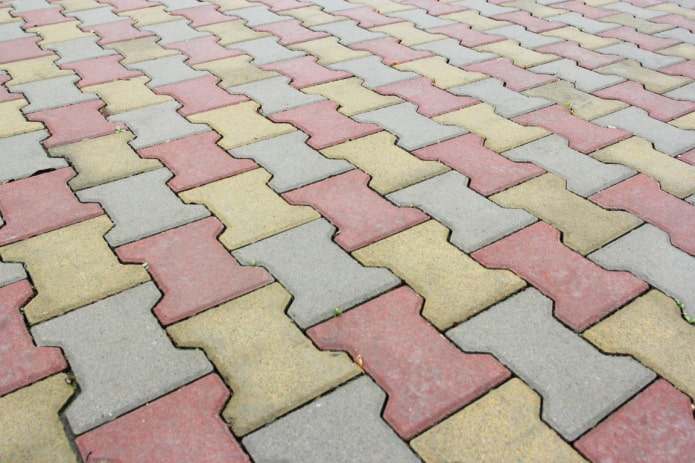
Allows you to decorate the surface with an original three-dimensional pattern in the form of a multi-pointed star or cube, perfectly complementing the surrounding exterior.

The photo shows a path with two-color paving tile cladding in the shape of a rhombus.
Brick
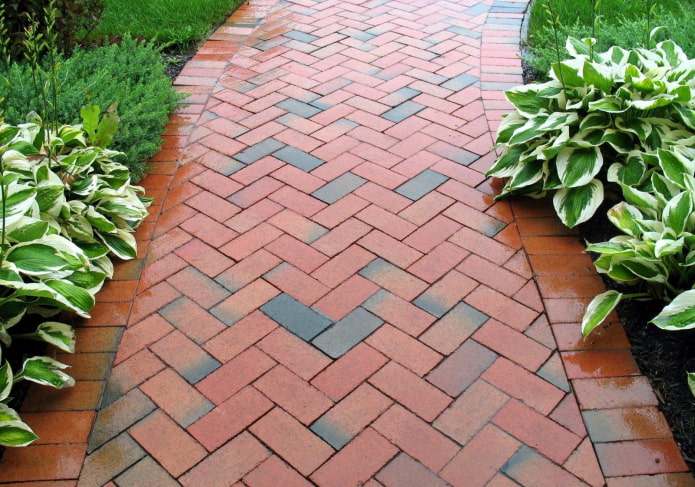
By imitating brick, you can achieve a smooth and regular surface with a neat appearance.
Wave (zigzag or snake)
It consists of elongated elements with curves resembling waves or lightning bolts, which can enliven the surrounding space and make it much more interesting.
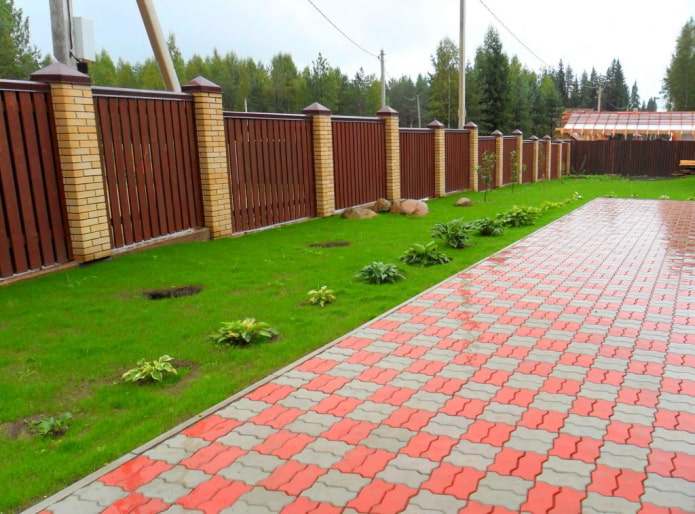
Square
This is the most traditional type of paving slab. Despite their simplicity, square models give the surface a special elegance.

Corner
It has a unique appearance and a rather interesting design.

Mosaic
Due to its small size, mosaics can be used to create a wide variety of artistic designs when paving paths.

Hexagon (honeycomb)
This shape always looks very stylish and can be arranged in almost any way.

The photo shows diamond-shaped paving slabs used in exterior design.
Octagon
It has a slightly austere but refined pattern reminiscent of an oriental canvas. Octagonal products can be combined with square elements or hexagons in combination with squares.

Round
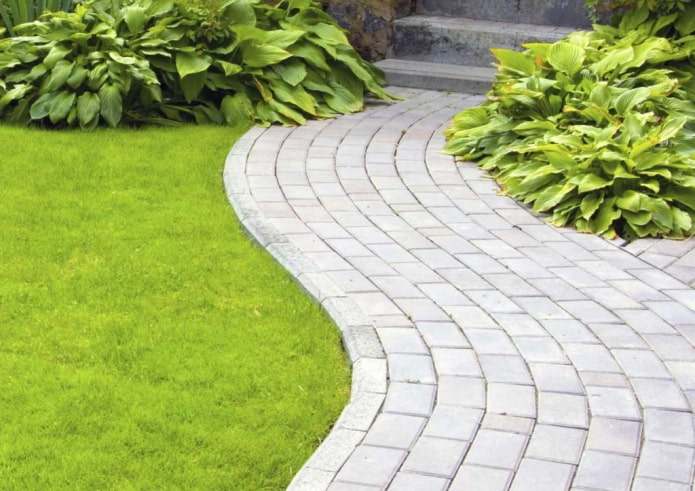
Thanks to its rounded edges, it looks very aesthetic and original. Round tile cladding harmonizes particularly well with garden lawns.

Chamomile
It has a beautiful, fanciful configuration, which allows you to bring various creative ideas to life and achieve unique compositions.
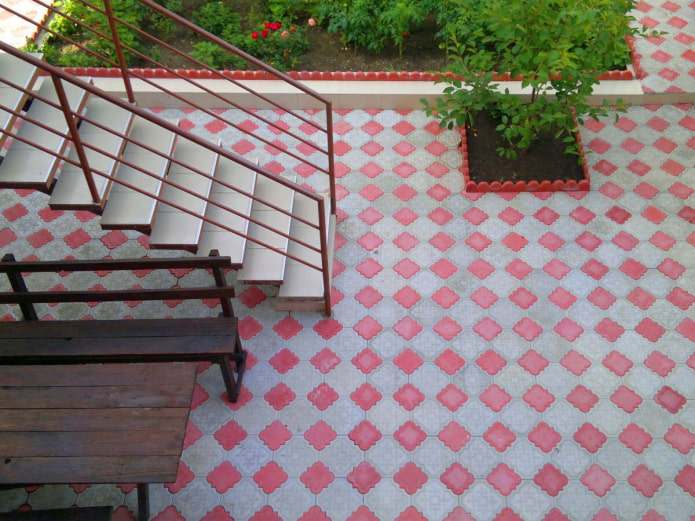
Scales
It creates an unobtrusive but at the same time impressive design, and thanks to various color solutions, it provides the opportunity to lay out original patterns.

The photo shows the landscape of a private house with a path decorated with gray paving slabs in the form of scales.
Maple
It has smooth lines that perfectly replicate the contours of a maple leaf. By combining different shades, you can achieve a very attractive decor that will be associated with autumn leaves.

Lizard
It has a unique appearance and a fairly complex shape, allowing tile modules to be laid with virtually no gaps.

Trapezoid
It provides the opportunity to create truly interesting combinations. Trapezoidal elements can be arranged in parallel lines, triangles, or hexagons. By using modules of different colors, you can achieve an unlimited number of patterns.

Types of tile texture
There are also several textured options.
Cloud
The surface of this product features a winding pattern and an unusual three-dimensional texture that gives the paving a rough and matte effect.

Mesh
It has a clear ribbed structure that provides anti-slip properties. Mesh tiles are often used in the design of sidewalks, steps, swimming pools, decorative ponds, or fountains.
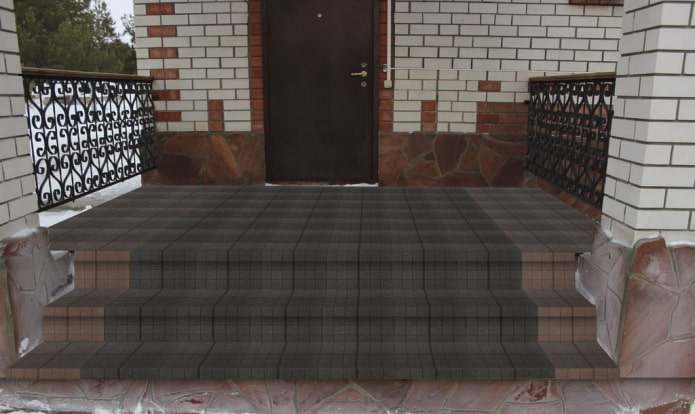
Boards
Thanks to its natural wood texture, this type of finish will give the exterior a special eco-friendliness and is perfect for decorating paths, steps, or flower beds.
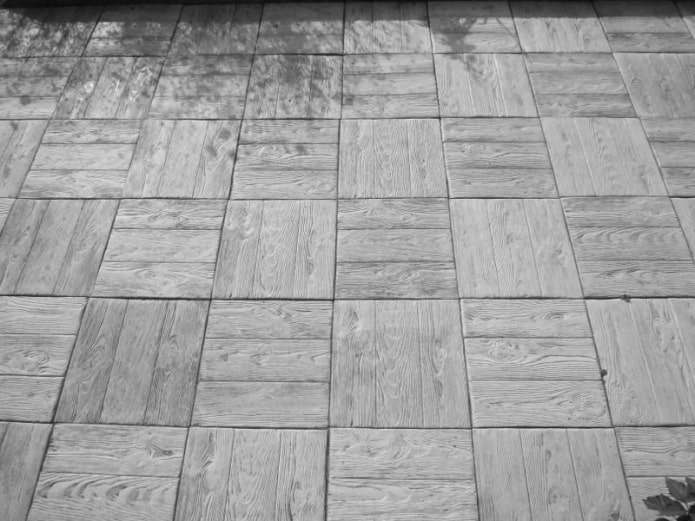
Wood-like
These paving slabs imitate the texture of natural material thanks to special molding and coloring techniques, accurately replicating the cut of wood with all its irregularities and grooves.

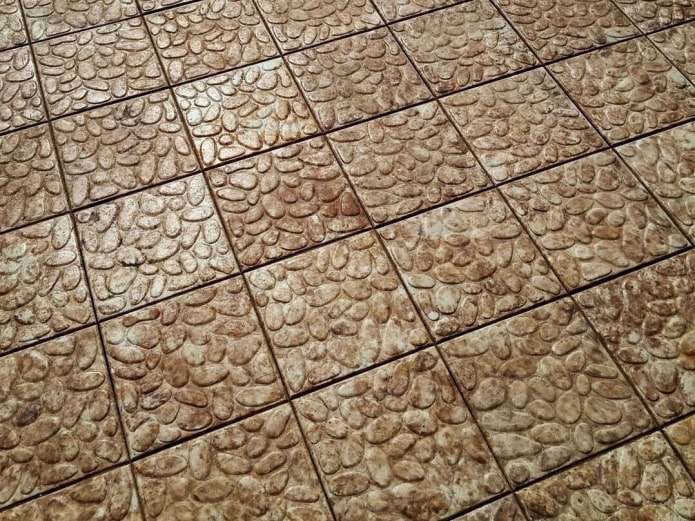
Stone-like
Elite marble-like cladding gives the design a special charm and sophistication, while models imitating sea pebbles look no less original, with regular geometric shapes and a non-slip rough surface.

Checkers
It will undoubtedly decorate and enliven the surrounding exterior. This paving stone can also have a multi-colored paving option.

Carpet
It is an incredibly elegant and at the same time durable covering that provides comfortable use, stable movement, and a non-slip surface.

Paving tile colors
With the help of a correctly chosen shade of the product, it is possible not only to transform paths and landscaping, but also to emphasize the design of buildings on the site. Colored paving slabs can be made in gray, black, yellow, red, white, beige, green, and brown tones, and can be two- or three-colored.

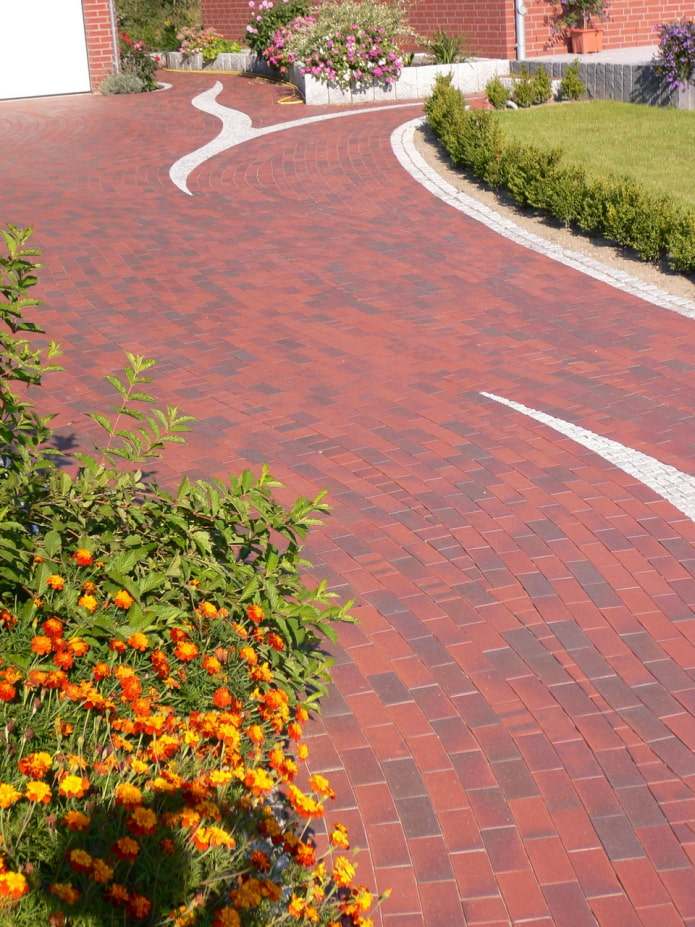
White coverings look very impressive and, due to their brightness, are clearly visible in the dark. Quite often, materials in pleasant dark orange, brown, brick, or cherry shades are chosen for finishing, as they are the most practical in use.
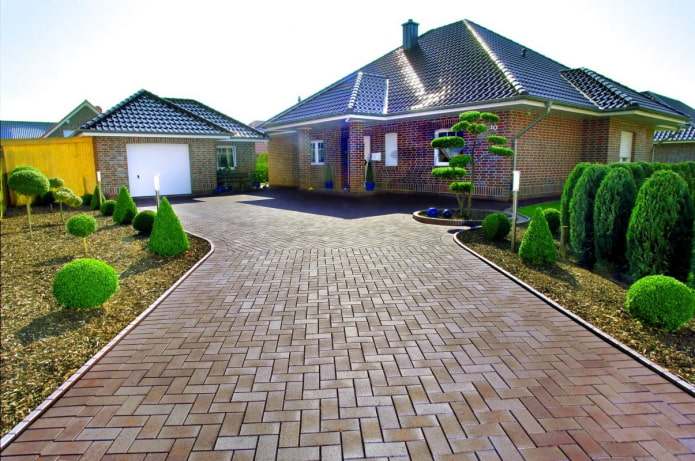
The photo shows a path leading to a private house with brown paving slabs.


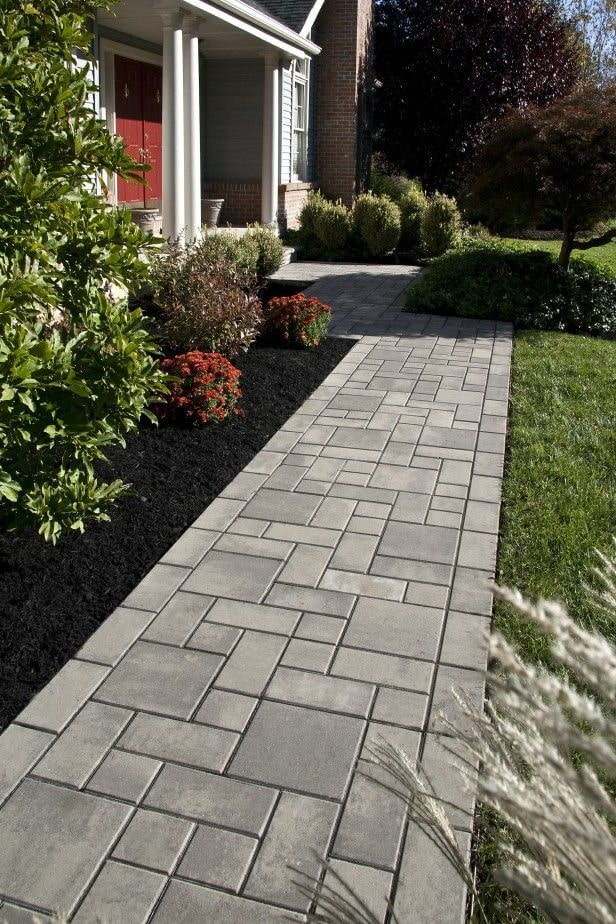
A universal solution is gray-colored cladding, which adds sophistication to the design, harmonizes with a wide variety of colors, and emphasizes architectural features.
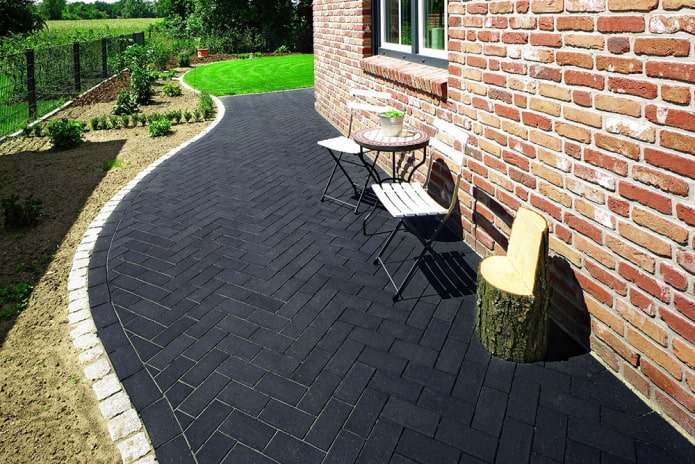
The photo shows rectangular black paving tiles used to decorate a path near a house.
Examples of street tile designs
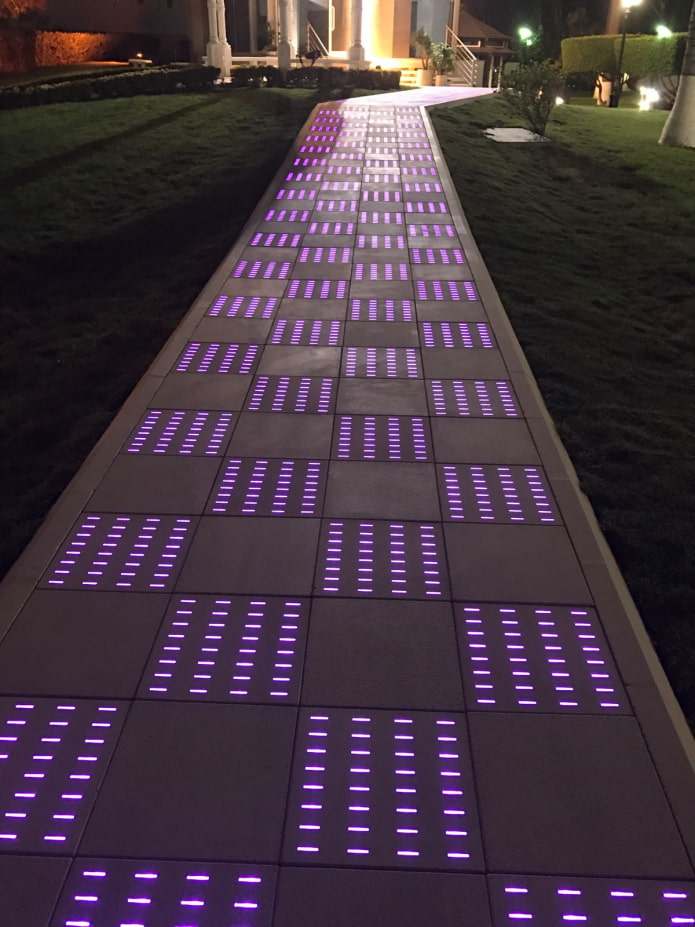
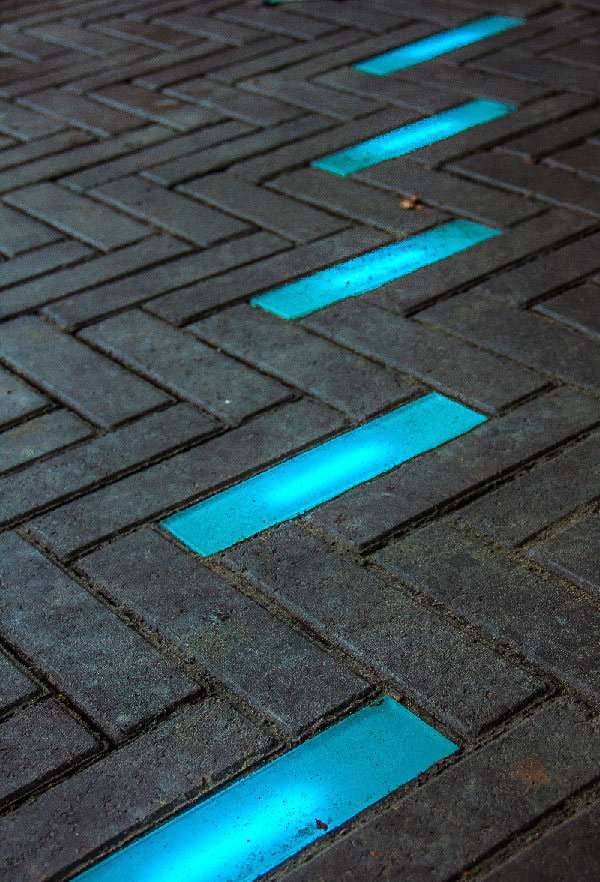
A rather unusual design move is luminescent, transparent, or matte glass paving slabs with built-in LEDs, which create a truly magical and unique atmosphere. Equally interesting in the exterior is cladding with a decor in the form of small colored inserts.

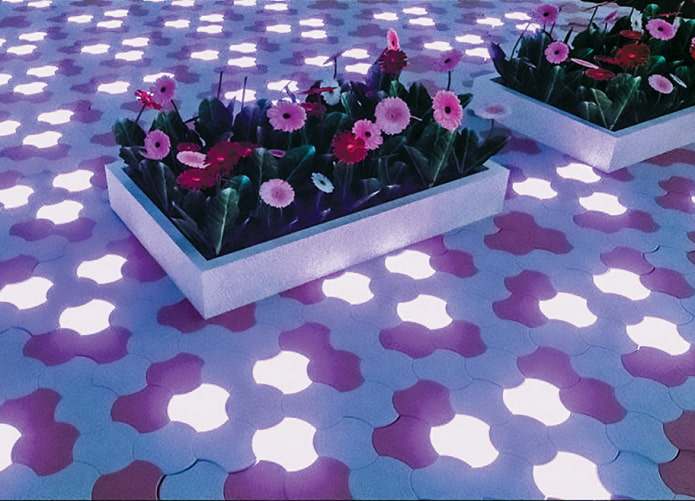

Gothic tile cladding is distinguished by a special ornament in the form of zigzag lines located between parallel strips and has an individual, distinctive style. Gzhel finishing allows you to assemble a pavement surface from shaped elements of different sizes and shapes, thereby achieving an unusual covering.
Options for pavement tile designs and patterns
Paths paved with tiles featuring various patterns and ornaments will undoubtedly give the surrounding space a special fairy-tale atmosphere.

The photo shows the landscape of a private house courtyard with a pattern made of paving slabs.
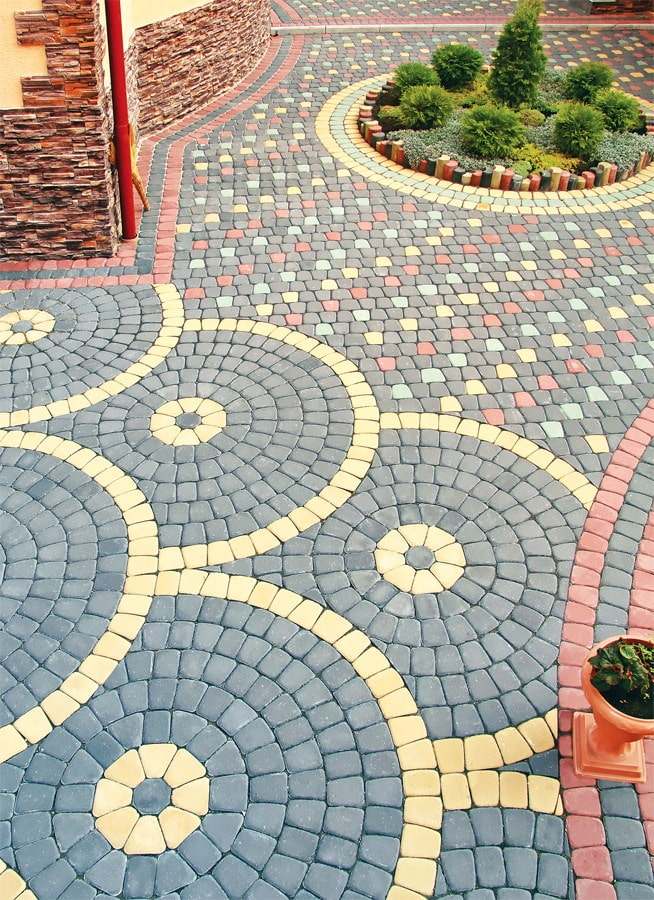

Thanks to a variety of geometric shapes in the form of large squares, rhombuses, rectangles, circles, or semicircles, it is possible to give the pavement design a dynamic look or, conversely, soften it.
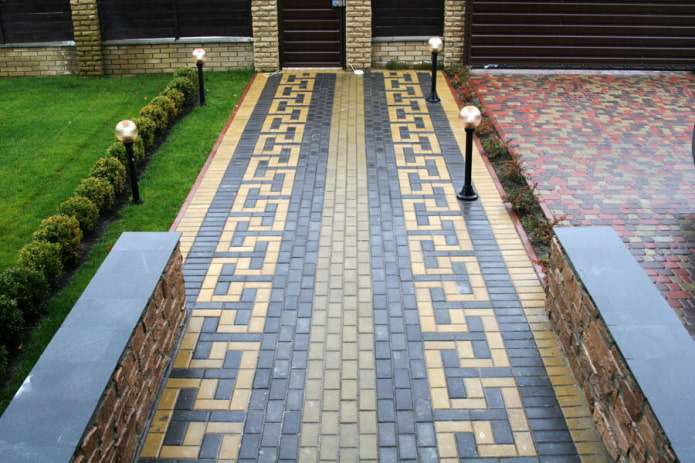
The photo shows a path in front of a house, decorated with paving slabs in the form of ornaments.
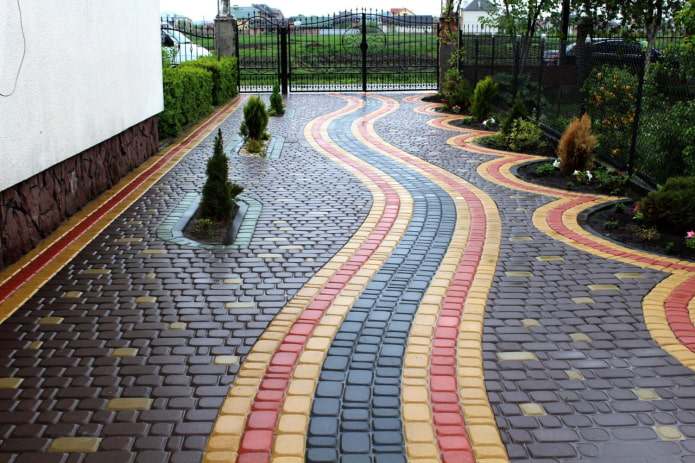
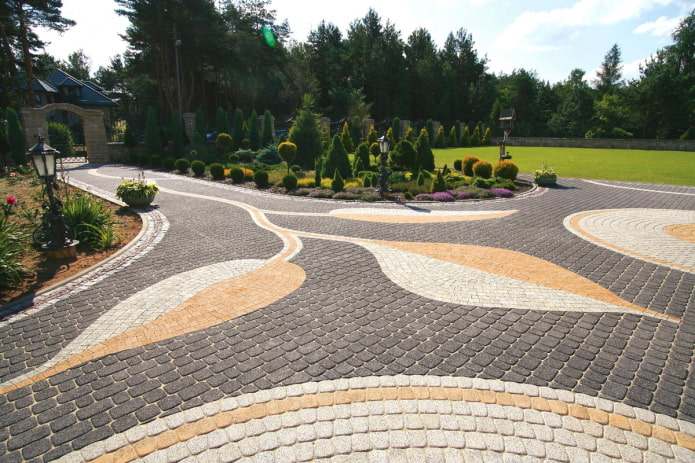
Paving tile layout
There are many laying options that can be used to create a harmonious and aesthetic composition.
Patterns for rectangular tiles
Main types:
- In a checkerboard pattern. This involves the use of two elements of different colors, most often black and white. Despite its simplicity, the checkerboard layout allows you to achieve a very impressive surface decoration.
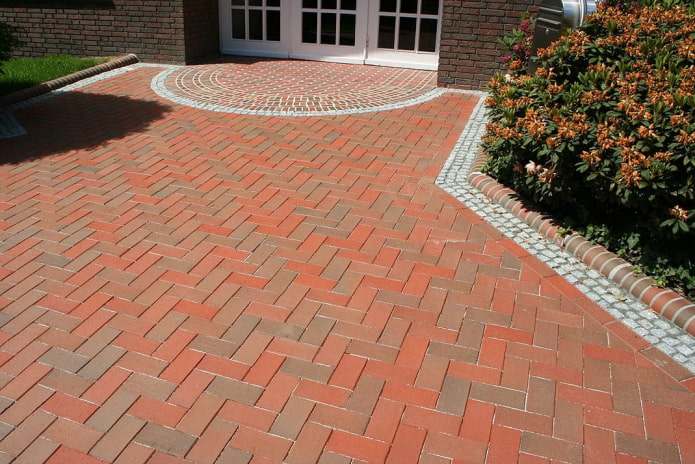
- Herringbone. In this case, the modules are arranged at an angle of 45° or 90° to each other, creating a fairly dynamic pattern.
- Staggered. This is a standard design that resembles brickwork.
- Wickerwork. It has a woven shape formed by placing rectangular elements perpendicular to each other.
- Zigzag. This is a rather complex pattern that involves laying a zigzag pattern.
- Random order. There is no specific layout. A chaotic order looks particularly good when using multi-colored products.
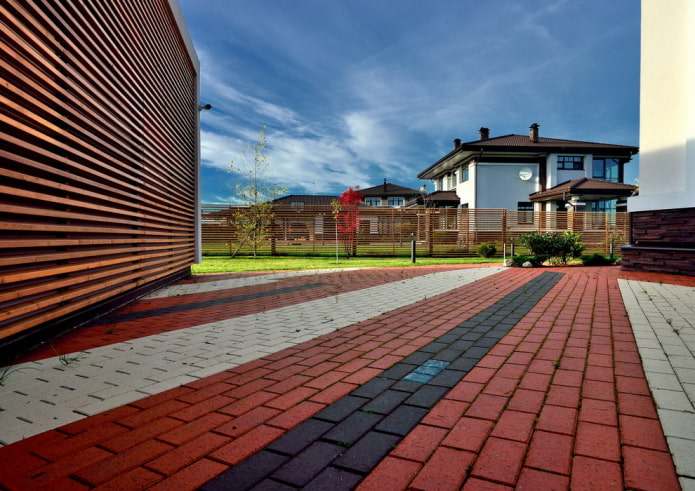
The photo shows multicolored rectangular paving tiles laid in a staggered pattern.
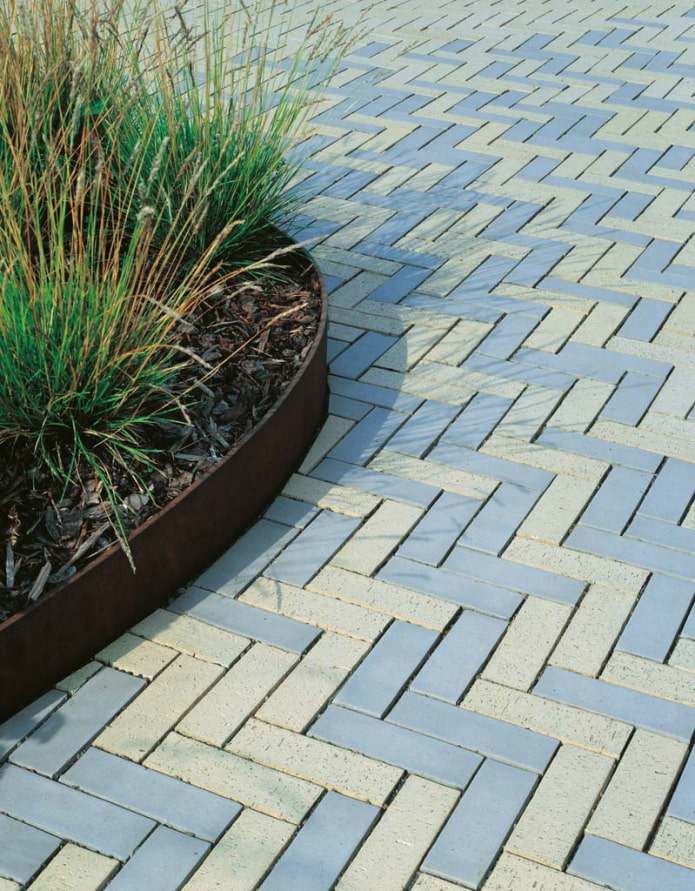

For shaped tiles
These products have a rather complex layout, which requires consideration of the color scheme and direction of each individual module. Unusually laid out shaped elements in the form of stars, leaves, flowers, and other shapes will give the landscape a special touch.

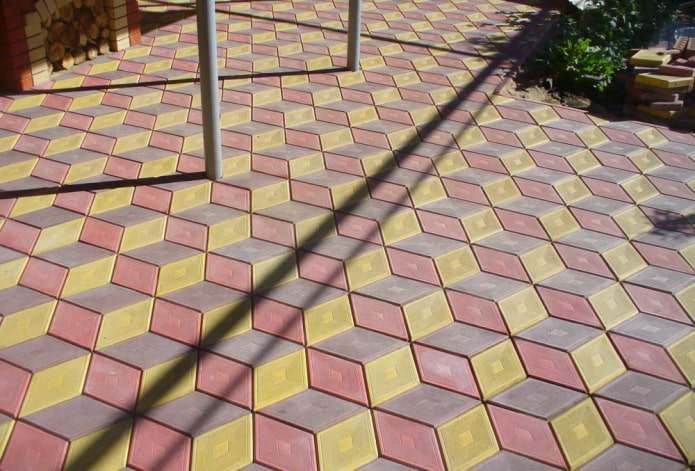

Paving slabs are not just a practical covering for paths and squares, but a real design element that can completely change the look of a yard or street. They come in different shapes — square, rectangular, hexagonal, wavy — and allow you to create both simple and complex patterns. The surface can be smooth, rough, or embossed — like stone, wood, or brick. The color range is huge: from classic gray to bright shades that do not fade over time. Thanks to the variety of patterns and laying schemes — “woven,” “herringbone,” “stripes,” or random puzzle — each area becomes unique.
Photos of paving slabs in use
Popular uses.
Photos of paths at the cottage
This type of design is an excellent alternative to simple concrete paths at the cottage. Thanks to the original compositions and variety of shapes and colors of paving finishes, it is possible to complement any landscape. For small garden plots, ornate paths with smooth lines are an excellent solution, and for large areas, clear straight paths are ideal.

The photo shows a path in a country house plot, decorated with paving slabs of different colors.
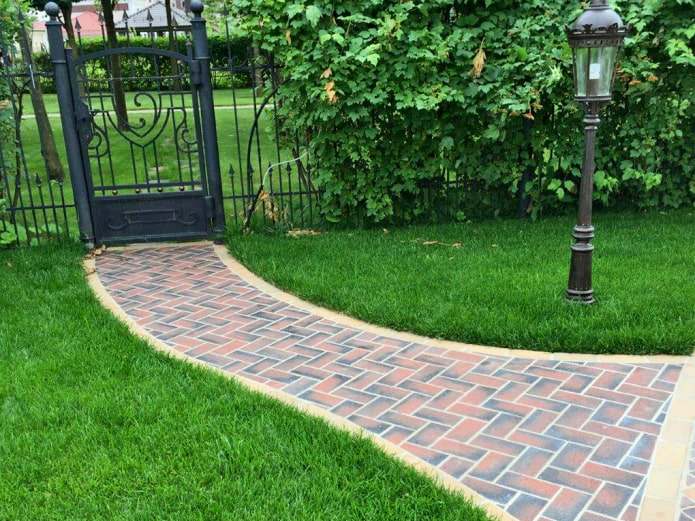
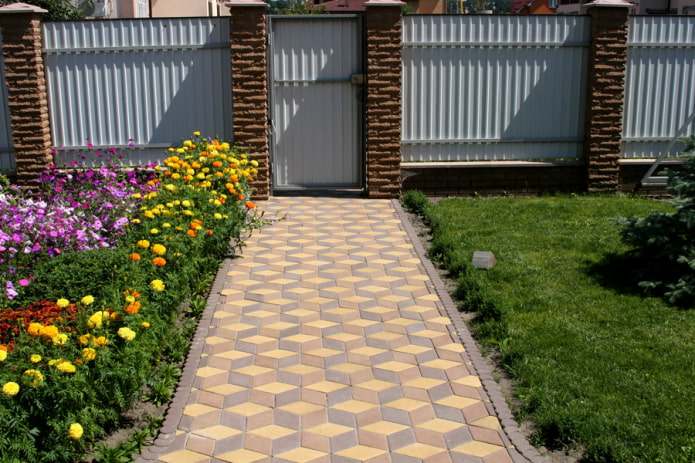
Photo in the courtyard of a private house
A path paved with paving slabs not only connects different objects, but also highlights certain structures. This type of paving can be laid around the house, in front of the house, in a gazebo, on an open veranda, or around flower beds, thus helping to keep the surrounding area clean.


On the grounds of a private home, outdoor paving is also used to create a parking area for cars. Reinforced concrete products that can withstand the weight of a car are used for this purpose.


Porch made of paving slabs
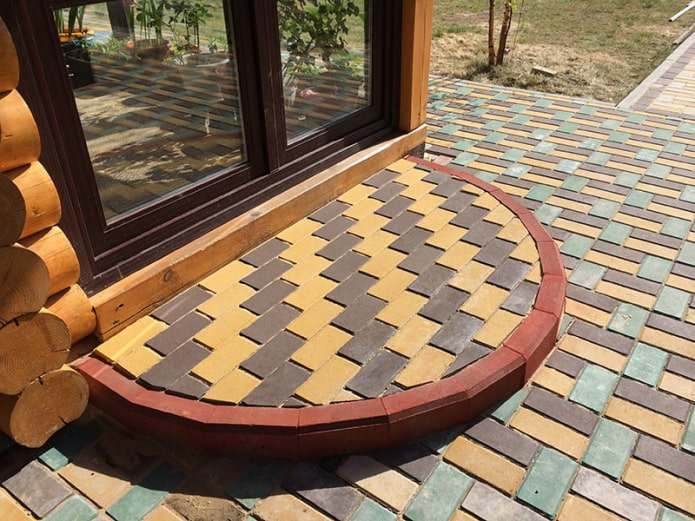
The porch can be decorated with plain or multicolored tile material of almost any shape, or even mosaic can be used to create a truly elegant design.

The photo shows a street threshold with sand-colored clinker paving slabs.

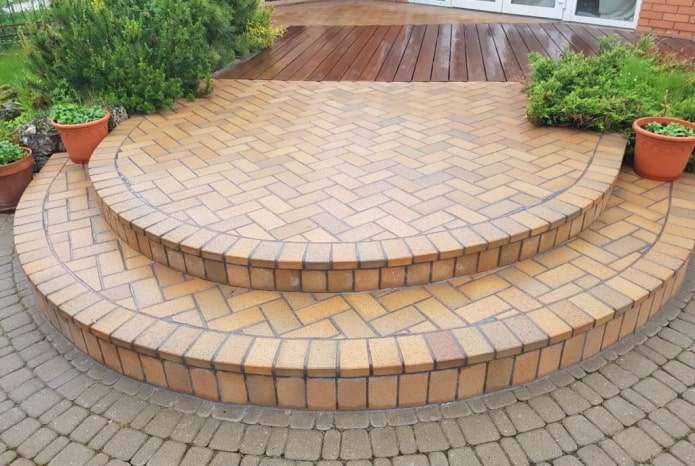
A porch covered with paving slabs that match the paths and apron looks very impressive.
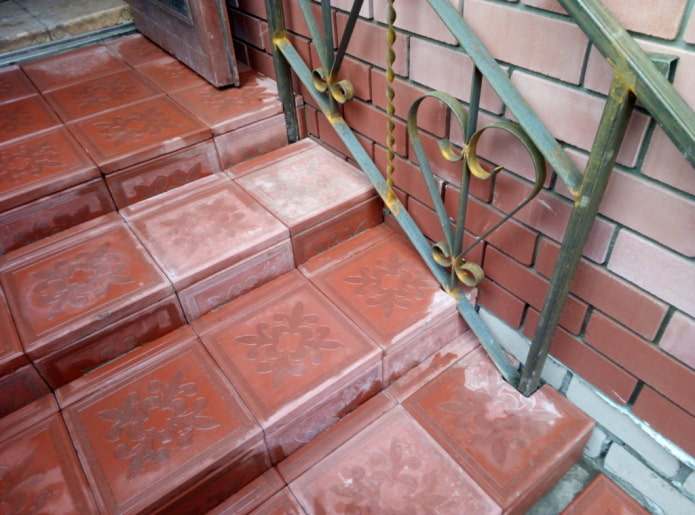
Ideas for stair cladding
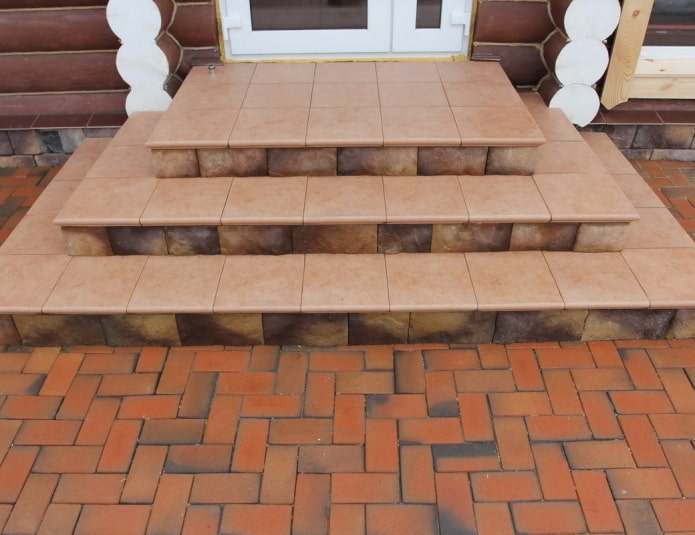
Stair steps are subject to heavy loads, so they require the most durable, wear-resistant, and non-slip finish possible.


As you can see, the world of paving slabs is much more diverse than it seems at first glance. These are not just gray squares under your feet, but a full-fledged material for creativity. From choosing the type and shape to selecting the color and texture, each step allows you to create a unique space.
The main thing to remember is that tiles should combine beauty and practicality. Think about how much weight they will bear, how they will look in different weather conditions, and how comfortable they will be to walk on. A well-chosen tile pattern can visually expand the space or highlight key areas.
Don't be afraid to experiment with combinations, but do it sensibly. It's better to draw a plan of the future area or path in advance to see how the chosen pattern looks. As a result, you will get not only a reliable covering, but also an expressive design element that will delight you for many years to come.


