
Whitewashing the walls might not be the first thing that comes to mind when it comes to exterior home renovations. Nonetheless, this age-old technique of painting walls has been around for centuries and has both functional advantages and aesthetic appeal. Whitewashing is a method that can give your walls a new, rustic appearance and increase their durability. It’s more than just a paint job.
Whitewash is breathable, allowing moisture to escape the walls, unlike modern paints. This feature is perfect for climates where humidity is an issue because it inhibits the growth of mold and mildew. Whitewash also acts as a natural shield against weathering and UV rays, giving your external walls protection from the elements. Lime, a naturally occurring antibacterial substance, is frequently included in its composition, which extends the life of your walls.
The versatility of whitewashing is one of its attractive features. It can be used on many different types of surfaces, such as wood, stone, stucco, and brick. This makes it a good option if you want to give your beachside retreat a coastal cottage feel or want to update the exterior of an old farmhouse. Applying whitewash is a simple process that usually involves combining lime with water and using a brush or sprayer to apply the mixture evenly. Its simplicity allows for creative expression in home design as well as accessibility for do-it-yourself enthusiasts.
In addition to its functional advantages, exterior wall painting gives your house a unique look. Whitewash’s matte finish softens the look of walls and gives them a classic appeal that goes well with a variety of architectural styles. Whitewash offers a customizable option that can change the appearance of your property without overpowering the natural textures of the walls, whether you prefer a crisp white finish or a tinted shade to match your exterior decor.
Explore the mysteries of exterior wall whitewashing with our all-inclusive guide. We provide all the information you need to achieve a new, long-lasting finish that improves the curb appeal of your house, from selecting the best materials to perfecting application techniques. This post will provide you with useful guidance and insider secrets to make sure your whitewashing project is a success, regardless of whether you’re taking on a do-it-yourself project or looking for professional advice.
- Whitewashing houses: advantages and disadvantages
- Principles of working with limestone material and application rules
- House whitewashing tool
- Preparing the composition
- Principles of working with lime whitewash
- Video on the topic
- lime colored whitewashing of walls so that they don’t get dirty part 2
- How to identify lime on a wall? Is it possible to paint over lime??
- Lime whitening – which tool to choose?
- How to #properly whitewash with lime
- How to prepare lime mortar for walls and ceilings.
- Lime ✨whitewash from sprayer 😍
- What you need to know before whitewashing the walls of your house with lime
Whitewashing houses: advantages and disadvantages
The process of whitewashing walls involves applying a liquid mixture made from diluted chalk or lime to specific parts of the structure. This coating is what will shield the structure from harm.
This kind of decorating is not very common among people in today’s world. Still, there are summertime residents who follow the older generation’s customs.
The following are some benefits of whitewashing buildings:
- These materials are natural and environmentally friendly.
- This is one of the cheapest design solutions for finishing buildings. The price will probably be the lowest.
- Lime has disinfectant properties and therefore prevents the formation of mold and mildew.
- The material is highly moisture resistant.
- The facades of buildings that are covered with whitewash look very good.
- To decorate the surface of a building you do not need to spend a lot of time, no special tools are required, and a small amount of materials.
- To carry out work on whitewashing a building, you do not need to have any skills; to do this, it is enough to understand the basic principle of working with the material and everything can be done with your own hands. Let"s look at all the stages in more detail below.
You must be aware of the flaws in a wall before you decide to whitewash it.
- No variety of colors.
- Not a long service life, although this is compensated by its low cost.
- When working with lime, it is necessary to use methods to protect hands and eyes, as the material is very caustic. For protection, use a respirator, goggles, gloves.
- There are very few garden styles with which whitewashed facades are combined. You can use stylistic solutions such as country or Provence.
- Care should be taken when preparing the solution, as improper mixing may result in defects appearing on the surface of the building. For example, bubbles, swelling of the material or streaks of different colors.
It’s important to note right away that practically any wall can be painted white. The walls made of adobe are even painted white. However, it’s more intricate. Straw is a material, after all, and needs to be prepared with care.
If you’re wondering how to use a water-based emulsion to whitewash walls, the process follows the same guidelines as applying chalk or lime. The same idea is involved, and it will be explained later.
Principles of working with limestone material and application rules
When using lime to whitewash a building, the facade must be coated with a pre-made mixture. Preparing a base plane is necessary for this. It ought to go easily. Ultimately, the coating will replicate all of the irregularities.
Attention: You must apply a primer to the façade’s base before beginning any whitening operations. After the primer has had time to fully dry, you can begin manual or machine whitening.
House whitewashing tool
Buildings can only have their surfaces whitewashed in the evening or on overcast days.
Climate. Since lime cannot withstand high temperatures, it is imperative to protect it from the sun while working.
Be aware that there shouldn’t be any lumps or clots in the composition; it must be homogenous. Therefore, it makes sense to use a drill with an attachment for kneading. The mass will then be uniform.
- If you choose a brush to apply the material, you must wet it. Some time before work, leave the brush in a jar of water so that its wooden base swells and particles of bristles do not remain on the surface that has already been whitened.
- According to the technology of applying whitewash to the facade of the house, it is necessary to cover the base in several layers. The first layer of lime is distributed in horizontal stripes. The second layer is applied after the first one has dried. However, it is applied from top to bottom, that is, perpendicularly.
- If a distributor is used when whitewashing a building, then the rule should be strictly followed. The lime mortar is distributed using a device at a right angle. This is necessary for economical consumption of material and uniform coverage of the entire surface.
Preparing the composition
Making the lime mortar is an easy task. The following ingredients should be added to the mixture: table salt, wallpaper glue, slaked lime, and baking soda.
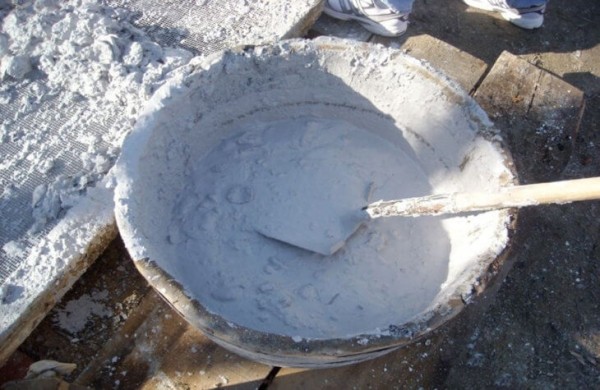
Fill a medium-sized container with 3 kg of lime, stir in 1 liter of water, and then add glue and 100 g of salt.
- Thoroughly mix the resulting mass so that there are no lumps. Then add water until the total volume is 10 liters.
- Wallpaper glue will give the solution stickiness, making it easier for the whitewash to adhere to the wall surface.
- Salt is added so that hands and clothes do not get dirty when touching it. You can also add blue, then the solution will turn out snow-white.
Note: Before beginning any work, it would be a good idea to moisten the wall surface. The whitewash will then adhere to surfaces better.
Principles of working with lime whitewash
To ensure that the whitewashing lays down properly and that there are no defects afterward, the base must be ready before beginning any work with whitewashing:
- Before starting work, the surface must be cleaned. This material should not be applied to substrates with rust, unevenness, or even efflorescence and greasy stains.
- If there are cracks on the surface, they must be treated and repaired. Old whitewash must be removed, it can be removed using a special brush. The entire surface is completely plastered and then primed. Prior to defiling, it is necessary to close all the objects with the film that the solution did not hit them.
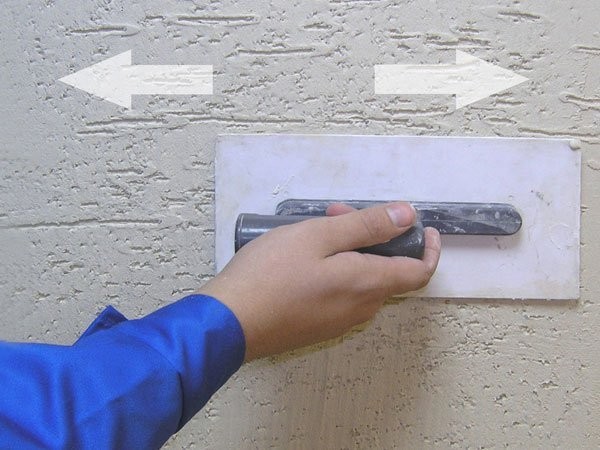
- To process small surfaces, you can use a brush. And in large areas, rollers or a sprayer are best suited. Using a brush is the simplest and most economically advantageous way.
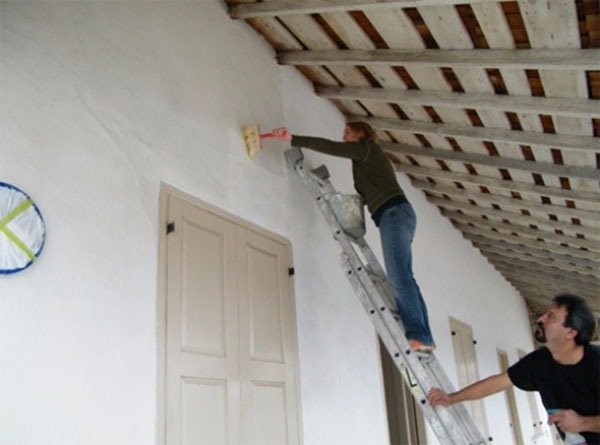
- As described above, you need to soak the brush in a jar of water, so that the villi does not fall on the white surface. It depends on this, then what the final result of the work will look like.
- A spray is used on a large area. Working with such a device requires compliance with the rules for imposing. The distance between it and the application place should be about 30 cm, and spray at a right angle. Then the material consumption will be small, and this is economically beneficial.
- Not everyone has the opportunity to buy a device, then an analogue of a sprayer can be a regular vacuum cleaner.
There is more to whitewashing exterior walls than just a conventional method of updating a building’s look. It’s an economical and useful method that dates back many centuries. Applying a solution of lime, water, and occasionally additional ingredients like glue or salt helps to create a permeable layer that inhibits the growth of mold and helps control moisture. This easy concoction keeps pests away that could harm your walls by acting as a natural insect repellent.
Sunlight reflection is one of whitewashing’s lesser-known advantages. In hot climates, this reflective quality can help buildings stay cooler, lowering the need for excessive air conditioning. Furthermore, by shielding porous materials like adobe or brick from weathering and erosion, whitewashing can increase their longevity. Since lime is a naturally occurring substance that is readily available in many areas, it’s also a sustainable option.
Whitewashing is an excellent choice for people who are worried about the effects on the environment. Lime-based whitewash is non-toxic and doesn’t release dangerous volatile organic compounds (VOCs) into the air, in contrast to many contemporary paints. As a result, it is safer for the environment and the users’ health. Furthermore, because of the way it is made, it ages gracefully and gives the building character as a patina develops over time.
Whitewashing is a practical, beautiful, and sustainable solution for any building, be it a historic structure or an old farmhouse undergoing renovations. It’s a flexible method that improves the external walls’ aesthetic appeal while also extending the life and durability of the building. The next time you want to add some historical flair to your property without spending a fortune, give this tried-and-true method a try.


