
An essential component of floor screeds, plasticizers enhance the workability and functionality of the material. Plasticizers are essentially additives that improve the strength and pliability of materials like mortar or concrete. They contribute to improved cohesion and smoother application of floor screed without compromising strength.
For floor screed, a variety of plasticizer types are utilized; each has a distinct function depending on the demands of the project and the surrounding circumstances. For example, water-reducing plasticizers reduce the amount of water required in the mix while keeping it workable, which is perfect for producing concrete mixes with more strength.
By introducing tiny air bubbles into the screed, air-entraining plasticizers improve freeze-thaw resistance and lessen bleeding and segregation during placement. These work well in colder climates where the screed is subjected to temperature fluctuations.
Retarding plasticizers allow for longer workability times and lower the chance of premature drying by slowing down the screed’s setting time. This kind is especially helpful in large-scale projects or hot weather situations where controlling quick setting can be difficult.
What it is?
Chemical surfactants known as plasticizers are substances that are added to a concrete mixture to improve its strength and functional qualities. These materials reduce the amount of cement addition needed while strengthening the structure, controlling the hardening parameter, and increasing the mass’s plasticity.
Plasticizers work on the basis of the idea that when water interacts with surfactants, surface tension is decreased, increasing the functional range.
This process yields highly specialized screeds, such as self-leveling, self-compacting, and underfloor heating system screeds.
What are they used for??

Plasticizers are primarily used in concrete screed to stabilize and adjust the subfloor, which makes it easier to distribute constant dynamic loads.
In addition to having enough fluidity and plasticity to form a layer of the necessary thickness and smoothness, the final concrete solution has the strongest adhesion to floor slabs, is capable of withstanding the calculated dynamic loads without cracking, and has design operational elasticity.
Plasticizers aid in improving the screed’s mechanical strength against compression and fracture, increasing adhesion to the subfloor, and shortening the time needed for the screed’s structure to dry and harden.
Plasticizers have the ability to significantly improve mixture stability and stop the development of microcracks when subjected to varying mechanical loads. These days, high-tech plasticizers for construction are also made with unique qualities for sound and heat insulation.
Plasticizers have a specific function when it comes to heated floor installations. Because they must meet specific standards for thermal conductivity in the high-temperature area where the heating elements are situated and in the event that the heating/cooling cycle experiences significant temperature variations. In this instance, it is crucial that the solution be sufficiently fluid to prevent harm to the heating elements that have already been installed.
Requirements
Concrete floor screed plasticizer is a complex chemical found in the construction group; the outcome of adding it to the solution depends on how precisely the usage instructions are followed.
The following are the main specifications for plasticizers used in concrete floor screed:
- creates high thermophysical and mechanical characteristics of the layer;
- reduces the volume of water in the solution by 15%;
- slows down the grasping process so that mistakes can be corrected, which is especially important for beginner performers;
- the ratio of plasticizer and cement should not be higher than 0.2 l per 400 kg., greater consumption of this substance indicates its low quality;
- must have inhibitor characteristics to inhibit corrosion processes in the screed;
- can be used in a wide temperature range from -25 to +50 C;
- prevents efflorescence.
Types for concrete compositions
The trading network contains a wide variety of plasticizers, which are divided into four categories:
- The first includes superplasticizers;
- to the second – potent;
- the third – medium plasticizing compositions;
- to the fourth – weakly plasticizing.
Plasticizers are available to buyers in the retail chain in single-component or multi-component forms, both liquid and dry.
In solution
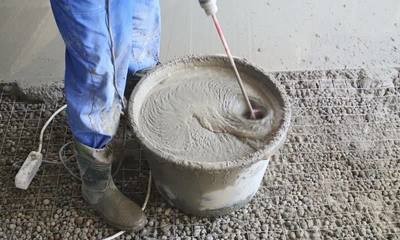
Liquid plasticizers are thought to be better because they are added to the solution in the necessary volume rather than being pre-dissolved to prepare the screed.
Principal benefits of liquid plasticizers:
- wide temperature range from +5 to +35C;
- the screed reaches the concrete strength in 5 days;
- increases the mobility of screeding mortars from P1 to P5;
- increase in resistance to moisture absorption by 4 steps to W8/W10;
- high workability of the concrete mixture without vibration;
- reduction of air entrainment, water separation and delamination;
- increases the frost resistance of the mixture to F200;
- creates an anti-corrosion environment for the reinforced layer;
- fire safety of the solution.
Among the drawbacks of liquid plasticizers are:
- the need for precise dosing of the solution;
- compliance with safety precautions when working with chemicals, since the solution has high alkalinity pH = 9-11.
Liquid plasticizer brands available in Russian construction markets include:
- Superplasticizer InterPlast AT, 5 l — 374 rub.
- Perekrestok 20.5 l — 475 rub.
- “Corbet” Superplast, 10 l — 1350 rub.
- ArmMix Thermoplast, 10 l — 1275 rub.
- LLC "RUSTEPLOPOL" PL 10460, 10 l – 2591 rub.
- Plasticizer “Super screed” 1 l -161 rub.
In ready-made dry mixture
Large-scale monolithic construction projects, the creation of molded concrete products, and the production of concrete and reinforced concrete products all employ this variation of the use of plasticizers in concrete floor screed. The plasticizer content must not exceed 10% of the cement volume in order for the finished dry mixture to be sold.
Principal benefits of a ready-made, dry plasticizer mixture:

- provides screed strength gain after 2 days;
- increase in final strength up to 30% of the norm;
- increases the workability of P1 – P4;
- reduces the delamination of concrete mortar;
- improves the structure of the screed;
- increases frost resistance and moisture resistance by 2 levels;
- saving of cement up to 20%, which, together with other positive properties, results in a reduction in the cost of the screed by up to 30%.
Among the drawbacks of dry mixtures are:
- The need to use large packages.
- The effectiveness of additives depends on the quality of cement and concrete fillers. If inert or binder components are changed, adjustments to plasticizer additives will be required, which can only be done in laboratory conditions.
Brands of plasticizers for ready-made dry mixtures that are available in Russian construction markets include:
- UPBS, 3 kg – 300 rub.;
- UP-2M, 1 kg — 80 rub.;
- S-3, 1 kg — 80 rub.;
- “UNIVERSAL-P-2”, 1 kg – 70 rub.;
- “RIAPLAST – C3”, 1 kg -65 RUR.;
- LST, 1 kg — 45 rub.;
- Superplasticizer KcG Viskor 25, 1 kg – 529 rub.;
- Superplasticizer Peramin SMF 10. 1 kg – 350 rub.
An essential component of floor screed that enhances its workability and flexibility is a plasticizer. Plasticizers make screed easier to mix, pour, and smooth out, which makes the finished product more resilient to cracking. Plasticizers come in a variety of forms, each intended to improve a particular aspect of the screed’s functionality—for example, flowability and drying time efficiency. Selecting the best type for your unique flooring requirements can be made easier if you are aware of the various types.
TOP 5 best brands
Every year, the nation’s major construction trading platforms compile a user rating of plasticizers with high demand and substantial sales volumes. They also calculate the average price of these products on the market. These figures show how plasticizers for concrete floor screed are rated in Russia.
Sika Sikament BV-3M

The universal area of action liquid additive for warm floors, foundations, and floor screeds is available in 5 liter capacities for 619 rubles. Benefits BV-3M Sika Sikament:
- high -strength and moisture -resistant concrete for wet rooms, including forcutated rooms and bridge structures;
- high fluidity and landing of the solution;
- high characteristics in frost resistance, heat resistance, moisture resistance and strength;
- simplicity of laying;
- low cement consumption;
- environmental Safety.
Among the drawbacks are:
- high cost;
- increased safety measures with chemicals.
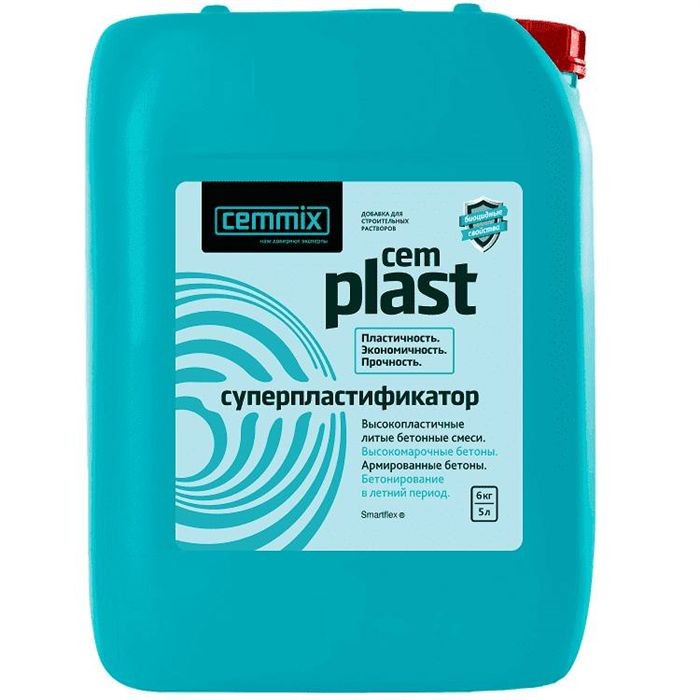
Cemmix Cemplast
Cans of 5 liters of liquid Superplastifier are available for purchase in Russian markets, with an average cost of 621 rubles.
Benefits of Cemmix Cemplast:
- creates high -moving concrete mixtures;
- reduces labor costs in the production of concrete screed;
- reduces the volume of water in the concrete solution;
- increases the strength and durability of the floor without delamination and water separation;
- significant savings in cement and water by 20%;
- high workability up to P5;
- increasing the survivability of cement mortar up to 2 hours;
- increasing the service life of the floor by 2 times.
Drawbacks:
- chemically active substance, increased safety requirements during work;
- It is forbidden to pour the solution onto the soil or into the sewer.
Plitonit Estrich
This liquid plasticizer, which comes in 10-liter canisters and is meant for semi-dry screed, costs, on average, 1,731 rubles on the market.
Benefits of the Plitonit Estrich
- reduction in cement use by up to 20%;
- increasing the wear resistance of the resulting floor screed;
- protection of working elements of the semi-dry screed supply circuit from premature wear;
- increases crack resistance in a not very thick layer up to 20 mm;
- wide range of operating temperatures, especially when using Plitonit Anti-Frost additive together.
Drawbacks:
- high price;
- narrow range of application, only for semi-dry screeds.

Isomat Plastiproof
This is a potent screed waterproofing additive that is typically sold for 1350 rubles per 5 kg canister of liquid.
The benefits of PLASTIPROOF
- increases the water resistance of concrete screed;
- guarantees the plasticity of concrete at a low specific water level per 1 m 3 of solution;
- prevents increased air entrainment when creating a solution;
- anti-corrosion characteristics due to the absence of chlorine in the composition;
- compatible with various types of Portland cement.

No flaws were discovered.
SP-1
Dry plasticizer, available in 15 kg bags, costs 922 rubles and is intended for use in concrete mixtures with a standard setting period.
Benefits of SP-1
- increase in mechanical strength up to 50%;
- reduction of water consumption by up to 25%;
- increase in adhesion of concrete to embedded parts by 1.5 times;
- air inclusions in concrete up to 1.7%;
- increase in concrete mobility up to P5;
- creating a smooth screed surface;
- increased water resistance;
- high frost resistance of the screed up to 350 cycles;
- reduction in specific cement consumption up to 22%.

No flaws were discovered.
Why is it important to choose the right one??
The purpose of the room determines the type of plasticizer to use and the composition of the concrete screed. It is crucial that residential buildings meet these requirements:
- vapor permeability;
- noise protection;
- heat resistance.
These qualities are crucial for non-residential spaces, such as general, laundry, and furnace rooms:
- water protection;
- strength.
The climatic zones of the construction site are taken into consideration when choosing plasticizers.
As a result, the customer needs to be fully aware of the usage guidelines as well as the percentage ratio of plasticizer to cement in the concrete solution before selecting a plasticizer. According to work technology, choosing the operating temperature range, frost resistance, thermal resistance of the resulting screed, and cement mortar durability are also crucial.
Material substitutes and how to cook?
Since they contain highly molecular weight chemically active substances, industrial manufacturing, it is impossible to completely replace the plasticizer with a substance made at home.
But in the capacity of stand-ins Simple construction tasks may involve the use of common household materials, such as:
- PVA glue;
- detergents;
- lime up to 20 % of cement volume.
They select detergents based on which ones produce the least amount of foam. It is imperative to bear in mind that the aforementioned household materials, which are employed as plasticizers, are also responsible for the development of mold and heights in the breached rooms.
Useful video
Regarding the screed addition additive shown in the video:
| Plasticizer | Description |
| What is a Plasticizer? | A plasticizer is an additive used in construction to improve the workability and flexibility of materials like floor screeds. It helps to make the mixture easier to spread and finish. |
| Types of Plasticizers | 1. **Water-Reducing Agents**: These reduce the amount of water needed in the mix, making the screed stronger. 2. **Retarders**: These slow down the curing process, giving more time to work with the screed. 3. **Accelerators**: These speed up the curing process, useful in cold weather or when quick setting is needed. |
Selecting the best plasticizer for your floor screed is facilitated by your knowledge of plasticizer types. The screed performs better overall thanks to these additions, which also give it greater flexibility and durability.
Making the right plasticizer choice will guarantee a more level and smooth surface. This prolongs the life of your flooring while also improving its appearance.
In conclusion, plasticizers are essential to producing a floor screed of the highest caliber. Making educated decisions for your renovation projects is made possible by being aware of the various types available.


