
It’s important to know how much cinder blocks weigh when doing construction and renovation projects. Because these blocks are inexpensive and long-lasting, they are frequently used to construct walls, foundations, and other kinds of structures. In addition to assisting with logistics planning during construction, being aware of their weight guarantees structural integrity and safety.
When dry, a typical cinder block weighs about 28 pounds (12.7 kg). However, the weight may differ slightly based on the block’s size and composition. Accurately calculating the weight is crucial to preventing issues during construction. Inaccuracies in weight estimation can result in problems like overloading structures, incorrect handling during transit, or incorrectly estimating the required material quantity.
You’ll need to take into account a few factors in order to determine the weight of cinder blocks for your project. First, figure out how big the block you want to use is. In the US, cinder blocks are typically 16 inches long, 8 inches wide, and 8 inches high. Next, ascertain the material’s density—which can differ between producers and geographical areas—for the blocks.
A cinder block’s weight can be easily determined using the following formula: weight = volume × density. To begin, determine the volume of a single block by multiplying its width by its height by its length. The weight of one block can then be obtained by multiplying the volume by the material’s density. When you purchase or handle the blocks on site, this method guarantees that you have an accurate estimate.
Your ability to calculate the weight of cinder blocks accurately will help you plan your construction projects more efficiently. With this knowledge, you can calculate the number of blocks required for a task, anticipate the load-bearing requirements of structures, and make arrangements for the right tools and personnel to handle them safely. In the end, being aware of these specifics improves the general effectiveness and success of any building or remodeling project.
- What does the concept of mass mean??
- Why you need to know?
- What does it depend on?
- What is the standard?
- Requirements for different walls and foundations
- How much does 1 piece and cube weigh??
- Calculation for size 400x200x200?
- For 390x190x190
- Consequences of incorrect calculations
- Video on the topic
- Cinder block, gas block.. which is more profitable? #construction #building a house #gas block #cinder block #double timber
- Battle of the century #cinder block #gas block #building a house #turnkey house #construction #wooden house #baumhaus
- WE BUILD FROM AERATED CONCRETE. Wall thickness, how to insulate and finish. detailed instructions.
- Cinder block machine
What does the concept of mass mean??
This is a crucial sign of the type of wall, as indicated by the following formula:
Density p x volume V = weight m
The manufacturer uses a laboratory to determine the material’s density. This is accomplished by carefully crushing the dried sample into a powder, which is then used to measure the volume in a pycnometer by measuring how much liquid the solid powder displaced.
In the case of monolithic blocks, the volume will match the product of all three dimensions. Determining the properties of non-monolithic blocks with internal empty cavities is far more challenging. In this instance, their volume needs to be deducted from the cinder block’s volume, which is established by looking at its external measurements.
When loading the material into vehicles, the standard or technological weight of the cinder blocks—which is specified in the manufacturer’s quality certificate—must match the actual weight of the blocks, as determined by weighing systems.
The difference between this indicator and the technological weight suggests that the seller may not have used the same brand of blocks, which could cause walls made of that material to collapse quickly and prevent the house from gaining the strength it needs to be occupied for the required amount of time.
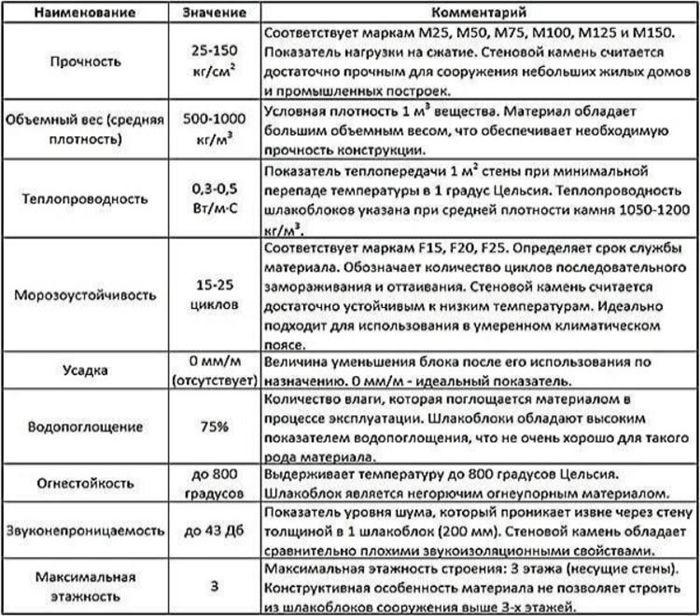
The developer must distinguish between the volumetric and specific varieties of this indicator when determining it. The first indicator is always less than the second because it sets the volume occupied by solid particles as well as the voids between them, whereas the second indicator only sets the volume occupied by solid particles. The volumetric weight indicator is used in the design process to determine wall strength, commodity costs, and transportation expenses.
Why you need to know?
When designing the facility, this cinder block indicator is taken into consideration. The designer of the design documentation chooses the manufacturer of the blocks with specific features in addition to the dimensions, wall material modification, and wall configuration. Depending on the manufacturing process and the volume percentage of the component ingredients, different manufacturers produce even blocks with different weights.
Efficient cargo logistics and transportation costs have an impact on the block manufacturer of choice. Following the selection of cinder blocks, the total mass is computed to determine the foundation, wall thickness, and reinforcement plan.
To prevent mistakes in building and remodeling, it is essential to comprehend the weight of cinder blocks and know how to compute it. The weight of a cinder block varies according to its size and composition, but it usually falls between 28 and 42 pounds per block. Multiply the required number of blocks by their average weight to determine the project’s total weight. By doing this, overloading structures is avoided, and construction site safety is guaranteed. Acquiring this knowledge facilitates builders in making efficient plans and preserving structural integrity during construction.
What does it depend on?
The cinder block’s dimensions and shape, as well as the density of the material that makes it up, directly affect this indicator. Its mass will increase with the number of fillers that can be added to a given capacity.
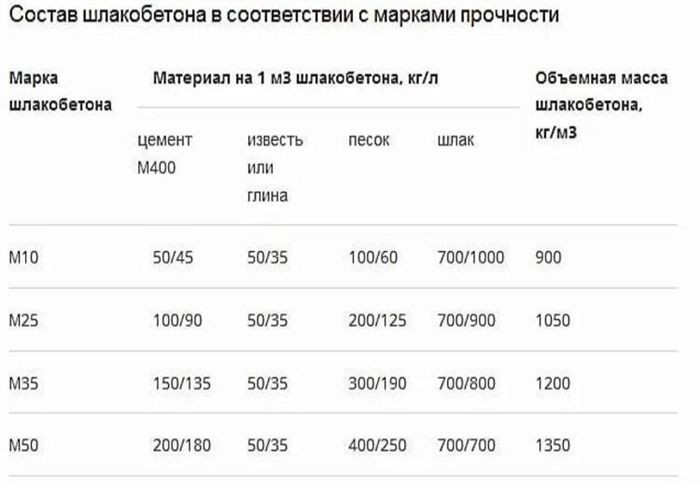
The type of filler is a necessary requirement for determining a block’s mass, though, as that makes sense. Solid heavy cinder blocks are made from crushed stone and sand, and light thermal insulation materials are made from all kinds of slag.
Furthermore. The percentage of voids, which is determined by the standard and falls between 28 and 40%, is the next indicator that has an impact on the mass of blocks. The plant in the cinder block quality certificate is also displaying this indicator.
What is the standard?
The mass of manufactured goods is defined by production technology, governed by standards, and recorded in the product passport. In addition, it documents the block’s frost resistance, thermal conductivity, manufacturing process, and ideal usage circumstances for various building projects.
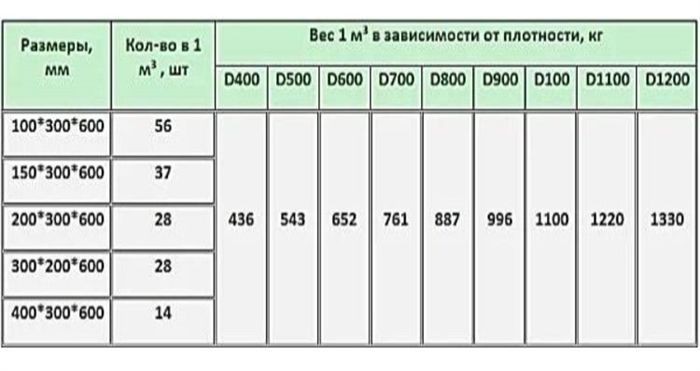
The types of filler and their percentage composition, the production processes, their strict adherence, and the need that the weight of the blocks match the manufacturer’s indicator all play a role in the weight of the blocks. It is considered when formulating car calculations and creating a project for building a facility.
Requirements for different walls and foundations
Only a solid block with high strength indicators is utilized for the construction of the plinth, foundation, and critical load-bearing wall structures. This block is made of crushed stone, sand, and concrete that are pressed into one form using a vibrating machine.
The grades M100 and M125 of foundation blocks are produced by manufacturers based on the percentage composition of the ingredients. The block has a standard size of 390x190x190, weighs 30 kg, and is capable of handling heavy loads. Because these blocks have more concrete in them, they don’t hold heat as well, so the walls will require more thermal protection.
During the installation of internal walls and partitions, M75 and M50 blocks with voids ranging from 28 to 40% may be used. Installing and cutting cinder blocks with rectangular internal cavities is fairly simple.
Numerous sizes and advanced manufacturing techniques for cinder block wall material indicate that different weight standards exist within the distribution network.
How much does 1 piece and cube weigh??
It is simple to determine the weight of one meter three using the cinder block’s LxHxW mm dimensions. To do this, count how many blocks are in one m3, then multiply the result by the weight.
For instance, a 400x200x200 solid block would be:
- find volume: 0.4×0.2×0.2 = 0.016 m 3;
- in one block there will be: 1 m 3: 0.0161 m 3 = 60.
One piece of block’s weight is determined by its density and percentage of hollowness; you can weigh it or use information from the passport.
Cinder block transportation is done using specialized pallets, the specifications of which are set by the product’s maker. Determine the mass of the loaded pallet using the block’s weight as a guide.
Products are packaged in two common pallet sizes, as is customary:
Typically, they can accommodate 84–105 regular cinder blocks.
Calculation for size 400x200x200?
A block of this size is utilized not only for wall construction but also for ornamentation, such as sidewalks and pavements. These blocks’ design characteristics enable the construction of structures with up to three stories.
Basically, standard wall materials are made from expanded clay that has a void content of 28–40%. The block’s structural features guarantee the maximum heat conductivity, ensuring that using it in residential construction is effective. Nevertheless, more wall insulation will still need to be installed in the country’s eastern and northern regions.
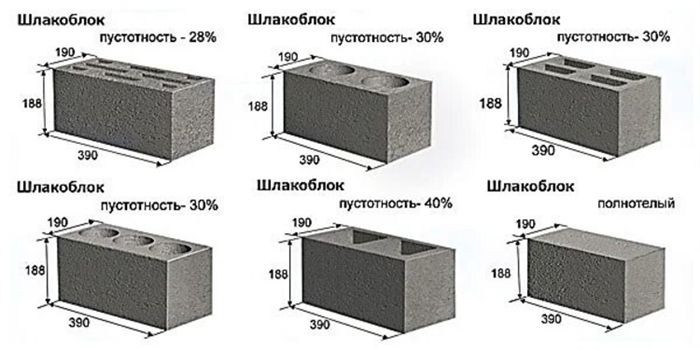
The weight and volume of a 40x20x20 cm cinder block can be calculated based on the filler used, which is 0% for solid and 28% for hollow.
- ash 1625 kg/m 3 x 0.016 m 3, 26/18 kg;
- brick and concrete 1875 kg/m 3 x 0.016 m 3, 30/21 kg;
- crushed stone and screenings 1750 kg/m 3 x 0.016 m 3, 38/20 kg;
- tripol and dolomite 1687 kg/m 3 x 0.016 m 3, 27/19 kg;
- gravel 1685 kg/m 3 x 0.016 m 3, 27/18 kg;
- expanded clay 1250 kg/m 3 x 0.016 m 3, 20/14 kg.
For 390x190x190
This variation on cinder blocks is commonly employed in public, industrial, and residential construction. It is employed in the construction of auxiliary buildings, fences, retail and entertainment complexes, and residential buildings.

Depending on the percentage of voids, the weight of a cinder block is calculated as follows: 390x190x190 (mm), volume 0.014 m 3, density 2200 kg/m 3.
- 0% – 0.014 m 3 x2200kg/m 3 x(1-0) = 30.8 kg;
- 20% – 0.014 m 3 x2200kg/m 3 x(1-0.2) = 24.64 kg;
- 30% – 0.014 m 3 x2200kg/m 3 x(1-0.3) = 21.56 kg;
- 35% – 0.014 m 3 x2200kg/m 3 x(1-0.35) = 20 kg;
- 40% – 0.014 m 3 x2200kg/m 3 x(1-0.4) = 18.48 kg.
Based on the percentage of voids, the mass of a cinder block is calculated as follows: 390x190x190 (mm), volume 0.014 m 3, density 1760 kg/m 3.
- 0% – 0.014 m 3 x1760kg/m 3 x(1-0) = 24.64 kg;
- 20% -0.014 m 3 x1760kg/m 3 x(1-0.2) = 19.71 kg;
- 30% – 0.014 m 3 x1760kg/m 3 x(1-0.3) = 17.25 kg;
- 35% – 0.014 m 3 x1760kg/m 3 x(1-0.35) = 16 kg;
- 40% – 0.014 m 3 x1760kg/m 3 x(1-0.4) = 14.78 kg.
Depending on the percentage of voids, the weight of a cinder block is calculated as follows: 390x190x190 (mm), volume 0.014 m 3, porosity 50%, density 1100 kg/m 3.
- 0% – 0.014 m 3 x1100 kg/m 3 x(1-0) = 15.4 kg;
- 20% – 0.014 m 3 x1100 kg/m 3 x(1-0.2) = 12.32 kg;
- 30% – 0.014 m 3 x1100 kg/m 3 x(1-0.3) = 10.78 kg;
- 35% – 0.014 m 3 x1100 kg/m 3 x(1-0.35) = 10 kg;
- 40% -0.014 m 3 x1100 kg/m 3 x(1-0.4) = 9.24 kg.
Consequences of incorrect calculations

Developers who have worked with the search and acquisition of cinder block are aware that, similar to other wall materials, it can be of excellent or poor quality.
A high-quality block is one that satisfies GOST requirements, is manufactured with normative technology, and starts with high-quality raw materials.
In general, it is always much easier in the mass of high-quality product. The defective stone is easily identified by mass, it does not meet regulatory requirements for this size, and so on.
Three factors lead to marriage in the making of slag blocks:
- violation of the composition of the source materials;
- violation of vibro -press technology;
- non -maintaining drying mode.
The developer should constantly verify the weight and actual slag blocks that the manufacturer has stated. Simply use the scales to measure the control batch and compare the results with the information from the passport.
The primary effects of using the incorrect mass of slag concrete blocks are:
- violation of the integrity of wall structures;
- purchase of insufficient number of blocks for wall structures;
- incorrectly chosen type of house foundation;
- incorrect calculation of the vehicle for transporting material.
Anyone working on building or remodeling projects needs to know how much a cinder block weighs. The weight of these adaptable building materials varies according to their size and makeup. An 8-inch cinder block typically weighs about 28 pounds (12.7 kg). But depending on things like the density of the concrete mix that was used, this can vary a little.
It’s critical to precisely determine the weight of cinder blocks in order to prevent mistakes during construction. First, figure out how big the block you want to use is. Its dimensions are in inches for length, width, and height. To calculate the volume in cubic inches, multiply these dimensions together next.
Once you know the volume, you can use the cinder block material’s density to estimate the weight. The density of concrete blocks typically ranges from 1,360 to 1,840 kg per cubic meter (85 to 115 pounds per cubic foot). To match your volume measurement, convert this density to pounds per cubic inch or kilograms per cubic centimeter.
A cinder block with dimensions of 8 x 8 x 16 inches, for instance, has a volume of 1,024 cubic inches. To calculate the weight per cubic inch, divide 100 by 12^3 (1,728 cubic inches in a cubic foot), assuming that concrete has a density of 100 pounds per cubic foot.


