
Maintaining the weathertightness of your roof is essential to shielding your house from the elements. Leaks can occur on roofs over time for a variety of reasons, including weather damage, aging materials, and poor installation. It’s probably time to think about waterproofing the roof when you see indicators of water infiltration, like damp patches on the walls or ceilings.
In order to properly seal leaks, roof waterproofing repair entails determining the extent of damage and selecting the right materials and methods. Repairs could involve anything from straightforward patching to more involved resealing or even replacing damaged sections, depending on the kind of roof and the extent of the leaks.
The type of roof and the particular requirements of the repair determine the materials used for roof waterproofing repairs. Materials that are frequently used to create a barrier against water infiltration include sealants, membranes, and coatings. The selection of materials is frequently influenced by elements such as the slope of the roof, exposure to the elements, and the kind of roofing material currently used.
Repairing a roof’s waterproofing usually requires multiple steps. First and foremost, it is essential to locate leaks by carefully inspecting them. Better adhesion of the waterproofing materials is ensured by cleaning and preparing the area for repair after it has been identified. The selected sealants or membranes are then applied, making sure that all impacted areas are completely covered to stop further water intrusion.
In what cases is it required?
There are several compelling arguments for initiating roof restoration:

- The service life of the waterproofing agent specified by the manufacturer has come to an end. The “eternal roof” has not yet been invented.
- The quality of the waterproofing material did not meet the expectations of the consumer, and it became unusable much earlier than expected. Sometimes waterproofing materials fail due to improper transportation or storage conditions.
- Incompetent selection of waterproofing coating for a certain type of roof. This is especially true for flat roofs, which are exposed to increased exposure to ultraviolet rays and increased load from precipitation.
- The builders committed violations of the roof installation technology, which resulted in leaks in the new roof.
Because of this, the majority of the time, the need for repairs results from the initial use of subpar materials or an ignorant approach to the problem.
In order to avert potentially fatal outcomes from potential roof leaks, you should be aware of the following "bells":
- Cracks appeared on the walls and basement. Water that seeps through a damaged roof gradually forms microcracks that increase in size. In winter, water turns to ice and breaks concrete.
- The humidity in the room increased sharply, fungus appeared on the walls and windows. This poses a danger not only to the structure, but also to human health.
- During a rainstorm, leaks form on the ceiling and the room floods. This is an advanced version of roof damage that threatens great destruction.
Crucial! It is impossible to ignore even the smallest indications of roof leaks. The sooner repairs are carried out, the more affordable and successful they will be.
What happens?
There are two approaches to fixing badly done waterproofing or getting rid of leaks:
- make major repairs;
- carry out local repairs.
The degree of damage and the available funds determine which approach is used.
Major
A major restoration of the roof necessitates the removal of the old waterproofing layer in its entirety and its replacement.
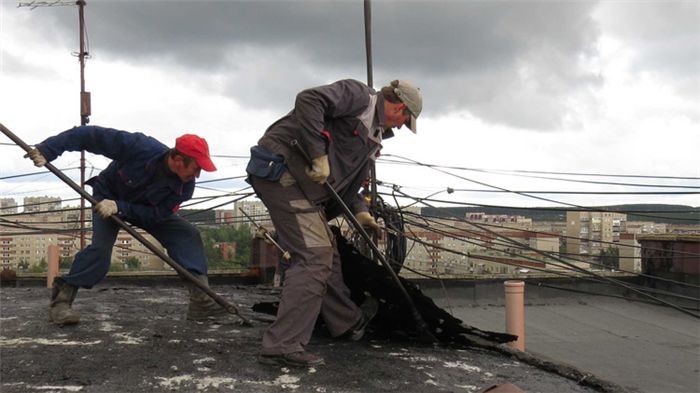
It might be required to remove and recreate the deeper layers of the pie in the case of soft roofing composed of fused materials. Destructive processes ensued as a result of the water that had been falling on the concrete screed for many years freezing at below-freezing temperatures and then thawing when it warmed up. When exposed to water, the heat insulator quickly loses its properties and must be replaced.
Kindly take note. Skilled waterproofing replacement is time-consuming and comes with higher costs. One advantage of this approach is that leaks are eliminated for the duration of the waterproofing’s service life.
Local
Sometimes localized waterproofing corrections, concentrated on a particular area, suffice. Sometimes it makes sense to just add a new waterproofing layer on top of the old one rather than tearing it down. The selection is contingent upon the kind of roof and insulator. The short turnaround time and comparatively low cost of local repairs make them appealing.

Local repairs aren’t always successful because not all damage is identifiable visually. The end result is a less sturdy building for the building’s owner. It’s likely that repeated repairs will be required next year.
Knowing when to repair your roof’s waterproofing is vital to keeping your house safe and sturdy. This article examines the telltale signs of damage, like leaks or moisture stains, and provides helpful advice on how to fix them. We will go over the fundamentals to help homeowners protect their roofs from water damage and increase the lifespan of their roofs, from examining the roof’s surface to selecting the appropriate materials, such as sealants or membranes. Does this sum up what you were searching for in its entirety?
Selection of method and materials
Every kind of roof needs a different strategy for repairs. The most widely used techniques are PVC membrane, rolled fused insulation, and liquid rubber. Both major and minor repairs are made with the materials on this list.
Liquid rubber
Maximum adhesion to the surface is provided by a bitumen-latex mixture with polymer additives that forms an elastic, long-lasting coating free from breaks and cracks. In the early stages of building construction, it serves as the primary waterproofing agent for all types of roofs, as well as for local and capital restoration.
The benefits of the liquid rubber layer are as follows:
- forms an elastic coating without seams;
- complete adhesion to the old base;
- Possibility of use on concrete, metal, brick, bitumen coatings.
Because liquid rubber adheres better to bitumen substrates, it works best in these combinations. Local leaks can be fixed without destroying the previous layer.
Regarding a note. Liquid rubber is applied with specialized spray equipment to expedite the process.
You can learn how to use liquid rubber to waterproof a roof by watching this video:
Roll fused insulation
The old coating is covered with rolls of fused insulation. These membranes are distributed by fusing with a burner and contain bitumen. Bitumen melts in the presence of fire and seals leaks.
The method’s drawback is that it uses open fire, which is risky if you’re inexperienced. Unstable seams develop as a result. The same fused materials can be covered with roll fused waterproofing.
PVC membrane
Polyvinyl chloride membranes are used to apply patches. It makes sense to use membranes to cover large areas of flat roofs. You will need to construct a structure out of slats and clamping elements for fastening.
Construction hair dryers are used to sew the sections together with a hot air stream to enhance the coverage area. A silicone roller should be used to "roll" the resulting seams. The patch needs to enclose the hole by at least 5 cm on all sides. Using this method, there is no adhesion to the base.
Crucial! Since the right angle must be created, installation may become challenging. Rainwater must be firmly directed into drainage funnels in this type of design.
Should there be any damage to the PVC covering, moisture may seep beneath the "carpet." Plus, a hairdryer makes it simple to fix inadvertent punctures. Select a 100% analogue if you want to install a patch over an existing membrane.
Comparison of waterproofing materials
The comparison table that follows will assist you in selecting the best waterproofing agent:
| Installation method | Degree of adhesion to the base | UV resistance | For what reasons is it used? | Average service life | |
| Liquid rubber | By hand or using a spray tool | Complete | High | Brick, concrete, metal, bitumen coatings | 7 years |
| Welded insulation | Using a torch | Partial | When using additional sprinkles | Similar to ZhR | 5 years |
| PVC membrane | Mechanical fastening + hair dryer | Lack of clutch | Depends on the weaving of the material | Concrete, brick, metal | 3 years |
Stages of work
The following necessary actions are included in the repair of the roof waterproofing layer:

- Identifying problem areas through visual inspection. The specialist determines the scope of work and suggests ways to solve the problem. All the pros and cons of local and major repairs are weighed.
- Selecting waterproofing material. A more profitable option for the customer is when the construction company cooperates with roofing waterproofing suppliers and can purchase the material at significant discounts.
- The next stage depends on the chosen method of work. This may involve dismantling the old coating or spot sealing leaks.
- Cleaning the roof being repaired from dirt and dust. Relevant when using any repair method.
- Applying primer for better adhesion. The stage is omitted when arranging the membrane.
- The actual application of a new waterproofing material, taking into account the specifics of the material, the shape of the roof, and the extent of damage.
Installing extra components, like snow retainers, drainage systems, and cornices, may be necessary in some circumstances. UV resistance needs to be considered if the final waterproofing coating is going to be a finishing coat. Shale or basalt with a coarse grain is used to cover the welded insulator.
Prices in the estimate
Depending on the type of waterproofing, repairing a flat, rolled soft roof can cost anywhere from
- Welded waterproofing – 250 rubles. per sq. m for applying one layer and 400 rubles. per sq. m. for two-layer coating.
- Spraying liquid rubber 250-350 RUR. per sq. m, respectively, with manual or mechanized application method.
- Repair of membrane roofing of varying complexity will cost 400-700 rubles. per sq. m.
The cost of removing the previous coating varies depending on the extent of the task and needs to be factored into the estimate.
Numerous factors, including volume, work complexity, roofing material, and weather, affect the final cost. Construction and repair companies typically offer substantial discounts for larger projects.
Regarding a note. The type of coating and the difficulty of the work will determine how much major roof waterproofing repairs will cost.
Of course! This is a succinct wrap-up for your roof waterproofing repair article:
Maintaining the waterproofness of your roof is essential to preventing water damage to your house. Your roof’s ability to withstand weather conditions and general wear and tear can all be compromised over time by a number of factors. It’s critical to routinely check your roof for damage indicators, such as leaks, wet areas on the ceiling, or cracked sealants.
It is imperative that you promptly address any indications of roof waterproofing problems to stop additional harm from being done to the interior and structure of your house. Repairs might include anything from caulking minor leaks to reapplying waterproof coatings or membranes, depending on the severity of the damage.
Depending on the kind of roof and the particular problem, different materials are used for roof waterproofing repairs. Bitumen membranes, polyurethane coatings, waterproof sealants, and specialty tapes for caulking joints and cracks are examples of common materials. Effective and durable defense against water infiltration is ensured by selecting the appropriate materials and installation techniques.
You can prolong the life of your roof and keep your home dry and secure for many years to come by taking quick care of waterproofing issues and employing the right repair methods.
Feel free to adjust this conclusion to fit the tone and style of your site!


