
Moscow is a city where history is literally carved in stone. Around every corner, you can find a building that has seen kings and general secretaries, survived wars, and celebrated triumphs. These structures have long ceased to be mere architecture. They have become the main characters of urban legends, symbols of eras, and the most recognizable postcard views of the capital.
In this article, we will take a walk past five such famous buildings. We will not only look at their facades, but also lift the veil on their secrets. You will find out which building hides a secret bunker and which became a real architectural revolution that changed the face of Moscow.
From the ancient Kremlin walls that hold tsarist secrets to Stalin's bold skyscrapers and modern glass pyramids, each of these giants tells its own part of history. Let's start this journey through time without leaving home.
- St. Basil's Cathedral: a rainbow mystery on Red Square
- Born of victory
- A debunked legend
- The mystery of the architectural design
- The test of time
- The Moscow Kremlin: a fortress that became a symbol of power
- The Italian Renaissance in Moscow
- The Spasskaya Tower and chimes
- Treasures of the Armoury Chamber
- A modern fortress
- The Metropol Hotel: a masterpiece of Art Nouveau in the center of Moscow
- The patron's idea
- Vrubel's majolica panel
- Witness to the ages
- Architectural features
- The main building of Moscow State University: Stalin's skyscraper on Vorobyovy Gory
- Architectural record
- Construction features
- A symbol of science
- A recognizable silhouette
- Arseny Morozov's mansion: an eclectic palace on Vozdvizhenka
- Construction history
- Architectural eclecticism
- Contemporary reaction
- Modern use
St. Basil's Cathedral: a rainbow mystery on Red Square
St. Basil's Cathedral, officially the Cathedral of the Intercession of the Holy Virgin on the Moat, remains an architectural mystery that has no analogues in Russia.

St. Basil's Cathedral. 1555–1561. Photo: Anton Zelenov / commons.wikimedia / CC BY-SA 3.0
Born of victory
In 1552, on the day of the Intercession of the Holy Virgin, Ivan the Terrible's troops captured Kazan. According to chronicles, the tsar vowed to build a temple in honor of this victory. Construction began in 1555 and was completed in 1561.
Architects Barm and Postnik created a unique ensemble: nine churches on a single foundation, eight of which are consecrated in honor of saints whose feast days coincided with important events in the Kazan campaign. The central church is dedicated to the Intercession of the Holy Virgin.
A debunked legend
The Pokrovsky Cathedral symbolizes Heavenly Jerusalem. The number 8 (eight churches around the central one) symbolizes the day of Christ's Resurrection. However, the meaning of the colors of the domes remains a mystery to researchers.
The mystery of the architectural design
Pokrovsky Cathedral symbolizes Heavenly Jerusalem. The number 8 (eight churches surrounding the central one) symbolizes the day of Christ's Resurrection. However, the meaning of the colors of the domes remains a mystery to researchers.
The test of time
In 1812, the French looted the temple and planned to blow it up during their retreat. The explosion did not take place — according to various versions, either the weather prevented it or Russian sappers managed to defuse the charges. After the war, the temple was quickly restored.

Moscow is not just a city, but a real architectural spectacle, where every famous building tells its own story. From the ancient Kremlin walls to the gleaming modern skyscrapers, centuries, styles, and destinies intertwine here. This article features five of the capital's most recognizable buildings, which cannot be confused with anything else: they have become symbols of eras, witnesses to events, and the pride of the city.
The Moscow Kremlin: a fortress that became a symbol of power
The Moscow Kremlin is a unique architectural ensemble that has been formed over centuries. It acquired its modern appearance in the late 15th and early 16th centuries.
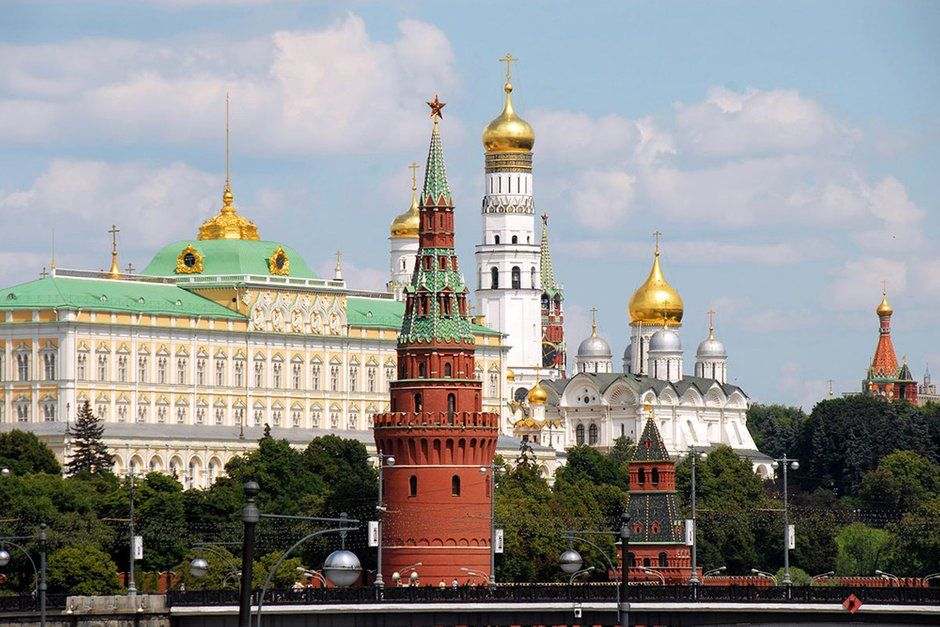
The Moscow Kremlin. Photo: Shutterstock
The Italian Renaissance in Moscow
The red brick walls and towers were built by Italian craftsmen. Antonio Solari built the Spasskaya Tower, while Pietro Antonio built the other towers. Aristotle Fioravanti created the Cathedral of the Assumption, and Alevis Novy built the Cathedral of the Archangel. The Italians brought the most advanced technologies of their time to Moscow.
The Spasskaya Tower and chimes
The modern chimes were installed in 1851-1852 and weigh about 25 tons. The mechanism occupies three floors of the tower. The melody of the chimes can be heard every 15 minutes, and at midnight the whole country checks the time by them.
The Spasskaya Tower does indeed house an icon of Christ Not Made by Hands — traditionally, men would remove their headgear when passing through the gate.

Photo: Tatyana Sukhova's personal archive
Treasures of the Armoury Chamber
The Armory Chamber houses one of the richest collections in the world: Monomakh's cap, Ivan the Terrible's throne, Fabergé eggs, and a collection of carriages. Many exhibits are not on display due to lack of space.
A modern fortress
The Kremlin remains the official residence of the President of Russia. The working offices are located in the Senate Palace, built by Matvey Kazakov in the 18th century.
The Metropol Hotel: a masterpiece of Art Nouveau in the center of Moscow
The Metropol is one of the finest examples of Moscow Art Nouveau, created at the beginning of the 20th century by a team of outstanding craftsmen.

The patron's idea
Savva Mamontov, owner of the Abramtsevo estate and patron of the arts, conceived the idea of creating a hotel of European standard. Architect William Walcott and the best artists were invited to participate in the project: Mikhail Vrubel, Konstantin Korovin, and Alexander Golovin.
Vrubel's majolica panel
The main decoration of the facade is the majolica panel “Princess Greza” based on a sketch by Vrubel. The panel was made in the Abramtsevo art workshops. It is one of the largest ceramic panels in Europe.
Witness to the ages
Over the years, George Bernard Shaw, Herbert Wells, and Henri Barbusse have stayed at the Metropol. After the revolution, government agencies were located here for some time, and some party officials lived here.
Architectural features
The building was constructed using the most modern technologies of the time: a metal frame, elevators, electricity, and telephones in the rooms. For the early 20th century, this was revolutionary.
The main building of Moscow State University: Stalin's skyscraper on Vorobyovy Gory
Lomonosov Moscow State University is the tallest of Stalin's seven skyscrapers and one of the symbols of Soviet architecture.

Architectural record
The building is 240 meters high and has 36 floors. It was the tallest building in Europe until the 1990s. Construction took place from 1949 to 1953 under the direction of architects Lev Rudnev, Sergei Chernyshev, and others.
Construction features
More than 400 architects and engineers worked on the project. The building is constructed of special ceramic bricks and natural stone. Precious woods and stones from different regions of the USSR were used in the decoration.
A symbol of science
The building houses not only classrooms, but also living quarters for students and teachers, a museum, and a library. At the time of its construction, it was a whole city within a city.
A recognizable silhouette
The Moscow State University building has become one of Moscow's most recognizable symbols. Its silhouette can be seen in films, on postcards, and in advertisements. The university is listed as a cultural heritage site.
Arseny Morozov's mansion: an eclectic palace on Vozdvizhenka
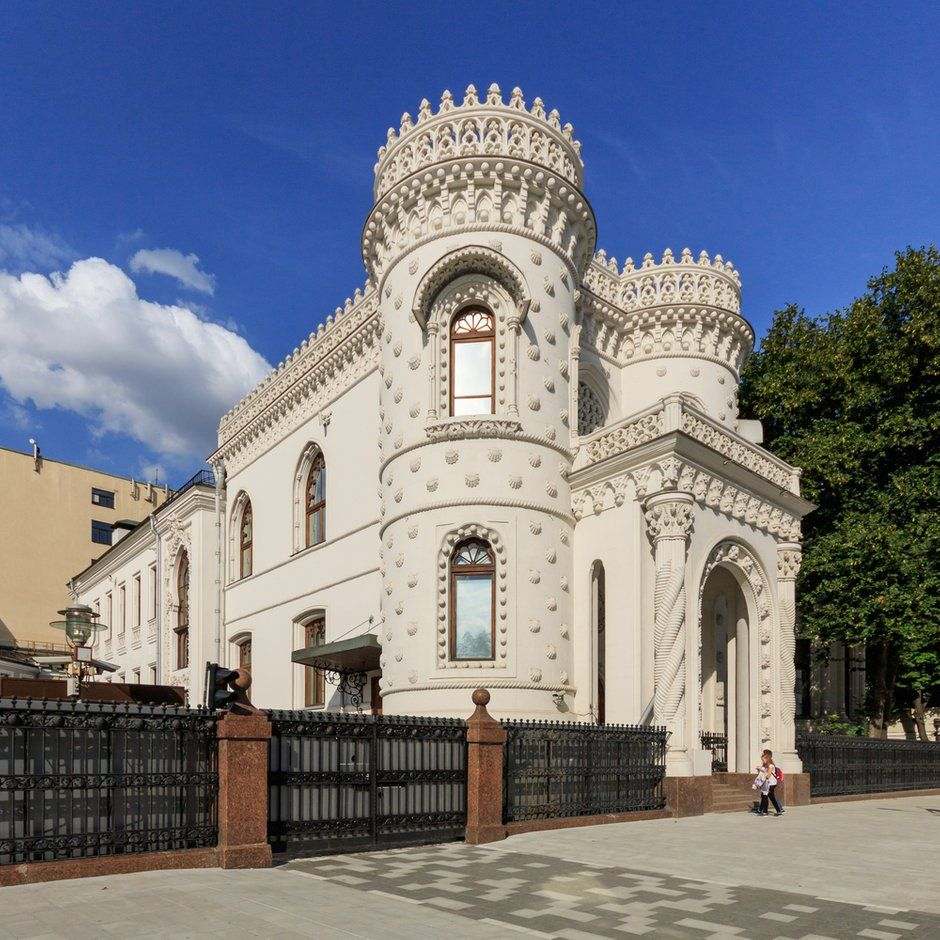
Morozov's mansion is one of the most striking examples of architectural eclecticism in Moscow, combining elements of different styles and eras.
Construction history
Arseny Morozov, a representative of a famous merchant dynasty, commissioned architect Viktor Mazyrin to design a mansion in 1895-1899. Morozov traveled extensively throughout Europe and wanted to incorporate elements of Moorish architecture into Moscow.
Architectural eclecticism
The building is a mixture of Neo-Moorish, Art Nouveau, Gothic, and Baroque styles. The facade is decorated with intricate ornamentation, including oriental motifs, coats of arms, and sculptural elements. Many of the decorative details were designed based on Morozov's own sketches.
Contemporary reaction
The mansion provoked a mixed reaction from Muscovites. It was called an “architectural curiosity” and criticized for not fitting in with the surrounding buildings. The building did indeed stand out against the backdrop of the classical architecture of Vozdvizhenka.
Modern use
After the revolution, the mansion housed various institutions, including embassies. Now the building belongs to the Russian Ministry of Foreign Affairs and is used for official receptions. The interiors have partially retained their original decor.
This is Moscow—a city where each of these five giants tells its own part of history. From ancient walls that remember kings to steel frames that watched the first cosmonauts. They are not just points on a map, but real symbols that have become part of our common cultural code.
Interestingly, their recognizability stems from a combination of everything: scale, unique history, and the role they played in the life of the country. Some buildings have become symbols of power, others of national pride, and still others of a bold vision of the future. But together, they create that very unique portrait of the capital.
Next time you walk around Moscow or simply see these silhouettes on postcards, you will know that behind each of them lies an entire era. These are not just stones and glass, but fossilized memories that still influence our present day.


