
Knowing how long each stage will take is essential when organizing any kind of building or remodeling project. "How long does it take for a semi-dry screed to dry?" is one frequently asked query. This is particularly crucial if you have a strict timetable and have to make sure that every step of the process has enough time to settle in.
Because semi-dry screed dries faster than traditional screeds and can be installed more quickly, it’s a popular choice for flooring. But before any more work is done on top of it, it still needs to cure for a certain period of time. Rushing this process can result in a number of problems, such as uneven surfaces and cracks, as well as long-term durability issues.
To assist you in better planning your project, we’ll analyze the variables that affect a semi-dry screed’s drying time in this post. Everything from the kind of screed mix used to the site’s environmental circumstances will be examined. By the time your renovation or construction project is finished, you’ll know exactly how to make sure your screed is given the proper amount of time to dry, giving your next steps a strong foundation.
Understanding how long it takes for a semi-dry screed to dry is essential for scheduling and guaranteeing a strong foundation when planning a flooring project. A semi-dry screed usually dries in 24-48 hours, enough for light foot traffic, and takes about 28 days to reach its maximum strength. The thickness of the screed, the surrounding air temperature, and the humidity can all affect this timeline. By being aware of these drying times, one can prevent premature loading and guarantee that the screed performs and lasts as long as possible.
- What factors affect drying??
- Ideal conditions in the house
- How long does it take to harden??
- How to Check Humidity Levels?
- Video on the topic
- How long should the floor screed dry before laying the laminate?. How to avoid cracks in screed.
- Learn from other people"s MISTAKES. Be sure to dry the SCREED for 30 days
- Caring for floor screed after pouring. Important information for those wishing to obtain a durable floor screed.
What factors affect drying??
Concrete floors need to be cleaned specifically after installation. Once it’s poured, you’ll need to give it the right conditions.
Things that could have a big impact on the outcome include:
- Ambient temperature. At reduced rates, freezing of concrete may occur, which leads to its delamination and looseness. At high levels, the screed dries faster, but does not have time to achieve strength. This leads to cracks.
- Sudden changes in air humidity. A dry environment (60-70% water) draws moisture out of concrete faster than required by building codes. This is where coating deformations occur. Increased moisture also negatively affects concrete. It doesn"t have time to dry properly.
- Draft. Intense air movement prevents the screed from gaining strength, since water evaporates from the screed faster than necessary.
Another element that draws moisture from the air and can cause the floor to dry out too much is the presence of dry wood in the space, such as lumber and sawdust.
Ideal conditions in the house
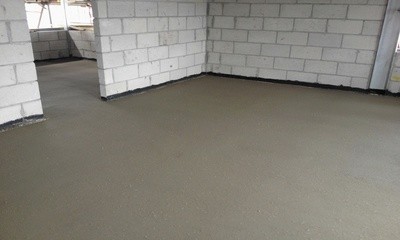
The following variables guarantee that the concrete coating ages uniformly:
- The temperature is within 20-26 degrees during the day and not lower than 5 degrees at night;
- Air humidity 65%–70%;
- Room tightness.
Nevertheless, you can make up for the water lost if temperature indicators rise above ideal ranges. The screed needs to be moistened frequently (one to two times per day), kept humid, and covered with plastic wrap.
It is impossible to guarantee the environment’s tightness when setting up a concrete structure on the street, but you can cover the entire pouring area with polyethylene.
The floor needs enough moisture during the first week. This is accomplished by spraying it, moistening the top layer, rather than pouring it from a hose.
Included in proper care are the following tasks:
- After pouring, cover with film with an allowance of 4-5 cm, it is recommended to fix the edges of the material.
- After 3 days of rest, the screed is sprayed at the rate of 0.2 l per 1 sq. m. This is required to slow down the drying process of the surface. Continue these procedures for a week.
- When the air humidity is low, place containers of water in the room. They will emit fumes and improve the microclimate.
Don’t tamper with the hardening process after one week of spraying. The only film on the surface should be that which slows down the drying process.
How long does it take to harden??
Tasks that can be completed following floor pouring are contingent upon time:
- 3-6 hours – walk on concrete surfaces with special pads;
- 10-12 hours – use equipment weighing up to 90 kg;
- 4-6 days – subject to stronger pressure up to 100 kg;
- 10 days – you can place a stepladder on the floor without the danger of leaving marks;
- 30 days – use a heated floor system.
Information is provided based on a 35–40 mm average floor thickness.
Only one month after pouring, when the solution has fully set, can you dry the floor by using the heated floor or heating system.
Depending on the height of the screed, the table below indicates when it will harden.
| Screed thickness, mm | Freezing time, days |
| 35 (3.5 cm) | 10-13 |
| 40-50 (4-5 cm) | 15-17 |
| 70-80 (7-8 cm) | 21-24 |
| 100 (10 cm) | thirty |
| 150 (15 cm) | 35-40 |
It demonstrates that a layer dries more quickly the lower its height. Because of this, a thinner layer of screed necessitates more attention to temperature and tightness.
A thick screed with reinforcement dries out more slowly than a thin screed, which makes it less prone to cracking and rippling.
How to Check Humidity Levels?
Accurately assessing the coating’s moisture content is crucial to ensuring timely completion of the flooring material installation process.
There are a few choices among all the methods that can be used to accomplish this:

- Folk method. It consists of creating a paper layer between two similar materials: concrete tiles and flooring. The slab is laid on the screed. If the paper remains dry after 24 hours, the topcoat can be applied without fear.
- Carbide hygrometer. Very expensive option for measuring humidity. The disadvantage of such equipment is partial destruction of the coating, because the hygrometer probe is stuck into the thickness of the floor.
- Electronic type moisture meter. Does not require immersion in the floor cake, due to which it has a small measurement error. Shows surface moisture.
Carbide hygrometers show the percentage of humidity in CM. This is an indicator based on calcium carbide that meets European standards. CM percentages and standard humidity readings are not the same. 1SM% is 1.7%.
Suggested SM parameters:
- Conventional semi-dry screed on a separating layer – CM1.8%.
- Concrete composition on a warm heating system – CM2%.
The completed structure should have a moisture content of no more than 3.4–4% if the measurement is done with a moisture meter.
When adding more floor coverings, indicators of the material’s water content become even more crucial. If there is too much moisture on the finished floor, fungus might grow on it.
Many experts advise installing a vapor barrier before installing floor coverings if the coating does not dry for an extended period of time or if the thickness of the concrete does not reach the recommended values.
You can use a specific primer, like epoxy, to treat the surface. There must be two layers of coating applied to the concrete. This will get rid of any remaining moisture.
The floor cake’s surface is sanded following the last drying process. Fill in the beacon holes if needed, then give the solution time to solidify.
Additional details regarding the video’s moisture level check:
| Condition | Drying Time |
| Standard Conditions (20°C, 60% humidity) | 7-10 days |
| Higher Temperature (above 20°C) | 5-7 days |
| Lower Temperature (below 20°C) | 10-14 days |
| High Humidity | 10-14 days |
| Using Accelerators | 3-5 days |
It is essential to know how long a semi-dry screed takes to dry when organizing a building or remodeling project. The drying time for a semi-dry screed can vary depending on thickness and environmental conditions, but it typically takes 21 days to dry enough for light foot traffic. The drying process can be made more efficient by making sure there is enough ventilation and by keeping the temperature constant.
It’s crucial to keep in mind that the screed may still contain moisture deep within, even if the surface appears dry. In the long run, rushing the process can result in problems like uneven or cracked flooring. The best outcomes require careful monitoring and patience.
You can guarantee a strong, long-lasting screed foundation for your flooring by taking these things into account and allowing the screed enough time to dry. Making the right plans and following drying instructions will save you time and money on future repairs. When in doubt about the details of your project, always seek professional advice.


