
When it comes to furniture design, Italian chic or Scandinavian minimalism often come to mind. But there is a country whose influence on the appearance of our homes has been no less profound, although not always so noticeable at first glance. That country is Austria.
At the beginning of the 20th century, here in the heart of Europe, ideas emerged that forever changed the perception of what furniture should be. Designers and architects asked themselves a simple but revolutionary question: how to make furnishings comfortable, functional, and accessible to many? Their answers formed the basis of modern interior design.
In this article, we will look at several key items that came out of Austrian workshops and studios. These are not just armchairs and chairs — they are manifestos that embody bold ideas about a new way of life in wood, metal, and fabric. Their forms, familiar to us today, were once a daring challenge to tradition.
1. Vienna Chair No. 14
Design: Michael Thonet. Manufacturer: Thonet
The Vienna Chair No. 14, created by Michael Thonet in 1859, was the first example of mass industrial furniture production in history and one of the most widely reproduced design objects—by 1930, over 50 million copies had been produced. Innovative steam-bending technology for beech wood allowed Thonet to create an elegant design consisting of only six parts connected by ten screws. The simplicity of the form concealed an engineering breakthrough: the chair weighed less than 2 kilograms, was easy to disassemble for transport, and was surprisingly sturdy thanks to the natural elasticity of the bent wood.
The aesthetics of the Vienna chair defined the canon of functional design for a century and a half: its graceful curved lines and minimalist construction anticipated the principles of modernism. From the Belle Époque cafés of Vienna to contemporary restaurants around the world, Thonet's chair has become a symbol of democratic, high-quality design accessible to the mass consumer.
Austrian furniture is not just beautiful objects, but true breakthroughs in design. Thanks to the bold ideas of Austrian craftsmen and architects, the early 20th century saw the emergence of items that changed not only interiors, but also our perception of comfort and functionality. From chairs without headrests to modular sofas, five iconic pieces from Austria have become benchmarks of modern design and continue to inspire the world with their simplicity, conciseness, and ability to combine form with intelligence.
2. Kubus sofa
Design: Josef Hoffmann. Manufacturer: Wittmann

The Kubus sofa designed by Josef Hoffmann. Photo: wittmann.at.
Kubus sofa designed by Josef Hoffmann. Photo: wittmann.at.
The Kubus sofa, created by Austrian architect and designer Josef Hoffmann, embodies the philosophy of the Vienna Workshops (Wiener Werkstätte) — a synthesis of functionality and geometric purity of form. Hoffmann, one of the founders of the movement, sought to create a “total work of art” in which every interior object was subject to a single aesthetic concept. The Kubus sofa demonstrates the master's characteristic approach: a strict cubic form, clear lines, and a minimalist design devoid of decorative excesses.
The modern production of the Kubus sofa by the Austrian company Wittmann remains faithful to Hoffmann's original design, using traditional upholstery methods and high-quality materials. The simplicity of the design—a rectangular frame with soft cushions—allows the sofa to fit organically into both historical interiors and modern minimalist spaces.
3. Fledermaus chair
Design: Josef Hoffmann. Manufacturer: Wittmann
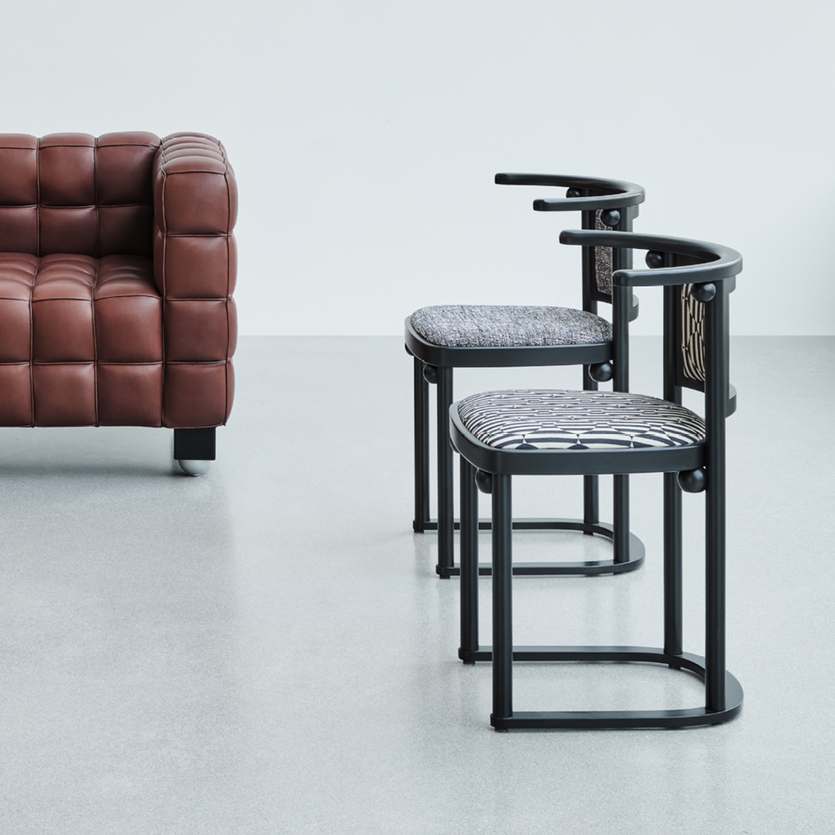
Fledermaus chair designed by Josef Hoffmann. Photo: wittmann.at.
Fledermaus chair designed by Josef Hoffmann. Photo: wittmann.at.
The chair got its name, “Bat,” from its characteristic perforated backrest with round holes resembling the wings of this animal. Hoffmann developed a design that was revolutionary for its time: a curved plywood backrest was attached to a simple wooden frame, creating a lightweight and durable piece of furniture. The geometric perforation pattern not only gave the chair a recognizable appearance, but also provided the necessary elasticity and ventilation.
Today, the Fledermaus chair remains relevant thanks to its versatility — it looks equally organic in modern cafes and museum interiors.

Fledermaus chair designed by Josef Hoffmann. Photo: wittmann.at.
The Fledermaus chair designed by Josef Hoffmann. Photo: wittmann.at.
4. Constanze 3/4 armchair
Design: Johannes Spalt. Manufacturer: Wittmann

Constanze 3/4 armchair designed by Johannes Spalth. Photo: wittmann.at.
Caracole
Let these ideas inspire you to make small but important changes. Experiment, add personal touches, and don't be afraid to break the rules. After all, a truly cozy place is where you can relax and be yourself. We wish your home to always be the place you want to return to.
Where to see it: Pavilion 15, Stand A28

Where to find us? Hall 9, stands A05, A09, C06, C12
A well-known European designer lighting brand will showcase all its new products at Euroluce and Salone del Mobile 2025. The brand is famous for its truly exquisite approach to creating lighting fixtures. This also applies to the materials used: precious metals are combined with crystal and handmade glass and complemented by exquisite decorative finishes. For example, the brand's lighting fixtures use brass coated with 24-karat gold. The official dealer of Castro Lighting in Russia is the Decoracia salon.
Austrian furniture, represented by these iconic pieces, is not just a story about comfortable chairs and practical wardrobes. It is a story about bold ideas that were ahead of their time and ultimately changed our everyday environment. Austrian designers were able to combine the audacity of experimentation with impeccable craftsmanship and a deep understanding of human needs.
Looking at today's minimalist interiors, the trend for sliding storage systems, and the popularity of inexpensive and stylish furniture, we often see echoes of those revolutionary designs. The Austrian approach — where functionality, aesthetics, and innovation go hand in hand — has become one of the pillars of contemporary design.
Ultimately, these five items teach us the most important thing: good design is timeless. It does not age, but only confirms its relevance with each new generation. When we buy a similar chair or cabinet today, we unwittingly become part of a rich history that began more than a century ago in the workshops and factories of Austria.


