
When it comes to building and remodeling, excavating a foundation for a sewer line is a task that frequently causes concern. In certain circumstances, whether you’re renovating an old house or building a new one, this becomes essential. You can save time and money by being aware of these cases and the procedures involved, as well as avert any possible structural problems.
Installing a new kitchen or bathroom in a basement or lower level is one typical situation. You must connect these spaces through the foundation because they frequently lie beneath the main sewer line. Another situation where modern plumbing systems need a new connection point is when the existing sewer line is old or damaged. Sometimes you have to break through the foundation to add a new structure, such as a garage with plumbing needs, or to extend your home.
Care must be taken when drilling through a foundation to avoid jeopardizing the structural integrity of the structure. The first step is to mark the exact location of the sewer line with careful planning. A precise and clean cut can be achieved by using the appropriate equipment, such as a concrete saw or hammer drill. When selecting the right technique and tools, it’s also critical to take the foundation’s thickness and type into account.
The most important thing when doing this task is safety. Accidents and structural damage can be avoided by donning protective gear and moving slowly to avoid overcutting. To stop water leaks and preserve the strength of the foundation, the new sewer line must be properly sealed after the opening is made. Getting professional advice is essential, particularly if you’re not sure how to proceed. This will guarantee that the task is completed safely and correctly.
Although breaking through a sewer foundation may seem difficult, it is a task that can be completed with the appropriate knowledge and strategy. Without jeopardizing the stability of your house, you can successfully integrate new plumbing systems by knowing when it’s necessary and adhering to the right procedures.
- Cases when it is necessary to break through the foundation
- Requirements for installation
- Parameters affecting the project
- Laying methods
- Useful tips
- Preparation
- Types of pipes
- Running a pipe under the base
- Foundation drilling
- Stages of technology
- Video on the topic
- Diamond drilling the foundation of the house for sewers
- Errors in plumbing! | How can not be installed with your own hands
- drilling holes in the foundation under the sewer with a crown Enkor.
- A hole for the sewer in the foundation, the Borisov crowns.PRO technology DIAMOND HIT
- OPEN SEWER pipe for a septic tank, how to do it, will it freeze or not?
Cases when it is necessary to break through the foundation
The following set of circumstances necessitates installing a sewer pipeline through the foundation from inside the home:
- Lack of experience among builders when constructing a house and taking into account the location of future communication systems.
- Improvement of the structure – connection of water supply and drainage systems.
- Redevelopment of premises, addition of bathrooms.
- Changing the position of the septic tank or receiving sewer main.
- Major repairs and modernization of housing with increased comfort.
In this instance, the type of foundation dictates the pipe-laying method to be used. Therefore, if the foundation is deep enough, it will need to be drilled; otherwise, if the depth is shallow enough and the circumstances permit, the sewerage system can be connected beneath it.
Crucial! It is important to carefully consider all potential changes to the structure’s operational characteristics and the effects on the house before determining how to drill a foundation for sewerage. It is crucial that work be done in accordance with the suggested building codes and technological guidelines.

Requirements for installation
When laying a sewer pipe through a house’s foundation, care must be taken to ensure that the following set of specifications are met in order to prevent costly errors:
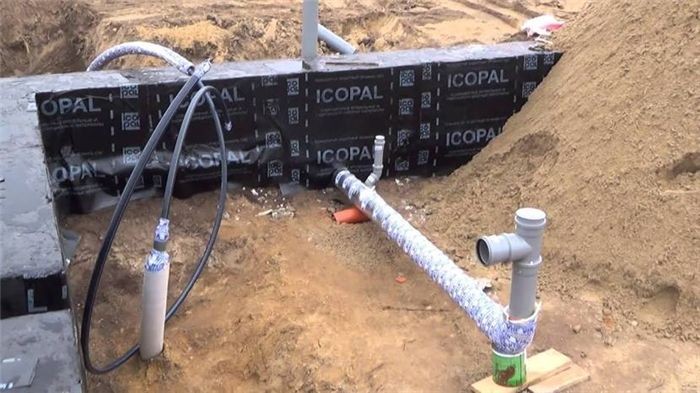
- Indicate on the diagram the locations of all elements.
- Perform level calculations.
- Ensure minimum sizes of water intake points to reduce material costs.
- Set the position of the receiving well or the point of supply to the main line, as well as the filter.
- Set the required slope to the sewer pipes for the natural and unhindered passage of wastewater.
- If possible, eliminate sudden changes and turns of the pipeline – ideally, the sewer system should be located linearly.
- Ensure high quality of all joints – mechanical, welded, soldered.
- At the end of the work, make sure of the reliability, strength and durability of the installed sewer system.
Note: The level must always be higher between the receiver’s connection point and the main line or septic tank entry point, regardless of the length of the drain pipe. It needs to be at least two centimeters for every pipeline meter. Adherence to this requirement will guarantee the swift and unimpeded flow of wastewater and prevent the development of congestion.
Parameters affecting the project
Apart from the aforementioned prerequisites, the project’s composition is contingent upon the subsequent factors:
- Type of prefabricated well or main, its location.
- Possibility of connection to wastewater treatment plants.
- Number of people living in the house.
- Seasonality of sewerage use (permanently, in summer, on vacation, on weekends).
- Project financing.
- Opportunity to attract professional installers.
Very useful information! Construction and sanitary standards dictate where the sewage well should be located. It needs to be at least two meters away from the adjacent site’s fence and thirty meters away from the drinking water source.
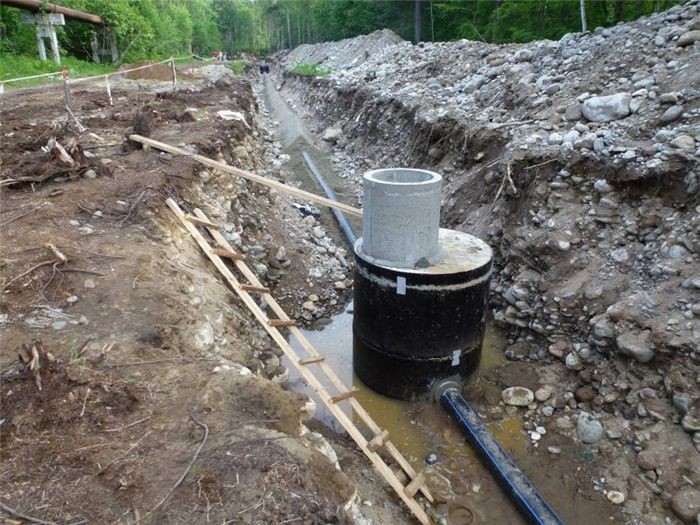
Laying methods
To create holes in the foundation for sewerage, there are two primary methods:
- Manually.
- Using automated equipment.
In the first scenario, instruments or devices such as hammer drills and drills are used to punch or drill a hole through which the pipeline can pass. In this instance, punching is required when filler components, such as crushed stone, gravel, etc., are in the way, and drilling is required for metal frame elements because of the intricate structure of contemporary foundations.

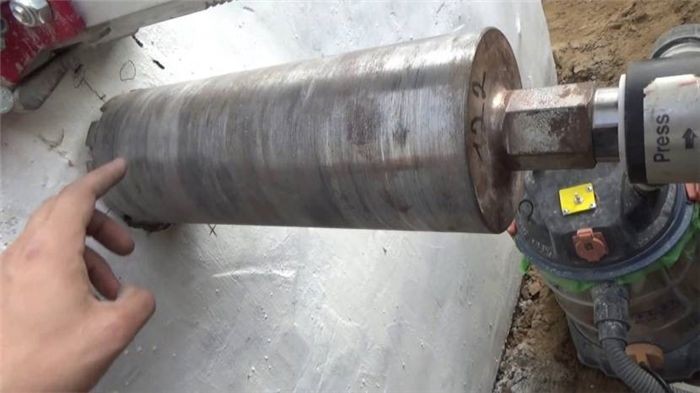
It is possible to drill a hole in reinforced concrete down to a maximum depth of 20–25 cm using both hand and power tools. Use of a specialized drilling rig will be required if the foundation is thicker. The following are some benefits of employing a professional drilling rig:
- The ability to accurately select the diameter of the hole to be made across the diameter of the pipe being laid due to the presence of a wide variety of drill bits.
- The geometric accuracy of the hole eliminates the development of destructive factors in the base structure and minimizes damage to the material of the pipeline itself when it is pulled through.
- Drilling a foundation even thicker than standard takes a few minutes – saving time and effort for the developer.
- Even a structure with a massive reinforcement frame can be professionally installed.
The choice of foundation punching technique, tools, and materials will have a significant impact on the sewer system’s longevity and functionality.
Useful tips
The following advice can help to improve the efficacy and security of work done to break through a house’s foundation for sewerage:
- Before starting work, you must make sure that there are no already installed communication systems at the drilling site – water supply, cables.
- It is best to remove fine waste from the drill site using a vacuum cleaner, a syringe or a blower.
- The working tool directly drilling into the foundation material must not have chips, cracks or other defects.
- The drill or bit should not overheat excessively during operation.
- The concrete mass lends itself best and fastest to cutting tools with pobedite or diamond coating.
Counseling! The process of laying a pipeline through a foundation hole requires a lot of labor and time. Therefore, only reinforced pipes should be installed in order to prevent changes or repairs to the system during continued operation. Should it be required, the inclusion of a reverse-acting valve will stop wastewater from going back into the receiver.

Preparation
The preparation of the soil and pipe selection are the two main tasks involved in laying sewerage through the foundation. You must excavate the ground on both sides of the location where you intend to drill the base. The trench outside the house should come right up to the point where the pipeline joins the main line or septic tank. In this instance, considering the local climate, the burial depth should ideally be about half a meter below the freezing point of the soil.
Of course, this requirement isn’t always satisfied. For instance, it would be necessary to dig a trench that is roughly 4.5 meters deep in the North and Siberia, which is technically impossible. Furthermore, there are instances when the sewer well’s actual bottom is not that deep. One solution to this problem is the use of thermal insulation materials and heating systems for subterranean communications that rely on thermal cables. Pipes with thermal insulation are placed 0.8 to 1 m below the surface in the middle climate zone, and pipes without it are placed around 2 m below it.

Types of pipes
Pipes are chosen based on their diameter and material suitability for the operating conditions during the planning stage of determining how to drill a hole in the foundation. Sewerage is chosen based on the overall volume of wastewater, per the first indicator. The pipe should be wider the more reception points it has and the higher the water flow. This parameter typically ranges from 50 to 150 mm.
The materials used to make pipes must be resistant to harsh environments. After all, chemicals such as detergents and cleaning agents can occasionally be found in household waste. Sewer pipelines are typically constructed from the following components:
Possesses tremendous strength. Ideal for deeply placing. One drawback is that it can rust. Therefore, extra protection is needed, like painting or applying an anti-corrosion coating.
- Cast iron.
Classic piping material. varies in the level of tolerable aggression to aggressive elements. Nevertheless, installing it is difficult, heavy, and highly expensive.
Lightweight, chemically unreactive substance. The comparatively low strength is the only negative aspect. Nevertheless, internal and external sewage systems are frequently built using PVC pipelines.
Suggested Use! The future sewer system’s load parameters should guide the selection of pipes, connectors, and other components. The weight of the entire house will press down on the material in addition to the soil layer.
Running a pipe under the base
Sewer communications can be laid most simply and cheaply by running a pipe under the base. There is a shallow foundation for the method. In this instance, cultivating the soil is the primary task. Drilling will only be necessary if a floor screed is present. There are two ways to carry out the process:
- Open trench – from the foundation to the well or highway.
- Horizontal inclined drilling – creating an underground well with a given inclination and pulling a pipe into it.
The first approach is more cost-effective and appropriate in situations where there is a short distance between the house and the drainage receiver; the second approach is pertinent in situations where the septic tank or highway is far away, and there may also be other impediments along the route that prevent open-pit mining.
Foundation drilling
In the following situations, it is necessary to drill a house’s foundation:
- When the bottom of the foundation is deep.
- In a monolithic foundation.
The intricacy of the project and the amount of time allocated for its completion dictate the kinds of equipment that are utilized. An electric drill can be used to drill the most basic structure, where the pieces of the reinforcing frame are spaced widely apart. You need a specialized drilling rig when working with reinforcement that is densely arranged and the foundation has thick walls.
Sometimes it is inevitable to drill a hole through a foundation for a sewer line, particularly when a home is undergoing extensive renovations or new plumbing is installed. The meticulous planning and execution of this process are necessary to prevent any damage to the building’s structural integrity. Selecting the best site, utilizing the appropriate equipment (such as jackhammers and concrete saws), and making sure that the installation is properly sealed and reinforced are all crucial phases. Homeowners and contractors can successfully integrate new sewer systems without jeopardizing the stability of the foundation by adhering to these guidelines.
Stages of technology
Here are some guidelines for punching a foundation for a sewer pipeline:
- A plan-project is drawn up.
- Pipes, materials and necessary working tools are prepared.
- Excavation work is carried out – a trench is dug, a receiving pit is dug from the inside of the foundation.
- A hole is drilled, bored or punched in the mass of the foundation.
- The pipe is laid through the trench through the hole.
- The pipeline is connected inside the house with the receiving pipe and outside – at the place of supply to the septic tank or line.
- The tightness and strength of all compounds is checked.
- Trench and chipping over.
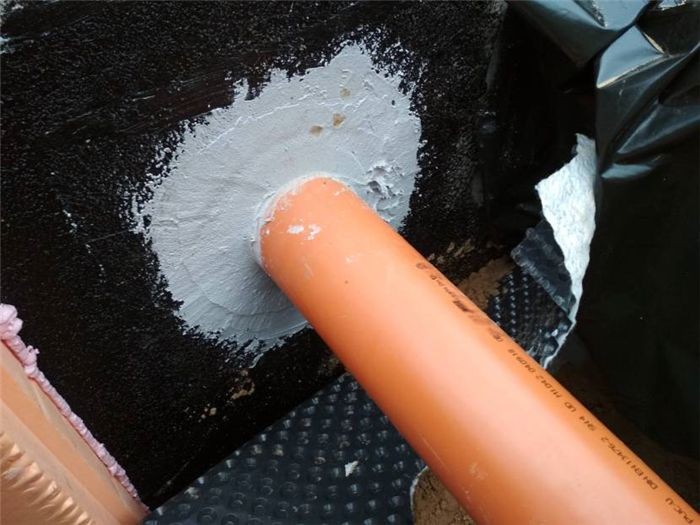
Take note! The best tool for breaking through the sewer foundation is a professional drilling installation. But the average user does not always have access to it. It is simple to damage the PVC pipe when pulling when using the manual method of cutting holes because the holes may be uneven and have protruding reinforcement. With a rubber sleeve or just a winding from roofing material, it will help prevent damage to the damage from occurring beforehand.
| Case | How to do it |
| Adding a new bathroom | Mark the spot on the foundation, drill pilot holes, use a concrete saw to cut an opening, and install a pipe sleeve |
| Installing a new sewer line | Determine the path, mark the foundation, use a hammer drill for pilot holes, cut with a concrete saw, and fit the sewer pipe |
| Repairing a damaged sewer pipe | Identify the damaged section, mark and cut the foundation, remove debris, and replace the pipe |
Installing a sewer line through a foundation can seem like a difficult task, but it’s frequently required to guarantee proper waste management in a building. Sometimes it’s impossible to avoid cutting a passage through the foundation, whether you’re building an extension, adding a new bathroom, or updating an outdated plumbing system. The secret is to tackle the work in a safe and methodical manner.
It is important to plan everything out in detail before you begin. Find the precise spot where the sewer line will pass through and make sure the foundation’s structural integrity won’t be jeopardized. A structural engineer’s advice and the use of comprehensive blueprints can help avert costly errors and possible dangers. Recall that, over time, a properly positioned sewer line can save both money and time.
Having the appropriate tools is crucial for breaking through the foundation. The best option for making accurate, clean holes without inadvertent damage is frequently a core drill. You may require more potent tools, such as a jackhammer, if you’re working with reinforced or thicker concrete. Wearing protective gear, such as gloves, goggles, and a dust mask, is crucial to shielding yourself from dust and debris while working.
After the hole is made, the sewer pipe installation needs to be done carefully and precisely. To stop leaks, make sure the pipe is firmly fastened and correctly aligned. Using high-quality caulk or sealant to seal the area around the pipe will help keep the foundation strong and waterproof. Over time, the system’s continued good condition can be ensured with routine maintenance and inspections.
In conclusion, although excavating a foundation for a sewer line is a big undertaking, it can be completed successfully with proper planning and the appropriate strategy. Through comprehension of the rationale behind the requirement, comprehensive planning, and application of suitable instruments and methods, you can effectively manage this obstacle. When done correctly, a building’s functionality is improved and its long-term durability and safety are guaranteed.


