
Any construction project must start with the construction of a solid and long-lasting foundation. Of all the foundation types, pile foundations are crucial for structures constructed on shaky or unstable ground. In order to ensure stability and safety, these foundations shift the building’s weight to deeper, more stable soil layers.
Pile foundations are composed of long, thin columns that can be made of steel, wood, or concrete. These piles are drilled or driven into the earth until they come to a rock or soil layer that is strong enough to hold the weight of the building. This technique is particularly helpful in situations where conventional shallow foundations are inappropriate.
It is essential to comprehend the various pile types and installation techniques when choosing the best foundation for your project. Every type of pile has different benefits and uses, such as friction piles that transfer load through surface resistance and end-bearing piles that rest on a strong soil layer.
This article will examine the various pile foundation designs and diagrams, outlining their constituent parts and functional principles. By the end, you’ll know more about the design of pile foundations and how they contribute to a building’s stability.
- Types of pile foundations
- Types of metal pipes
- Base structure
- Screw pile design
- What grillages exist
- What does it consist of?
- Brief description of installation technology
- Useful video
- Video on the topic
- Construction of a pile foundation using the hollow auger method "Gidrospetsstroymontazh" #1
- installation of pile foundations
- CONSTRUCTION OF PILE FOUNDATIONS
Types of pile foundations
The kind of supporting elements separates different types of pile foundations.
They are separated into:
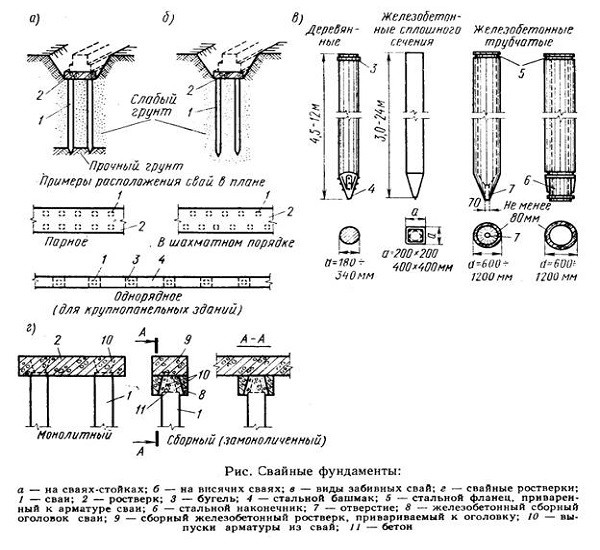
- Rack piles. Immersed in the ground until hard contact with dense layers appears. They have the greatest strength and load-bearing capacity and are used for the heaviest and most important buildings and structures.
- Hanging piles. They have no support on dense layers of soil; they are held due to the frictional force on the side walls of the trunks. Load-bearing capacity depends on the length of the pile, t.e. from the depth of immersion in the ground. Used in cases where dense layers are too deep. The disadvantage of hanging piles is the ability of sudden subsidence that occurs due to changes in hydrogeological conditions – seasonal changes in groundwater levels.
Materials come in heaps:
- Wooden. Traditional appearance, which originally appeared and currently practically not used.
- Metal. The piles use segments of rails, channels, lobes, etc.D. Specially made samples are only screw piles. Metal piles have an important advantage – they are plastic, which allows them to flexibly respond to side loads from frosty fusion or soil movements. The disadvantage of metal piles is a tendency to corrosion, mainly to its electrochemical variety. Because of this, the service life of metal piles is relatively low-up to 75 years (on average-40-50).
- Reinforced concrete. These piles are used in the most critical supporting structures. They can be manufactured at specialized enterprises, or cast directly on the site. The service life of reinforced concrete piles reaches 150 years, which determines the preference of this type among builders.
By kind of dive:
- Drivers. Basically, reinforced concrete piles with prestressed reinforcement are used. They are able to withstand maximum loads and have the greatest load-bearing capacity. Metal driving elements are used much less frequently.
- Rammed (or bored). Manufactured directly on site by filling pre-drilled and reinforced wells with liquid concrete. When using this technology, the need for transportation and loading and unloading operations is significantly reduced; there is no need to use pile driving equipment. This has made bored piles preferred among individual developers.
- Screw. This is a separate type of piles that are driven into the ground using the screw principle. Have the ability to immerse and extract both mechanically and manually. A special feature of screw piles is that there is no need for site planning or excavation work in general. In addition, it is possible to build on slopes or folds of the terrain. Disadvantage: corrosion that destroys metal.
Pile foundations can be designed to be:
- Pile-grillage.
- Pile-screw.
- Pile-tape.
- Pile-slab.
Some sources combine pile-tape and pile-grillage types into one group because they don’t really differ from one another. Some experts, however, believe that there is a fundamental difference between the two in the way loads are distributed—while the grillage rests only on piles, the tape is laid on the ground.
Types of metal pipes
Screw piles are made of metal pipes with a minimum wall thickness of 4 mm that have spiral-shaped cutting blades and a sharp tip that is either cast or welded.
The process of driving screw piles is essentially the same as screwing in a self-tapping screw: the blades progressively tighten the barrel after the tip is driven into the ground and the barrel rotates.
It is thought that they can be manually submerged with just muscular force.
This is accurate, but only to a certain extent. For example, it is nearly hard to manually load the most common screw piles, which have a diameter of 108 mm.
Experts advise against manually driving any piles at all, not even tiny ones.
The soil surrounding the trunk and blades is considerably weakened by uneven force distribution and axis vibrations, which lowers the support’s bearing capacity.
Screw piles come in a variety of designs with unique features.
- Tip type – welded or cast.
- Number of blades – one, two or three.
- With or without a protective layer of galvanization.
Paint on screw piles cannot be regarded as a protective layer because it is completely removed when submerged. A galvanized layer is the only kind of protection that works well. Searching for alternative options is advisable if it is not accessible.
There are variations in the ratio between the trunk and blade diameters as well. Large diameters are used to provide a large supporting area for loose and soft soils.
Multi-turn screw-type piles are used for rocky or clastic soils; however, they should not be used for individual construction. Additionally, there are mounds for submersion in permafrost.
Since they are submerged in the leading well, they lack a pointed tip, and their blade diameter is relatively small—less than 1.5 times that of the trunk.

Base structure
Regardless of the kind of piles, a pile foundation’s layout is nearly always the same.
The foundation is made up of:
- Supporting elements (piles) – vertical rods resting on deep dense layers of soil or held motionless due to friction force.
- Grillage – a strapping belt on which the walls of the house are installed.
- Strapping – used in addition to grillage on metal (screw) piles to connect all trunks into a single system and increase the rigidity and strength of the pile field.
After the piles are properly submerged in the ground, the tops of them are trimmed to create a uniform horizontal plane throughout the field. After that, unique caps with mounting platforms—heads on which a metal or wooden strapping belt is mounted—are put on them.
Instead of using caps, formwork is assembled and a monolithic strip with an armored belt that is rigidly attached to the pile frame is cast for reinforced concrete grillages. Ensuring the strongest and most rigid connection between the grillage and all piles is the primary task, combining separate components into a single system.
This will enable the weight of the house to be supported by the grillage and dispersed over all supports, transferring the load to solid soil layers.

Screw pile design
Metal pipe fragments with a wall thickness of at least 4 mm are known as screw piles.
Ready-made, they come in a range of lengths from 1.5 m to 5 m (or longer). A spiral-shaped cutting blade is attached to one of the pipe’s pointed, cone-shaped tips on one side.
In finished form, tips can be welded to the pipe or cast, made as a single unit with the blade. Additionally, there are joined petals cut from the same pipe that have been welded into tips. The blades are welded separately in this instance.
For denser soils with solid inclusions, cast tips are utilized.
Since welded tips can collapse and cause damage to the pile when submerged in dense layers, they are typically used on relatively soft soils.
At the top of the pile is a technological hole that can be used for immersion, and a crowbar is threaded into it.
It is covered with sections of pipe, which rotate the pile like long levers. While others rotate the trunk and submerge it in the ground, one person should stand at the trunk and adjust its position.
Construction machinery allows for much faster, more accurate, and nearly error-free installation.
It is crucial to create a driving diagram beforehand that shows the pile installation procedure in order.
If not, a scenario might occur where the equipment is able to reach the internal supports but not the external ones.
It is not acceptable to reverse the pile during installation. Additionally, it is not permitted to submerge the pile in the same hole where a previous support was just removed. The soil loses density and takes a while to recover because of how much the blades loosen it.
What grillages exist
Three primary categories of grillages exist:
- Wood. A timber size of 150: 200 mm or 200: 200 mm is used. Sometimes, instead of one solid beam, a pack of edged boards 50 mm thick and 200 mm wide is used. This option eliminates the formation of deep cracks and twisting with a screw, which is common for this material. The beams are laid on the heads and fixed with stepladders and bolts. They are connected to each other in half a tree with a jute lining.
- Metal. An I-beam, rail or angle is placed on the head and firmly connected to each other by welding with additional fixation with threaded connections. Heads are not used for channel bars; rolled products are laid with the shelf up directly on the tops of metal pipes (screw piles).
- Reinforced concrete. It is an almost complete analogue of a shallow strip foundation, only installed not in a trench supported by the ground, but point-by-point on the tops of piles. At the same time, the tape is cast with a rigid connection between the reinforcement and the pile frames, which makes all the elements a single concrete casting. The reinforced concrete grillage is able to withstand maximum loads, does not rot and does not corrode, which ensures a long service life.


Since a pile foundation shifts the weight of the structure to deeper, more stable soil layers, it is an essential component of construction, particularly for buildings on soft or unstable ground. The types, advantages, and common installation techniques of pile foundations will be covered in this article’s tutorial. To help you visualize how pile foundations function, we’ll also provide you with an understandable diagram, so you’ll be prepared for any construction projects you undertake.
What does it consist of?
A grillage, though not limited to reinforced concrete, is a strapping belt that resembles traditional tape. Its location entirely repeats the tape’s configuration, with it beneath both the internal and external load-bearing walls around the perimeter of the pile field.
Shallow and buried grillage structures are occasionally employed; in these instances, however, a pile-strip foundation is being discussed.
The classic grillage is characterized by its placement on top of piles at an elevation above ground.
This prevents snow or melt water from coming into contact with the skin and allows access to structures for maintenance and inspection.

Brief description of installation technology
The steps are as follows:
- Site preparation. Excess plants and objects are removed, the site is planned, if necessary.
- Marking. Using pegs, the centers of the wells are marked. It is necessary to maintain the accuracy and precision of measurements, check the correspondence of the diagonals.
- Drilling of the wells. Wells are drilled to a given (or possible) depth, and if necessary, an expansion is made – the heel.
- The sleeves are lowered into the cavity– pieces of plastic pipes, roofing felt rolled into a tube. They will serve as a kind of formwork that prevents water from leaving the concrete into the surrounding soil.
- Reinforcement cages are assembled and lowered into wells. Their length should be such that there is enough left for subsequent connection with the armored belt of the grillage.
- Concrete is poured into wells. It is carefully bayoneted, removing air bubbles. After this, the piles are kept until completely hardened (28 days).
- While the concrete dries, the formwork and reinforcement cage for the grillage are assembled. The procedure is almost the same as the method for constructing a strip foundation.
- When the opportunity arises, the grillage is poured. The concrete is bayoneted, removing air, then covered with polyethylene and kept for 28 days. Formwork can be removed 10 days after pouring.
You can move on to more building once the tape has fully solidified.

Useful video
You can familiarize yourself with the layout of a pile foundation in section:
| Diagram Component | Description |
| Pile Cap | The top part of the pile foundation, which distributes the load from the structure to the piles. |
| Pile Shaft | The long, slender part of the pile that transfers the load through weak soil layers to stronger, deeper layers. |
| Ground Level | The surface of the earth where the pile foundation is installed. |
| Bearing Layer | The strong, deep soil or rock layer that supports the end of the pile. |
| Reinforcement | Steel bars or mesh placed inside the pile to increase its strength and durability. |
| Concrete | The material used to form the pile, providing structural integrity and load-bearing capacity. |
| Load | The weight or force exerted by the structure on the pile foundation. |
Anyone working on building or renovating projects needs to be familiar with the pile foundation diagram. These foundations ensure stability and longevity by giving structures built on shaky or unstable soil the support they need.
There are several varieties of pile foundations, and each is appropriate for a particular set of soil parameters and structural needs. Choosing the right one can have a big impact on a building’s longevity and safety. You can choose wisely for your building projects by looking over the diagrams and comprehending the ideas behind pile foundations.
By putting this knowledge to use, you can guarantee that your projects adhere to safety regulations while also producing higher-quality work. Knowing the fundamentals of pile foundations will help you feel more confident and equipped to take on construction challenges, whether you work as a professional builder or are a do-it-yourself enthusiast.
Recall that having a strong foundation is essential for successful construction. Long-term benefits include a solid and safe foundation for any structure you build if you take the time to comprehend and apply pile foundations correctly.


