
Cutting-edge building methods are revolutionizing the sector and increasing the sustainability and efficiency of building operations. Using Penoplex thermal insulation boards in formwork systems is one such method. These boards provide a contemporary solution that improves the performance of the completed structure as well as the building process.
Penoplex thermal insulation boards are well known for their superior insulating qualities, which contribute to a building’s ability to keep a constant temperature. They offer further advantages like lower energy costs and increased thermal efficiency when incorporated into formwork. This approach helps to create buildings that are more energy-efficient while also accelerating the construction process.
The materials used in traditional formwork techniques are frequently bulky, heavy, and less effective at insulating. On the other hand, Penoplex boards provide better insulation and are lightweight and manageable. Their features render them a compelling option for builders seeking to optimize their processes and attain superior outcomes.
The use of Penoplex thermal insulation boards in formwork is a noteworthy advancement in building technology. It facilitates the construction of sustainable structures, improves thermal performance, and streamlines the building process. Adopting such cutting-edge techniques will be essential to satisfying the demands of contemporary construction as the sector continues to change.
| Advantages | Explanation |
| Energy Efficiency | Penoplex boards provide excellent thermal insulation, reducing energy consumption. |
| Ease of Installation | Lightweight and easy to cut, making the formwork process faster and simpler. |
| Cost-Effective | Reduces overall construction costs by minimizing the need for additional insulation materials. |
| Durability | Resistant to moisture and mechanical damage, ensuring a long-lasting formwork solution. |
| Environmental Benefits | Reduces the carbon footprint of the construction project by improving energy efficiency. |
- New way of formwork
- Speeding up and simplifying work
- Reliability of permanent formwork
- Simple and quick installation
- 1. Preparing the area
- 2. Assembly of permanent formwork
- 3. Pouring with concrete mixture
- Video on the topic
- Penoplex Foundation Krasnodar
- Permanent formwork made of expanded polystyrene with your own hands ..
- Insulation of foundation formwork Few people know about this. Errors and nuances
- Permanent formwork Penoplex
- Strengthening and leveling the foundation from EPS (XPS)
New way of formwork
The modern trend in the construction of strip foundations is permanent formwork made of extruded polystyrene foam. The structure for concreting is not made of expensive wood, but of high-strength thermal insulation boards PENOPLEX®, which remain after pouring as thermal insulation for the foundation. The sheets are connected using universal polymer ties and screws. Such special fasteners allow the permanent formwork structure to withstand the pressure of the concrete mixture during pouring and vibration. After the concrete solution has hardened, the formwork is not dismantled, but remains in the foundation structure, providing reliable thermal protection. The outdated traditional formwork method cannot compete with the convenient and new method, which has a number of advantages.
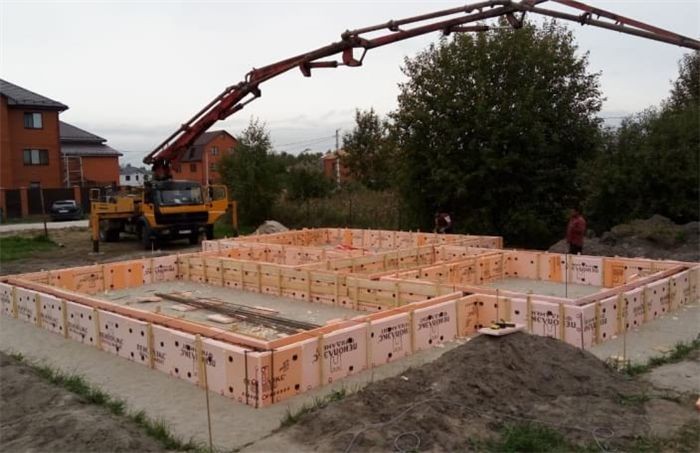
Firstly, formwork does not require the purchase of costly wood that will eventually be disposed of. reduces labor expenses for building with wood, curing concrete, and demolding. A large portion of the production work is done at this stage, and permanent formwork will speed up installation and save money on labor.
Speeding up and simplifying work
The construction of formwork and thermal insulation of the foundation are integrated into a single technological cycle through the use of permanent formwork. When these two phases are combined, building a house goes more quickly and efficiently.
With its low thermal conductivity coefficient and fixed formwork, PENOPLEX® thermal insulation shields the foundation from all directions of thermal energy loss. Frost heaving of soils is lessened by a horizontal layer of PENOPLEX® slab thermal insulation around the building’s perimeter. Highly thermally conductive concrete loses less heat due to the permanent formwork’s contour, which also makes the concrete’s surface bioimpermeable, enhancing the structure’s biostability. Fixed formwork creates a closed thermal circuit and is incorporated into the building structure.

Reliability of permanent formwork
The subterranean structure needs to be constructed with sturdy, moisture-resistant materials. Technical experts advise using PENOPLEX FOUNDATION® high-strength thermal insulation when building permanent formwork. The slabs are not crushed or deformed by the weight of the concrete or the pressure of the surrounding soil.
Please take note that using materials that are waterproof and bio-resistant is crucial to extending the foundation’s service life. It is commonly known that moisture provides mold and mildew with nutrients and a favorable environment. The foundation may sustain damage or even collapse as a result of moisture seeping in and creating dampness within building structures. PENOPLEX® thermal insulation has nearly zero water absorption, shielding the base from these harmful environmental factors. The material’s complete biostability stops the growth of dangerous microorganisms.
Simple and quick installation
1. Preparing the area
We start by getting the construction site ready. We take out all trash and extraneous objects. We consider beforehand the potential for construction equipment access. We start the excavation process by marking the foundation’s location. We dig a pit, set up a cushion made of sand, and then install TERRAISOL ECO geotextiles. Plant roots are unable to penetrate the separating layer and enter the structures above.

Further information as depicted in the diagram above:
- Outer layer made of PENOPLEX® board
- Inner layer made of PENOPLEX® board
- Universal screed
- Reinforcement frame
2. Assembly of permanent formwork
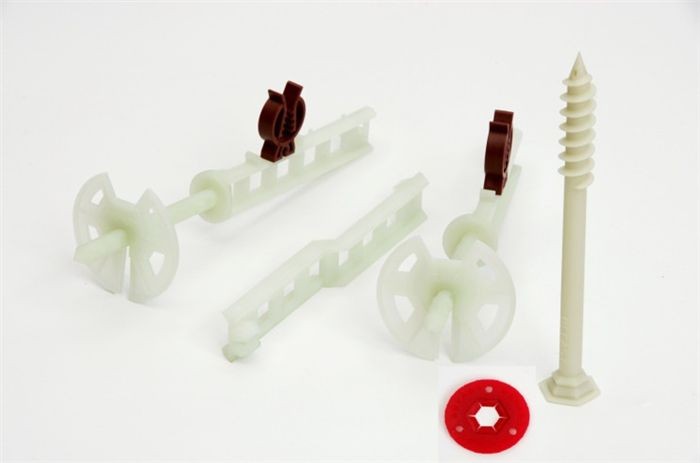
Assembly of permanent formwork begins from the corners of the structure. Holes are drilled in PENOPLEX® slabs and universal ties of the first row are placed in them, which are secured using a special lock. The lower horizontal layer of slab formwork is cut to size depending on the width of the foundation; the slabs are fastened to each other at the corner joints using polymer screws. To avoid concrete leakage through the seams, with a single-layer formwork method, it is recommended to glue them with polyurethane foam glue and fasten adjacent sheets together using nail plates. The slabs have a stepped edge around the perimeter, so they are mounted as tightly as possible to each other. The permanent formwork is placed in the design position and the pit is backfilled for additional reinforcement. Then reinforcement is carried out with the step-by-step installation of ties and clamps for reinforcement, iron rods are connected with knitting wire.
3. Pouring with concrete mixture
The next step is to pour the concrete mixture, making sure to vibrate while doing so to prevent cavities from forming and create a completely closed thermal circuit.
A unique process map provides a detailed description of the entire technology used to create a shallow strip foundation using permanent formwork made of PENOPLEX® thermal insulation.
Penoplex thermal insulation boards are creatively used for formwork, which benefits the construction industry in many ways. This technique improves the building’s insulating qualities while also streamlining the construction process. These boards are integrated into the formwork system to produce a more economical and energy-efficient solution.
This method’s simplicity of installation is one of its main advantages. Because Penoplex boards are lightweight and manageable, labor costs and time are decreased. Furthermore, their high thermal resistance guarantees superior insulation, which lowers energy consumption and enhances building comfort.
An additional noteworthy benefit is durability. Penoplex boards are a dependable option for long-term performance because they are resistant to moisture and decay. Because of their strength, the formwork will remain intact during the building process, resulting in a final structure that is more durable and of higher quality.
In addition to modernizing the building process, incorporating Penoplex thermal insulation boards into formwork also encourages sustainability. This approach is in line with modern green building practices since it increases energy efficiency and lessens environmental impact. All things considered, implementing this creative strategy can result in significant advantages for both residential and commercial building projects.
Find out how to transform your construction projects with Penoplex thermal insulation boards used as formwork. This creative approach not only streamlines the construction process but also boosts insulation, lowers expenses, and increases energy efficiency. Penoplex is a game-changer for both do-it-yourselfers and professional builders because it makes it simple and quick to construct sturdy, dependable, and well-insulated buildings.


