
Stone blind sections surrounding homes have long been a preferred option for homeowners wishing to blend aesthetic appeal with usefulness. These sturdy constructions give the property a touch of elegance in addition to shielding the foundation from water damage. However, there are benefits and drawbacks to each construction decision, including stone blind areas.
The longevity of a stone blind area is one of its primary advantages. Stone is a durable material that works well in areas with extreme weather because it can withstand harsh weather conditions. Furthermore, stone needs little upkeep, which ultimately saves homeowners money and time. Its organic appearance adds a classic and elegant finish that completes the property’s overall aesthetic appeal.
There are certain drawbacks to take into account despite its many benefits. It can take a lot of work and money to install a stone blind area. To guarantee correct placement and drainage, skilled labor is needed, which may increase the project’s final cost. Furthermore, improper installation may result in water collecting around the foundation, which could eventually damage it.
It’s important to adhere to certain guidelines when installing a stone blind area to make sure it works properly. In order to stop water from leaking into the foundation, proper drainage is necessary. The stones have to be set on a base that has been prepared properly and slopes sufficiently to divert water away from the house. By taking these safety measures, you can optimize the advantages of having a stone blind area and reduce any potential disadvantages.
| Advantages | Disadvantages |
| 1. Durable and long-lasting | 1. Expensive to install |
| 2. Attractive appearance | 2. Requires professional installation |
| 3. Low maintenance | 3. Heavy material, difficult to handle |
| 4. Resistant to weather and pests | 4. Can crack if not properly installed |
- For what purposes is it used??
- Types of material with photos
- Flagstone
- Sandstone
- Granite
- Requirements for construction materials
- Correct pie diagram
- What you need?
- How to calculate the required amount of raw materials?
- DIY finishing instructions
- Flagstone
- Sandstone
- Granite
- Possible mistakes
- Pros and cons of application
- Prices in the Russian Federation
- Cost of work per m2 of area
- Video on the topic
- HOUSE BLINDBOARD: INSTALLATION FEATURES
- 🔥blind area near the house, which is better?️🔥
- 🔥Economy option for blind area🔥
For what purposes is it used??
Because of its strength, dependability, variety of colors, and structural integrity, stone has long been a favorite material for finishing and building projects.
This material’s production process gives it the required surface textures, including chipped and filmed, polished and ground, and heat-treated, all of which significantly expand its range of applications. Rigid, bulk, and multi-layer blind areas are applications for this material.
Issues that natural stone cladding resolves when covering blind areas:

- creating a representative appearance;
- construction of a monolithic structure without voids and defects;
- long period of use, capable of maintaining its original consumer qualities for at least 300 years;
- use of environmentally friendly building materials;
- durable building structure;
- invulnerability to natural precipitation, temperature changes and UV radiation.
Types of material with photos
Today’s retail chain offers a wide variety of natural finishing materials that are mined from massive, solid rocks for the blind area.
- basaltic,
- marble,
- limestone,
- granite.
They must, first and foremost, be strong and hardy, free of weathered areas, different kinds of cracks, and other flaws that would reduce their durability and strength.
Since they are all expensive, the most popular option for finishing
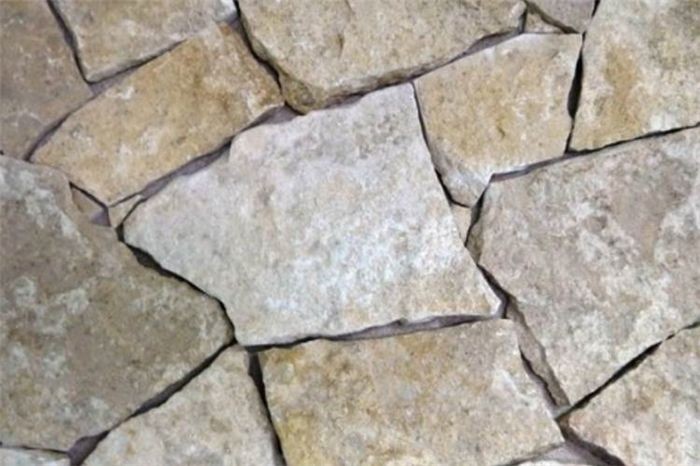
Flagstone
Flagstone is the term for limestone or shale rocks that can spontaneously split into tiles of different sizes during the mining process. Such flat tile components don’t need to be processed.
In addition to its lovely appearance in a range of shades, the material offers numerous other benefits that make it particularly well-liked by individual developers.
- Non-slip slab surface.
- Safe environmentally friendly material without radioactive contamination.
- Frost-resistant.
- Low moisture absorption.
- Quite durable building material.
- Long-term color fastness.
- Ease of processing and installation.
A hardware store sells flagstone at a reasonable price. If it occurs naturally, you can gather it yourself and choose slabs that are the right size.
Sandstone
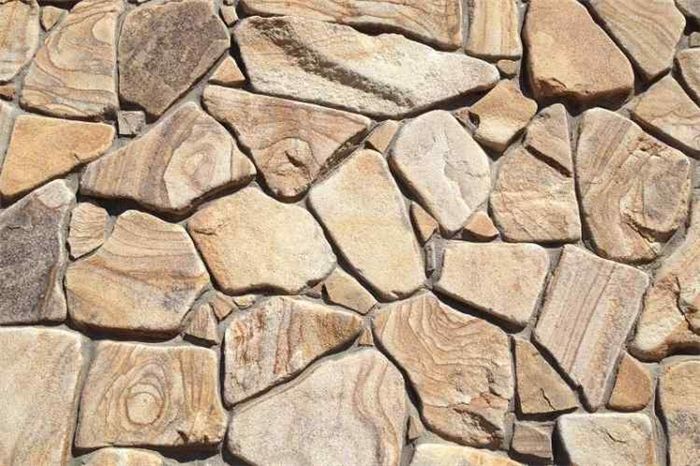
Given that it is a product of nature, sandstone is likewise a natural stone. Its name comes from the fact that the majority of it is made of compressed sand. It might also include clay, organic chemical compounds, and tiny shells.
The colors of sandstone can range from gray to tiger depending on the mining location and processing technique.
The following are some benefits of cladding with sandstone:
- high moisture resistance;
- high-strength building material;
- has a layered structure, which makes it possible to create interesting design projects;
- has insignificant weight, which forms the least load on the blind area;
- impeccable in terms of heat and sound insulation qualities, due to its layered structure;
- not afraid of precipitation and erosion processes;
- strongly pronounced rough surface, which creates an anti-slip effect in icy conditions;
- has a relatively low purchase price;
- well presented in prices, colors and sizes in the retail chain.
Because sandstone lacks the strength and durability of granite, it is not advised to be used in areas used for cargo transportation.
Granite
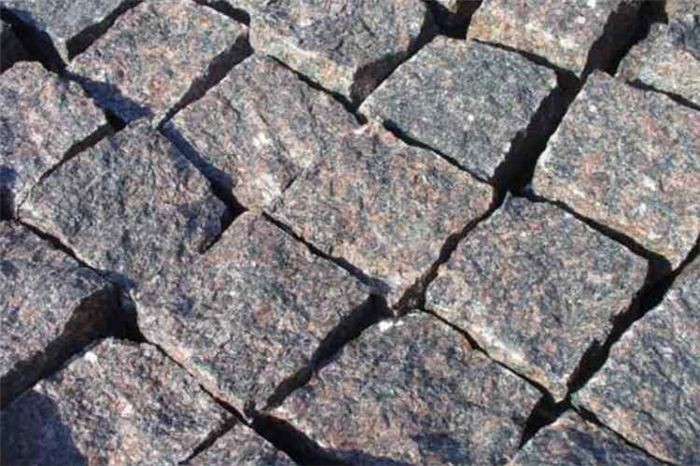
For blind areas, granite stone has long been thought to be the best finishing material. Due to its traditional geometric design, a variety of paving options can be used, allowing for the combination of traditional and ornate surface patterns.
Three varieties of granite stone are obtained from quarrying and used in this type of construction finishing:
- chopped,
- sawn-split,
- clean sawn.
Granite’s highest technological qualities are the main factor behind its widespread use in the construction of blind areas:
- Strength is at least 2700 kg/m3, in this indicator it is second only to diamond.
- Durability, ability to work without loss of quality for more than 300 years.
- Thermal and frost resistance, able to withstand approximately 300 freezing/unfreezing cycles without loss of consumer characteristics.
- Waterproof.
- Environmental safety, does not emit substances hazardous to human health, while the radioactive background of the material does not exceed the natural level.
- Excellent compatibility with other types of finishing stone on the base and walls.
- Large selection of textures.
- Easy to process.
- Wide range of colors.
Granite’s price is its only drawback, but considering its lengthy lifespan, this is a cost that is deemed justified.
Requirements for construction materials
The dimensions of the stone that you choose for a blind area must meet the requirements of the construction project and are determined by the following factors:
- the smallest thickness of stones for main pedestrian paths is 80 mm;
- the smallest thickness of stones for secondary pedestrian paths is 60 mm;
- the smallest thickness of stones for transport infrastructure is 100 mm;
- stones whose sizes differ from each other by more than 2 times cannot be used;
- when choosing a stone, in order to reduce the number of sawn joints, provide a coating width that is a multiple of 1 m;
- using standard sizes, which will simplify the replacement of damaged slabs in the future;
- if possible, choose standard shape sizes from quadrangles to six or octagons, which will minimize the length of the seams in the blind area.
Correct pie diagram
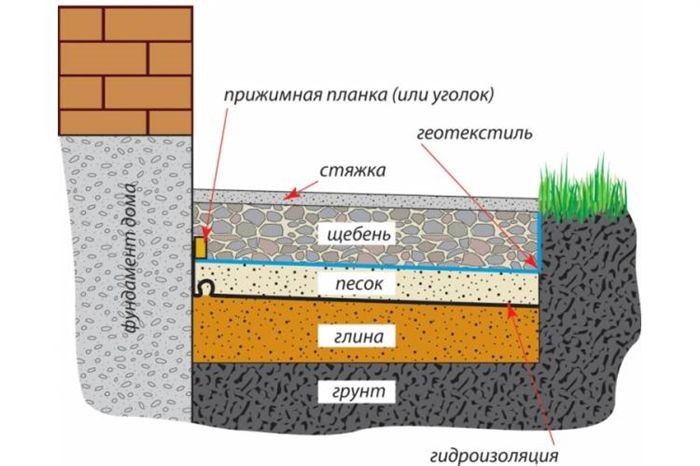
The kind of soil and groundwater table in the construction site have a direct bearing on the stone laying technology selected. In certain situations, constructing a blind area on a sand cushion with stone reinforcement suffices, but in other situations, a sophisticated technological cycle is required.
A professional granite pie for a concrete blind area should have the following layers:
- Priming.
- Clay.
- Waterproofing
- Pressure bar.
- Sand pillow.
- Geotextiles.
- Crushed stone.
- Sand or reinforced concrete.
- Stone.
What you need?
The type of structure determines the equipment and tools needed for stone paving. The master most likely needs:
- a rod up to 2 m long, for detecting defects on the visible part and for monitoring the quality of the coated surface;
- tape measure/meter for measuring distances and making markings;
- square for checking the compliance of angles;
- building level, plumb line and cords for placing beacons and markings;
- fasteners for waterproofing and formwork;
- mortar container;
- paint brushes;
- steel and rubber hammer;
- Master OK;
- electric drill with sets of special drills;
- cutting machine for trimming elements.
There are many benefits to installing a stone blind area around a house, including increased resilience, defense against water damage, and improved visual appeal. But there are drawbacks as well, such as increased expenses and the requirement for expert installation. It’s crucial to adhere to installation guidelines, which include creating a stable base, making sure drainage is adequate, and utilizing high-quality materials, to guarantee the effectiveness of the stone blind area. This post will walk you through the benefits and drawbacks of installing a stone blind area and show you how to do it safely and beautifully.
How to calculate the required amount of raw materials?
You must have the following information in order to determine how much stone is required to lay the blind area:
- perimeter and width of the structure,
- as well as the size of the stone,
- thickness of masonry joints and border size.
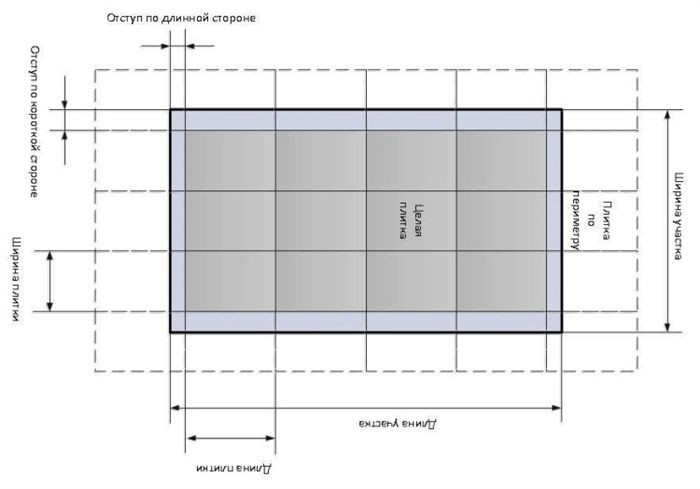
An illustration of how to calculate Kapustinsky crushed stone for a residential building’s blind area with a 10 by 10 m plan is as follows:
- perimeter of the blind area 10×2+10×2=40 m;
- width, 1m;
- total paving area, 1mx40m=40m2;
- tile dimensions, 100x100x50 mm;
- area of one tile, 0.01 m2;
- number of tiles per 1m2,1:0.01= 100 pcs.
- cost of tiles 1 m2, 1530 rubles./m2.
- cost of work, 1400.0 rub./m2.
The entire cost of using stone to face the blind area is 1530×40+1400×40 = 61200 + 56000 = 117200 rubles.
DIY finishing instructions
Without calling professionals, you can lay a natural stone blind area on your own. For nearly every kind of stone, the subsequent actions are required:
- Design and calculation of necessary materials.
- Purchasing stone and preparing tools.
- Excavation and construction work.
- Fixing curbs and laying tiles with a slope from 1 to 10%.
Flagstone
Flagstone installation on the blind area is a straightforward process. The marking scheme that determines the placement of pegs with cords is necessary.
Step-by-step flagstone cladding procedure for blind areas:
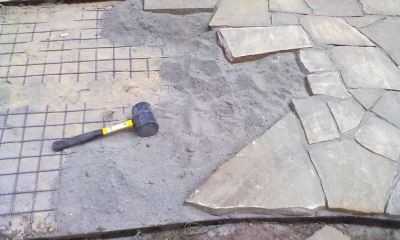
- Prepare a trench around the perimeter with a depth that corresponds to the selected construction pie of the blind area from 200 to 600 mm; when installing curbs, add 50 mm to it.
- Spray the base with water and compact it to reduce the risk of soil subsidence.
- Geotextiles are placed to distribute the load.
- Perform a 150 mm layer of gravel with tamping and checking the level with a level.
- Lay geotextiles to prevent mixing of subsequent layers.
- Pour the cement-sand mixture and level it with the rule.
- Flagstone is laid, loading into the top layer.
- Carefully compact the seams with a dry mixture.
- Sweep away the excess mixture, carefully moisten the resulting blind area with water to prevent the cement from being washed out of the seams.
- Cover with film so that the cement hardens uniformly and
- eliminate mechanical loads on the structure for a week.
Sandstone
The stone needs to be cleaned before sandstone is laid. There are two methods for installing the blind area: dry and wet.
In the first option, a 3:1 sand to cement ratio dry mixture is applied on top of the crushed stone. Sandstone is then laid; big tiles are installed first, working from the edges. The slabs are filled with a similar mixture and have water spilled over them, while the slabs are slightly submerged in the dry mixture.
This mixture is diluted with water and Ceresit 85 glue is added when using the traditional wet installation method. To make installation easier, the stone is first laid out with width and length equivalent to the house wall, allowing pieces to be chosen based on desired size and color.
Once the stone has been laid out, take out a few units and fill the empty space with a solution up to 20 mm thick. Place the tiles back where they belong and firmly press them into the liquid mixture. Use a mixture to rub the seams after the stone is installed.
Installing sandstone in a visually impaired area:
Granite
Granite pavers can be laid over a sand cushion, a concrete base, or a layer of reinforced concrete. Technology used to lay granite:
- prepare a trench;
- water the soil and compact it;
- lay out geotextiles, crushed stone and 5 cm of the mixture, which is compacted;
- the next layer is laid every other day, with a greater thickness than the first;
- Granite stones are laid on it, crushed and knocked out with a rubber hammer and seams seams with a solution.
Possible mistakes
Because natural stone is heavy, the most common mistakes made by developers are in selecting a blind area pattern and in not following the width, depth, and slope of the design. In this regard, the design fails to fulfill its protective purposes.
One of the most common mistakes made when executing a pie is not following the instructions on layer tamping and not adding a waterproofing layer. This can result in the blind area being destroyed within the first year of operation.
Pros and cons of application
Natural stone complete material to complete the blind area arrangement.

Among its most prized attributes are:
- Large selection in the construction market.
- Simplicity of laying.
- Long life.
- Thermal resistance and moisture resistance.
Many users consider stone’s high cost, weight, and high shipping expenses to be its drawbacks.
Prices in the Russian Federation
The type, size, location, and processing method of the natural stone determine the price for blind areas.
For instance, the cost of granite varies depending on how it is obtained; chipped granite costs 1050 rubles per square meter, while sawn-split granite costs 3,200 rubles per square meter. Flagstone’s external dimensions, thickness, and appearance all affect its price.
Giant, thick slabs cost 3,500 rubles per square meter, while thin "MULTICOLOR" slabs start at 300 rubles per square meter. The price of red burnt flagstone ranges from 630 rubles per square meter to 3 mm in thickness, while 100×200 mm stones cost 1900 rubles per square meter.
Cost of work per m2 of area
The size of the paving stones or slabs, the construction area, and the finishing material selected will all affect the cost of creating natural stone blind areas.
The average cost to pave a stone blind area is:
This section contains important and helpful information regarding materials for the construction and finishing of blind areas surrounding the house.
Adding a stone blind area to your home’s exterior has both functional and aesthetic advantages. It protects your home from soil erosion and water damage while also improving its aesthetic appeal. For homeowners wishing to upgrade their property, stone is a wise investment due to its longevity and minimal maintenance needs.
But it’s crucial to take into account any potential disadvantages. When compared to other options, the initial cost of materials and installation may be higher. Furthermore, a poorly installed stone blind area might not offer the desired protection, which could cause problems later on.
To guarantee the efficacy of a stone blind area installation, adhere to certain important guidelines. An adequate foundation and careful excavation are essential. Make use of premium materials and take your property’s drainage requirements into account. The advantages and lifespan of your stone blind area will be maximized with careful attention to detail during installation.
In conclusion, a stone blind area adds value, beauty, and functionality to any home. To get the most out of this home improvement feature, carefully consider the benefits and drawbacks and follow the installation guidelines.


