
Are you considering buying a new house or remodeling the one you already own? Adobe houses could be the special remedy you’ve been searching for. Built from organic materials like straw, sand, and clay, these homes have a long and illustrious history. Homeowners looking for a link to conventional building techniques and a smaller environmental impact are drawn to them because of their combination of sustainability, energy efficiency, and aesthetic appeal.
The remarkable thermal mass of adobe homes is one of their main benefits. The year-round maintenance of a comfortable interior temperature is facilitated by the slow release of heat at night from the thick walls composed of adobe materials. Adobe homes are a sensible option in both hot and cold climates because of their inherent insulation, which can result in significant energy savings on heating and cooling bills.
Nevertheless, adobe has disadvantages just like any other building material. Upkeep can be an issue, particularly in areas that frequently experience high levels of precipitation. Periodic inspection and repairs are necessary for adobe walls to avoid moisture damage, which over time can erode the structure. Furthermore, compared to contemporary building materials, adobe may not be as resilient to seismic activity or severe weather.
Many owners of adobe homes express overwhelming satisfaction with their choice despite these challenges. They value the comfortable atmosphere the thick walls provide, which engenders a sense of peace and security. Living in a place that feels deeply rooted in tradition but is still flexible enough to accommodate modern living needs, homeowners frequently discover that they are closer to nature and history.
| Pros | Cons and Reviews |
| Natural insulation | Requires regular maintenance |
| Eco-friendly material | Prone to moisture damage |
| Energy-efficient | Initial construction costs can be high |
| Durable in dry climates | Not suitable for humid environments |
Through first-hand accounts from owners, we examine the benefits and drawbacks of adobe homes in this article. Adobe homes have a distinct charm and an eco-friendly appeal. They are renowned for their sustainability and natural insulation. Owners value their rustic appearance and energy efficiency. On the other hand, difficulties with upkeep in humid areas and vulnerability to pest and earthquake damage are also covered. This article offers a fair summary based on real-world experiences to assist prospective homeowners in making well-informed decisions regarding the use of Adobe for building or remodeling projects.
- Types of material
- Advantages
- Products
- buildings
- Flaws
- Samana
- buildings
- Reviews
- About the use of the material
- Building owners
- Useful video
- Video on the topic
- HOUSE from SAMANA. Philosophy and practice. Part I
- Problems with a house made of clay. You can"t even imagine!
- Huge adobe house with a bathhouse inside.Review
- Adobe. The house is 150-200 years old, built from very old adobe material, only the walls remain.
- Life in Kuban. What is adobe. Why are adobe houses in Kuban.
- Breaking down the house – problems of an adobe house/New Life
- The whole truth about adobe. Pros and cons of adobe construction. We show our house and draw conclusions
Types of material
You should start by thinking about the different kinds of adobe that are utilized in building construction. The variations result from the construction method and the percentage of clay in the blocks:
- Easy. The finished product contains about 10% clay and 70% straw. It is almost impossible to form blocks from this type of adobe. Therefore, it is used simultaneously with the construction of a wood frame and sheathing. The adobe mixture must be placed in the space between the sheathing. The advantage of lightweight adobe is ease of construction and low cost, and the disadvantage is the need for wooden structures. This increases financial costs.
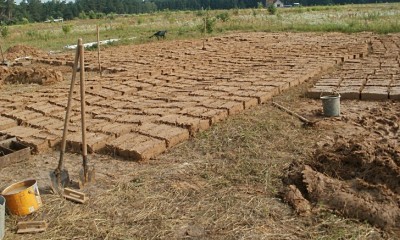
- Heavy. The share of clay in such a composition is much greater – up to 45%. Sand is also often added to the composition. Heavy adobe is molded into bricks that are excellent for masonry. They are durable, but the manufacturing process is considered labor-intensive. In addition to mixing the mixture, molding and laying, long drying is required under careful observance of certain conditions.
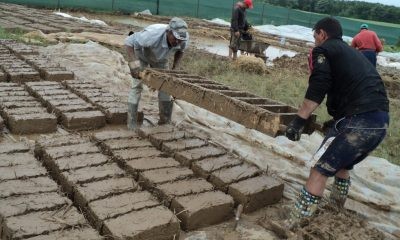
Blocks may be:
- different sizes;
- with additives;
- full-bodied;
- hollow;
- solid;
- half (half blocks).
Crucial! The specifications of Adobe blocks are not subject to legal restrictions. As a result, their selection is based on the wall’s dimensions and building method.
Advantages
Let’s weigh all the advantages and disadvantages of blocks and buildings.
Products
In order to assess all of the material’s benefits, builders typically contrast it with alternative kinds:
- Construction speed. Compared to foam block and brick, adobe allows you to complete the process much faster.
- Environmental friendliness. There are many natural building materials, but making adobe with your own hands allows you to completely control its naturalness. The mixture does not contain chemicals and is not processed by them.
- Budgeting. Material costs are minimal. Most often, clay or clay soil is taken from your own site. The biggest cost may be the cost of delivering sand (clay).
- Thermal conductivity. The blocks maintain temperature balance well. Of course, this parameter also depends on the size of the block and the type of cladding. If you lay out a wall 60-80 cm thick, it will provide a constant microclimate in the room. The indicator depends on the amount of fillers added to the clay.
- High vapor permeability and optimal humidity. If there is high humidity in the house, then adobe blocks absorb excess moisture without retaining it. Therefore, bricks do not become moldy.
- Fire resistance. This is not to say that nothing will be damaged when exposed to high temperatures, but it will be very easy to restore the walls.
- Density. It gives blocks the ability to hold weight. For example, driving a dowel into shell rock is quite difficult. The adobe perfectly supports various shelves and hanging cabinets.
- Ease of production. You can make blocks yourself. No long experience required. The only caveat is to carefully select the composition of the mixture that will provide the required performance.
Take note: Clay blocks don’t need to be fired and have an extremely long service life.
buildings
One can categorize the benefits of adobe homes into multiple groups.
Monetary. Among them are:
- Availability of natural material. All components of the mixture are low cost and abundant.
- Economical technology construction. The walls do not require additional decoration due to the natural layered structure of the material. Also, for the construction of load-bearing walls from heavy adobe, no additional frame or means of fastening are needed.
- Affordable restoration. An ordinary clay solution followed by grinding is suitable for this.
- Application area. The technology of building houses from adobe blocks is suitable for the construction of residential and commercial buildings.
- Strength. Walls made of adobe blocks can withstand decades without destruction. The indicator increases over time.
- Room microclimate. Humidity is at a comfortable level and stays at 40-60%. It does not require additional purchase of humidifiers. Thermal conductivity and thermal insulation of walls allows you to save on heating.
- Fire resistance. The non-flammability of clay will allow the house to withstand even a serious fire.
- Durability. Clay walls are highly resistant to environmental factors. Therefore, adobe houses last a very long time, especially with high-quality blind area and maintenance.
- Good sound insulation and breathability.
- Compatibility with any type of roof, but the best options would be classic and attic. With a streamlined shape, the house has high resistance to wind loads.
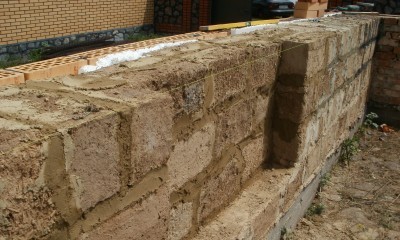
The fact that you can construct an adobe house with your own hands in practically any location adds to its uniqueness.
A modern house can be built even by novices.
There are always three options when it comes to laying an adobe wall. There are also a number of choices for completing the structure.
Observation: The building is very inexpensive.
Every material has unique properties. While there are benefits associated with some of them, there are drawbacks as well. Before using the material, you must be aware of them.
Flaws
Let’s address the drawbacks first.
Samana
The following are drawbacks that builders observe with products:
- High hygroscopicity and the need for protection from excessive humidity. The blocks need to be dried under cover so that moisture does not destroy the bricks before they are used.
- Time limit. Construction of walls is possible only in the warm season.
- Drying time. Blocks gain strength over time – this also needs to be taken into account.
- Low load-bearing capacity. Bricks are not suitable for the construction of high and multi-story structures without additional reinforcement.
- Vulnerability to pests and rodents. Therefore, it is imperative to treat the surface of bricks with antiseptic agents and anti-rodent compounds.
Some people comment on how ugly the blocks look. All of the aforementioned drawbacks, though, are remediable.
buildings
Although there aren’t many flaws in buildings, they still have to be considered.
- Building subsidence. This is due to the considerable weight of the blocks and the lack of a high-quality foundation.
- Mandatory plastering or cladding of wall surfaces. Otherwise, during the active rainy season, a river of mud will flow along the walls of the house.
- Possibility of damage to the building by rodents or insects. This is especially true if the mixture contains a lot of organic matter.
- Difficulty driving in fasteners. True, this does not happen over the entire surface, but still such a problem exists.
- Low productivity during house construction. The bulk of the work is done manually.
- The difficulty of building a second floor. But, in this case, the use of an additional frame and strengthening of the floors will help.
Crucial! Some of the drawbacks will vanish if you employ contemporary wall construction techniques.
Reviews
Let’s examine actual user evaluations of the content and organization.
About the use of the material
Reviewers discuss their experiences using clay bricks.
They draw attention to the primary benefits:
- environmental friendliness;
- material availability;
- ability to "breathe";
- the ability to make bricks with your own hands;
- variability of block sizes and mixture components.
Drawbacks:
- limited period of block molding (heat);
- labor intensity of brick production;
- duration of drying.
You can read reviews about using blocks here and here.
Building owners

Users credit the benefits to:
- comfortable microclimate;
- opportunity for creativity;
- environmental friendliness and safety;
- budget construction;
- the ability to purchase factory-made blocks.
Drawbacks:
- you cannot use cement plaster for finishing;
- the possibility of walls freezing at low temperatures;
- unaesthetic appearance;
- houses often turn out cold due to the incorrect selection of facing materials.
See more homeowner testimonials here and here, as well as on the Forumhouse, RMNT, Mastergrad, and Stroydom forums.
Useful video
Watch this fascinating video where the owner discusses the benefits and drawbacks of the mentioned construction technology:
A special combination of charm, sustainability, and historical appeal can be found in adobe homes. Because adobe bricks create a warm, earthy ambiance that is difficult for modern materials to replicate, owners frequently compliment their natural aesthetic. Excellent thermal mass from the thick walls keeps the interiors warm in the winter and cool in the summer, which can drastically lower energy costs. Moreover, local suppliers of materials are usually used in adobe construction, contributing to its environmentally friendly and economically beneficial nature.
Nevertheless, there are some disadvantages to adobe homes. Maintenance is a big issue because adobe walls need to be maintained on a regular basis to prevent erosion from wind and water. Plastering and sealing done correctly is crucial to preventing moisture damage, which can be a big problem in humid areas. The initial outlay of money and effort must also be taken into account. Building an adobe home can be a labor-intensive process that calls for skilled artisans who are conversant with traditional building methods.
Many owners of adobe homes express great satisfaction with their homes in spite of these difficulties. They take pride in maintaining a traditional building technique and value the connection to history and culture that adobe construction embodies. Furthermore, compared to synthetic materials used in contemporary construction, the natural materials used in adobe houses contribute to better indoor air quality.
To sum up, although adobe homes need careful upkeep and an initial financial outlay, their advantages in terms of sustainability, energy efficiency, and aesthetic appeal frequently surpass these drawbacks for people who value a distinctive, environmentally conscious living environment steeped in tradition.


