
Selecting the appropriate roofing material is essential for any building or remodeling project. There are numerous options available on the market, each with specific benefits and drawbacks. Of these, ondulin is a well-liked option because of its cost-effectiveness and robustness. However, how does it stack up against alternative materials like clay tiles, asphalt shingles, or metal roofing?
Making educated decisions about roofing materials can benefit both builders and homeowners by being aware of the differences between them. The best fit for a given project is determined in large part by factors like cost, lifespan, ease of installation, and aesthetic appeal. A better idea of what to anticipate from each choice can be obtained by comparing these characteristics.
With its reputation for being waterproof and lightweight, ondulin makes a compelling argument for both home and business use. It’s crucial to compare these advantages with those of alternative materials, though, as some may provide better strength, durability, or aesthetic appeal. One can choose the roofing material that most closely matches their individual requirements and tastes by looking at these factors.
- Ondulin
- Pros of ondulin
- Cons of ondulin
- Which is better, ondulin or slate
- Advantages of slate
- Flaws
- Ondulin Smart and Ondulin Standard: differences and installation features
- Ondalux (difference from Ondulin)
- Onduvilla
- Ondulin or soft tiles, which is better??
- Ondura
- Useful video
- Video on the topic
- 165. ONDULIN AND METAL TILES
- 188. Comparison of Ondulin Smart and Onduvilla (material characteristics are current for 2026)
- Ideal Roof for a Private House in 2026. Which Roof to Choose in 2026
- Roofing material Ondulin
- Comparison of Ondulin and flexible tiles
- 187. Comparison: ONDULIN and slate
- Did you know this about Ondulin Tile?!
Ondulin
Slate roofing is becoming less and less common in today’s world of modern building technologies. The building industry is being taken over by new roofing materials. Among these roofing materials is ondulin, also referred to as Euroslate.
This French-invented material is composed entirely of organic raw materials. Every cellulose molecule that goes into the making of ondulin is heated to 120°C. Following that, the resultant mass is corrugated and compressed. After being painted in a variety of hues, the completed sheets are impregnated with bituminous polymer resins.
Ondulin is safe, waterproof, and eco-friendly. Additionally, the sun’s heat during operation strengthens the solder by heating the thin cellulose fibers together.
Pros of ondulin

- Water resistance. In this case, the ondulin sheets are overlapped during installation, which ensures additional tightness.
- Environmentally safe and hygienic. Rainwater flowing over its surface can be used as drinking water.
- Resistant to aggressive environments (acids, alkalis, petroleum products, industrial gases)
- Ease. A sheet of ondulin 2 m long and 1 m wide has a mass of 6.5 kg. It is 4 times lighter than a slate sheet.
- Easy installation, no need for bulky rafters. Quick and easy calculation of ondulin sheets using an online calculator.
- Easy to process – Effortlessly cuts with a regular wood hacksaw. And if you also lubricate the teeth with oil, then the work will be quite simple. More details here.
- Flexibility. Can be given any shape. And, therefore, it is possible to install roofs of any shape and complexity.
- Price. A sheet of ondulin costs about 300 rubles. This is several times cheaper than metal tiles. Slate, however, is much cheaper than this coating, but it contains harmful asbestos.
- Silent. You can"t hear the sound of drops when it rains.
Nevertheless, ondulin has a lot of drawbacks despite its allure. It is important to remember that this is frequently the result of poor roof installation.
Cons of ondulin
- Strength. Very often, consumers complain about durability: they say that the coating is so thin and fragile that it is impossible to walk on it like asphalt. Can"t even withstand deep snow. This happens due to improper sheathing of rafters and saving on nails. After all, in order for the sheet to lie firmly on the rafters, you need at least 20 nails. In this case, the pitch of the rafter sheathing is 60 cm, and the slope is more than 15ᴼ. Only then will the roof calmly support a weight of 960 kg per 1 sq. m
- Roof repairs should not be done in hot weather – high temperature softens the coating. This may cause roof damage. In addition, in extreme heat, bitumen is released. That"s why the smell is specific.
- Fire hazard. Ondulin is organic. That is why during a fire it burns very cheerfully. Although a cheap “tin can” burns well.
- Durability. There are owners whose roofs collapse in just two or three years. And some enjoy their coverage for 15-20 years. Durability is directly related to operating conditions. In extreme conditions and service life is short. And if, at the same time, the fasteners are made with violations, then 2-3 years of operation is the maximum period.
- Loss of color. After a certain time in direct sunlight, the paint fades. If this happens very quickly, then this can only mean one thing – ondulin is not real, but simply an analogue. Real quality coatings are first painted and then impregnated with bitumen.
- Biological resistance. In this regard, ondulin, like slate, is susceptible to infection by various fungi and mosses. After 2 years of operation, such a roof begins to turn green in those places that are in the shade and poorly lit by the sun.

When ondulin is installed correctly, the roof can provide dependable weather protection. But in terms of strength and durability, this coating pales in comparison to all others. It can be applied when a low-cost roofing material is required. It is important to keep in mind that ondulin sheets are either continuously coated underneath the sheathing or attached to it with a fairly fine pitch.
Let’s now examine inexpensive ondulin alternatives.
Which is better, ondulin or slate
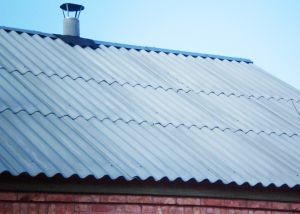
Following the completion of the walls of his home, the homeowner must decide which roofing material to use. Slate? Ondulin? What are the benefits and drawbacks of using this particular roofing material?
Please carefully review the characteristics of the proposed materials before making a roofing purchase.
Consider the benefits and drawbacks of each.
Slate. Very durable and reliable material. constructed from slate that has been laid in a variety of sizes and patterns of slabs. The slate has a 100-year service life if it is installed in accordance with all regulations! Slate is not afraid of harsh surroundings and is highly resistant to unfavorable climatic changes.
Since the Soviet era, asbestos has been added to slate to create a useful material. The West no longer uses it. The toxic nature of asbestos, which is bad for your health, is the cause. However, asbestos slate is still widely used because a variety of paints and primers can bind asbestos dust and stop it from spreading. It presents challenges when installing intricate structures, though.
Ondulin. The manufacture of this roof solely employs natural, eco-friendly raw materials. Thus, it is not harmful to people’s health, in contrast to asbestos slate. The composition’s bitumen, cellulose, and resins provide the material’s strength and durability. Any façade and any roof shape can be matched with a variety of colors.
Advantages of slate
- Hardness.
- Anti-corrosion.
- Low heat transfer (in hot weather it heats up a little).
- Price.
- Life time.
- Maintainability.
Flaws
- If the slate is not treated with an antifungal solution, moss may appear on the surface.
- Asbestos dust is harmful to health.
- Quite a large mass of plates.
- Fragility (requires care during transportation and installation).
You should consider their service life when deciding between Slate and Ondulin. They are nearly equal when operating in the same conditions. The slate does not distort when the temperature changes, which is the difference. However, if the coating is applied properly, it is not less effective than slate. Compared to slate, the sheet is much lighter, easier to work with, and more flexible during installation.
The low ignition temperature of ondulin (only 300ኼC) is one of its drawbacks in terms of fire safety. Prior to making a roofing purchase, thoroughly research the features of the material as well as the installation and maintenance guidelines.
Ondulin Smart and Ondulin Standard: differences and installation features
There is very little difference between Ondulin and Ondulin Smart; it’s all in the details. All of Ondulin’s attributes and traits were previously discussed. We will talk about the attributes and features of the Ondulin Smart roofing sheet in this section. The various companies that produce it result in varying performance qualities. Thus, Intelligent:
This content is more contemporary. After all, "smart lock" fastenings were introduced by smart manufacturers. It enables you to obtain an exact even edge and install the roof more quickly. They did not overlook the nail holes at the same time.
Smart has superior waterproofing and weighs less. It is environmentally friendly, just like Ondulin. Consequently, we obtain an enhanced and modernized version of the same Ondulin.
How does Ondulin compare to other roofing materials like metal, asphalt shingles, and clay tiles? Ondulin is a well-liked roofing material that is well-known for its affordability and ease of installation. The purpose of this article is to assist homeowners in making an informed decision regarding their roofing needs by comparing the benefits and drawbacks of ondulin with these alternatives and looking at aspects like cost, weather resistance, durability, and visual appeal.
Ondalux (difference from Ondulin)
In France, Ondulin-producing factories also produce Ondalux, also known as Ondura. However, this material also offers benefits:
Ondalux is easy to install and doesn’t require any specialized knowledge. You will need a hammer, nails, a hacksaw, a pencil, and installation instructions. A single sheet weighs only 5 kg, but a roof requires 60 sheets, each weighing 300 kg.
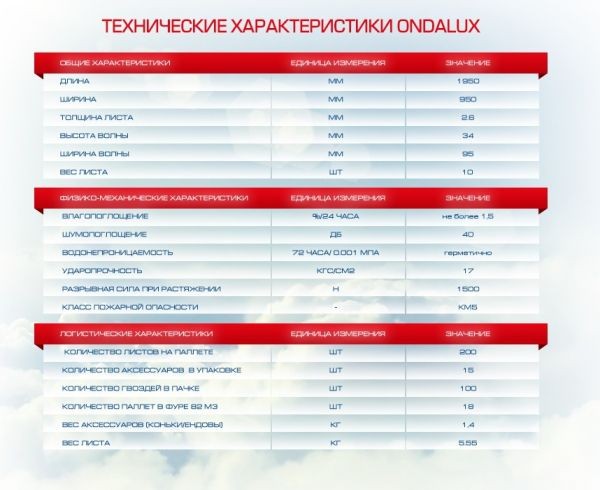
Ondalux’s technical specifications (ONDALUX)
Onduvilla
Is Onduvilla or Ondulin superior? Let’s examine the materials’ composition first. The material for Onduvilla is asphalt shingles. While there are some differences, its composition and production process are similar to that of ondulin.
Despite being on the market for just ten years, onduvilla has grown in popularity. It embodies every beneficial aspect of ondulin. The frame made of cellulose fibers serves as the foundation of the sheet. Additionally, the material is made wavy to ensure adequate strength and good drainage.
But after being impregnated with SBS-modified bitumen, ultimate strength is obtained. In addition, bitumen is impregnated into the tiles following painting. Apply four layers of paint on the tiles: one base layer and one primer layer. Technically, ondulin and onduvilla are equivalent. They vary in price in addition to sheet size and weight. Although Onduvilla is slightly more costly, its features make up for it. Additionally, every Ondulin accessory is compatible with every kind of Euro slate.

Onduvilla in comparison to other materials
Ondulin or soft tiles, which is better??

A soft roof can serve as an alternative to ondulin. It is a global phenomenon. For soft roofing, fused bitumens were initially utilized, but new coatings have since emerged. The soft roof is composed of bitumen, fiberglass, different stabilizers, and quality-adding ingredients.
These kinds of roofs include membrane roofs, rolled materials, mastic, guided roofs, soft bitumen tiles, and shingles.
They don’t need any extra fasteners and are simple to install. This is a 15–35 year service life.
Which is better: ondulin or flexible tiles? Flexible tiles are superior based on their features, but they have a pricey disadvantage.
Ondura
What’s the difference between ondura and ondulin? There is a lot of overlap between these two roofing materials. a widely used roofing material that is high pressure vacuum bituminized. Ondura is damage-resistant, soundproof, and waterproof. withstands variations in temperature between -50 and +50 degrees. Ondura can withstand harsh conditions, mold, and fungi.
One sheet of a sufficiently large size costs only 350 rubles, making the price appealing. As demonstrated by actual use, ondulin is slightly less expensive than ondura but offers less noise insulation. The properties of these materials are identical otherwise.

Useful video
We cordially encourage you to view this video on selecting a roofing material:
| Material | Advantages | Disadvantages |
| Ondulin | Lightweight, eco-friendly, affordable | Less durable than metal, prone to color fading |
| Metal Roofing | Highly durable, fire-resistant, long lifespan | Expensive, noisy during rain |
| Asphalt Shingles | Affordable, easy to install, variety of styles | Shorter lifespan, less eco-friendly |
| Clay Tiles | Very durable, aesthetically pleasing, fire-resistant | Heavy, expensive, requires reinforced roof structure |
| Slate | Extremely durable, low maintenance, classic look | Very heavy, very expensive, difficult to install |
For roofing to be long-lasting, economical, and aesthetically pleasing, the right material must be chosen. A popular option that many homeowners prefer is Ondulin because of its affordability and simplicity of installation. However, there are a number of considerations when contrasting it with alternative roofing materials that could affect your choice.
Although ondulin is weather-resistant and lightweight, materials such as metal roofing and tiles offer greater longevity and durability. For example, metal roofs are renowned for their durability and ability to withstand fires, despite the fact that they can be more expensive and difficult to install. Conversely, tile roofs have a timeless appearance and exceptional longevity, but they need a strong framework to support their weight.
Furthermore, asphalt shingles offer a compromise between cost and reasonable durability, but they might not have the same long-term or visual advantages as tile or metal roofs. Every roofing material has distinct benefits and drawbacks, so it’s crucial to take your specific needs into


