
In many construction projects, trench excavation is an essential step, ranging from utility line installation to foundation installation. To guarantee that the trench satisfies precise specifications for depth, width, and safety, the procedure calls for accuracy and effectiveness. Using an excavator can greatly expedite the process of digging, even though it can be labor- and time-intensive when done by hand.
An excavator is a multipurpose heavy equipment tool with a strong arm and bucket for rapidly digging and moving large amounts of dirt. An excavator can make trenches that are precise, safe, and uniform when operated by a qualified operator. This shortens the project’s duration while also lessening the physical strain on employees.
But using an excavator to dig a trench effectively requires more than just operating the tool. It necessitates thorough planning and knowledge of the site’s characteristics, such as the kind of soil, any subterranean utilities, and surrounding elements. In order to avoid mishaps and guarantee that the work is done correctly, there are also crucial safety precautions and best practices to adhere to.
Everything you need to know about trench digging with an excavator will be covered in this article. We’ll go over all the important details to help you have a successful excavation, from selecting the appropriate tools to comprehending the steps in the digging process.
| Aspect | Description |
| Preparation | Ensure the area is clear of obstacles and utilities are marked to avoid damage. |
| Choosing the Right Excavator | Select an excavator suitable for the trench size and type of soil. |
| Operator Skill | Hire a skilled operator to ensure efficiency and safety during the excavation. |
| Safety Measures | Wear protective gear and follow safety protocols to prevent accidents. |
| Trench Depth and Width | Dig to the specified dimensions to ensure stability and compliance with regulations. |
| Soil Management | Properly dispose of or store excavated soil to keep the site organized. |
| Weather Considerations | Avoid digging during adverse weather conditions to prevent complications. |
| Inspection | Regularly inspect the trench for stability and safety throughout the digging process. |
| Completion | Ensure the trench meets all requirements before moving on to the next construction phase. |
- Features of machine development
- When and why is digging with special equipment used??
- Types of cars
- Technology and rules for developing soil using special equipment
- Typical technological maps
- Description of construction work
- Development of soil using a machine
- What is the price for equipment services?
- Pros and cons of using machines in soil development
- Video on the topic
- Digging a trench with a New Holland excavator
- How not to dig a trench! Mini-excavator.
- How an experienced excavator operator drives onto a trawl
- How to dig with an excavator with centimeter accuracy?!
- PULLING THE BUCKET EVEN. HOW TO LEARN TO DIGGING Smoothly WITH AN EXCAVATOR
- How to learn to dig with an excavator
- How to dig a trench with a crawler excavator/quickly and smoothly with a Hyundai 210
- How to dig a trench with slopes using an excavator
Features of machine development
Certain construction projects are hard to envision without trench development. Work involving excavation is categorized as basic operations. In order to stabilize the situation, trenches are dug to strengthen building foundations.
The dimensions of trenches are elongated in one direction, which sets them apart from pits. To put it another way, this is just a longer ground channel. The breadth is between 50 cm and 5 meters. Additionally, the depth may be important.
The main factor contributing to excavators’ rise in popularity is their extraordinary efficiency. Whether you use a backhoe or a straight shovel, the execution speed is faster than with manual labor. Superior machinery can move between fifty and one hundred cubic meters of dirt in an hour.
When and why is digging with special equipment used??
Any kind of rock or soil can be used with single-bucket equipment. Including—with elevated humidity and infiltration of groundwater. It is advised to use multi-bucket types of equipment for soils that fall into categories 1 through 4. Though only categories 1 through 3 allow for safe operation. Only homogeneous layers should be used for manipulations in case 4.

When choosing a car to dig a trench, consider the following crucial factors:
- The need to use replaceable devices.
- Availability and possibility of groundwater inflow.
- Category of cut material.
- Notch characteristics.
When multiple models are appropriate at the same time, it is advised to prioritize forward and reverse shovels, also known as "draglines."
It is crucial to ascertain the bucket capacity’s volume by filling it to the maximum in the shortest amount of time. The type of material being processed, the depth of work, and the complexity of cutting all directly affect the maximum load indicator. Terrain and climate have an impact on the choice as well.
Types of cars
The most basic single-bucket excavator is a tool used in the construction industry for a variety of excavation tasks and operations.
The equipment production cycle has only a few stages:
- First, the soil layer is cut and the bucket part is filled.
- The filled bucket is raised to allow easy access to the dumping site.
- The boom is raised to the unloading area. Sometimes lifting the bucket is performed simultaneously with this operation.
- The cut rock is poured out.
- Feed the bucket part again to repeat loading.
Equipment advancement is ensured by running it. Self-equipment is broken down into various categories:
- Rail-walking. With reduced surface pressure and increased maneuverability.
- Walking. It is stable, the pressure on the surface is also minimal.
- Pneumatic.
- Crawler. Provides increased cross-country ability. Suitable for working with difficult terrain.
Chopping and gathering rock takes up to 15–30% of the working hours throughout the production cycle. Multi-bucket types are therefore thought to be more productive. The work process is kept going with multiple buckets of varying widths. However, there are limitations concerning the size of the rock being raised. Equipment with a single bucket operates without these limitations.
Additionally, there are chain and rotary excavators:
- Rotary – these are units with strictly parallel digging. The rotor itself rotates parallel to the axis of the trench.
- Chain varieties are also named after the main working body with which the equipment is equipped. Usually the main body is the frame on which additional equipment is hung.
Mini excavators started to appear over time. Due to its versatility, this technique is now almost universal. The devices can handle a variety of fillings up to one ton in weight.
Generally speaking, a mini-excavator is a scaled-down version of standard equipment. A great choice for tight spaces and small amounts of work.
Technology and rules for developing soil using special equipment
You can see this kind of work at nearly all residential and commercial construction sites.
The typical diagram appears as follows:
- Geological examination, site analysis.
- Development of project documentation.
- Selection of special equipment with the right characteristics.
- Organizational and preparatory activities.
- Soil development. The layers are removed sequentially.
- Strengthening and processing of pit walls.
- Acceptance of work from the customer.
Surveyors are experts who keep an eye on the project’s execution at every turn. Keep an eye on the observance of safety regulations separately. Design documentation is created based on engineering surveys, which is then used as a basis for carrying out work.
Typical technological maps
The following acts form the foundation of the regulatory framework:
- SNiP-3-42-80.
- SNiP_12-03-2001.
- SNiP_3.05.04-85.
- SNiP_3.02.01-87.
- SNiP_12-01-2004.
The technology indicates that a permit is first granted in Gati. After that, they start working on preparation and organization. At this point, information boards are installed and the responsible parties are identified. They accept the breakdown base separately and are provided with a working draft that includes a pipeline plan.
There are other matters that require attention:
- Obtaining a technological map.
- Conducting training for workers.
- Creation of access roads.
- Installation of inventory structures according to the construction master plan.
They then proceed to get the tools and equipment ready. Everything required, including personal protective equipment, is given to the workers. A report indicating that the object is prepared for additional work is only issued after the preceding stages have been completed.
Description of construction work
When developing a ditch, the following construction phases are involved:
- Excavation of soil, after which it is thrown into a dump. This is done until the depth of the trench corresponds to the pre-created project.
- Pits are dug in areas with pipe joints.
- If required, slopes and drainage systems are installed.
Plan for digging a trench using an excavator:
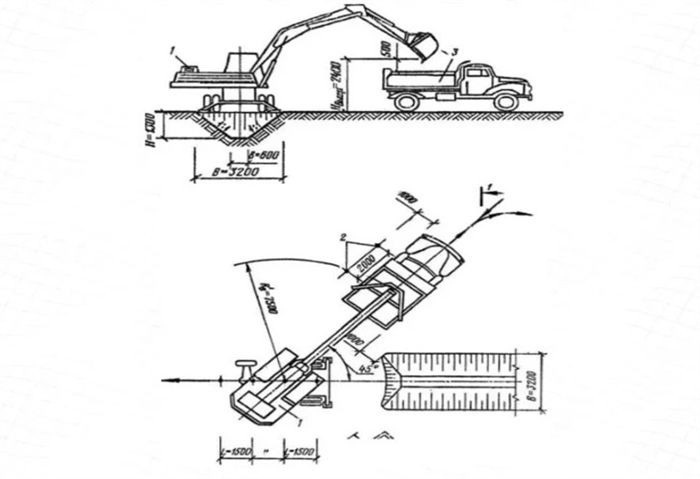
The region is laid out geodetic in both horizontal and vertical planes. This work’s prerequisites are outlined in SNiP 3.02.01-87. Make sure to thoroughly clean the area before excavating a ditch; it’s crucial to get rid of any debris and remnants of previous construction materials.
A bulldozer will level the area and create a surface slope that is in line with the original plan. It is possible to remove unevenness and ground mass up to 15 cm in height.
Development of soil using a machine
Which scheme is used for the first work organization is determined by the project. For instance, using a backhoe is assumed in the technological map. In this instance, excavation occurs beneath the parking level and the cutting occurs on itself. Dumps are positioned on one side of the trench, at least 50 centimeters from the edge.
After the waste soil has been removed, it may be used again for the following uses, if needed:
- Backfilling an unclaimed trench.
- Sinus filling.
- Organization of reserve dumps.
They guarantee the preservation of high soil strength because of the scarcity. The excess material is compensated for by backfilling the excavation with the same local soil. In accordance with the design, adding the composition to the mark is sufficient. The ideal coefficient for compaction is 0.95.
For safety and efficiency, it’s essential to comprehend the procedure when using an excavator to dig a trench. From planning and preparation through the actual excavation and finishing touches, this article will walk you through all the necessary steps. We’ll go over how to pick the best tools, make sure everything is safe, and carry out the digging process efficiently so that your project runs more smoothly and successfully.
What is the price for equipment services?
The cost of utilizing this equipment for soil development is influenced by a number of factors:
- Distance between workplace and base.
- Soil topography along with its condition.
- Soil characteristics.
- Total scope of work.
Base price estimate The primary document that establishes the price is TSN. The results need to be calculated taking into consideration the soil group and bucket capacity. The equipment itself is larger in proportion to the size of the bucket.
An illustration of trench development costs per meter is as follows:
| Name of works | Unit | price |
| Compacted crushed stone base manually layer by layer more than 300 mm | M2 | 2200 |
| Compacted crushed stone base by hand up to 300 mm | M2 | 200 |
| Compacted sand base from 300 mm | M2 | 600 |
| Compacted sand base up to 300 mm | M2 | 600 |
| backfilling | M3 | 200 |
| Manual soil development | M3 | 300 |
| Mechanized method | M3 | 300 |
| Site breakdown, coordinates removal | DOT | 400 |
Pros and cons of using machines in soil development

Any kind of excavator used increases productivity by default.
For the purpose of obtaining statistics for the entire industry, the equipment ensures stable and safe operation.
The drawbacks of modern technology are almost nonexistent. All you have to do is stay tuned for their updates and technical details.
Although there may be an initial cost increase, the benefits of continued operation are so great that they can offset all expenses.
In many construction projects, ranging from utility installation to foundation installation, digging a trench with an excavator is an essential task. A thorough understanding of the tools, procedures, and safety precautions involved can greatly impact the effectiveness and outcome of your project.
The first step is to select the appropriate excavator for your trenching requirements. Take into account elements such as site conditions, soil type, and trench size. In order to guarantee accuracy and safety, proper operator training is necessary. The machine can be operated effectively by an experienced operator, lowering risks and shortening project duration.
It’s crucial to plan thoroughly before you begin digging. Determine the trench’s path, look for subterranean utilities, and obtain the required permits. Planning ahead ensures that the trench is dug correctly the first time and prevents delays.
The first priority should always be safety. Wear safety equipment, adhere to safety procedures, and keep the excavator well-maintained. Accidents can be avoided and the workplace can be kept safe with routine inspections and adherence to safety regulations.
Gaining a comprehensive understanding of the fundamentals of trenching with an excavator will help you to optimize your project, improve safety, and efficiently accomplish your goals. An emphasis on safety, appropriate equipment, and careful planning are essential for trench digging to be successful.


