
Although it could seem like a difficult undertaking, you can replace a garage roof on your own if you have the correct instructions and equipment. Whether you’re upgrading, repairing leaks, or dealing with weather damage, taking on this project yourself will save you money and provide you with the satisfaction of a job well done.
We’ll guide you through the process of replacing your garage roof in this article. You’ll discover how to effortlessly manage every step of the process, from assembling the required supplies to applying the finishing touches. We’ll concentrate on using economical and effective techniques to make sure your new roof is strong and long-lasting.
Don’t worry if you’re a beginner. Our clear instructions and helpful hints will assist you in avoiding typical problems and successfully finishing the task. So prepare to turn your garage roof into a strong, weatherproof shelter by rolling up your sleeves.
| Step | Description |
| 1 | Remove old roofing material and clean the surface. |
| 2 | Inspect the roof structure for damage and repair as needed. |
| 3 | Install a waterproof underlayment to protect against moisture. |
| 4 | Lay down the new roofing material, starting from the bottom and working upwards. |
| 5 | Secure the new roofing material with nails or screws as required. |
| 6 | Seal edges and seams to prevent water leaks. |
| 7 | Inspect the finished roof for any missed spots or loose sections. |
With the correct advice, replacing a garage roof yourself can be a simple and affordable project. In order to achieve a finish that is weather-resistant and long-lasting, you should follow the steps outlined in this article when covering a garage roof. Whether you’re trying to fix damage, leaks, or just want to upgrade, you’ll find all the advice you need to finish the job quickly and affordably.
- The need for complete coverage
- The better to remake?
- The most economical options
- On concrete slabs and wooden beams
- Preparing for work
- Revision
- Dismantling
- Replacement of structural elements
- Methods for laying a new roof
- Using hot bitumen
- Soft roofing materials
- Installation of corrugated sheets or metal tiles
- Laying a new roof over the old one
- Video on the topic
- Repair of wooden roof and garage roof
- MAJOR REPAIR OF GARAGE ROOF. How to repair a roof. GARAGE ROOF REPAIR DETAILS
- Corrugated garage roof! With your own hands
- Garage Roof Repair Fast, Easy and Cheap
- Complete repair of the garage roof: dismantling, processing and laying the material in 2 layers.
- Major garage roof repair.
- Garage roofing for ONLY 3 thousand. Rub! The CHEAPEST, high-quality DIY GARAGE ROOF repair!
- DIY garage roof.
The need for complete coverage
When tiny holes or cracks develop in the canvas and the overall damaged area is less than 10%, it is sufficient to make cosmetic repairs in order to fix the resulting mistakes.
In situations where there are significant flaws in the structure or any of its component parts, along with a 60% or greater volume of worn-out surface, only extensive repair work—which includes replacing the roofing material entirely—will be beneficial.
The building’s owner has the authority to determine which work—repeatedly applying patches or applying a completely new coating—is more profitable for him due to the significant difference in percentages.
The better to remake?
You should base your material selection on the following key ideas:

- type of roof structure – flat or pitched;
- roof base – concrete or wooden structure;
- roofing cost;
- the need and quality of sound and thermal insulation;
- durability of operation.
The most economical options
One of the least expensive materials is roofing felt. However, because it is made of cardboard that has been slightly impregnated with bitumen, its durability cannot be compared to that of other coatings. The surface is treated with specific talc or asbestos crumbs to strengthen its quality in some way.
A square meter that is one meter wide starts at twenty rubles. On the other hand, keep in mind that you will need to apply multiple layers for the roof to be more protected. Such a material has a maximum life of five years.
More contemporary options, such as rubemast and bikrost, cover material based on bitumen impregnation. Polymer materials are present in the first. Such a product is priced starting at 47 rubles per square meter. The second choice is an impregnated fiberglass structure. One square meter costs roughly one hundred rubles.
The standard gray slate is the most cost-effective choice when it comes to hard materials. It has good operating qualities despite its low price. Nonetheless, experts list increased fragility and heavy weight as two of the major drawbacks. A payment of 120–140 rubles per square meter will be required.
As a roofing material, corrugated sheeting is another option. It can also be categorized as a reasonably priced material, even though the price will be slightly higher at 240–280 rubles/m. kv. Profiled sheets have the best performance characteristics when installed correctly and are safe and environmentally friendly.
On concrete slabs and wooden beams
Roll material works best as a covering for concrete floors that are installed either straight horizontally or with a small slope. Roof felt is the most fundamental.

It takes a lot of time and work to lay roofing felt sheets, so more recent roofing materials with better qualities have started to be used.
For instance, bikrost, an enhanced version of roofing felt, is more ductile, has a longer service life, and is far simpler to install.
There are no material restrictions if the base is constructed of wooden beams. Both soft and hard materials can be used for pitched roofs, depending on the slope’s angle.
The sheathing should be nearly continuous if you use corrugated sheeting with tiny corrugations and no stiffeners to cover the roof.
Additionally, laying the guided web directly on the beam may cause some issues. In this instance, the use of open fire may cause damage to a portion of the rafter system. The roof needs to be treated with an antiseptic and fire retardant first in order to prevent this.
Preparing for work
There are several tasks that must be completed in advance of beginning any repairs. The roof must first be inspected, the old roofing must be removed, and the major components of the roof structure must be replaced if needed.
Revision
Prior to anything else, the roof must be carefully inspected, particularly in the case of rocky views:
- identify corrosion, various kinds of damage;
- make an assessment of the temperature of the structural elements;
- determine the moisture content of the wooden base;
- see how suitable for further use the roofing.
If the roof is flat, the condition of the waterproofing coating is the first thing they check. Moreover, if waterproofing is present, where it is located in relation to vertical elements (such as exhaust pipes, parapets, etc. D.
Dismantling

It is preferable to remove the old coating completely before applying a new one. You can use a special scraper to carefully clean the roof all the way down to the base.
Using a burner to heat the bitumen will aid in its removal as it is tightly packed on the surface. Additionally, any concrete and plaster growths that may still be there from the prior overlap must be removed.
If only the top one or two layers of the soft roofing sheet need to be replaced, that replacement should only be done partially. In this instance, it’s critical to look for and remove any damage throughout the lower layers.
Replacement of structural elements
Any wooden frame flaws need to be replaced and cleaned with an antiseptic solution. The concrete surface must be free of cracks and potholes, and any gaps must be filled in with cement mortar.
If necessary, the tides should be adjusted right before the ceiling is installed. When a roll is applied tightly, all minor components are put in place prior to the primary roofing material layer being adhered to.
Methods for laying a new roof
Choosing the right coating is the first step in any repair process. In this case, it is important to take into account the condition of the garage itself, how worn out the structure is, what type of roof and its base. This makes it possible to distinguish between three primary repair techniques: metal profile coating, soft roll waterproofing, and heated bitumen.
Using hot bitumen
The steps listed below should be followed when utilizing this method:
- Thoroughly clean the surface of the base from debris, rinse and dry, for example, with a hair dryer.
- Prepare bitumen solution. To do this, add used oil or diesel fuel to it. This will provide the material with better adhesion.
- Heat the bitumen and gradually pour it over the entire roof area. To determine the correct direction of the mixture, it is advisable to use a wooden board.
In the event that the concrete base has already had holes made in it, they must be filled entirely with bitumen to prevent leaks from occurring.
Soft roofing materials
Roll bitumen roofing materials are utilized in this instance. Applying the first requires that repair work be done in the order listed below:
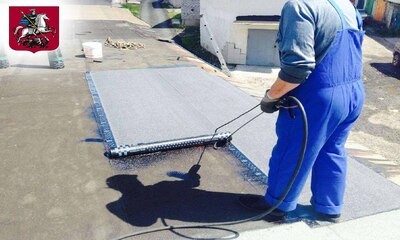
- Apply a layer of oxidized bitumen to the previously prepared roof base. This will allow the rolled web to quickly and firmly adhere to the base.
- During installation, the roll is gradually rolled out to 50-60 cm, the underside is heated and gently pressed to the surface using a T-shaped device or stick.
- Next, you need to stand with your feet on the laid piece of canvas and roll it out to the same length. Repeat all steps described in the previous paragraph. And so on until the roll ends.
- The second strip must be overlapped by approximately 8-10 cm.
In the event that roofing felt was chosen, then:
- First, the base is filled with tar. It can be applied in small areas as repair work is completed. You can also use mastic. Then an additional lining material should be applied to it, and for good adhesion, it should be heated with a gas burner.
- The second stage is already laying roofing felt strips with an overlap of 10-15 cm. If swelling appears, these places are cut, pressed tightly to the base and an additional layer of tar is applied on top. It is worth paying attention that roofing felt is spread perpendicular to the backing sheets. The installation itself begins from the bottom up. You also need to ensure that the edges extend onto the roof curb or adjacent building, if any.
Installation of corrugated sheets or metal tiles
Typically, these materials are applied to a wooden frame with an inclined roof at a specific angle. Thus, in order to cover with corrugated sheeting, the following is needed:
- If the sheets are solid and do not require lengthening, then repair work should begin by securing (not tightly) the first element in the upper right or left corner. To do this, use self-tapping screws with rubberized linings. In this case, ordinary nails will not be reliable, and in a strong gust of wind the sheets may come off. To attach the sidewalls, which should be located along the overhang, a special profile is additionally purchased.
- Next, more sheets are placed next to each other, overlapping them on one wavelength. If the intersection goes along the transverse line, then overlap by about 2-5 cm.
- After the sheets are aligned, they are finally secured. The middle is in a checkerboard pattern, and the top and them through the wave.
Work gloves should be the only gloves used for the task. You could get hurt because of the profile’s extremely sharp cut edges.

If the roof has a wooden or metal frame, it is possible to cover it with metal tiles (the first option is preferable).
Fastening is accomplished with self-tapping screws and rubber gaskets. There is overlap between the sheets. The top and bottom of the sheet have unique latches to guarantee a secure fit.
Laying a new roof over the old one
Sometimes it’s not necessary to remove the old sheet entirely (this option works better with flexible roofing materials). Just removing one or two of the top layers and adding new ones is sufficient.
That being said, after cleaning and drying the surfaces that need to be repaired in advance, the bottom sheet needs to be inspected for damage and removed.
Using roofing felt pieces with stone chips as patches is advised. The process of installing a new coating is the same as that of completely removing the previous one.
You can save a lot of money and have the satisfaction of a job well done when you cover your garage roof yourself. When the proper supplies and equipment are used, the procedure is simple and doable.
Assessing the state of your current roof and replacing any outdated or damaged materials should come first. To guarantee that the new roofing material is applied smoothly, make sure the surface is completely clean.
Think about cost, weather resistance, and durability when selecting your roofing materials. Rubber membranes, metal panels, and asphalt shingles are a few examples of efficient and reasonably priced options.
When installing the material of your choice, pay close attention to the manufacturer’s instructions. Make sure you firmly fasten every component to prevent leaks or damage in the future. Make sure to seal the joints and edges with extra care.
Lastly, give your work a thorough inspection and make any necessary corrections. In addition to protecting your possessions, a well-covered garage roof raises the value of your house.


