
A lot of homeowners search for ways to modernize their floors without having to deal with the inconvenience of tearing out the old ones. Whether laminate flooring can be put directly over existing linoleum is one frequently asked question. While there are time and mess savings with this method, it’s important to weigh the benefits and drawbacks before moving forward.
It is generally possible to install laminate flooring over linoleum, but there are a few things to keep in mind to make sure the installation goes well. Important factors include the kind of laminate being used, the subfloor underneath the linoleum, and its condition. Linoleum can often be used as a good underlayment, giving the laminate a stable and smooth surface to rest on.
The flatness and integrity of the existing floor are two of the main things to consider when laying laminate over linoleum. Any flaws in the laminate, like bumps or indentations, could lead to issues. It’s critical to perform a comprehensive inspection of the linoleum and make any required adjustments or repairs. To build a strong base for the new flooring, this may entail securing loose areas or filling in low spots.
Checking the moisture levels is also important because mold and mildew problems under the laminate can result from trapped moisture. Applying a moisture barrier can help shield your new floor from potential harm, particularly in moist areas. It’s also crucial to make sure the laminate has had enough time to acclimate before installation to avoid problems with expansion and contraction.
Without having to remove their old linoleum, homeowners can achieve a beautiful and long-lasting new floor by carefully weighing these factors and adhering to recommended installation practices. For floor renovation projects, this method can be more affordable in addition to saving time and effort.
- Is this possible and in what cases?
- Pros and cons of the solution
- Required materials and tools
- Preparatory work
- Is it necessary and what kind of substrate to use?
- Laying instructions
- Video on the topic
- Why can linoleum be used instead of a laminate underlay??!
- Laying laminate directly on linoleum! Well, it was possible?
- LAYING LAMINATE ON LINOLEUM
Is this possible and in what cases?
The question that was posed above conceals not one, but two issues:
- what will happen to the old covering, linoleum, after laying a new layer of flooring on it;
- How will installing slats on old linoleum affect the durability of the floor?.
Rolling out linoleum is a wear-resistant, practical floor covering composed primarily of vinyl and other synthetic materials with a felt lining. retains its consumer qualities whether a second floor of parquet, laminate, or wood is installed on top of it.
The sole drawback of this kind of layer cake is that moisture that seeps beneath the linoleum does not go away for a long period, which causes the felt to start to rot and develop mold and mildew. Thus, there’s no reason not to use linoleum as the subfloor for laminate flooring in dry rooms.
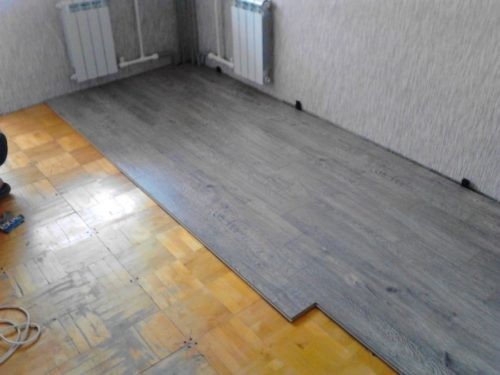
Modern and elegant, laminate flooring is installed on a dry, strong, and level base. To be compliant with SNiP, it needs to fulfill the following criteria:
- surface humidity should not exceed 2%;
- The difference in screed height is allowed within 2 mm, which is compensated by the substrate. In our case, linoleum cannot have bumps – it itself acts as a substrate and must level out errors in the base of the floor (you can lay a substrate between the linoleum and the laminate if the linoleum does not have a felt lining underneath). If this rule is neglected, then over time the existing protrusions in places where the floor is used intensively will squeeze the same tubercles onto the surface of the lamellas, which are easily erased when walking;
Important: It is not essential if there are different types of indentations on the linoleum surface, such as scratches from furniture and sharp heels, for laminate flooring.
- the slope for every 2 m cannot exceed 4 mm (2% of the length). This indicator is especially important for places where linoleum floors are used intensively, where the felt lining wears out a lot and shrinks. It is not recommended to check such differences by eye, since the surface of linoleum always looks smooth and flat. Here you need to use a long rule to determine the amount of slope.
There are no barriers to installing laminate over linoleum if these conditions are satisfied.
Linoleum frequently has flaws (such as holes, cuts, and completely deteriorated felt) and lies in waves (swollen). In this situation, is it possible to install laminate flooring over linoleum? Linoleum cannot be used as a substrate if the prior coating is worn off because there is a chance that the lamella locks will break quickly.
Pros and cons of the solution
Linoleum offers numerous benefits when used as a substrate.
- the time for repair work is reduced – there is no need to remove the old floor and lay the underlay;
- money is saved on the work of replacing the old floor covering with a substrate, as well as its purchase;
- the floor in the room receives good insulation (linoleum has a higher coefficient of resistance to heat transfer than the bulk of the substrate), which allows you to save on heating;
- the sound insulation of the room is improved – the old floor perfectly muffles all types of noise;
- an additional barrier appears when protecting the laminate from moisture from below.
However, there are drawbacks to this technological approach as well:
- old linoleum behaves unpredictably and can become deformed for no apparent reason, resulting in waves (swelling) that lead to rapid failure of the locking joints;
- if moisture gets under the linoleum, it will protect the lamellas from swelling and subsequent destruction, but it itself will suffer – mold and mildew begin to actively develop on the felt, which will ultimately lead to the replacement of the laminate;
- a number of experts express a purely theoretical assumption, which has not yet been tested in practice, that under load and without access to moisture, linoleum can dry out and become brittle.
Required materials and tools
In order to manually install laminate flooring, you need to have:
- unpacked slats;
- measuring instruments: a metal ruler at least 1 m long, a construction square and a 3 or 5 m tape measure;
- level;
- rule 2-2.5 m long;
- jigsaw or grinder with a narrow cutting wheel for cutting laminate panels. These tools can be replaced by a hand saw for wood with a very fine tooth (some novice repairmen use a hacksaw for metal, which also gives a good result);
- a set of wedges or a self-made rail for fixing the technological gap;
- a hammer made of wood or rubber for knocking out lamellas;
- a mounting bracket or a piece of lamella with a spike at the end;
- marker or construction pencil;
- crowbar – it is used to close the lock of the last row of laminate.
Preparatory work
Lamella installation on old flooring requires very little prep work. The detailed steps of the entire preparation process are as follows:
- All unnecessary things are removed from the linoleum: furniture and baseboards;
- surface condition analysis is carried out. During the inspection, the following are revealed: differences in height; the magnitude of the slope; condition of the material: are there any swelling, cuts, holes; surface humidity level;
- linoleum is vacuumed and then washed.
You can use a level or rule to determine the surface’s levelness. The instrument is moved along the floor after being put there. Every barrier has a measurement. The linoleum is removed and self-leveling mixtures are used to level the screed if the height difference is greater than 2 mm (replacing the screed is the only technology used). However, in this instance, the editors advise laying a traditional substrate beneath the laminate rather than worn-out linoleum because of its predictable behavior.
The slope can be measured with a construction square and a level after checking it with a rule and a level or by pulling threads (cord, fishing line) diagonally. The situation is the same here: the floor (screed) base is leveled if the standards are exceeded.
Holes, fractures, and cuts are patched. This can be accomplished in a few ways:
- at the cut, the edges are glued to the screed or double-sided tape applied to the back of the floor covering;
- holes and large cracks are subjected to cold or hot welding. For this, damaged pieces of linoleum are cut out and a patch of the same shape is put in their place, after which the connecting seam is filled with a special mixture. Under the influence of cold welding, vinyl goes into a semi-liquid state for a short time, after which it polymerizes. The result is a smooth, strong and durable seam. With hot welding, the seams are brought into a plastic state by heating devices.
Along the ridge, bulges (waves) are cut and then stretched. Polymer glue is used to adhere the cut edges to the floor screed (repeated swelling is likely if tape is used).
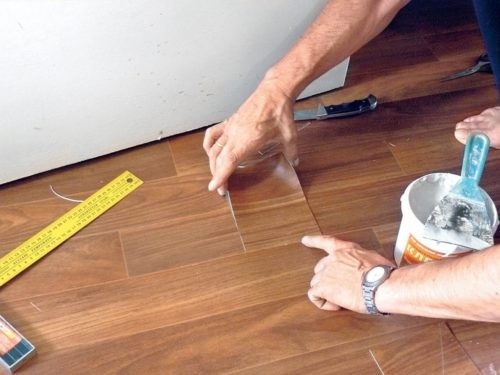
A 1 m2 polyethylene film will assist in monitoring the surface humidity. Tape is used to adhere it to the floor all the way around. Within a day, the film is taken out. Ventilate the space until everything is dry after removing the film if the linoleum or film is wet to the touch.
Important: According to many experts, linoleum should be glued all the way to the floor’s base. However, the editors of StroyGuru.com disagree for a number of reasons.
- the costs of gluing linoleum to the floor and laying the underlay are almost identical. In this situation, preference should be given to a naturally new substrate;
- the functional role of the glue is unclear, t.e. there is no clear explanation of why this is being done;
- no one thinks about the day when the glued linoleum will have to be removed.
Additionally, the primary contention in the apartment owners’ reviews is that none of them adhered linoleum to a concrete screed.
Is it necessary and what kind of substrate to use?
The idea behind installing laminate flooring over linoleum is to avoid using a substrate, since the old floor covering will serve those purposes. Here, everything is evident.
However, keep in mind that you cannot lay it over felt-covered linoleum because this will result in a thick, cushiony layer between the screed and the laminate. Such a floor will require a complete replacement after 1-2 years of use since the castle joints will be destroyed. It will start to creak within a few months of operation.
The only exception is linoleum that has no underlayment. In this instance, a substrate is required, but it should only be 2 mm thick. The best choice is the cork lining.
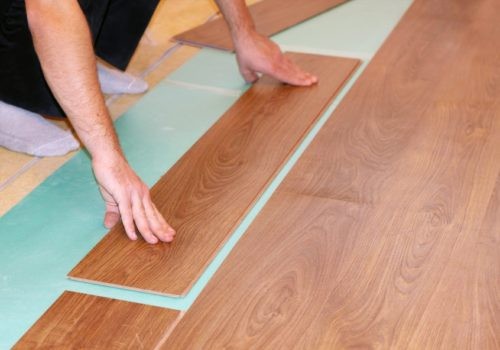
It is possible to install laminate flooring over linoleum, and it can be less time- and labor-intensive than tearing out the old flooring. It is important to make sure the linoleum is clean, dry, and level because any flaws could affect how the laminate is installed. Stability, noise reduction, and potential damage prevention all depend on having the right moisture barriers and underlayment. This method can be a quick and easy way to update a space without having to deal with demolition.
Laying instructions
There is nothing new in the directions for applying a laminate to linoleum by hand. Similar to how laminate is laid on a concrete or wooden floor (see the articles "How to lay a laminate on a concrete floor?" and "How to properly lay a laminate on a wooden floor?"), the process for completing the work follows a step-by-step algorithm.
Recall the primary phases of the job:
- The laminate is introduced into the room for a day and unpacked – the lamellas should take a geometric shape to the moisture and temperature of the room;
- the method and direction of installation is determined, which you can read about in the work “How to lay laminate flooring – along or across the room?";
- the place to start installing the lamellas is selected – tips are in the material “Where and how to start laying laminate correctly?";
- Wedges or a lath are placed between the wall and the first row of lamellas – a technological gap of 1.0-1.5 cm is provided;
- the first row is laid. Before this, the tenons are cut off from the lamellas – the laminate panels are laid with the cut side facing the wall. The end locks are closed using an insert and a mallet;
- the second row should be shifted by 1/3 or ½ the length of the lamella in relation to the first row. To do this, the first panel is cut off. Floor joints must have a brickwork configuration. The second panel of the row is first installed in the lock of the first row along the length, and then hammered forward with a mallet until the end connections are completely connected. It is prohibited to strike the edges of the slats (the locks may be damaged) – you must use a mounting bracket or a piece of laminate. In this case, the bracket is installed in the locking connection of the adjusted laminate panel.
Take note: to close the expansion gap, a wedge is inserted at the start of each row.
Make sure to precisely measure the final panel row before installing it so that there is still a gap to the wall after the locks are closed.
| Pros | Cons |
| Easy Installation: Laminate can be laid directly on linoleum without much preparation. | Height Increase: Adding laminate over linoleum raises the floor level, which may affect doors and appliances. |
| Cost-Effective: Saves time and money as you don"t need to remove the old linoleum. | Hidden Issues: Any damage or mold under the linoleum will remain hidden, potentially causing problems later. |
| Comfort: Linoleum provides a cushioned layer, making the floor more comfortable to walk on. | Uneven Surface: If the linoleum is not perfectly flat, it can affect the laminate installation and durability. |
For many homeowners, installing laminate flooring over linoleum is a workable solution. Because the old flooring won’t need to be removed, it saves time and effort. But it’s crucial to make sure the current linoleum is in good shape. Any unevenness, damage, or excessive softness could lead to future laminate issues. An easy installation depends on the surface being properly prepared.
The extra insulation and cushioning that the linoleum offers is a big benefit of this method. The floor may feel cozier and more pleasant to walk on as a result. The linoleum can also serve as a moisture barrier, shielding the laminate from any possible moisture that may come from the subfloor. This can be especially helpful in places where there is a chance of humidity or small water spills.
Notwithstanding these advantages, there might be some disadvantages to take into account. Since the new floor will be higher than the existing one, doors and thresholds may need to be adjusted. Before installing the laminate, any mold or mildew problems that may have existed on the linoleum must also be fixed. Ignoring such issues can eventually result in offensive odors and health issues.
All things considered, installing laminate flooring over linoleum can be a practical and efficient fix. It gives the aesthetics of your house a quick makeover while utilizing the advantages of both materials. To ensure a durable and appealing outcome, just make sure to properly evaluate the state of your linoleum and prepare the surface.


