
Behind the bright colors and giant playgrounds of Squid Game lies an interesting paradox. The series' sets evoke warm nostalgia for childhood games, but at the same time instill a real, chilling fear. This is not a random effect, but the result of the thoughtful work of the production designers.
The design team deliberately used images familiar to everyone from childhood: bright colors, simple geometric shapes, toy bridges, and slides. They wanted to create a sense of innocent childhood fun. However, fear arose from the contrast: these joyful decorations were placed in frighteningly empty, huge spaces or used for cruel adult games.
A key technique was distortion of scale. A huge doll, bridge, or slide, which were supposed to appear small to a person, were actually built in full size. The actors, standing among these structures, felt lost and helpless, like children. This physical discomfort was directly conveyed to the viewer, heightening the sense of anxiety.
Thus, the magic and horror of Squid Game were born at the intersection of the familiar and the distorted. The sets became not just a backdrop, but a full-fledged character that lures the viewer with nostalgia and then scares them to their knees.
Recreating memories
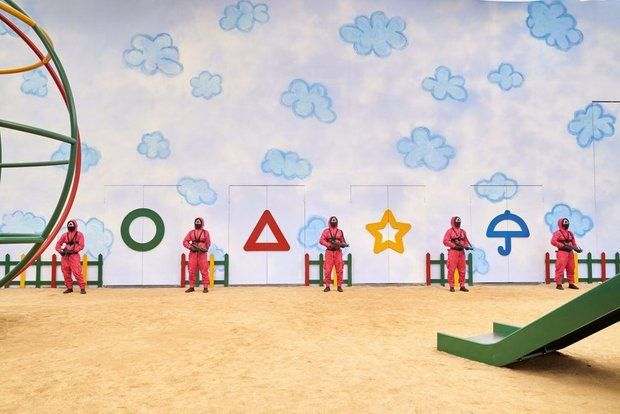
One of the main features of Squid Game is said to be the creation of dissonance—the series combines naivety and childishness with incredible cruelty. The show's director and production designer claim that the playgrounds had to look cute and appealing—the team clearly succeeded in achieving the desired effect.
Many playgrounds were built from scratch, and computer graphics were used in moderation. The authors recreated enlarged versions of real playgrounds so that the actors would perceive the space as small children would. "I tried to simulate the atmosphere of real playgrounds. I thought that such scenery would help make the actors' performance more believable," the director shared.
On the edge of reality
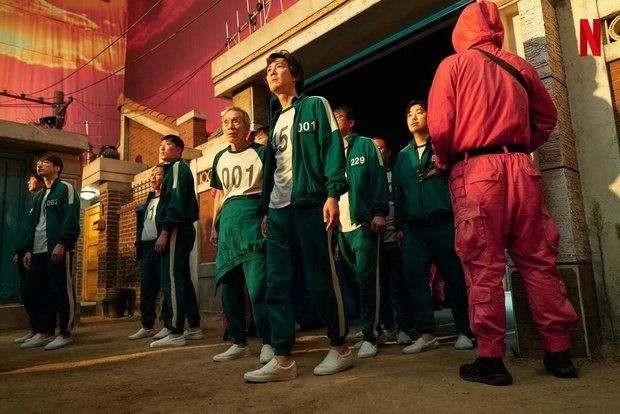
The set for the fourth game was more complex: it took place in a traditional Korean neighborhood. Viewers could see the streets, houses, and their decorations — the atmosphere was conveyed even to those who had never been to South Korea.
The series' production designer, Chae Kyung-sun, admitted that the team put a lot of effort into creating these sets. “It took so much time. We thought very carefully about how to accurately depict the sunset. We thought it should be a set on the border between fiction and reality,” she added.
A true sense of fear
During one of the games, the participants find themselves on a glass bridge — we are sure that many felt uncomfortable watching this episode. The creators of the series terrified not only the viewers, but also the actors themselves: as we said earlier, the sets are designed in such a way that the players' experiences do not look fake.
For example, the glass bridge used in the fifth game was made of real glass. Of course, it was not installed at a dizzying height, but the actors behaved as if they were on the edge of a precipice.
“Just 1.5 meters in height can seriously scare you. The glass made them nervous. It was like jumping off a real high bridge: the game was real, and they felt real fear. We think these sets had a unique power of realism,” Hwang explained.

The creators of Squid Game built the sets to look familiar, but with a touch of strangeness and unease. Giant playgrounds, empty dormitories, and faceless halls evoke nostalgia for Soviet courtyards and schools, but something is clearly wrong with them — the bright colors seem artificial, the space is devoid of life, and the scale is unnaturally huge. This aesthetic, familiar at first glance, is actually oppressive, disorienting, and heightens the sense of fear, as the viewer is transported back to childhood, where everything is big, you are small, and the rules are unclear.
A grand finale
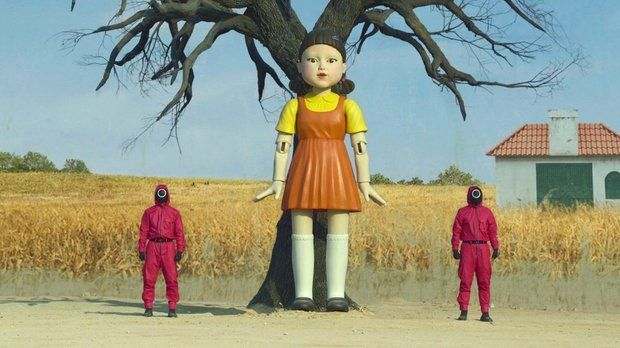
Attentive viewers may have noticed that the final game takes place on the same court as the first one — this was a conscious choice by the production designer.
“The first and last games are held in the same place. We focused on the fairy-tale and eerie feelings of this location. That's how we ended the last game,” added Chae Kyung-sun.
An unusual waiting area
Not only the game arenas themselves were carefully thought out, but also the waiting areas where the participants are located. If you watched the series, you probably remember the bright staircase resembling a maze—the characters had to walk up it to get to the games. The pastel yellow and pink shades are memorable, and the shape of the staircase is delightful.
The staircase may be reminiscent of the designs of Spanish architect Ricardo Bofill or the levels from the game Monument Valley, but the set design was inspired by the works of Dutch graphic artist Maurits Cornelis Escher.

The colorful design, in turn, was intended to contrast with the usual depiction of violent games. “Games with death usually take place in creepy and terrifying places,” the director explained. Instead, Hwang and Chae sought to make the sets cute — they were meant to evoke nostalgia.
The work of the production designers on Squid Game was an important part of the series' stunning success. They managed to transform the abstract rules of children's games into powerful visual metaphors that literally overwhelm the viewer. Behind the bright colors and seemingly simple forms lay a deep psychological calculation.
The sets they created turned out to be a trap not only for the characters, but also for our memory. They combined the carefree nature of childhood with the chilling horror of adult life. This unique combination created a unique effect, where nostalgia for simple games turns into real fear. It is difficult to imagine that the story would have had such power if it had unfolded in gray, realistic concrete corridors.
Ultimately, the genius of the design lies in its simplicity. Every space and every prop is understandable to anyone in the world because their roots go back to childhood. This is what makes the threat so universal and recognizable. The authors have managed to prove that the strongest fear is born not from darkness and chaos, but from a distorted, exaggerated memory of something bright and joyful.


