
There is more to a house’s blind area than just a narrow strip of asphalt or concrete. By diverting rainwater away from the base of your home, it plays a vital role in preventing water damage to your foundation. Even the best blind areas, though, are susceptible to weaknesses and cracks over time that can reduce their efficacy.
You can avoid these problems and increase the life of your house by strengthening the blind area around it. The current structure is strengthened by this process, which also improves its resistance to the elements. It’s a sensible move that can ultimately save you money by preventing expensive foundation repairs.
We will examine the rationale behind and advantages of reinforcing the blind area in this article. Additionally, we’ll provide you a step-by-step manual to help you finish this project quickly and successfully. Regardless of your level of experience with do-it-yourself projects or lack thereof, following these guidelines will enable you to confidently reinforce your blind area.
| Purpose | Feasibility and Instructions |
| Protects foundation from water damage | Assess the soil condition and drainage needs around your home. |
| Prevents soil erosion | Determine the materials required: gravel, sand, cement, reinforcement mesh, and waterproofing membrane. |
| Improves home aesthetics | Excavate a trench around the foundation, ensuring a slight slope away from the house for water runoff. |
| Enhances property value | Lay a gravel and sand base, compacting it firmly to ensure stability. |
| Provides a walking path | Place the reinforcement mesh on top of the compacted base to add strength to the concrete. |
| Mix and pour the concrete, spreading it evenly and smoothing the surface. | |
| Allow the concrete to cure properly, protecting it from extreme weather during this period. | |
| Apply a waterproofing membrane to the cured concrete to enhance durability and prevent water infiltration. |
- If necessary?
- When it is necessary?
- In what cases can you do without it??
- Recommendations
- What reinforcement to use to create a reinforcing mesh?
- Metal
- Geosquet
- Fiberglass
- Classical
- Standard
- Reinforced frame cell dimensions
- Tools and materials for work
- How to make it yourself?
- Installation errors
- Price
- Video on the topic of the article
- Video on the topic
- RELIABLE! DIY crushed stone blind area #shorts
- Construction of a concrete blind area around the house.
- Making a blind area around the house. Ch2
- Reinforcement of the blind area
If necessary?

The technical properties and service life of the blind area, foundation, and entire house can all be extended with the use of structural reinforcement.
It is possible to arrange reinforcement longitudinally, transversely, or in two directions. The cells are shaped most frequently like a square or hexagon. Almost no other forms are used.
For many coatings that are prone to breaking, strengthening is utilized. You can shorten the time it takes to finish building a blind area by using reinforcing mesh. This is because the product is offered for sale in its completed state.
Material with a 100 x 100 mm cell size is typically used. This reinforcement structure satisfies every requirement needed to build a blind area.
There is no need to manually tie reinforcement when using this material. Additionally, the grid will produce a lot less waste. Because of this, very little reinforcement is used when building a blind area, which adds weight, raises construction costs, and lengthens the time needed to finish the job.
Polymer construction mesh is not advised for use as reinforcement since it will sag and fail to fulfill its intended purposes.
When it is necessary?
To stop the structure’s surface from being destroyed, reinforcement is required. For instance, concrete, asphalt, or paving slabs. Regulations specify that this kind of work must be done.
The benefits of reinforcing the blind area are as follows:
- Increased mechanical and thermal resistance.
- Resistance to temperature changes.
- Increased foundation strength.
- Distribution of compressive and tensile loads.
- Additional concrete stiffness.
- Elimination of structural deformation.
Despite the fact that this kind of work has many benefits and extends the structure’s service life, some builders ignore it.
In what cases can you do without it??

However, a reinforced frame is not required exclusively in the case of monolithic slabs. This is because it is very expensive and heavy.
Furthermore, laying reinforcement just along the house is not advised. The fasteners will therefore be subjected to longitudinal mechanical loads.
A reduction in service life and surface destruction are possible in the absence of reinforcing in the structure.
Recommendations
The following conditions need to be fulfilled when installing reinforced mesh:
- installation of 1 layer of material;
- overlay is made at the joints;
- reinforcing mesh is laid on a straight base;
- at the last stage, corners are reinforced;
- It is not recommended to use homemade fittings, which may differ in thickness and characteristics.
A robust structure can be achieved by using blind area reinforcement and adhering to technological advancements.
Standard sheets of reinforcing mesh are produced and can be ground with a grinder.
What reinforcement to use to create a reinforcing mesh?
Multiple varieties of reinforcing mesh exist:
- metal,
- geogrid,
- fiberglass,
- classical,
- standard.
The type of reinforcing mesh chosen depends on the construction type and financial capacity.
Metal
Reinforcement is used to make the structure more sturdy. It is more common to use the mesh than individual reinforcing rods. This is because the materials are inexpensive and the styling is easy.
This variety stands out for having great strength. It is applied to fortify construction structures. Temperature drops, corrosion, and other external factors do not affect the metal mesh.
Further benefits will be obtained by the material if zinc is applied to the metal reinforcing mesh:
- Beautiful appearance.
- Long service life.
- Resistance to external aggressive influences.
- Increased strength.
Concrete blind areas are ideal for this kind of mesh.

Geosquet
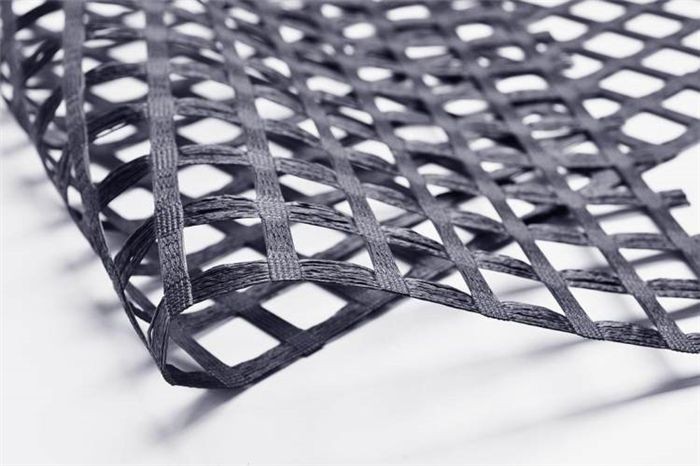
The materials of the geosquet are polymers and cloth. The material is covered in rubber, geotextile, or cloth. This kind is applied to the soil to fortify it prior to the asphalt concrete coating.
Fiberglass
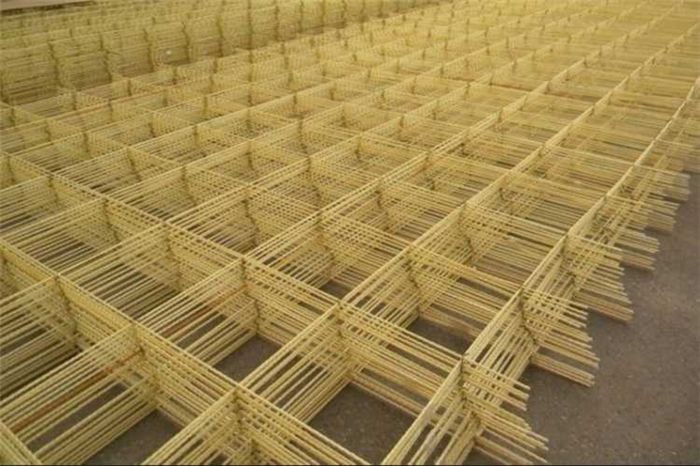
Fiberglass reinforcement is a contemporary material that is gaining popularity. Purchasing reinforcement with a diameter of 6–8 mm is advised. The product’s pitch must be no more than 20 cm, and it must be at least 15 cm.
Coils of fiberglass reinforcement are available for purchase; these must be unwound and cut to the necessary length for the whips. The product can be cut using a hacksaw or grinder.
The formwork is filled with a reinforcing mesh that is clamped or secured with a gun and wire. For secure fastening, the wire’s diameter needs to be at least 1 mm. Raising the mesh to the center of the pouring structure is necessary.
Classical
Because of its lightweight design, this type of reinforced mesh is utilized frequently. The base is under much less load as a result. The welding of the wire is perpendicular.
For concrete or paving slab blind areas, the traditional style works well. The substance is also utilized in brick and concrete screed constructions.

Standard
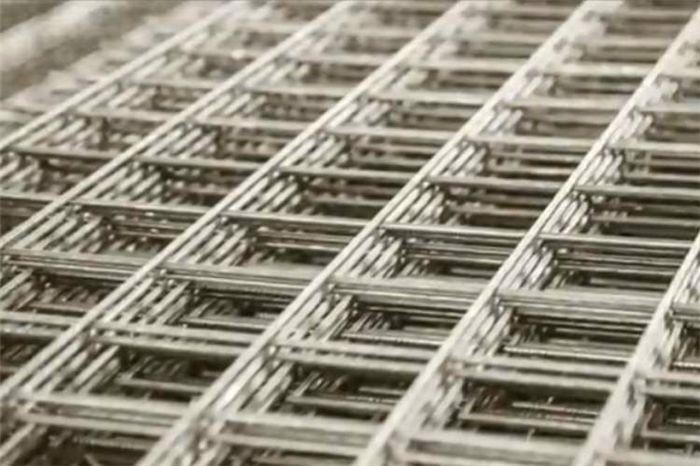
Cell sizes in the standard version range from 6 to 7 cm. Used for concrete screeds, blind areas, foundations, etc. The material has a very high strength. The standard type also boasts a lengthy service life. There is a right angle weave on the rods.
Reinforced frame cell dimensions
The cell size varies depending on the kind of reinforced material.
- 50*50*5 mm. This type is used as a plaster sheet. Due to the small cells, the solution is applied evenly and securely attached to the structure. In addition, the weight of the material is significantly small – 1.5 kg/m2.
- 100*100*4 mm. The cells are of sufficient size for use in concrete structures. For example, screeds, blind areas, etc.d. The weight of the material can be from 1 to 3 kg/m2.
- 150*150*8 mm. Cells size 15 cm. Depending on the diameter, the weight of the reinforcement can be from 2 to 4 kg/m2.
Rods with a diameter of 3 mm or more can be used in lightweight structures. The substance is produced in sheets or rolls.
Tools and materials for work
The following instruments are required to install a blind area:
- tamping;
- roulette;
- pegs;
- shovel;
- level;
- hammer;
- tool for cutting material;
- welding machine;
- hacksaw;
- twine.
It’s also essential to get ready the following supplies:
- concrete;
- reinforcing mesh;
- nails;
- boards.
Everything needs to be ordered ahead of time.
How to make it yourself?
The following actions are necessary to reinforce the blind area:

- Prepare the base.
- Compact sand and crushed stone.
- Arrange the membrane.
- Install removable wooden formwork. Secure from outside with bars.
- Installation of expansion joints in the formwork in increments of 2 to 2.5 m. Including the corners of the structure. To seal the seams, wooden blocks coated with bitumen are used.
- Installation of an expansion joint with a width of 1 to 2 cm near the wall. It must be filled with roofing felt.
- The edge of the formwork should be aligned taking into account the difference in height for the slope of the structure.
- Reinforcement is hammered into the basement of the building in increments of 70 cm. Thus, the load-bearing capacity of the structure can be increased. A reinforcing mesh is associated with this reinforcement.
- Reinforcement is carried out on straight sections, and then on external and internal corners in 1 layer. There is no need to use stones or other elements to support the reinforcement. It is necessary to arrange a cushion of crushed stone 3 cm thick. Excess material should be cut off with a grinder or other tool.
- Concrete is poured to the top of the formwork. A vibrator is used to prevent the formation of pores.
The service life of a concrete blind area is twenty years. Paving slabs should be placed over the structure to extend its service life.
If you want to shield your foundation from soil erosion and water damage, you must reinforce the blind area surrounding your home. This post will examine the rationale and advantages of strengthening the blind area, evaluate whether it is feasible for homeowners to undertake the work, and offer a straightforward, step-by-step instructions for doing so. You can increase the longevity of your home and protect it from the weather with easy-to-follow directions and helpful advice.
Installation errors
It is important to take into account the following details when strengthening the blind area:
- The use of a metal frame is advisable only when building large houses. Since this material makes the structure heavier and increases the cost of the blind area.
- All metal rods must be welded together. Otherwise, the blind area will only work for longitudinal loads. Cracks will appear along the rod.
Price
The kind and dimensions of the cells affect the price of reinforcing mesh:
| Kinds | Cell sizes | ||
| 50*50*5 mm | 100*100*4 mm | 150*150*8 mm | |
| Classical | 270 rub. | 110 rub. | 140 rub. |
| Standard | 260 rub. | 100 rub. | 150 rub. |
| Fiberglass | 140 rub. | 80 rub. | 130 rub. |
| Geogrid | 130 rub. | 110 rub. | 110 rub. |
| Metal | 270 rub. | 100 rub. | 150 rub. |
This section compiles the most significant and practical information on blind area construction.
Video on the topic of the article
You will learn about the blind area’s reinforcement from the following video:
Preserving the integrity of your foundation requires you to reinforce the blind area surrounding your home. By keeping water from penetrating into the ground near your foundation, this extra layer of defense helps stop costly damage from occurring over time. You can extend the life of your house and avoid costly future repairs by taking the time to properly reinforce this area.
With minimal professional assistance or on your own, you can confidently complete this project by following the detailed instructions provided. The procedure, although simple, needs some physical work and close attention to detail. But in the end, you have a blind area that effectively diverts water away from your house and is more sturdy and safe.
It is a wise financial and practical move to reinforce the blind area of your house. It improves your property’s overall stability in addition to safeguarding your foundation. Despite being frequently disregarded, this project is crucial for peace of mind and long-term home maintenance.


