
The selection of building materials and the techniques used in their installation are critical in guaranteeing the longevity and structural integrity of a home, whether it is being built or renovated. The mortar used to install aerated concrete blocks, which are renowned for being both lightweight and durable, is an essential component in wall construction.
The popularity of aerated concrete blocks, also known as AAC blocks, can be attributed to their ease of handling and ability to provide thermal insulation during construction. Because of their lightweight design, these blocks need a particular kind of mortar to ensure a solid bond between each block.
Usually, a thin-bed mortar that has been specially formulated to offer sufficient adhesion and support is used to lay AAC blocks. Thin-bed mortar is intended to reduce the chance of cracking and improve the overall stability of the wall, in contrast to conventional masonry mortar, which may be thicker and stronger for heavier materials.
For AAC block walls to be reliable, the right mortar composition and application method must be followed. When mortar is applied evenly and at the right thickness, it can be precisely aligned and the load can be distributed uniformly throughout the structure, which will increase the structure’s durability over time.
| Mortar Type | Reliability |
| Cement-Sand Mortar | Commonly used, strong and durable, suitable for many types of walls. |
| Thin-Joint Mortar | Specially designed for aerated concrete, provides good adhesion and thermal insulation. |
| Polymer-Modified Mortar | Offers enhanced strength and flexibility, ideal for high-performance requirements. |
- Is it possible to lay aerated concrete blocks on a cement composition?
- Mixture requirements
- What components does it consist of??
- Ingredient proportions
- How to prepare?
- How to calculate the cost of laying walls?
- Process Features
- How long does it take for the composition to set and gain strength??
- Price
- Video on the topic
- 12 IMPORTANT secrets of laying the first row of aerated concrete
- Gas block for solution
Is it possible to lay aerated concrete blocks on a cement composition?
A house built with aerated blocks should have its design solution dictate the type of masonry mortar used. It is dependent upon the building’s height, construction style, and wall material quality. There are, however, some circumstances in which using cement mortar is required; one example of these is first-row masonry. This phase establishes the foundation for all ensuing geometric dimensions of the wall constructions under construction.
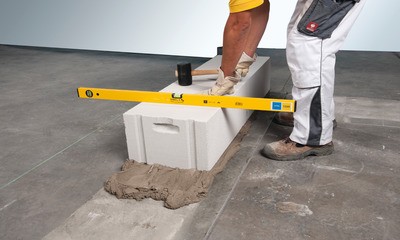
Special consideration is given to the starting row. Superior waterproofing of the base or foundation comes first.
The highest hygroscopicity characteristics of aerated concrete provide an explanation for this. Consequently, bitumen that has been rolled into at least two layers is used to create cut-off waterproofing.
The first row of aerated concrete is then laid over a conventional, premium cement-sand component. Use a standard 1:3 ratio of cement to finely sifted sand for this. To create a thicker mixture, add water to the final mixture.
In this instance, it will enable the correction of all current irregularities on the plinth in addition to guaranteeing a strong connection between the gas blocks and the plinth.
Here’s another justification for the use of cement by developers. It is just not possible to construct low-quality gas blocks with fractured geometry with thin adhesive mixtures from the factory in a smooth manner.
Mixture requirements
The masonry composition for this kind of wall material must adhere to the following specifications:
- High plasticity, so that all roughness, cracks and empty spaces in the blocks are efficiently filled.
- Sufficient strength after thickening is complete so that the solution does not cause deformation of aerated block walls.
- Have the necessary period of time for setting so that the master has time to work it out before it hardens. Typically, in the presence of plasticizers and additives, such properties are maintained for 1.5-2.5 o"clock.
For low-rise private home construction, cement-sand mortar for aerated concrete walls is thought to be the easiest and most economical option; it offers several benefits.
- relatively low cost for all components of the composition;
- availability of all components;
- good ductility, ability to accept the established configuration;
- high levels of rigidity;
- does not exhibit arbitrary shrinkage.
The abundance of imitations on the market, which raises the risk of efflorescence and stains on the blocks and reduces the strength of the completed masonry, are among the drawbacks of cement-sand mortar that developers view. Additionally, plasticizers will need to be purchased by the developer in order to enhance the mechanical properties of the CPR.
Low-quality masonry can result from many inexperienced craftsmen finding it difficult to follow the technology for mixing the materials and the necessary proportion.
What components does it consist of??
Cement:sand ratio in the classic CPR recipe for aerated concrete is 1:3. Many developers alter this ratio to 1:6 depending on the loads that the walls will support and how they are used. The proportion increases with decreasing planned load.
Next, the grade of cement and the moisture content of the sand should be considered when making the masonry mixture.

For the CPR components of aerated concrete walls, Portland cement M400/500 and meticulously sifted sand with fractions up to 2 mm are utilized. In other words, the sand mixture’s strength characteristics will decrease with increasing volume.
When constructing homes out of aerated blocks, experts suggest utilizing the following cement grades and ratios:
- M25 – five to one;
- M50 – four to one;
- M75 – three to one.
M50 or M75 composition is advised for masonry sections that are particularly loaded.
Understanding the mortar used to lay aerated concrete blocks is essential to investigating the dependability of residential walls. For the walls to remain stable and long-lasting, this kind of mortar is essential. Because aerated concrete blocks are porous and lightweight, a special mortar is needed to suit their special characteristics. In order to accommodate the blocks’ slight expansion and contraction due to temperature variations, the mortar must offer strong adhesion. For walls made with aerated concrete blocks to remain structurally sound and long-lasting, the proper mortar composition and application method must be used. A strong basis for a safe and long-lasting home structure is ensured by being aware of these factors.
Ingredient proportions
The accuracy of the proportions in the masonry mixture is a crucial step that directly affects the dependability of the house’s entire structure. The brand of blocks and the intended use of the walls determine the type and composition of masonry mortar, which is specified in the design documentation.

Developers typically use three parts cement to one part sand. It may differ depending on the kind of wall:
- external walls: 3/1;
- partitions in the room: 4/1.
How to prepare?
Because a sizable amount of mortar will be needed to erect gas block walls, it is mechanically mixed with a concrete mixer or construction mixer. Hand-preparing CPR results in incomplete mixing of the mixture and an unsatisfactory chemical reaction, which causes the seams to become loose and brittle.
CPR mixing technology:
- After the developer has decided on the required volume, he first adds water to the working mixer in the required volume, 1 hour is taken equal to 10 liters.
- Add 1 hour – a ten-liter bucket of cement and mix.
- Sand is added 1 bucket at a time, little by little. Make sure that it is completely mixed, and the composition has become homogeneous. Otherwise, the mixture will become unusable for installation.
- Stir the solution for 5 minutes until it becomes paste-like.
By using this technology, air microbubbles are infused into the cement mortar to stop it from settling. Furthermore, these bubbles serve as tiny spheres that evenly distribute loads.
Aerated concrete requires the cement mortar to be applied within 2.5 hours of preparation. Especially if installation work is resumed after a forced break, the surface of the embedded blocks is wetted because they cannot absorb water from the masonry mortar.
How to calculate the cost of laying walls?
The manufacturer lists the consumption rate per cubic meter of aerated concrete masonry on the packaging in the event that the developer purchases a ready-made CPR mixture.
Furthermore, this rate can be independently computed based on the block sizes as follows:
- R – volume of mixture per 1 mm of seam thickness (kg/m3);
- D – length of aerated block (m), H – height of aerated block (m), W – width of aerated block (m);
- 1.46 – norm per 1 mm.
Example calculation:
- wall volume – 25 m 3;
- block dimensions 0.625*0.250*0.150 mm;
- Р= ((0.625 + 0.250)/0.625*0.250)*0.150*1.46*25 = 191.6 kg;
- for mortar 3mm thick: 191.6*3=574.8 kg;
- with ready-made mixtures of 25 kg: 574.8/25 = 23 bags.
The computation, which is regarded as nominal, has to account for process losses of up to 6% as well as the mason’s professionalism. The amount for non-professionals is increased by 5%.
Process Features
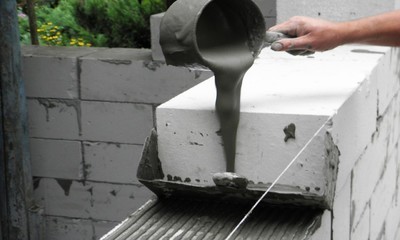
Sand-cement mortar is traditionally used for the first row of aerated concrete masonry.
The method used to install aerated concrete walls:
- Lay out 2 cm of mortar on the foundation or plinth and then a layer of waterproofing: waterproofing, roofing felt or rubemast.
- The 1st row of aerated blocks are laid on the insulating layer using classic cement mortar.
- At this stage, the maximum adjustment of the surface is carried out for even laying of the next layers of the wall.
- Perform ligation of blocks while controlling vertical seams of all rows that should not be combined.
- Close up irregularities.
- When using blocks using the tongue-and-groove system, external corners, dents and chips are filled with mortar.
- The remaining unevenness is rubbed with a grater, and the resulting dust is removed with a brush.
How long does it take for the composition to set and gain strength??
This is a crucial metric that determines how long a mason can work with the ready-made mortar. The mixture’s maker extends this duration by incorporating extra ingredients into the blend. For instance, additives allow the pot life of the Aerok cement mixture, which is meant for thin-seam masonry, to be extended to five hours.
The temperature during this time will also depend on it; for the winter option, it may drop as low as -10 C.Ideally, it will be between +5 and +30 C.
The CPR has a maximum shelf life of two hours if it contains no additives. Masonry mortar typically becomes stronger in a day or two.
Price
When selecting a masonry mixture, the developer needs to exercise extreme caution because it will have an impact on both the financial metrics associated with construction costs and the overall dependability of wall structures. You should familiarize yourself with the technological features and application scope of a pre-made CPR before making a purchase.
Common alterations to gas block adhesive:

- Professional Quick Block, thermal protection, seam thickness 5 mm, temperature range from -10 C to 25 C, working time 2.5 hours, norm 25kg/1m3, frost resistance F150, 170 rubles/bag;
- TOILER TL 400, thermal protection, seam thickness 4 mm, temperature range from -10 C to 30 C, application time 4 hours, norm 25 kg/1m 3, F50, 160 rubles./bag;
- Ytong, winter, thermal protection, seam thickness 3 mm, temperature range from -10 C to 30 C, use time 5 hours, norm 25 kg/1m 3, F150, 350 rub./bag;
- Cleber K32, thermal protection, seam thickness 10 mm, permissible temperatures from -50 C to 50 C, application time 3 hours, norm 25 kg/1m 3, F50, 350 rubles/bag; 25kg.
Selecting an appropriate mortar for the installation of aerated concrete blocks is essential to guarantee the durability and steadiness of your house’s walls. In addition to holding the blocks together, the mortar also acts as insulation and a structural support. Thin-bed mortar, which is specifically designed to achieve strong adhesion while maintaining uniformity in wall thickness, is commonly used to lay aerated concrete blocks.
It is imperative that the mortar be compatible with the properties of aerated concrete, including its porous structure and light weight. This kind of mortar permits sufficient penetration and grip, guaranteeing a strong connection between blocks without undue weight that might eventually jeopardize the blocks’ integrity.
Additionally, when using mortar with aerated concrete blocks, proper application techniques are essential. In order to avoid structural problems like wall cracking or uneven settling, it is important to maintain a uniform layer of mortar between each block and to pay close attention to alignment and leveling.


