
There are a number of efficient techniques for bolstering partitions and reinforcing drywall that can improve the robustness and stability of these crucial components in building and remodeling projects. Drywall, sometimes referred to as plasterboard or gypsum board, is inexpensive and simple to install, making it a popular choice for interior walls and ceilings.
The combination of joint compound and drywall tape is one of the best ways to reinforce drywall. Using this method, the seams where panels join are covered with drywall tape, and then several coats of joint compound are applied. By strengthening the joints and filling in spaces, the compound produces a seamless surface that is less likely to deteriorate and crack over time.
Furthermore, adding backing support can make drywall partitions much stronger. The drywall panels may be supported by metal or wood studs positioned behind them. These studs give the drywall structural support and stop it from bending or bowing, which is especially important in high-traffic areas and places where heavy fixtures like cabinets or shelves will be installed.
Using fasteners or drywall anchors is another efficient technique. These tools are intended to firmly fasten items—like TVs or shelves—to drywall so that the material won’t break or separate from the wall. By more evenly distributing the weight across the surface, anchors lower the chance of damage and guarantee long-term stability.
Metal corner beads can be installed in areas that need additional support, like the corners or the areas around door frames. This thin metal strip is curved to cover edges and corners, shielding them from chips and dents. Additionally, it strengthens the drywall’s corners, increasing their resistance to wear and impact.
Finally, adding a layer of protection and improving the drywall’s aesthetic appeal are achieved by applying a primer and paint coat. Paints and primers made specifically for drywall can aid in sealing the surface, increasing its resistance to moisture and small blows. This last stage ensures a long-lasting and appealing finish by strengthening the drywall and extending its lifespan.
- When reinforcement is needed?
- Methods for walls
- Seam reinforcement
- Using two profile layers
- How to strengthen with a timber tab?
- Reinforced profiles
- Installation of embeds
- Double casing GKL
- Features of choosing a method
- Useful video
- Video on the topic
- How to strengthen a plasterboard wall? Plasterboard partition
- Reinforcement of external and internal corners. Perforated tape or metal corner? [#74]
- How to properly seal a gypsum board, gypsum board seam (it won’t crack anymore)
- Sealing four types of drywall joints
- How to properly seal drywall joints?
When reinforcement is needed?
Interior partitions can be quickly organized with drywall. It is the least expensive installation method in addition to being straightforward.
However, these are not the most stable structures because shelves, wall kitchen cabinets, and TV brackets cannot be installed using standard surface installation. There could be breaks or tears in the material.
It is not required to select an alternative material for partition organization in order to prevent this. It is sufficient to fortify plasterboard constructions that are mounted on metal frames.
Methods for walls
You must fortify the partition’s surface entirely in order to hang a shelf or water heater on the wall. Selecting the appropriate approach to enhance the surface’s strength properties is crucial.
The following techniques are employed by artisans to reinforce partitions:
| Seam reinforcement | The technology involves applying serpyanka to the seam with putty. The result is improved joint protection, but the rest of the sheet surface does not gain increased strength. |
| Using two layers of profiles instead of one to create a frame | A connection of two profiles is used, which are fixed to each other using ordinary self-tapping screws. The method allows you to obtain a truly strong and stable structure, but is not suitable for small spaces, because it will lead to an even greater reduction in area. |
| Timber inlay inside the profile in the frame | In this case, a beam of smaller width is placed in the inner part of the metal profile. As a result, the necessary strength is ensured and the structure is strengthened. In this case, care must be taken to ensure that the structure does not become deformed. |
| Installation of reinforced profiles for the frame | This is the optimal solution that allows you to create a reinforced structure from ready-made elements. As a result, a strong plasterboard partition is formed, but you need to choose elements that are optimal in thickness so that the usable area is not significantly reduced. |
| Installation of mortgages | This is one of the convenient options when you need to install a heavy boiler or secure hanging furniture. In this case, mortgages can be installed both as frame elements and on top of drywall. |
| Drywall double fault | Installation on a regular frame is ensured, the thickness of the elements of which can be no more than 50 mm. In this case, plasterboard sheets are attached in two layers. It is important to act carefully and not allow the joints of different layers of glazing to overlap. This can lead to reduced sound insulation and heat loss. |
Be aware that the question of when the decision to reinforce the partitions was made is crucial when selecting a method. Both the intended outcome and the intricacy of the task are taken into consideration.
Seam reinforcement
Serpyanka is one of the best materials for reinforcement because it strengthens the compounds and keeps them from breaking.
To begin with, the joints are prepared as follows:

- The chamfer is removed from the edges of the GCL. The work is carried out using a specialized rubbish or a wallpaper knife. The width and depth of the chamfer is about 5 mm. The procedure is performed at an angle from 20 to 45 degrees.
- Surfaces are cleaned of dust traces. This is important that the putty holds well on the hollow that appeared, and the sheets are well fastened with each other before the Serpyanka was installed.
- Primer joints. It is performed to improve the clutch of putty with drywall.
- The seams are covered with putty. It is better to choose a finished composition without lumps and with a high degree of viscosity. Application is carried out directly between the joints of the drywall sheets. After drying, a seam of several millimeters may remain. After re-puttying the surface will become perfectly smooth.
Should the putty be applied haphazardly, tiny lumps might emerge. The reinforcing tape might not fit properly as a result. Not serving its purpose, to the surface. Sandpapering over the dried joints can solve the issue.
For further work, you will require a serpyanka that is 5 cm wide. You must total up all of the joints’ lengths to determine the necessary length, then choose reinforcing tape with a small margin for error.
The seam’s center should be precisely where the tape runs. Using the adhesive side of the material, you can apply it to the drywall surface. Smooth it out and then apply putty on top.
In the second instance, the serpyanka is attached to the newly composed surface and pressed with a spatula or hands after putty has been applied along the entire length of the seam. Removing extra plaster is necessary.
Using two profile layers
One of the simplest ways to reinforce plasterboard partitions is to use a frame made of reinforced rack profiles.
Strangenesses:
- For work use a profile with a width of 100 mm.
- Due to the too large width, they prefer to install racks made of two profiles, which can withstand a significantly larger load.
- The connection is made using self-tapping screws with a pitch of 15-20 mm.
Note that this method is not applicable in every situation, even with all of its benefits. Much more space will be needed because of the double frame than when installing plasterboard partitions the traditional way. A small room appears even smaller on the inside.
How to strengthen with a timber tab?

The process entails inserting a sturdy wood beam into a metal profile.
Standard self-tapping screws with a 20 cm pitch are used for fastening.
The materials’ sizing matching is a crucial factor. The beam in this instance ought to be a little bit smaller.
It is crucial to make sure that the frame’s horizontal and vertical shapes are maintained rather than changing.
The required level of reinforcement won’t be reached if the structure flexes or deforms. The plasterboard sheets will only adhere to the frame’s surface properly if the geometry is correct.
Reinforced profiles
What influences the maximum load indicators is:
- material thickness;
- product width.
The final frame will be more durable if the profile is wider and thicker. Selecting prefabricated components made to withstand higher loads is the best course of action.
Rack profiles come in the following varieties from manufacturers:
- 50 mm. This is a universal choice belonging to the standard category. The choice is optimal for small-sized rooms, protects against loss of living space, and is suitable for insulating partitions.
- 75 mm. This option is relevant for strengthening large plasterboard surfaces. This type of rack profile is used in most cases.
- 100 mm. The profile is suitable when increased demands are placed on the strength properties of the structure.
Take note! Selecting prefabricated reinforced structures should ideally center around certified goods. In this instance, one can only hope that the proper tests were performed, demonstrating the robustness and dependability of the profiles.
Whichever rack profile is selected, it is crucial to concentrate on metal sheets with a minimum thickness of 0.55 mm. A sheet that is 0.6 mm thick is the ideal material. You can only obtain a long-lasting surface in this situation, even with just one layer of drywall.
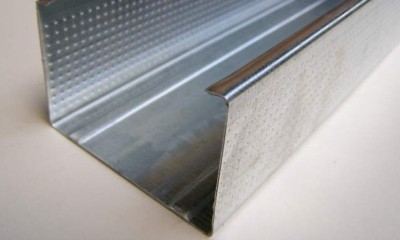
The 75 mm profile is the best option. In this instance, the partition is reinforced concurrently, but the structure as a whole won’t be heavy.
The frame can handle the highest loads best with a 100 mm profile.
Increased sound insulation qualities set this option apart, and any utility networks can be hidden within the interior space.
Installation of embeds
The method’s primary benefit is that work can be done either before or after plasterboard sheets are installed.
It makes no difference what kind of frame you choose. These could be wooden blocks or a metal profile. While there are several building materials that can be used as mortgages, wooden beams are the preferred option. Installing OSB or plywood pieces is permitted.
As you select a wooden beam, you must ascertain its thickness precisely.
The choice is based on the anticipated weight of the items to be mounted on the wall surface:
- A small thickness of timber is suitable for attaching a bookshelf.
- If you need to secure a heavy water heater, you will need a really massive beam.
The best choice for reinforcing interior plasterboard partitions is this one. However, you must arrange ahead of time for the precise location of the furniture or technological device to be fixed.

While it can be used in the early stages of design, the first case eventually becomes ideal. Following the arrangement of the main design, no further steps will be necessary.
In terms of external fixation, more challenges might arise here because precise location of the frame elements is required for drywall installation.
Take note: The mortgages are mounted from above or directly within the frame.
Double casing GKL
Double sheathing technology is used if reinforced racks are unable to strengthen the frame.
What makes it up:
- Two plasterboard sheets are used, which are installed on each other. So, on a profile of 50 mm thick, you can install two sheets of GLC. In this case, not only the total thickness increases, but also the strength characteristics of the wall.
- Additional strength is created thanks to the installation of sheets by crossing the seams. In this case, the joints on the first layer of the partition will not coincide with the front covering. This helps to increase both strength characteristics and greater sound insulation properties.
- The work is carried out by forming a standard frame from wooden beams or metal profiles. Then lay mineral wool or similar insulating material. This solution helps improve sound insulation and thermal insulation.
- Laying is carried out when both parts of the frame are well fixed. There should be no free cavities between the sheathing of plasterboard voids. In this case the sound will not resonate.
- Drywall sheets are secured to the frame using self-tapping screws. After the first layer of drywall is completely installed, fix the second row of sheathing. It is necessary to first cut the first and last sheets so that they do not exactly coincide at the seams with the previous row.
Crucial! The caps must not protrude past the surface and must be slightly recessed inward.
Only in this instance is the finishing work easier to complete and more cladding can be added without any issues.
Furthermore, avoid screwing in the fasteners too firmly as this could compromise the strength and dependability of the connections and compromise the integrity of the drywall.
Features of choosing a method
It is crucial to choose the best course of action to reinforce the structure in addition to completing the work accurately. If not, you risk having the opposite effect when the drywall and frame are unable to support heavier loads.
It is preferable to select reinforced frame posts with a minimum thickness of 100 mm if maximum stability is needed. It is best to install the wood in a metal frame or double sheathe with sheets of gypsum plasterboard if the requirements are not too severe.
Useful video
Watch this helpful video to learn how to construct a sturdy gypsum plasterboard partition.
For interior walls to be stable and long-lasting, drywall reinforcement and partition strengthening are essential measures. The strength and resilience of your walls can be greatly increased by being aware of the weaknesses in drywall and using effective techniques for reinforcement.
Joint compound and fiberglass mesh tape are two of the best tools for reinforcing drywall. Applying several layers of mesh tape along the drywall’s joints and seams helps to disperse pressure and stop cracking. This technique offers a smooth surface for finishing in addition to strengthening the structural integrity.
Increasing the number of studs or framing behind the drywall is another useful method. Further support can be added by attaching extra framing members or installing extra studs between already installed studs. This method works especially well in places with a lot of traffic or where heavy objects might be mounted on the walls.
Think about employing soundproofing methods that improve structural integrity to fortify drywall partitions. In addition to lowering sound transmission, adding acoustic insulation materials to the wall cavities gives the partitions more mass and rigidity. This two-pronged strategy enhances the walls’ overall strength and acoustic performance.
Finally, it’s critical to select the right anchors and fasteners for mounting heavy items like shelves or cabinets when reinforcing drywall and partitions. The risk of damage over time is reduced by distributing the weight evenly and attaching directly to studs or using drywall anchors.
You can improve the strength and durability of partitions and drywall by putting these strategies into practice. This will ensure that the materials can withstand normal wear and tear. These techniques aid in creating strong, durable walls that improve the overall resilience and quality of your building, whether you’re creating new spaces or remodeling old ones.
In this post, "The Best Ways to Reinforce Drywall and Strengthen Partitions," we’ll look at doable strategies for making drywall partitions in building and remodeling projects stronger and more resilient. We explore practical methods that increase structural integrity without sacrificing aesthetics or affordability, such as employing sophisticated framing techniques or adding reinforcing materials like steel studs or fiberglass mesh. Whether you’re working on a commercial building or a home renovation, these methods provide dependable ways to increase the durability and longevity of your drywall partitions, making sure they can easily endure normal wear and tear.


