
For efficiency and comfort, selecting the ideal water heating system for your house is essential. Numerous system types exist, each with unique benefits and factors to take into account. Making an informed choice that fits your needs and budget can be facilitated by being aware of these options.
The conventional storage tank water heater is one popular kind of water heating system. Before using it, this system heats up water and keeps it in an insulated tank. It is simple, dependable, and appropriate for a wide range of households. However, because of standby heat loss, it may not be as energy-efficient as more recent technologies.
On-demand water heaters, sometimes referred to as tankless water heaters, are becoming more and more well-liked due to their capacity to save space and consume less energy. By heating water only when needed, these units prevent heat loss from standby. They are perfect for homes with high demand or limited space because they are small and have a continuous hot water supply.
Instead of producing heat directly, heat pump water heaters work by moving heat from the ground or the air into the water tank. When compared to conventional electric water heaters, they can drastically save energy costs due to their high efficiency, particularly in moderate climates. They might not be appropriate, though, in areas with low ambient heat or in colder climates.
Solar water heating systems use solar collectors on the roof to heat water using the sun’s energy. In the long run, they can result in significant energy bill savings and are friendly to the environment. Nevertheless, the quantity of sunlight and the local climate both affect how effective they are.
When comparing these systems, you should take into account things like the initial cost, continuing maintenance, energy efficiency, and your home’s unique requirements. Prior to making a choice, each system should have its own installation specifications and operational factors carefully considered.
This post will go over each kind of water heating system in great detail and provide diagrams to show how they operate. You can select the most efficient, economical, and comfortable water heating system for your house by weighing the advantages and disadvantages of each option.
- Heating with natural circulation
- Advantages of gravity heating
- Disadvantages of gravity heating
- Heating with forced circulation
- Types of water heating systems
- Single-pipe heating systems
- Two-pipe heating systems
- Radiant heating system
- Underfloor heating
- Heating pipes
- Heating with metal pipes
- Heating a house with polypropylene pipes
- Heating with metal-plastic pipes
- Heating with water baseboard
- Video on the topic
- 3D diagram of a single-pipe heating system made of metal-plastic
- Which heating scheme to choose for a private home? / DOUBLE-PIPE or BEAM system?
- Two-pipe or Manifold? Tichelman loop? Selecting a Heating Scheme!
- TOP useless HOME HEATING solutions that many people dream of!
Heating with natural circulation
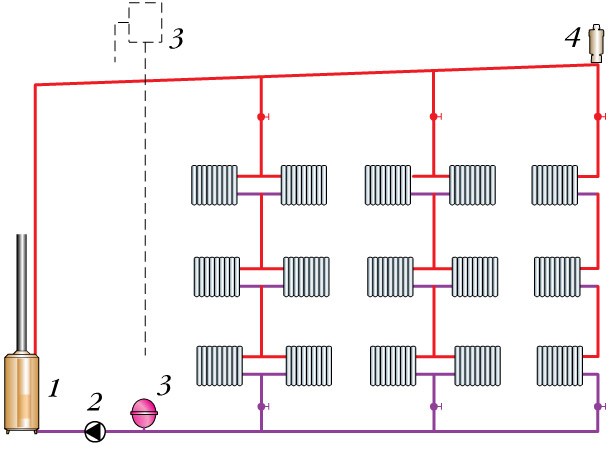
Systems of natural circulation, also known as gravity flow systems, have been in use for a considerable amount of time. The name itself makes it clear that they operate according to natural physical laws rather than requiring the assistance of specialized equipment like pumps.
It is a well-known fact from physics classes in school that heated liquids or gases always rise. That’s exactly the idea behind this kind of heating. Water starts to ascend the pipes as it heats up in the boiler. It starts to descend back to the boiler after reaching the farthest heating device, where it reheats and circulates upward once more. The water return section needs to be sloped when installing a self-circulating system. Additionally, an expansion tank must be installed at the coolant supply, the highest point in the system, to serve as a buffer and account for the rise in liquid volume.
Advantages of gravity heating
Home gravity water heating systems have been around for a while and have proven to be effective due to their many benefits, as previously mentioned.
-Price. After all, no additional equipment needs to be installed in order to use this system.
-Simple to install and maintain (you can even build a heating system for your own house).
– Operating off of no electricity. The liquid will run through the system until the boiler temperature falls below fifty degrees for a while.
-Another benefit of not having a pump: nearly silent operation.
Disadvantages of gravity heating
Even with all of the aforementioned benefits, self-circulation heating systems have a number of drawbacks that make using them to heat a home in the modern era inappropriate.
-The inability to use this kind of system in large spaces. Water circulation will be a challenge, even for a two-story private home.
-Variations in temperature across heating appliances. The room will be colder the farther it is from the boiler. Furthermore, there are instances when the difference is substantial—up to five degrees.
-Difficulty controlling the heat. First off, you won’t be able to lower the house’s heating power below this threshold because the system won’t activate until the boiler reaches a temperature of 50 degrees. Second, there will still be a 3 to 5 degree temperature error even with heat regulators installed, which is a considerable difference.
These programs are becoming less and less relevant over time, and more contemporary mandatory programs take their place annually. If you want things to be easier, we advise using water heating with natural circulation.
In this post, we examine several popular water heating systems for homes, offering concise schematics and contrasting their salient characteristics. We explain the functions and advantages of various heaters, ranging from conventional tank-based heaters to contemporary tankless systems and energy-efficient heat pumps. Whether you’re looking to install, upgrade, or save energy, this guide tries to assist you in making decisions that are specific to your home’s requirements.
Heating with forced circulation
Thus, it is evident that systems featuring inherent liquid circulation possess several noteworthy drawbacks. Systems with forced circulation, which employ extra equipment to improve the coolant flow in the system, are an alternative to them. specifically the pump for circulation.
Yes, this kind of water heating at home is more complex and expensive, but there are a lot of benefits:
Capacity to warm a sizable space. Large homes are not suited for natural circulation, as we have previously stated. A forced circulation system is your only choice if you are the sole owner of this.
The intricacy of the system. Installing a pump allows you to be independent of indicators like pressure. Consequently, in a forced system, an impediment that existed in a gravity system does not exist. For instance, if your home’s design calls for it, you can now add more pipe bends.
– Employing tiny pipes. Indeed, the neat appearance of the heating system is not the final sign that needs to be considered.
– Less reliance on air presence in the system to maintain heating quality. The movement of coolant through pipes would become considerably more difficult if self-circulation occurred and air entered the system. This issue is resolved by a forced system, but in the event that metal pipes are installed, specific expansion tanks equipped with air vents and fuses must be utilized to prevent system corrosion.
-The potential to use lighter, more resilient plastic pipes.
-Pipe installation that is hidden is possible. Pipes can be discretely hidden in walls and screeds without any issues.
Types of water heating systems
Let’s now examine your options for water heating installation. Similar to the circulation method, we have an easier and less expensive option that is less technical than an expensive and more complicated one.
Single-pipe heating systems
The first, most straightforward and affordable, type of water heating system for a home is a single-pipe system in which the liquid circulates through each pipe, radiator, and other heating device in the chain in turn before returning via the return pipe to the boiler. Once more, this option works better in a smaller space.
One of these systems’ drawbacks is that proper balancing is impossible. The last gadget is always warm, and the first one is always hot.
Two-pipe heating systems
It is preferable to choose a more sophisticated two-pipe system for larger rooms. The radiators’ bottom connections will be used in this instance. However, adding a circulation pump will make this type of heating installation absolutely flawless. If not, heating distant rooms will be challenging.
Furthermore, special bypasses on each battery and liquid supply regulators to a separate radiator can be installed to lower the cooling rate of the liquid in the system.
The installation of a single pipe to the farthest radiator, from which a branch is made to intermediate heating devices, is what distinguishes a two-pipe water heating system from another. Consequently, after traversing the complete heating system, the coolant goes back to the boiler via a dedicated return pipe, facilitating the uniform distribution of heat transfer throughout the space.
Of course, the biggest drawback of this type of heating is how expensive and difficult it is to install, but the comfort it provides makes up for these drawbacks.
Radiant heating system
The perimeter method is exemplified by the two types of heating pipe laying that were previously discussed. Radiation is an alternative, though. Each radiator in this installation has a separate supply of pipes: one for the coolant to enter the heating device and another for its return. You can use this system to set a comfortable temperature in every room of your house. Furthermore, it is sufficient to turn off the heating in the designated area only in the event that one of the radiators or pipes breaks down.
Installing a radial system requires a lot of pipes, so all communications are mounted directly into the walls or floor, which is advantageous for the interior of the home.
It is best to use pump circulation of the coolant when installing radially.
Underfloor heating

Water-heated floors are the best option for uniformly warming the entire space. This system can be used independently or in conjunction with other heating appliances. For instance, when heated floors are put in the restrooms, hallways, and rooms, and radiators are installed in the rooms. In other words, rooms with marble or tile flooring will benefit greatly from warm flooring.
When the coolant is forced to circulate, the "warm floor" system can be used.
The following are some benefits of water heating combined with underfloor heating:
- Uniform heating of the room. A screed that releases heat by radiation releases it in equal shares in each square of the room.
- Rational heat distribution. Heat moves from bottom to top.
- Comfort and microclimate.
- Absence of heating devices on the walls in most cases
Heating pipes
We should also think about the different kinds of pipes that are used to heat private homes. Without a doubt, every material has advantages and disadvantages. Together, we can determine which option is best.
Heating with metal pipes
Copper and steel pipes are examples of metal pipes.
The primary benefit of using steel for a home’s wiring is how inexpensive it is to install water heating. This metal works well for heating both water and steam because of its versatility. withstands intense pressure. Steel pipes’ primary drawback is how quickly they corrode. Rusted pipes don’t make for the best interior décor, so this has less of an impact on the heating quality and more on the aesthetics of your house.
More benefits of copper pipes include their exceptional durability, ability to maintain temperature, and resistance to corrosion. The smooth inner surface of copper pipes ensures high fluid movement speed through the heating system, which is another benefit. The primary drawback of copper is its expensive cost.
It is important to remember that copper and steel pipes cannot be installed in walls or floors and are only appropriate for open heating systems. Thus, as we can see, their versatility has a limit.
Heating a house with polypropylene pipes

The primary benefit of polypropylene pipes is their resilience to outside environmental elements, such as rust, decomposition, bacterial growth, and chemical exposure.
Additionally, this material’s light weight is one of its main benefits. This has additional benefits in that these pipes can be used on both the interior wall and the support and are simpler to install.
Because polypropylene has a low coefficient of friction and coolant flows through the heating system with ease, it reduces the amount of fuel (gas or electricity) needed to heat the boiler. However, the distinction is negligible.
Furthermore, polypropylene pipes are highly adaptable, feature multiple joints and modifications, and can be combined with an extensive array of different components to enable the installation of intricate heating systems.
Lastly, when all of the pipes are concealed within the walls or floors, heating with polypropylene pipes can be done in both open and closed systems.
These pipes have drawbacks despite all of their obvious benefits. First of all, despite having a decent level of resistance to chemical influences, these pipes are readily influenced by mechanical forces (you can cut them with a regular kitchen knife). Second, not every kind of heating system can be used with polypropylene. They are great for the water heating we are thinking about, but they can’t be used at all with a steam generator. Additionally, using polypropylene for water heating necessitates a lot of joints, which has a big impact on the system’s dependability.
Heating with metal-plastic pipes
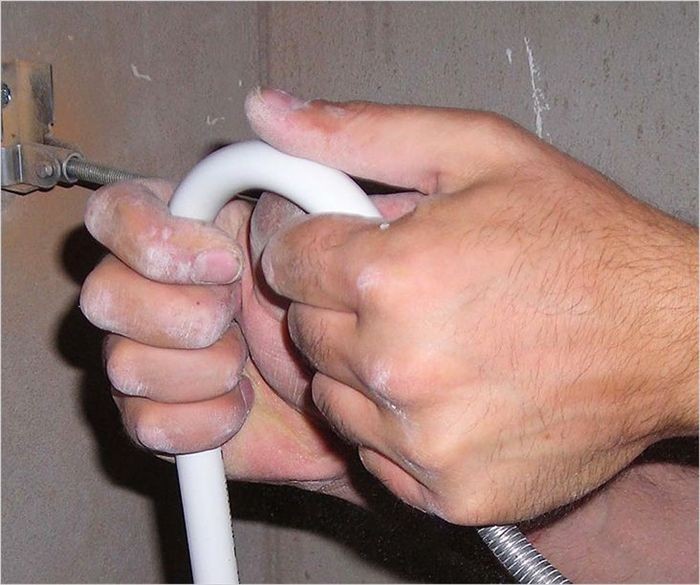
The benefits of metal-plastic pipes are similar to those of their polypropylene equivalents when discussing their benefits. However, it is important to note separately that they have a greater temperature tolerance. Furthermore, and this is what sets them apart from the competition, metal-plastic bends flawlessly. You also don’t need to be concerned about breaking it. Additionally, this feature makes this kind of pipe the best choice for a "warm floor" system.
One drawback is that it costs more than equivalent products made of polypropylene.
Heating with water baseboard
In closing, we would like to share with you the "final word" regarding water heating systems. Baseboard heating is a viable option if you want the heat in your house to be completely invisible.
A heating element made of special tubes is housed inside a housing that resembles a standard baseboard in this type of heating device. They heat up first, followed by the body and the distribution of heat along the walls.
This kind of heating is perfect for our region, where the moisture in the air frequently leads to the growth of mold on walls. Furthermore, as was already mentioned, radiators and pipes won’t damage your interior.
However, this system also has some shortcomings:
- it cannot be used on walls along which furniture is installed
- for large rooms, the installation of 2-3 buildings will be required, since the maximum length of the heating circuit is 15 meters.
| Types of Water Heating Systems | Diagrams and Comparison |
| 1. Conventional Tank Water Heaters | Uses a large insulated tank to store hot water; simple setup. |
| 2. Tankless (On-Demand) Water Heaters | Heats water directly without a storage tank; efficient for smaller spaces. |
| 3. Heat Pump Water Heaters | Transfers heat from air or ground to water; energy-efficient but requires space. |
| 4. Solar Water Heating Systems | Uses solar panels to heat water; eco-friendly but initial costs can be high. |
| 5. Indirect Water Heaters | Connects to a boiler for heating; ensures consistent hot water supply. |
| 6. Point-of-Use Water Heaters | Small units for specific areas; reduces water wastage and energy use. |
A number of considerations must be made when selecting the best water heating system for your house, including cost, efficiency, and your unique heating requirements. There are various benefits and drawbacks associated with each type of system, including heat pump, tankless, and conventional tank water heaters.
With a conventional tank water heater, hot water is kept in a sizable tank for instant use. It is a dependable solution that is effective for homes with regular hot water needs. Comparing it to more recent technologies, though, may result in lower energy efficiency.
Conversely, tankless water heaters provide instantaneous and continuous hot water by heating water only when needed. Since they only heat water when necessary, they are more energy-efficient and over time may result in lower utility bills. They might cost more up front, though.
Heat pump water heaters don’t produce heat directly; instead, they transfer heat using electricity. They may not function as well in colder climates without additional heating sources, but they can be very effective in moderate climates.
Take into account aspects such as the cost of installation, upkeep, and the availability of energy-efficient models when comparing these systems. You should also consider the climate and hot water usage habits of your household, as these will determine the best and most affordable system for you.
The ideal water heating system for your house will ultimately depend on weighing up-front expenses against sustained energy savings while taking your unique needs and circumstances into account. You can make an informed choice that maximizes efficiency and savings while guaranteeing dependable hot water by being aware of the differences between these systems and assessing your priorities.


