
Popular building material shell rock is prized for its longevity and innate beauty. However, there are a number of variables that can affect price. Making an informed decision and ensuring you receive the best value for your project can be achieved by being aware of these factors.
The quality of the shell rock is one of the main factors influencing its price. Costs are typically higher for higher quality shell rock because it is more uniformly textured and contains fewer impurities. Furthermore, the origin of the shell rock is important. Because local resources don’t require as much transportation, they could be more affordable than imported shell rock.
The size and quantity you require are equally important considerations. Purchasing in bulk frequently results in a lower price per unit, but precise calculation is essential to prevent wasteful spending. The project’s complexity and the ease of access to the building site may have an effect on the final cost. Elevated labor and transportation costs can arise from intricate projects or remote areas that require more effort to access.
Measure the area you want to cover and figure out how much material you’ll need in order to accurately calculate the cost of shell rock. To ensure accuracy, take into consideration seeking professional advice. Remember to factor in extra expenses for labor, delivery, and possible waste. You can effectively budget for your shell rock needs and prevent any unforeseen expenses by carefully weighing these factors.
- What determines the cost of a stone??
- Classification
- M15
- M20
- M25
- M35
- Crimean shell rock by brand and application
- How much does it cost to lay limestone??
- Table with prices for services
- How many bricks are needed to build a house??
- How many blocks are there in 1 m2 and in a cube??
- Example of calculation for load-bearing walls and partitions
- Rules for drawing up estimates
- How to calculate expenses?
- Video on the topic
- House made of shell rock in Crimea| How to save on heating while building @allstroycrimea
- How to saw and load shell rock (shell rock).!Unloading shell rock into a small cliff.
- Correct laying of shells)))
- 🛠CONSTRUCTION TECHNOLOGIES FROM SHELL ROCK. ILYA SAVCHENKO SAVBUILD. SHELL. CONSTRUCTION
- Aerated concrete or shell rock ?! Advantages and disadvantages! What to choose?
- Shell rock or gas block? Advantages and disadvantages!
What determines the cost of a stone??
Those developers who have chosen to construct a home using shell rock blocks may find this question interesting. This is required to get the most accurate estimate of construction costs, taking into account the price of materials, the cost of delivery, and the cost of building and installation work.
Features of the Crimean shell rock:
- brands No. 15-35;
- thermal conductivity: 0.20.6 Kcal/m* hour* C;
- frost resistance from F50 to F70;
- compressive strength 16.7 kg/cm 2 .

Because of these qualities, shell rock can only be used under specific circumstances. For example, one M15 brick can only be used to build partitions and utility buildings, and two bricks with a minimum grade of M 25 can be used to build load-bearing walls.
Important: Plaster or another finishing material must shield all shell rock walls from moisture.
Classification
The strength and density of shell stone blocks are categorized into classes, which has an impact on the wall material’s ultimate cost and application range.
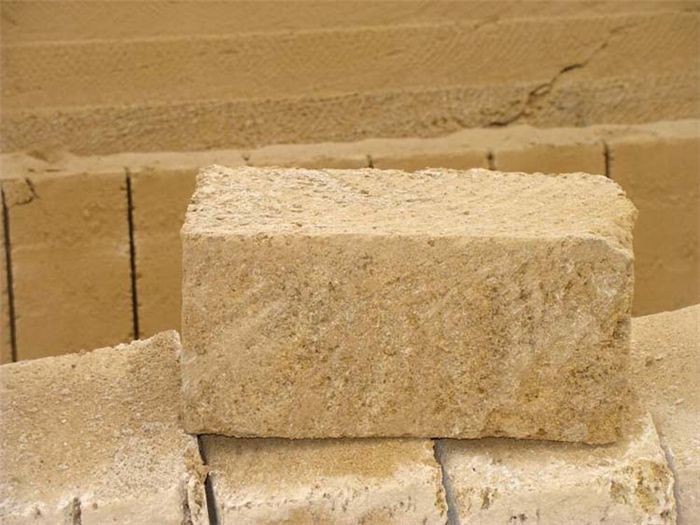
M15
Application areas include fences, non-load-bearing walls, and small structures.
Benefits
- lowest cost;
- a light weight.
Drawbacks:
- cannot withstand heavy loads;
- high sand content;
- softness and porosity of the structure, due to which they exhibit low strength.
M20
Applications include building low-lying homes, fences, and partitions.
Advantages: stronger and denser than M15.
Drawbacks:
- yellow;
- high sand content;
- high softness.

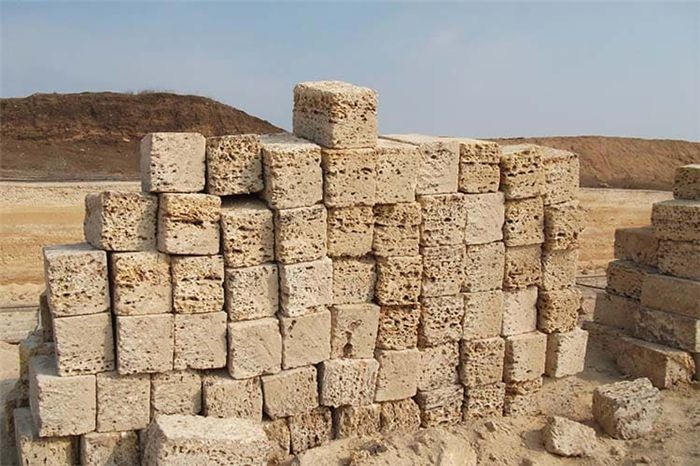
M25
Application areas: up to three stories of an object’s load-bearing walls.
Benefits
- the most acceptable and best-selling block for residential construction of walls in frame-concrete buildings;
- solid block;
- relatively heavy up to 15 kg;
- low sand content;
- color yellow and yellow-white.
Drawbacks:
- high moisture absorption;
- When stone freezes, mold can form on it, so additional heat and moisture protection of the walls is required.
M35
Application areas: up to seven-story buildings’ load-bearing walls.
Benefits
- low sand content;
- high strength and hardness;
- good heat and noise protection characteristics.
Drawbacks:
- high weight up to 27 kg block;
- high cost per block.

Note: The season of the goods sale determines the price of a single block; during the winter, it is 20% less. The reason for this is that construction activity tends to slow down during cold weather, and material stored at temperatures below freezing can negatively impact the blocks’ properties.
Crimean shell rock by brand and application

One 39x19x19 block mined in the Russian Federation’s center regions sells for an average of 70–80 rubles on the market, while blocks mined in Crimea start at 30 rubles. Dagestan shell rock is the priciest; it costs between 700 and 1200 rubles per square meter when purchased as facing tiles.
How much does it cost to lay limestone??
The primary determinant of shell stone masonry services is the type of block: smooth, dense, or porous. Hiring a contractor to construct these walls from these blocks is the least expensive option.
But, placing an official company order for masonry will cost between thirty and forty percent more, but it will also be more dependable because a contract is signed and warranty periods are set in this instance. Such a business must additionally present all licenses attesting to their authority to carry out the necessary tasks.
The final point is critical to the construction of housing because, upon the official opening of the home, the client will have to provide these documents to the relevant regulatory bodies.
Furthermore. Because construction companies have additional overhead and tax obligations, their prices are typically higher than those of individual builders.
Laying shell rock blocks: the cost of the cobblers’ labor typically ranges from 700 to 1000 rubles per square meter, and the construction company’s contract is finalized in accordance with price lists that fall between 1200 and 1700 rubles per square meter.
The primary factors influencing the price of shell rock block masonry walls are:
- The brand of the block, the higher it is, the higher the final cost of the work, this is explained by the fact that denser blocks weigh more, for example, M15 – 13 kg, and M35 – 27 kg, which means lifting them will require more effort from the performers.
- Season of the year, market prices apply in construction. The peak cost of laying shell rock per 1 m 3 occurs in spring and early autumn, and the lowest prices are in winter.
- Wall thickness.
- Type of walls – external load-bearing, internal or partitions.
- Type of building project, classic or complex.
- Building height, number of floors.
- Built-up area.

Shell rock walls are laid in two rows, with spoon and butt rows alternated, and seams must be ligated.
Mortar is poured in vertical joint filling from above.
Maximum thickness for vertical joints is 20 mm, and maximum thickness for horizontal joints is 15 mm.
Wedges or rows are used to make jumpers; the latter need to be strengthened.
Table with prices for services
Prices for shell rock masonry are usually set per meter three or meter two in the Russian Federation. Standard dimensions for load-bearing walls are 390 mm in thickness and one block in width, with masonry dressing every fourth row and extra thermal insulation of at least 100 mm.Non-load-bearing walls can have reinforcement and measure 190 mm.
Pricing chart for a construction company’s shell rock wall installation services:
Citation. These indicators can be used to calculate the cost of individual builders with a coefficient of 0.6; additionally, a coefficient of 0 can be included for work that will be done in the winter. 7-0.8 for a reduction in seasonal prices.
How many bricks are needed to build a house??
You will need to know the block’s dimensions in order to calculate how much shell rock you will need to buy for wall construction. For instance, the following features of a one-story residential building are taken into account when performing the calculation:
- Construction area: 100 m2 .
- Building plan: 10×10 m.
- Length of external walls: 10×4=100 m.
- Length of internal walls: 10 m.
- External corners – 4 pcs.
- Internal corners – 4 pcs.
- Window sizes: 1.2×1.2 m – 3 pcs.
- External door: 1.2×2.2 – 1 piece
- Internal doors: 1.2×2.2 – 2 pcs.
- Wall reinforcement – every 4 rows.
- Seam thickness from 15 to 20 mm.
- Block dimensions – 390x190x190 mm
How many blocks are there in 1 m2 and in a cube??
You must consider its measurements to determine the number of shell rock blocks in 1 m3.
Note: Common dimensions for these blocks are 390 x 190 x 190; 490 x 240 x 188; and 390 x 190 x 288 mm.
Finding the number of shells in a cube:
- Convert dimensions from mm to meters by dividing all indicators by 1000: 0.390X0.190X0.190; 0.490X0.240X0.188; 0.390X0.190X0.288 mm.
- The volume of one block is determined by multiplying all the characteristics of height, width and length: 0.390X0.190X0.190=0.01408 m 3; 0.490X0.240X0.188=0.02211 m 3; 0.390X0.190X0.288=0.02134 m 3 .
- The quantity is determined by dividing 1 m3 by the volume of one block: 1/0.01408=71 pcs.;1/0.0221=45 pcs.;1/0.02134=47 pcs.
Finding the number of shells in a square meter:
- Convert dimensions from mm to meters by dividing all indicators by 1000: 0.390X0.190X0.190; 0.490X0.240X0.188; 0.390X0.190X0.288 mm.
- Determine the area of one block by multiplying the height and width: 0.390X0.190=0.0741 m2; 0.490X0.240=0.1176 m 3; 0.390X0.288=0.1123 m 3 .
- The quantity is determined by dividing 1 m2 by the volume of one block: 1/0.0741=13 pcs.;1/0.1176=9 pcs.;1/0.1123=9 pcs.
Example of calculation for load-bearing walls and partitions
The computation is performed for a 100 m³ single-story home with a 10 x 10 m floor plan.
| No | Names of indicators | Formula | Calculation | Unit |
| 1 | Volume of load-bearing walls | 10x4x3x0.390 | 46.8 | m 3 |
| 1.1 | Total area of load-bearing walls | 40×3 | 120 | m 2 |
| 1.2 | Doorway area | 1.2×2.2×1 | 2.64 | m 2 |
| 1.3 | Window opening area | 1.2×1.2×3 | 4.32 | m 2 |
| 1.4 | Area of load-bearing walls without windows and doors | 46.8-2.64-4.32 | 39.84 | m 2 |
| 1.5 | Number of blocks per cubic meter | 1:0.01408 | 71 | PC. |
| 1.6 | Estimated number of blocks for load-bearing walls | 71×39.84 | 2829 | PC. |
| 1.7 | Quantity of masonry mesh | 35.2 | m 2 | |
| 1.8 | Blocks laid down for battle | 0.10×2829 | 283 | PC. |
| 1.9 | Total number of load-bearing wall blocks | 2829+283 | 3112 | PC. |
| 2 | Volume of partitions | 10x3x0.190 | 5.7 | m 3 |
| 2.1 | Full area of partitions | 10×3 | thirty | m 2 |
| 2.2 | Doorway area | 1.2×2.2×2 | 5.28 | m 2 |
| 2.3 | Window opening area | 0 | 0 | m 2 |
| 2.4 | Area of partitions without windows and doors | 30 – 5.28 | 24.3 | m 2 |
| 2.5 | Number of blocks in 1 m 3 | 1:0.01408 | 71 | PC. |
| 2.6 | Estimated number of blocks for load-bearing walls | 71×5.7 | 405 | PC. |
| 2.8 | Blocks laid down for battle | 0.10×405 | 41 | PC. |
| 2.9 | Total blocks for partitions | 405+41 | 446 | PC. |
Rules for drawing up estimates
If the developer intends to create an estimate for shell rock on his own, he must consider the cost of both the primary materials and the auxiliary ones required for building walls of superior quality.
The primary factors that should be considered when creating an estimate for the construction of a shell rock building, along with an average value for a 100 m2 home, are:
- Materials for the foundation: concrete M300, 35 m 3; crushed stone – 10 t; roofing felt – 8 rolls; film-100 p.m.; reinforcement 12 mm – 1400 p.m.; board 150x25mmx6 – 80 pcs.
- Internal walls 390x190x190 mm, m15 – 446 pcs.
- External walls 390x190x190 mm, m25 – 3123 pcs.
- Mortar for laying blocks, joint 15-20 mm, 10 m 3 .
- Concrete M300 for lintels, 5 m 3
- Reinforcement 16 mm for jumpers, 250 p.m.
- Installation of floors: concrete – 25 m 3; reinforcement – 1000 p.m.; 150*50 mm board – 70 pcs.; timber 200*100mm – 30 pcs.; roofing felt – 12 rub., insulation Isoblock – 16 m 3; vapor barrier 2 rolls; waterproofing – 2 rolls; fastener.
- Roof and roofing: board 200*50mm – 80 pcs.; board for lathing 150*25mm -150 pcs.; vapor barrier and waterproofing 3 rolls each; metal tiles 260 m 2; drainage system; fasteners and screws.
- Construction and installation works.
- Transport services.
- Loading and unloading operations.
- Overhead costs, in housing construction, 102% of the workers" compensation fund are accepted.
- Estimated profit, in housing construction 62% is accepted to the workers" compensation fund.
The estimate, at an average price point, for a 100 m³ one-story residential building composed of sandstone with a hip roof composed of metal tiles is as follows:
- Materials: RUB 1,650,350.
- Loading and unloading operations: RUB 16,000.
- Procurement costs 15%: RUB 247,553.
- Construction and installation works, including.h. salary: 880,050/ 378,000 rub.
- Overhead: 1.02X 378,000 rub.= 402393 rub.
- Profit:0.62x 378000 = 234360 rubles.
- Total: RUB 3,430,706.
How to calculate expenses?
This category of cost, which makes up the majority of all building-related expenses, is included in the local estimate’s required sections.
The following computations by material volume, multiplied by price, must be used to determine the costs of buying and installing limestone blocks:
- Shell rock m25 for load-bearing walls – 3123 pcs.:3123×29=90567 rub.
- Shell rock m10 for partition walls – pcs.: 446 x15=6690 rub.
- Mortar for laying blocks – 10 m 3: 10x 4,200.0 RUR.=42000 rub.
- Concrete M300 – 5 m 3: 5×4800 rub.= 24,000 rub.
- Reinforcement 16 mm for jumpers: 250×57=14250 rub.
- Laying shell rock M25 for load-bearing walls – 39.84 m 3 x1500=59760 rub.
- Laying shell rock M10 for partition walls – 5.28 m 3 x1200=6336 rub.
- Total: RUB 243,603.
| Factors Affecting Shell Rock Prices | How to Calculate Shell Rock Prices Correctly |
| Quality of the material | Determine the required quantity in cubic meters |
| Supply and demand | Check current market prices per cubic meter |
| Location and transportation costs | Include delivery costs to your location |
| Supplier reputation | Compare prices from different suppliers |
| Seasonal variations | Consider any seasonal price fluctuations |
Shell rock can range in price for a number of reasons. Three main factors that can affect the price are the rock’s quality, density, and color. Rarer and higher-quality colors are typically more costly. The distance between the quarry and the construction site also influences the cost of transportation, which ultimately affects the total cost.
The demand in the market is also very important. Prices for shell rock may rise in periods of high demand. On the other hand, if there is an excess, prices may decrease. Seasonal variations can also have an impact on costs because there may be an increase in construction activity during particular times of the year, which raises the demand for materials like shell rock.
Finding the volume of rock needed and measuring the area where it will be used are the first steps in figuring out how much shell rock will cost for your project. Precise measurements guarantee that you buy the appropriate quantity, preventing overspending or shortages. Your project’s budget will be more accurate if you confer with suppliers to obtain an estimate based on current market rates and transportation costs.
To sum up, you can effectively manage your construction budget by knowing the factors that affect shell rock prices and how to calculate your needs. Throughout your remodeling or building project, you can make well-informed decisions and steer clear of unforeseen expenses by taking quality, transportation, demand, and precise measurements into account.
Popular building material shell rock’s price is determined by a number of factors, such as its quality, where it comes from, and how much demand there is right now in the construction industry. The final price is also influenced by market fluctuations, processing techniques, and transportation costs. Accurate cost calculation requires taking into account the required volume, delivery fees, and any additional costs such as shaping or cutting. Comprehending these components facilitates the maintenance of a reasonable budget for shell rock construction projects.


