
The correct screws must be used when fastening drywall to wood. Using the right screws guarantees that your drywall will remain firmly in place and that the finished wall will have a smooth, polished appearance. However, it can be challenging to determine which screws are best for the job given the abundance of options.
For this purpose, drywall screws are specifically made. They feature threads that grip firmly to keep the drywall from coming loose and a sharp point that easily penetrates both wood and drywall. The two most popular varieties are screws with coarse and fine threads. Fine-thread screws are better suited for metal studs, whereas coarse-thread screws perform best on wood.
It’s crucial to take the screws’ length into account. For attaching 1/2-inch drywall to wood, 1 1/4-inch screws work well. You may require longer screws, about 1 5/8 inches, if you’re working with thicker drywall, like 5/8-inch. By using the proper length, you can make sure the screws go just deep enough into the wood to provide a firm hold without damaging the surrounding area.
The kind of screw head is an additional consideration. Because of their slightly rounded top that sits flush with the drywall’s surface and makes joint compound application easier, bugle-head screws are frequently used for drywall. This leaves an even, smooth surface that is prepared for painting or wallpapering.
You can simplify and improve the look of your construction or renovation project by selecting the proper drywall screws for wood. Making sure the screws are the right kind, length, and head style will help guarantee that your drywall remains securely fastened and attractive for many years to come.
| Type of Screw | Description |
| Coarse Thread Screws | Best for attaching drywall to wood because they grip better and are less likely to strip the wood. |
| Fine Thread Screws | Not ideal for wood; they are better suited for attaching drywall to metal studs. |
| Self-Drilling Screws | Useful for thicker wood or when pre-drilling holes is not preferred. |
| Bugle Head Screws | Designed to sit flush with the drywall surface, preventing damage to the paper surface. |
- Can it be used for wooden frame?
- Varieties
- Phosphate coated
- With galvanized
- Aluminum or brass
- How to choose?
- TOP 5 manufacturers
- Knauf
- Hilti
- OMAX
- SWFS
- "Bison"
- Rules and technologies of application
- Advantages and disadvantages
- Video on the topic
- Installation of plasterboard on a wooden wall
- Drywall-wood screw (ShSGD)
- Drywall on a wooden frame
- How to properly fasten drywall with screws
Can it be used for wooden frame?
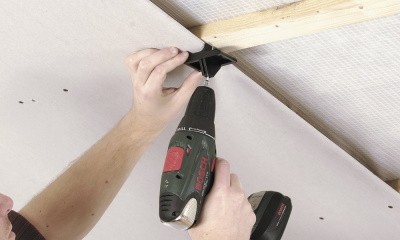
Trees have a special kind of structure that is both solid and porous.
This enables you to create a strong, dependable, and long-lasting interface by fastening nails, screws, or self-tapping screws to bars or boards.
Gypsum board sheets may be fastened with screws designed specifically for these materials when a plasterboard partition is being installed using a supporting frame constructed of mutually orthogonal wooden blocks.
Note: The design strength of the screws themselves, the plasterboard’s dead weight, and the operational loads on the building envelope all play a role in determining the number, dimensions, and spacing of the hardware, which are all calculated.
Varieties
There is a vast array of wood screws available on the market that are perfect for fastening drywall sheets to the frame components. There are various categories into which this hardware is divided.
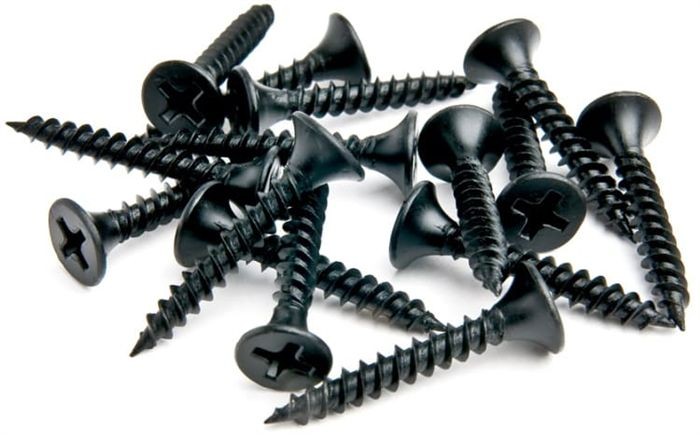
Phosphate coated
Self-tapping screws, also known as "black" screws, are the most widely used fasteners for attaching gypsum plasterboard sheets to wooden frames.
Details:
- have a flat head with a cross-shaped slot up to 3 mm deep;
- the back side of the cap is conical;
- its diameter ranges from 5 to 6.5 mm;
- height – from 3 to 4.5 mm;
- thread pitch – from 0.5 to 1.5 mm.
Most often utilized geometric parameters:
- diameter – from 2.5 to 3.2;
- length – from 25 to 35 mm.
With galvanized
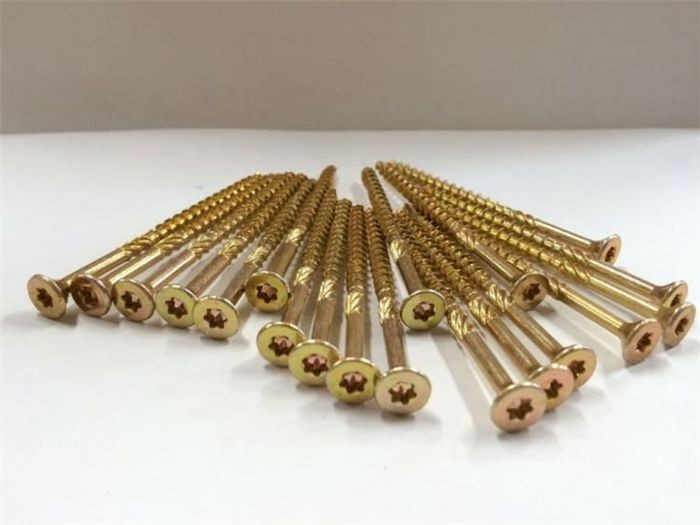
For wet rooms, premium self-tapping screws with an anti-corrosion compound coating work wonders because they don’t smudge when water seeps through.
Details:
- They are distinguished by the presence of a rounded head with a combined slot, as well as a press washer;
- head height – from 3 to 5 mm;
- diameter – from 5 to 7 mm;
- Schlight depth – up to 2.5 mm;
- thread pitch – from 0.6 to 1.0 mm.
Most often utilized geometric parameters:
- diameter – from 2.5 to 4.0 mm;
- length – up to 45 – 50 mm.

Aluminum or brass
Non-ferrous metal products are the priciest category and are regarded as the most dependable and long-lasting.
Note: They are not exposed to harsh environments and can be readily submerged in pre-drilled holes in the partition sheathing element.
Details:
- slot depth – up to 3 mm;
- head height – from 2.5 to 4.5 mm;
- diameter without press washer – up to 5.5 mm;
- with a press washer – up to 6.5 mm;
- thread pitch – from 0.6 to 1.2 mm.
Most often utilized geometric parameters:
- diameter from 2.5 to 4.0 mm;
- length from 20 to 45 mm.
Vital. Because black self-tapping screws have the highest mechanical tensile and bending strength, are dependable, and retail for a reasonable price, experts advise paying close attention to these screws.
How to choose?
When buying dependable fasteners to secure plasterboard sheets to a wooden block supporting frame, it’s important to consider the following features of the products displayed at the point of sale or in the online store’s electronic catalog:
- The material from which the products are made.
- The presence of a certificate of conformity and a quality passport for each batch of goods, which guarantees a high level of reliability and compliance with GOST requirements during manufacturing.
- The quality of the thread edge, there should be no burrs or chips on the surface of the spiral.
- Thread pitch – the larger this parameter, the faster the screw will tighten, but more force will be needed to tighten it.
- The type of finishing anti-corrosion coating of the product.
- The type of wood from which the frame is erected, on which the physical and mechanical characteristics of the hardware should depend.
- Geometric dimensions of the wood screw.
- The type and depth of the slot, which determines the category of screwdriver or screwdriver bits.
After installing gypsum boards, the following signs of the completed enclosing structure depend on the careful selection of high-quality hardware to screw into wooden structures:
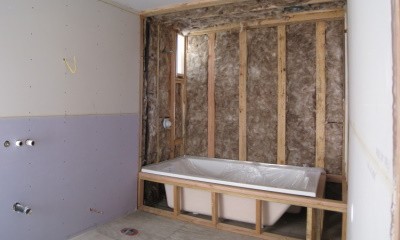
- High strength of the joint, taking into account the own weight of the gypsum board sheets, as well as the magnitude of all permanent and temporary loads.
- The loosening of hardware is eliminated due to temperature changes in the frame, or under intense mechanical stress.
- Durability of operation of the finished enclosing structure.
- Optimal ratio of cost of materials, their installation and high quality.
Vital. It is advised to buy hardware only from reputable producers whose goods are available throughout the Russian Federation and who have amassed a large number of favorable reviews from pleased customers and contractors on online forums.
Coarse-thread drywall screws are the best option for fastening drywall to wood because they offer a firm hold and keep the drywall from coming loose over time. Because of their wider threads, these screws are perfect for fastening drywall to wooden studs and joists, guaranteeing a sturdy and secure installation.
TOP 5 manufacturers
The most well-known and well-liked producers of wood screws, whose goods are available in the majority of significant retail establishments across our nation, are ranked in the TOP 5 below.
Knauf
German business established more than 90 years ago. The company produces gypsum board sheets in two of its own factories in the Russian Federation. It also possesses all the necessary parts to construct a complete enclosing structure. Knauf hardware features a combined slot and multiple layers of galvanization.
Benefits
- consistent German workmanship;
- perfect smooth thread spiral;
- quick and easy insertion of self-tapping screws into wooden blocks.
Drawbacks: Knauf can only offer products in the middle or high price range because only galvanized products are on sale.

Prices range from 200 to 260 rubles for one kilogram.
Hilti
American business with a global footprint. The company supplies the market with premium products made of aluminum and black steel. The brand produces its self-tapping screws on its own production lines in the Russian Federation.
Note: Nearly all common sizes needed to build plasterboard partitions are included in the brand’s assortment.
Benefits
- excellent brand quality;
- all products are certified in the Russian Federation;
- service life of at least 30 years.
Drawbacks: exorbitant price, which is supported by internal brand pricing and marketing strategies.

1 kg costs, on average, between 280 and 400 rubles.
OMAX
Russian business that has been in business for over 15 years. The brand’s products have risen to the top in terms of best value and dependability over the course of its existence.
Note: The production line is outfitted with CNC machines and meticulous quality control at the factory to ensure the lowest possible percentage of defects.
Benefits
- wide range of products;
- high quality in relation to affordable prices.
Cons: The widened cap on products with press washers makes it harder for air to enter the core body, which leads to cracking.

Prices range from 170 to 220 rubles for one kilogram.
SWFS
A relatively new, homegrown manufacturing business that is growing quickly.
The majority of the Russian Federation’s regions sell the brand’s goods, and experts remark on each product line’s excellent quality and dependability.
Benefits: The product’s degree of dependability is comparable to that of many international counterparts.
Drawbacks:
- small model range;
- the need to make holes for galvanized self-tapping screws, since they do not have a pointed end.

Prices range from 190 to 250 rubles for one kilogram.
"Bison"
This company has a long history of popularity among Russian consumers. One of the most well-known manufacturing companies of federal significance, with official dealers spread across the nation.
Note: This brand has a large selection of products available in every retail location that sells fasteners.
Benefits
- a rich range of products;
- the lowest price among other competitors presented in the rating.
Drawbacks: Tightening can be challenging due to the rapid deterioration of certain splines on galvanized products.

Prices range from 140 to 210 rubles for one kilogram. The aforementioned rating is subjective, not promotional in nature, and is based on user reviews of the product. It cannot be used as a direct inducement to buy.
Rules and technologies of application
Attaching gypsum board sheets to the partition’s wooden load-bearing frame is an easy task that can be completed without the help of a professional. Should you handle this production and installation process on your own, the home master needs to consider several crucial details:
- Before fixing the gypsum board sheet, markings should be applied strictly opposite the axis of the wooden elements of the supporting frame of the future partition.
- Self-tapping screws should be arranged evenly, with slight staggered spacing, to prevent splitting of wood fibers. In order not to make a mistake with the correct positioning of hardware, it is recommended to mark in advance all the places where they need to be installed.
- When installing a self-tapping screw with a diameter of more than 3.2 mm, it is recommended to drill a hole in advance to prevent cracking of the wood.
- It is not recommended to tighten the screws with a screwdriver at high speeds, as this can lead to end-to-end damage to the structure of the core.
- All hardware heads must be recessed into the body of the gypsum board by up to 2 – 3 mm.
- Before finishing drywall, it is recommended to check the tightening force with hand screwdrivers.
- If the hardware enters the body of the partition with force, it is necessary to make a hole of a larger diameter using a drill with a wood drill, which will eliminate the risk of stress concentration and splitting of the material.
Vital. It is advised that you familiarize yourself with in-depth professional video lessons and master classes before beginning to fix the plasterboard components of the building envelope on your own. These experts frequently share their recommendations with other users on the network.
Drywall to wooden frame attachment:
Advantages and disadvantages
Self-tapping screws are highly sought after because they offer numerous benefits when fastening plasterboard sheets to a wooden block supporting frame during the installation of a partition.
- High strength and reliability of the joint.
- The dive is carried out without the use of special equipment.
- Durability of the interface.
- The unit remains in a static position under dynamic loads.
- High speed of work with minimal labor costs.
- Low retail cost of fasteners in this category.
- The ability to completely dismantle a sheet of drywall without destroying it.
- High-quality self-tapping screws are practically free of defects, which ensures the reliability of the design.
However, in addition to the drawbacks, these fixation-related elements also have a few minor drawbacks:
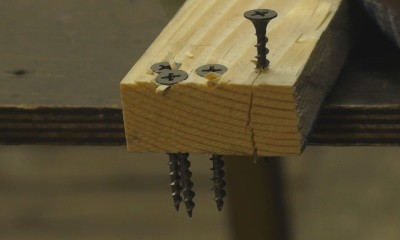
- There is a risk of wooden blocks splitting from self-tapping screws during tightening or operation of the partition, which will lead to weakening of the fastening.
- When applying excessive force, the screw head can damage the core of the gypsum board.
- Considering that all screws are very similar in appearance, the consumer will not always be able to distinguish a high-quality original product from a cheap fake, which may subsequently affect the quality of the entire structure.
Kindly take note. Notwithstanding the drawbacks, this type of fastening is still the most widely used, and manufacturers of different wood screws are selling an increasing number of goods annually.
For a sturdy and long-lasting installation, selecting the appropriate screws is crucial when fastening drywall to wood. The greatest option are coarse-thread drywall screws because they offer superior grip in wood, lowering the possibility that the drywall will eventually pull away. These screws are ideal for fastening standard 1/2-inch or 5/8-inch drywall to wood studs because they usually come in lengths ranging from 1-1/4 inches to 1-5/8 inches.
It’s crucial to take the coating and material of the screws into account. Because zinc-coated screws resist rust and maintain the integrity of the installation, they are frequently used. Use a drill with a depth-sensitive nosepiece or a drywall screw gun to avoid overdriving the screws, which can weaken the drywall’s holding capacity.
Another important consideration is spacing. The spacing between screws for the studs should be about 16 inches, and the spacing between the drywall sheets should be about 8 inches. This keeps the drywall from sagging or warping and guarantees an even distribution of pressure.
You can achieve a long-lasting, professional-quality finish by selecting the appropriate screws and using the right installation techniques. Whether you’re an experienced pro or a do-it-yourself enthusiast, paying close attention to these details will improve your drywall projects significantly.


