
Whether it’s in low-lying areas, following heavy rains, or during construction, water accumulation in pits can be a common problem. Overabundance of water can cause structural damage, impede work progress, and pose safety risks. Maintaining a safe and effective work site requires knowing when and how to pump out this water.
There are various situations in which it becomes essential to pump water out of a pit. Water can build up in excavation sites during construction projects, making it challenging for workers to continue. Excessive precipitation can swiftly fill excavations, and regions with elevated groundwater tables may continuously allow water seep into the excavation. It’s critical to quickly remove the water in each of these situations.
Pumping out water requires the use of specialized machinery made to manage big liquid volumes. A variety of pumps, from basic submersible pumps to more potent centrifugal pumps, can be used, depending on the size of the pit and the volume of water. Selecting the appropriate pump type for the task is crucial to guarantee successful and efficient removal of water.
Water pumping can be planned and carried out properly to avoid delays and extra expenses in building projects. You can maintain the safety and timeliness of your work site by being aware of the need for and procedures surrounding pit water pumping. The different methods and tools used for this crucial task will be discussed in the sections that follow.
| When is it necessary to pump out water from a pit? | How is water pumped out of a pit? |
| Water accumulates due to rain, groundwater, or construction activities | Use a submersible pump or a trash pump to remove water |
| Excess water can weaken the pit walls and cause collapses | Place the pump at the lowest point of the pit |
| Needed before concrete pouring or installing foundations | Ensure proper drainage and discharge the water away from the construction site |
- What is drainage?
- Why is drainage needed??
- Water reduction techniques
- Open
- Closed
- Calculation of the inflow of water masses
- Types of drainage of construction pits
- Scheme and technology of open drainage
- Closed drainage
- Wellpoint
- Vacuum pump
- Using Electroosmosis
- Prices
- Video on the topic
- How to quickly pump water out of a pit
- Pumping water out of a pit – Rentapump.ru
- Site drainage! FREE Old-fashioned method works 100%
- Septic tank with a high groundwater level
What is drainage?
A pit’s drainage system is a collection of techniques that help you remove standing water. Work on the construction site can proceed while maintaining the integrity of the pit’s walls through the appropriate selection of tools and techniques.
Water accumulation is a problem that arises in almost every area, which is why planning should consider drainage.
This enables you to resolve a variety of issues:
- special equipment and workers will not work in water at any stage of construction;
- safety is ensured for people and equipment from the collapse of pit walls;
- workflow efficiency increases as there is no downtime.
Work is finished on schedule if water is pumped out as needed. Resuming construction doesn’t come with extra complexity or high costs, though.
Why is drainage needed??
You can quickly drain the site and continue construction by pumping water out of the pit. In the event of the following issues, drainage is supplied:
| Groundwater | Almost any construction project is subject to their influence. When water is close to the ground, it happens that the pit is completely flooded and work is forced to stop. |
| Bad weather conditions | Accumulation of water can occur due to sudden warming during the cold period or heavy rains in the summer. Powerful equipment will allow you to quickly drain the pit from the water that fills it and save the foundation when it is being built. |
| Mistakes during excavation work | Before construction begins, calculations are carried out and comprehensive surveys are carried out on the site. This allows you to identify possible threats and prevent them. If the preparatory work is not done, water may be detected. |
As snow melts, groundwater levels rise. This impacts not only finished items but also the pit’s construction. The issue is made worse by persistent rain. Despite efforts to strengthen the soil, all of this worsens its bearing capacity.
Drainage that is planned and executed on time will remedy this condition. Specialized tools and advance planning are needed. It takes some time to work in this instance. You can then proceed with building the object.
Water reduction techniques
Ground, precipitation, and melt water must be promptly removed, which requires drainage. Prior to beginning work, a thorough assessment of the construction site and soil is conducted, and an appropriate technique for extracting water is chosen.
The subsequent technical parameters are considered:

- the scheme according to which the excavation is carried out;
- volume of water taking into account the capacity of the container;
- hole depth for installing pumps;
- calculation of the amount of water entering the pit;
- determining the time for pumping while maintaining the parameters of lintels and slopes.
Drying technology is a complicated set of procedures that call for equipment use and professional involvement. It is essential to consider the qualities and traits of the soil as well as a particular pit.
Conventional techniques are applied to arrange drainage:
- Open drainage. The process is carried out directly from pits and trenches.
- Closed. Pumping is carried out through technological depressions or wells that are outside the pit. Special filters are used to collect water masses.
The majority of the time, an open type is utilized, but the decision is made based on the soil’s quality and the particulars of the building site. Following the guidelines provided by building codes and regulations is crucial.
Slopes and other supporting structures are continuously observed while water is being pumped. Reinforcement is applied if problem areas emerge. The state of the lintels and mounting elements affects the quality of the work.
Open
This kind of water pumping ends up being the most straightforward and widely used solution. It works well in situations where the bottom and walls are composed of the following kinds of soil:
- cohesive, with inclusions of sand and thin layers;
- layered, where soil water flow is at an average level;
- non-cohesive with a dense build, characterized by sufficient resistance to washout;
- waterproof, dense type, in which rain and melt water accumulate.
This is the simplest and most affordable method. The process is performed on soils that preserve the stability of the slopes and the integrity of the excavation base.
The following designs are utilized when selecting an open drainage system:
| Cavaliers | This is an embankment of fencing type walls, which is carried out on the upland side or along the perimeter. |
| Upland ditch | It is laid if there is a slope on the site. The system is used if water flows into the pit from the top point of the site. |
| Ditches, trays, open drains | Elements allow for effective moisture removal. It is important to calculate the slope correctly. The requirements of regulations and building codes are taken into account. |
| Pump equipment | Stationary systems or portable compressors are used. The latter elements are used if constant pumping of water is required. |
| Water collection wells | The device is ensured by the sulfur and pier. The system is equipped at the bottom of the pit to effectively collect soil or meltwater. |
Careful calculations are made before selecting an open system. If the trench’s slope is between 75 and 90 degrees steep, they can be used. The minimum slope in this instance with respect to the horizon is 2-3 cm per meter.
Closed
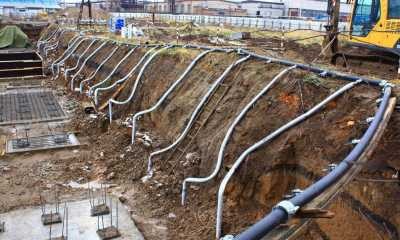
The foundation pit or trench walls may collapse if the site exhibits incoherent soils with low resistance to leaching.
Closed systems are the better option here. On loose soils, this method of cleaning water is employed in construction.
The following methods are applied:
- needleofilter;
- vacuum;
- Electroosmos to expand the area of action of needleofilter installations.
The foundation of the system is an artificially induced, but effective, drop in water level. This approach is ideal and efficient, but it’s also challenging to set up. Water is pumped through wells that are positioned around the pit or along the trench to complete the task.
It’s critical to understand when and how to pump water out of a pit when working on building or renovation projects. Whether you have to deal with a flooded basement, an overflowing groundwater construction site, or a rain-filled pit in your pit, efficient water management keeps everything safe, stops structural damage, and keeps the project moving forward. This article walks you through the key actions and equipment required to effectively pump out water. It covers the circumstances in which pumps are required, how to select the best pump for the job, and useful advice for keeping the area dry while working on your project.
Calculation of the inflow of water masses
Completing preliminary drainage system calculations is crucial. Water drainage becomes less effective if things are done wrong. As a result, construction at the site comes to an end as the pit gradually fills with water.
It is decided what the pumps’ minimum capacity is. Even in unusual circumstances, such as intense melting of ice and snow, prolonged and heavy precipitation, or quicksand breakthrough, they must have enough time to pump out water.
Calculations are required to accurately choose the best tools and amount of time to finish the procedure. There are formulas for two types of containers: pits and trenches. Vertical slopes are taken into consideration to make the calculation simpler.
The proportion of width to length is considered:
- less than 1:10 for small containers;
- more than 1:10 for wide pits of various shapes, including non-standard ones.

In case the container lacks an elongated shape, the r0 parameter, also known as the equal-area circle radius, is utilized. The value for rectangular pits is computed as follows:
| B/L | 0 | 0.2 | 0.4 | 0.6 | 0.8 |
| η" | 1 | 1.12 | 1.16 | 1.18 | 1.18 |
Use the following formula if the form is incorrect:
R0 = √F/π, where F is the pit’s area expressed in square meters.
Use the formula for the current method of lowering the water level to find the inflow of water. The weighted average filtration value must be ascertained if multiple soil layers with varying degrees of water impermeability are found:
- k1 and further represent the filtration coefficients for each layer of earth in meters per day;
- h indicators represent the thickness of the layers in meters.
It is possible to determine the true water supply at a given well by combining the features of the well, pipeline, and pumping unit.

The following characteristics are considered:
- The bc curve characterizes the pumping unit. It is built taking into account the fact that hydraulic losses are observed in the pressure pipeline.
- Along line a-1 you can see the geodetic height of the feed. It corresponds to the difference between the place where water flows from the pipeline and the static water level in a particular well.
- Line a-2 indicates the location of the pipeline;
- Line a-3 defines the well.
- Line a-4 means a combined characteristic of the well and pipeline. To do this, you need to add to line a-3 the pressure loss in the pipeline from the pressure pipe to the point where water is discharged from the pipeline.
The entire network of dewatering wells is typically utilized during construction. In this instance, the well’s overall flow rate determines the overall groundwater reduction.
Types of drainage of construction pits
One of two methods is employed to ensure adequate drying:
- preliminary;
- subsequent.
Pre-drainage is the process of lowering water levels prior to beginning construction. Using this technique, you can stop subterranean floating vessels from breaking through. In regions where there is a lot of water, it works.
As a result, during excavation, the soil’s overall stability increases and new strength emerges.
There are various ways to pre-dry:
- installation of absorption and relief wells;
- organization of drainage wells and wells;
- use of wellpoint filters and ejector units.
You can use post-draining in conjunction with pre-draining or apart from it. Moisture from the soil permeates the pit’s walls and bottom. Subsequently, it proceeds into sumps, which are specialized drainage channels. A depth of two to five meters is used for each of these elements. Its measurements are 1.5 x 1.5 m, or meters by meters.
Scheme and technology of open drainage

The following components are part of the general open drainage scheme:
- 1—reduced groundwater surface;
- 2 — pressure pipeline;
- 3 — initial groundwater surface;
- 4 — pump;
- 5 — collection ditch;
- 6 — pit.
The diagram’s arrows indicate which way the water is moving.
When employing the open method, water enters through the bottom and slopes, travels through the drainage ditches, and eventually falls into the pits. Pumps are then used to pump it out. An additional load of sand and gravel is applied if the soil has fine particles. It raises the water’s conductivity.
Centrifugal pumps of the following kinds are in use:
| C | Used when choosing an open water pumping system. They are effective if there is severe water pollution. |
| K | Suitable for preparatory drainage of water after development using soil excavation or hydraulic mechanisms. |
| MS | Sectional devices are suitable for working with temperatures up to 60 degrees. They are used to power the ejector system. |
| ND | Single-stage equipment is equipped with an impeller and a split casing in a horizontal position. The system is suitable for working with temperatures up to 100 degrees. |
It’s critical to choose the most effective pumps and schedule their use in advance. Both the site’s characteristics and the soil quality characteristics are taken into consideration.
Closed drainage
Artificial water reduction is used when open water pumping efficiency is low. The continuous pumping makes the process possible. The procedure is organized prior to construction.
The subsequent techniques are employed:
- electroosmosis;
- vacuum;
- wellpoint.
The particular operating conditions determine which method is best. Considerations include depth, equipment parameters, and capacity parameters.
Wellpoint
Wellpoint units are used in this instance. They consist of a self-priming vortex pump, a collector to hold water, and steel pipes with filters. Around the perimeter of the hole, steel pipes are submerged in soggy soil. The wellpoint filter consists of a filter unit and a pipe with a 40–50 cm diameter.
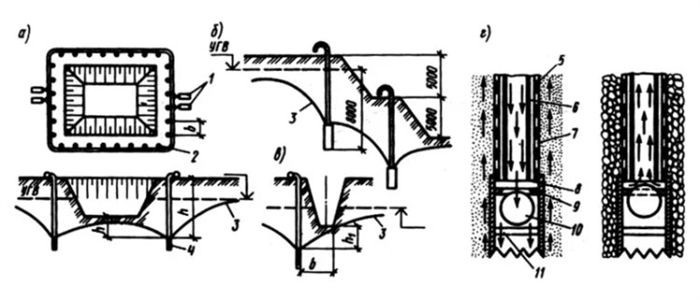
The following elements are depicted in the diagram:
- “a)” for single-tier placement of wellpoints;
- “b)” in the case of a two-tier arrangement;
- “c)” for working in a trench;
- "d)" when using a filter unit.
The elements listed below are relevant:
- 1 – pumps;
- 2 – ring collector;
- 3 — depression curve;
- 4 – filter unit;
- 5 — filtration mesh;
- 6 — inner pipe;
- 7 – outer pipe;
- 8 – ring valve;
- 9 — ring valve seat;
- 10 – limiter.
The ball valves raise when they are turned on, and the hole shuts. Water is directed into the area between the pipes at the same moment when a valve is lowered.
Vacuum pump
It is predicated on how ejector equipment, which operates at a depth of 15 to 20 meters, functions.

The following elements are used as depicted in the diagram:
- “a)” – vacuum installation;
- “b)” – the operating principle of the ejector wellpoint;
- 1 – centrifugal pump with low pressure;
- 2 – circulation tank;
- 3 — prefabricated tray;
- 4 – pressure pump;
- 5 – pressure hose;
- 6 — ejector wellpoint;
- 7 – pressure water;
- 8 — nozzles;
- 9 — sucked water;
- 10 — check valve;
- 11 — filter mesh.
According to the technology, the filter element is submerged in a bend. It operates on the idea of a light wellpoint. In this instance, there is an outer and an inner pipe with a unique nozzle in the above-filter section.
Following immersion, gravity causes the soil to erode and the pipe to descend. After that, the inner pipe is lowered to the appropriate height. Water is drawn out of the working pipe and turns into a solution.
Using Electroosmosis
With a filtration coefficient of up to 0.05 m/day, it is applied to soils. A pipe or steel rod is submerged to the same depth as wellpoints. gives a range of 50 cm to 1 meter for the distance between elements. Pipes are connected to the anode and needle filters are to the cathode.
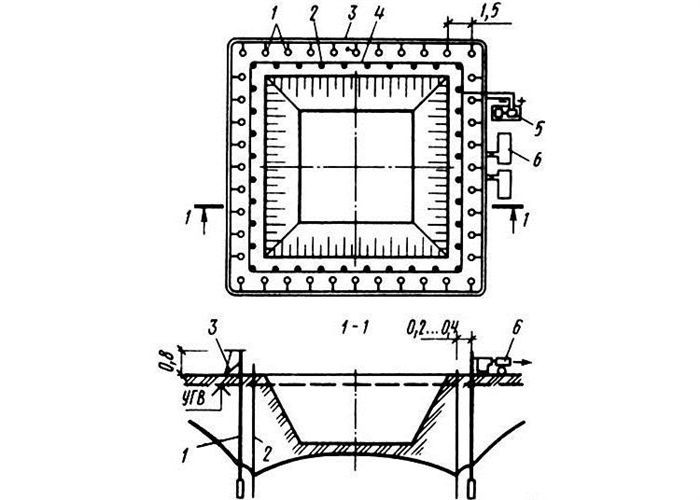
The elements’ image is displayed in the diagram:
- 1 — cathode (needle filter);
- 2 — anode (pipe);
- 3 — collector;
- 4 — current lead.
Current action causes the release of water. The needle filters are the next step. The amount of filtration increases by five to twenty-five times, contingent upon the power indicators of a given installation.
Prices
The cost of pumping water is determined by the volume, complexity, and equipment required for the task. Conditions at a particular location and the necessary operation speed are considered.
It’s crucial to bring experts to the location in order to ascertain the precise cost. They carry out an investigation, decide how best to execute the task, and make the forthcoming expenses clear.
The starting price per cubic meter is 1,300 rubles. This considers the kind of pump, the site’s distance, the preliminary work, and the existence of unusual circumstances.
This section contains all of the most significant and practical information regarding the pit and its evolution.
In many building and remodeling situations, it is necessary to remove water from a pit; this is particularly true when digging for basements, foundations, or drainage projects. If left unchecked, excess water accumulation can cause delays in work and jeopardize structural integrity.
Submersible pumps, which are made to function underwater, are a popular tool for extracting water. These pumps can handle debris and different water depths, making them effective for continuous drainage.
Make sure the pit is stable and safe for operations before starting the pump. Adhering to safety procedures is essential in order to avoid mishaps or equipment damage. Regularly check the water level to monitor the situation and stop it from building up again.
When releasing pumped water, take environmental regulations into account as well. In particular, if the water contains sediment or other pollutants, filtering or treating it might be required to comply with local laws.


