
Choosing a material for your countertop is not just a matter of appearance. It is a decision that will directly affect the usability, durability of your kitchen, and your mood for years to come.
There are so many options in stores today that it's easy to get confused. Some materials impress with their durability, others with their price, and still others with their unique colors. How can you find the right balance and not regret your choice?
Let's take a look at the five most popular and practical options. We will talk about their strengths and weaknesses without using complicated terms so that you can choose what is right for your home and lifestyle.
1. Artificial acrylic stone
Acrylic stone was invented by scientists at DuPont in 1967 and patented under the brand name Corian in 1968. Its popularity is due to its unique structure, which has no micropores. This means that the stone is less prone to contamination and prevents the growth of bacteria and fungi. It also feels warmer to the touch than natural stone.
Thanks to seamless production technology, the countertop can be of any shape and length. Minor scratches or cuts can be polished with a regular sander.
Pros: it is cheaper than natural stone. It is resistant to household chemicals and easy to care for. Manufacturers offer a wide range of colors, from imitation natural stone to floral patterns. The surface can be matte or glossy.
Cons: the stone is sensitive to high temperatures. Placing hot dishes on the countertop may leave marks. Knife cuts and moving heavy dishes can also cause scratches. It is not recommended to use abrasive cleaning agents.
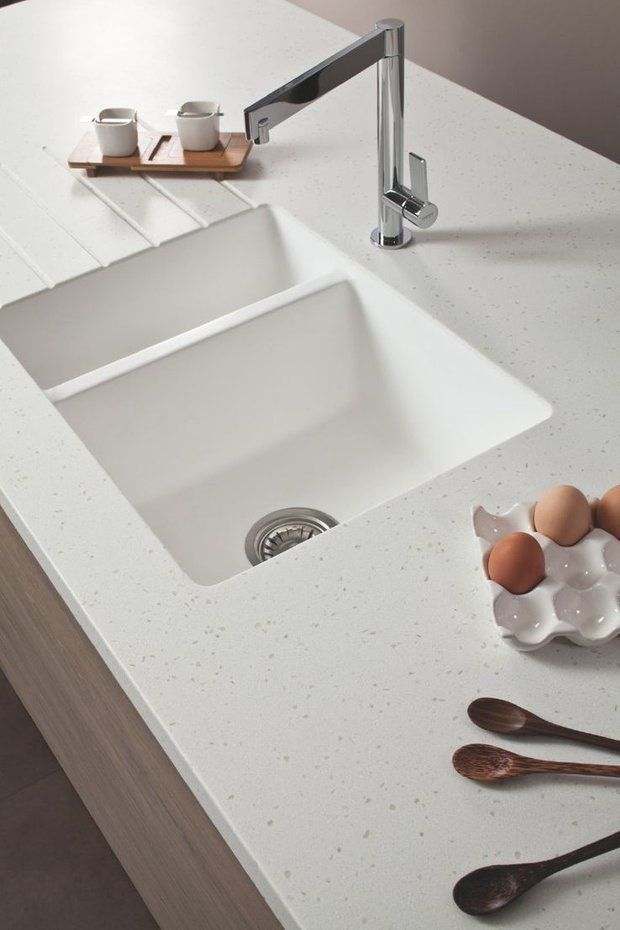
2. Artificial quartz stone (agglomerate)
The most well-known production technology is Bretonstone, patented in 1983. It is a combination of quartz particles and resin. The stone looks like natural stone but does not have its disadvantages.
Pros: it is not affected by high temperatures. You can safely place hot dishes on the countertop without fear of damaging it. It is more resistant to abrasive cleaning materials and detergents. It is distinguished by its durability.
Cons: all technological holes must be made in advance at the factory using special equipment. It cannot be restored at home. The countertop is heavy and more expensive than acrylic. And visible seams may appear at the joints between quartz slabs.
3. Natural stone
One of the most common and oldest materials for countertop design. It has different properties depending on its structure. Stones with a porous structure, such as marble, limestone, and travertine, require more careful handling. Less porous and denser granite is more practical to use. However, its color palette is more limited than that of marble.
Onyx has interesting design characteristics—it transmits light. Such a countertop can be effectively illuminated.
Pros: it is durable and fairly easy to care for. It is resistant to moisture, mechanical stress, and high temperatures. It always looks appropriate and attractive in the kitchen.
Cons: this type of countertop is expensive and heavy. Due to the complexity of installation, a specialist will be required. In addition, when first encountering stone, one should not forget about its uniqueness.
When choosing a material for a countertop, it is important to find a balance between beauty, durability, and maintenance. Each option—whether wood, stone, ceramic, acrylic, or postforming—has its own advantages: wood adds warmth and comfort, stone can withstand anything, ceramic tiles are resistant to heat and scratches, acrylic looks monolithic and is easy to repair, and postforming is affordable and practical. The main thing is to consider where the table will be placed, how it will be used, and what style you like.
4. Laminated chipboard
The most economical option. Chipboard is made from wood chips and resin. At high temperatures and pressures, the chipboard is coated with plastic and then film. It is additionally coated with a special varnish that is resistant to moisture and mechanical damage.
Pros: low price, sufficient strength, and a wide range of colors. It is moisture-resistant and impact-resistant and is not afraid of hot dishes.
Cons: where the countertop meets the wall, the joints need to be sealed with sealant. Complex shapes cannot be joined without a visible seam. And if it is mechanically damaged, it cannot be restored.

Choosing a material for a countertop is always a search for a balance between beauty, practicality, and budget. There is no ideal option for all occasions, but there are decent solutions for different tasks.
Think about what is most important to you: absolute durability and heat resistance, like stone, or the warmth and uniqueness of natural wood. Maybe you need the most budget-friendly and easy-to-care-for plastic or a perfectly smooth and modern surface made of quartz agglomerate.
Focus on your lifestyle. For an active kitchen where a lot of cooking takes place, damage resistance is more important. For a study or living room, aesthetics may come to the fore. Compare the main properties of the materials from the article — their strengths and weaknesses.
Ultimately, the best countertop is one that will delight you with its appearance every day and will not cause any hassle in use. Carefully weigh all the pros and cons, and you are sure to find your ideal option.


