
Curtains are not just a piece of fabric on the window. They set the tone for the entire room, affect the light and mood, and can hide the flaws of the interior or, conversely, emphasize its advantages. But where to start when your eyes are dazzled by hundreds of options in the store?
Often, the choice comes down to a beautiful pattern, and then it turns out that the fabric fades in the sun or does not drape well. To prevent this from happening, it is worth thinking about the practical side first: how much light do you want to let in, do you need complete privacy, how often are you willing to wash these curtains?
Only after figuring this out can you move on to the design—color, texture, and style. The combination of these elements creates the ideal result, where the curtains look expensive and last for years. Let's take a step-by-step look at how to make this choice without unnecessary fuss.
We formulate the task and determine the number of textile layers
In order to choose the right model and fabric for curtains, I recommend thinking not about the general purpose of the rooms, but applying a professional approach of “textile layers.”
You need to clearly understand what specific tasks you want to solve with textile design in a particular room. Each task will be solved by one layer of textiles. If there are several tasks or functions, then there will be several layers of textiles. Let's look at the most popular requests in our country.
We close ourselves off from our neighbors
During the day, it's important that your neighbors can't see you, but that light can enter the room.
Solution: transparent textile layer.
In the evening, the electric lights are on, and you want to avoid the “aquarium” effect so that your neighbors can't see into your life.
Solution: dense textile layer.
Conclusion: you will need two layers of fabric.

To ensure that curtains look good and last a long time, it is important to choose a fabric that strikes a balance between appearance, practicality, and the lighting in the room. For example, thick fabrics such as linen or cotton are suitable for the living room—they hold their shape and look cozy, while for the nursery or kitchen, it is better to choose lightweight, stain-resistant materials that are easy to wash. Consider how much light you want to block out: coarse fabrics and tanned silk provide good blackout, while roller blinds or organza let light through. The color and pattern should match the interior, but not overwhelm it — large patterns are appropriate in spacious rooms, small ones in small rooms. The main thing is to think not only about beauty, but also about how comfortable it will be to live with these curtains every day.
Please note:
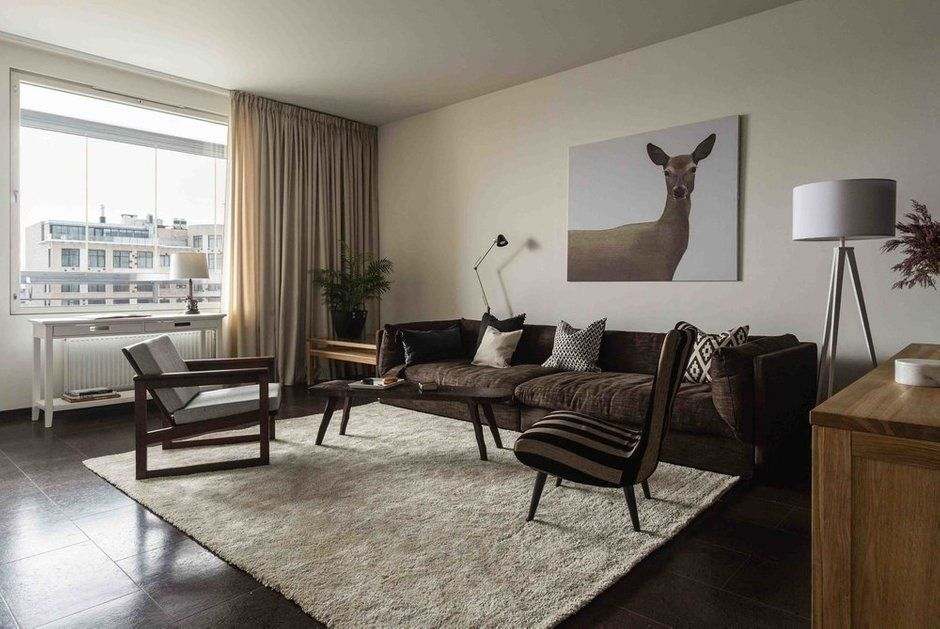
Shading from the sun during the day
If direct sunlight bothers you during the day, simply diffuse the light and the room will become a pleasant place to be.
Solution: any cotton fabric, patterned or plain, will do.
Conclusion: one layer of fabric.
Block out the sun in the morning
If the sun shines into the room in the morning and you like to sleep in, you need sufficiently powerful blackout curtains.
Solution: very thick curtains will come to your rescue.
Conclusion: one layer of fabric, possibly with a lining. If the fabric on the curtains is dark and thick (e.g., velvet), a lining is not necessary. If the curtains are not dark or thick, a blackout fabric lining is required.
Choose the right curtains
The textile layer that solves your problem can be implemented in any curtain model — this is an unexpected and pleasant surprise for many people in my approach. That is, the transparent layer can be implemented as floor-length curtains (this is what professionals call “tulle”), Roman blinds, or pleated blinds. And the dense layer can be made in any model: curtains on a lining, wooden blinds, dense Roman blinds, or pleated blinds.
Let's explain with examples!
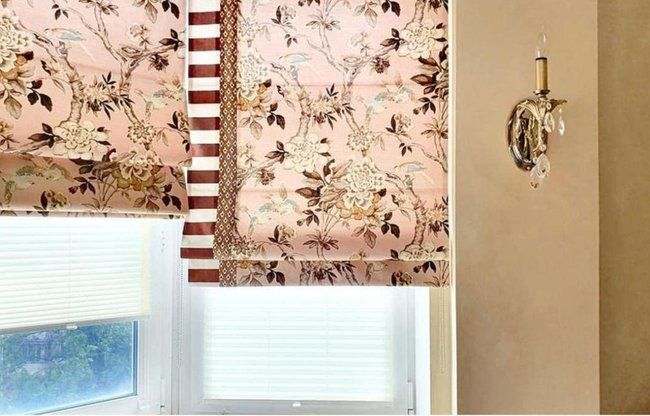
Designer's comment: this apartment is located in a densely built-up area in the center of Moscow. A semi-transparent layer of pleated fabric is attached directly to the window sash—it protects you from the gaze of neighbors. And in the window opening, there are Roman blinds made of medium-density fabric — they block out the bright sunlight.

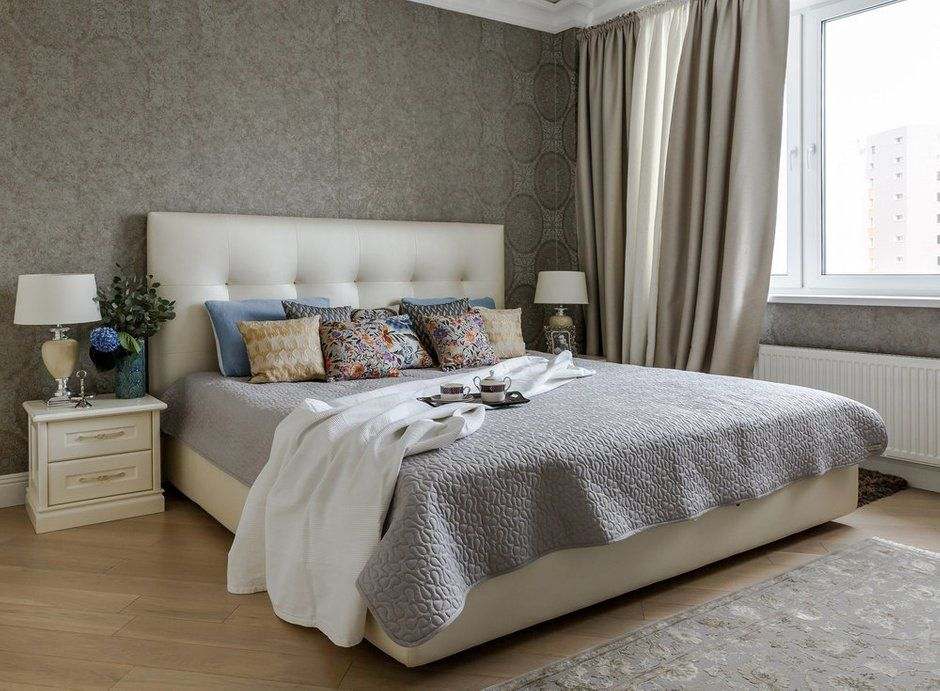
Designer's comment: this apartment is located on the 25th floor. There is no need to protect yourself from the gaze of neighbors, so there is no transparent layer of curtains, commonly referred to as “tulle.”
A layer of plain beige-gray blackout fabric is provided for protection from the sun, allowing you to sleep longer in the morning.
Plus, a layer of velvet with a classic pattern to maintain the style of the interior. The function of this textile layer is purely decorative.
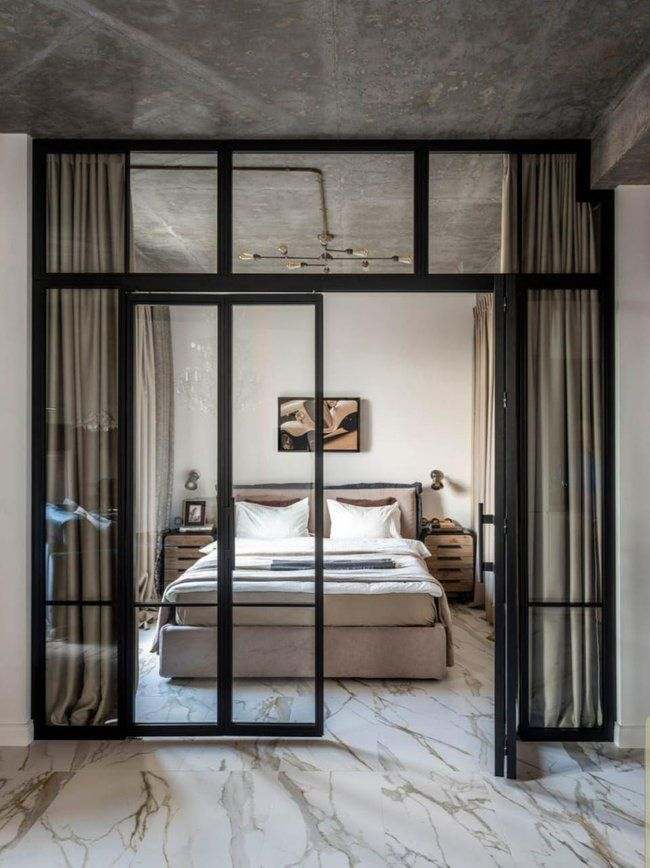
Designer's comment: this is a bedroom with a window facing east. There is only one textile layer here — a plain blackout curtain so that you can sleep in the morning despite the bright sun.

Designer's comment: that this apartment is located in the center of Moscow. Here are two layers of fabric in a style beloved by Russians: curtains (tulle) to protect from neighbors' gaze during the day and thick floor-length curtains to protect from neighbors' gaze in the evening.
If your apartment is on the first floor, the most convenient solution is pleated curtains. The advantage is that you can cover the lower part of the window, not the upper part. Such curtains protect you from the gaze of passers-by, while leaving the room well lit. That is, the upper part of the window remains free during the day, and in the evening you can close the window completely.

Designer's comment: this is a Moscow apartment near Victory Park, where the buildings are located far apart from each other. Therefore, a semi-transparent roller blind is needed to protect from the sun during the day. And curtains on eyelets are needed for sleeping, as this is a bedroom.
When choosing a curtain model, remember do you like your radiator? And be sure to evaluate the window sill area: if your window sill doubles as a work area or has flowers and beautiful trinkets on it, it can and should be left in plain sight. A beautiful radiator, work or decorative window sill calls for short curtains; any model with a lifting mechanism will do: Roman, Austrian, London, or pleated.
Pro tip:
Forget about wall-to-wall curtains.
If we consider the tasks and functions of textile design, it becomes clear why the post-Soviet “European renovation” tradition of hanging curtain rods from wall to wall and covering the entire wall with textiles, rather than just the window, looks so strange. In this case, the curtains cover the wall, not the window. This is illogical, non-functional, and therefore unaesthetic.
But when curtains frame the window symmetrically on both sides, it looks appropriate and conforms to classical canons. The window looks slender, elongated vertically rather than horizontally, which is logical. In addition, this option is economical—you will use less fabric.
The “wall-to-wall curtains” option is only appropriate in the case of truly panoramic wall-to-wall glazing.

Choosing fabric for curtains is not just a technical step, but a creative process that sets the mood for the entire room. Remember that the ideal curtains are a balance between beauty and practicality: they should appeal to you, match the style of the interior, and perform the necessary functions, whether it is darkening, slightly diffusing light, or simply decorating the window.
Don't be afraid to experiment with texture and layers; use different types of fabrics in the same room. And most importantly, listen to your feelings. A material that is pleasing to the eye and pleasant to the touch will create comfort in your home for many years to come. Start with samples, evaluate them in your lighting at different times of the day, and you will definitely find your ideal option.


