
Imagine a garden that never sleeps. From early spring to late autumn, it comes alive with waves of color, like a living kaleidoscope. Some flowers are just gaining strength, others are already in full bloom, and still others are forming new buds. This magical effect is created by flower beds that bloom continuously.
Their main secret lies not in special plant varieties, but in careful selection. The key is to combine species with different flowering times. While tulips and daffodils are preparing to rest, irises and peonies are already rushing to take their place. And when their petals fall, daylilies, phloxes, and roses take up the baton.
Creating such a flower bed is like putting together the perfect orchestra, where each instrument comes in at the right moment. It requires some planning and knowledge, but the result is worth it. You will get an ever-changing, living decoration for your garden that will delight you with its bright colors throughout the season.
Do you want your flower bed to bloom all summer and be pleasing to the eye? Choose plants with different flowering times: some bloom in early spring, others in the height of summer, and others closer to autumn. Add a couple of perennials that come back every year and a few bright annuals, and that's it, your flower bed will live and change from month to month. The main thing is to choose the right combination so that one flower blooms right after another, and there are no gaps. Such a flower bed requires almost no complex care, but looks like a professional design.
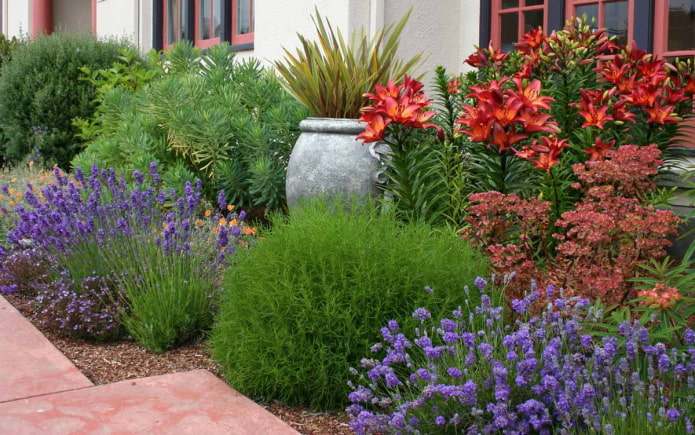
Mixborder of perennials
The most effective and easy-to-care-for option is a free-style flower bed, where perennials form the basis. Such a mixed border develops gradually and only fully reveals its beauty in the fourth or fifth year of growth. However, the following season will allow you to appreciate the decorative effect of the plantings, especially if you supplement the perennials with annual flowering plants. Mixed borders are radically renewed every 7-8 years.
Approximate composition of the mixborder:
- Plants with long-lasting, stable flowering include astilbes, hostas, geyheras, and darmeras. Most of these plants have large, beautiful leaves, which further diversify the texture of the mixed border.
- Decorative greens include brassicas, Swiss chard, ferns, bergenia, and grasses. They compensate for the “gaps” between the flowering of different crops and maintain the picturesque appearance of the mixed border. This also includes low shrubs such as various varieties of barberry, silver loch, and heather.
- Periodic or seasonal flowering plants. These include all bulbous plants, peonies, irises, rudbeckia, delphiniums, and so on. These plants form the basis of a mixed border. They are arranged in small groups between consistently flowering species to hide empty spaces after they have faded.
The spring season of the mixed border begins with bulbous plants. They are planted in the foreground, as most of the flowers are short. It is better to use species that do not require annual digging: crocuses, daffodils, muscari, and scillas.
To grow replacement bulbs and not spoil the appearance of the flower bed, the plants are planted in special baskets. With this solution, tulips can also be used for the mixed border. After wilting, the baskets are dug up and transferred to distant beds, and annuals are placed in their place.


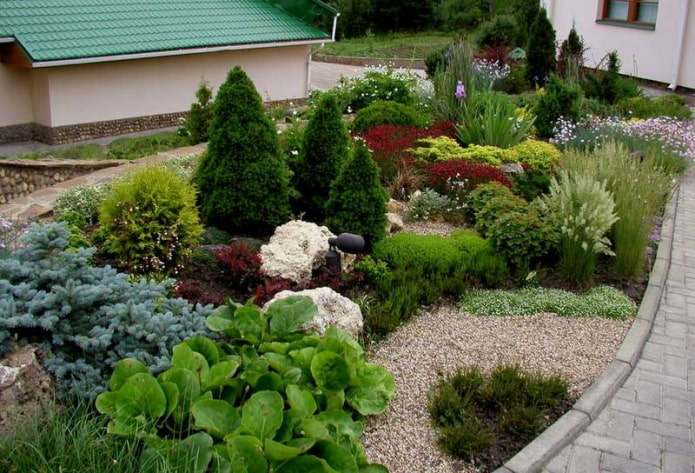
Mixborder with conifers
Thanks to conifers, the flower bed will retain its aesthetic appeal even in the winter season. Thuja, juniper, and miniature fir varieties are recommended for mixed mixborders. They do not acidify the soil or create shade that will harm other crops.
- Thuja trees form the so-called skeleton of the composition, setting its highest point.
- For the next tier, choose beautifully flowering shrubs: roses, panicle hydrangea, and physocarpus. You can add delphiniums and rudbeckia to them.
- Next come hostas, heuchera, woolly stachys, stock roses, phlox, irises, bergenia, and chrysanthemums.
- The lower tier will consist of any ground cover plants, as well as low-growing perennials: daisies, puskinia, warty carnations, armeria, and asters.


Flower bed of annuals
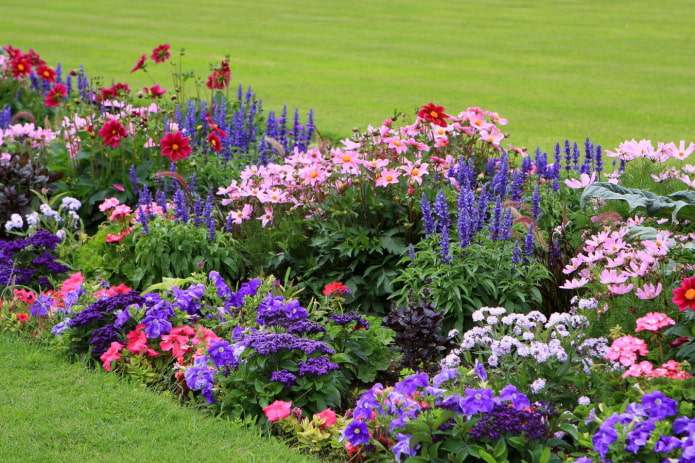
Simple compositions of annuals will allow you to quickly change the appearance of the garden, “revive” the lawn, and add a colorful accent to the entrance area. It is advisable to select plants of different heights to achieve a picturesque effect. A natural style is suitable for a flower garden, as with regular planning, areas of fading plants will be visible. For lovers of strict geometry, it is better to decorate flower beds with seasonal plants and periodically update the plantings.
Annuals for continuous flowering:
- purslane,
- tagetes (marigolds),
- alyssum,
- petunia,
- annual dahlias,
- cineraria,
- antirrhinum (snapdragon),
- iberis,
- begonia,
- salvia,
- lobelia,
- calendula,
- callitesfuses.
Annuals of the same color are planted in groups so that they are clearly visible in the composition.
An old cart, barrel, stump, bathtub, etc. can be turned into a flower bed. This solution will make the garden as a whole original and atmospheric.


Multi-tiered flower bed
In multi-level structures, plants are planted according to the pyramid principle: the tallest ones are placed at the top, and ground cover and low-growing ones at the bottom. As for the size of inflorescences and leaves, the opposite is true: the higher they are, the smaller they should be. It is also important to have moisture-loving plants at the bottom, as water flows down and accumulates at the base during watering.
Example of a two-level cottage flower bed:
- The upper tier consists of multicolored hanging petunias in a circle and western thuja in the center.
- Lower tier – pelargonium, verbena, daylily, bearded irises, scaly juniper, Greek fir, cascading petunia, marigolds, ground cover perennial arabis (rock cress).
Multi-tiered flower beds are located in well-lit areas. They are usually used to save space and create additional relief with minimal resources.


Entrance arch
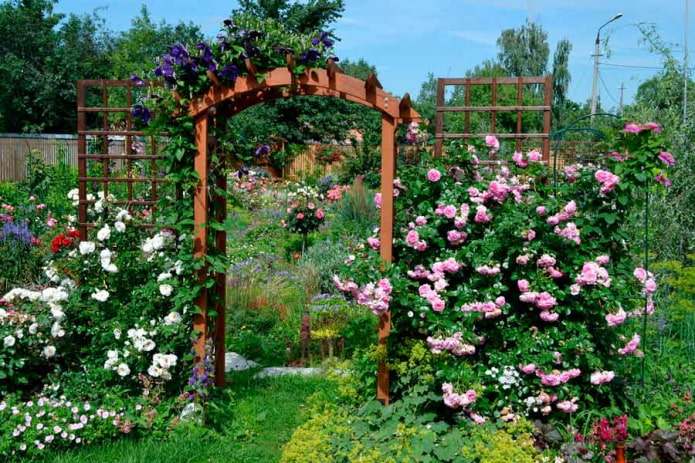
Decorating the entrance area with plants means making your home welcoming and hospitable. It is not difficult to select a range of plants that will ensure long and continuous flowering around the gate. The adjacent fence will be hidden by giants such as decorative sunflowers, mallows, and David's buddleia. Next, you need to gradually reduce the height of the plants, completing the composition with a tier of sage, stonecrop, and other ground cover plants.
Any climbing flowers are suitable for the arch, such as climbing roses and clematis, which can be trained to grow towards each other.


Rockery
Continuous flowering softens the somewhat austere style of rock gardens. Low, graceful plants and ground cover are selected for the rockery so as not to disrupt its scale. An example of continuous flowering in a rocky garden:
- In spring, deciduous perennials that have overwintered emerge from under the snow. They form a carpet, which is complemented by glades of botanical crocuses – miniature and long-blooming. It is better to avoid hybrids in rockeries, as they do not fit the style.
- Botanical tulips bloom next.
- In May, awl-shaped phlox, creeping thyme, and armeria appear.
- Starting in mid-summer, the rockery is filled with thyme, oregano, carnation, and Japanese spirea.
- Autumn crocuses complete the flowering season.
During the winter season, the decorative appearance of the rockery is maintained by low-growing conifers, such as the mountain pine “Ophir” or the juniper “Viltoni.”


“Dry stream”
A stream imitation is one of the most fashionable types of rockeries. Instead of water, pebbles are used, which can be painted blue or decorated with a layer of glass beads for authenticity.
A mixborder of perennials is placed along the “shores.” The tone is set by bamboo leaf grass, which replaces the reeds and rushes characteristic of water bodies. Blue, lilac, and purple flowers are also added to the composition—irises, bluebells, delphiniums, and lobelia. Plants with large leaves and creeping cultures will help to create volume.


Creating a flower bed that blooms continuously is like becoming an artist in your garden for the whole year. Instead of one bright but short burst of color, you get an ever-changing living picture. From the first spring bulbs to autumn asters and ornamental grasses, your corner will always be full of life and charm.
Of course, such a project will require a little more planning and attention than a regular flower bed. You need to choose plants so that they not only replace each other, but also match in height, color, and growing conditions. But this is a fascinating process that only becomes more interesting over time.
The main reward for these efforts is your own personal flowering island that never goes to sleep. It delights you from early spring to late autumn, attracts butterflies and bees, and gives you new reasons to admire it every month. Such a garden is not just a decoration, but a place where something beautiful is always happening.


