
Today, wall carpets often seem like a quirk of past interior design, a strange relic that is difficult to fit into modern minimalism. We look at old photos and smile, thinking about the strange tastes of our parents or grandparents. But behind this decision was not just aesthetics — it was a practical response to everyday problems that many have now forgotten.
The main reason was simply to conserve heat. In Soviet-era prefabricated buildings and even in older brick buildings, the walls were often cold. They froze in winter, creating a feeling of dampness and drafts in the room. There were simply no affordable materials available for insulation. This is where carpets came in handy — thick, heavy, made of natural wool. They acted as an additional barrier, preventing heat from escaping through the walls and making the home noticeably cozier.
In addition to warmth, carpets dampened sound. In homes with poor sound insulation, where every step of the neighbors above and every conversation behind the wall could be heard, they created a quiet, intimate atmosphere in the room. It was a way to shut out the general noise and create your own personal, comfortable corner.
So, when hanging carpets on the walls, people in past decades were not only guided by fashion. They solved specific problems of warmth, silence, and comfort with the means available to them. It was a forgotten but very practical form of household insulation that became a striking feature of an entire era.
When you see a carpet on the wall, the first thing that comes to mind is decor. But in the past, it was hung not for beauty, but to keep the house warmer. Old houses, especially those with thin walls and large windows, lost heat quickly. There was no central heating, and wood-burning stoves were not enough. People simply nailed carpets to the walls, and it worked: the fabric reduced drafts, retained heat, and even muffled sounds. It was a folk but very practical form of insulation that has now been forgotten and replaced with modern materials.
Thin walls and concrete cold: the physics of Soviet panel buildings
In the 1960s-1980s, the USSR built prefabricated houses on a massive scale. These “boxes” quickly solved the housing problem, but they had their drawbacks: thin walls, through-seams, condensation in winter, and poor sound insulation.
Corner rooms were damp and cold, and empty walls amplified the echo. A carpet on the wall became a universal solution. It retained heat, absorbed noise from neighbors, hid defects in the panels, and visually “brought together” the interior. Where insulation and construction technologies were lacking, textiles served as an affordable alternative.
The main reason why carpets were hung on the walls in children's rooms and bedrooms was the short heating season: from late October to mid-April. To avoid getting sick and protect children from colds, Soviet people insulated the walls of brick and block houses in this way.
How did the carpet retain heat? A carpet hung on the wall created an additional layer of air, reducing heat loss in corner rooms and preventing condensation. A gap was left between the wall and the carpet for ventilation—this was important.
Most often, carpets were hung in the bedroom near the bed. This way, people were not blown by the cold from the wall while they slept. In typical Khrushchev-era and panel houses, the walls were thin, the apartment cooled down quickly, and did not retain heat well. A carpet on the wall really helped to keep the heat in and even provided some protection from drafts.
Leaning your back against a soft, warm surface is more pleasant than against a hard, cold one. The carpet protects the wallpaper, which in the Soviet era was thin, paper-based, and not moisture-resistant. Sometimes nothing was glued under the carpet at all: why spend money on repairs if it won't be visible?
A digital look at Soviet interiors
Sound insulation: when neighbors hear every little noise
The second important reason was noise insulation. Noise from neighbors passed easily through concrete floors and flimsy walls, but thick carpets dampened the sounds, making the environment quieter and more comfortable.
Sound insulation in domestic high-rise buildings left much to be desired, as the walls in most houses were very thin. Carpets allowed people to block out extraneous noise a little and also hide the content of family conversations from curious and omnipresent neighbors.
At the same time, textiles absorbed sound, reducing noise between apartments — an important advantage in homes with poor sound insulation. Despite the absence of sex in the USSR (just kidding), snoring was far from the only reason for carpets on both sides of interior partitions, both within apartments and between neighbors.
In conditions of housing shortages, when families of several generations lived in cramped apartments, a carpet on the wall created at least some privacy.
“A carpet on the wall means that the room is warmer and quieter.” This formula became ingrained in the popular consciousness. A high-quality wool carpet was an expensive and scarce commodity that people saved up for months to buy. But the result was worth it.
Wall carpets transformed Soviet homes in an amazing way. It was much more pleasant to look at a soft, fluffy fabric with an intricate pattern than at boring bare walls.
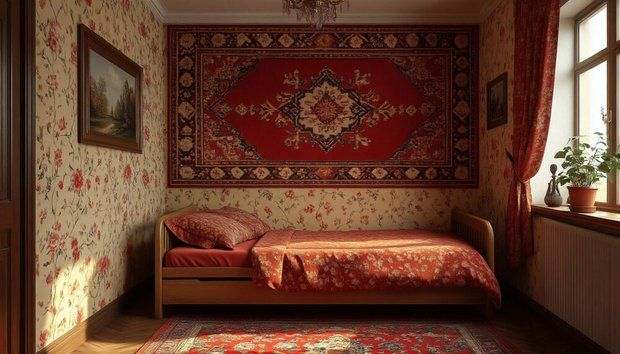
Created using the Alisa AI neural network
Carpet instead of wallpaper: saving on renovation
Wallpaper was in short supply and quite expensive in the USSR, and it was not easy to get new wallpaper, so carpets protected them from damage or covered stains and holes. In addition, if you hung a carpet on one wall and moved a massive wall unit to the other, you could save on buying wallpaper for decades.
The beauty of carpets compared to paper-based wallpaper is undeniable. But there was a catastrophic shortage of wallpaper, and the batches that did appear on sale had a number of drawbacks:
- Unstable coloring, which could fade even from the use of wallpaper glue;
- The difference in color saturation;
- Large batches of the same color, supplied to all hardware stores.
Soviet-era carpets helped compensate for the shabbiness of the walls, adding elements of charm and luxury to the Soviet uniformity.
The carpet visually became the centerpiece of the interior: it also masked the boundaries between different wallpaper patterns and “piecemeal” repairs, making the room more cohesive.
Carpets as a status symbol: an investment
In times of scarcity, a high-quality wool carpet was considered an expensive purchase. In the USSR, a carpet was not just about comfort. It was considered a luxurious gift and a sign that the family was doing well.
Their price started at 150 rubles and could reach 800 rubles, with an average salary of 120-150 rubles in the 1970s and 1980s. In the 1970s, the average factory-made carpet cost 150-300 rubles. Formal, handmade versions cost up to 800 rubles and above. For many families, this meant months of saving.
Getting the carpet was not easy: withsoviet wall carpets were an indicator of prosperity and wealth. It was not for nothing that people stood in huge queues for them, bought them from speculators, or obtained them through connections.
Such carpets were woven in the southern republics: Turkmenistan, Azerbaijan, and Armenia. Scarce carpets were given as gifts for significant events, such as weddings, housewarming parties, or the birth of a child. People took pride in these treasures, whether acquired or received as gifts, and hung them in a prominent place as works of art and interior decorations to admire and show off to guests.
Buying a carpet was considered a good investment. The cost of one could be comparable to the price of a TV, which made placing it on the floor, where it quickly wore out, irrational.
A carpet could serve for decades on a wall. It preserved its appearance and served as a backdrop for photographs. Hanging a carpet on the wall was not a pose, but a strategy for saving money.
How carpets were hung: a forgotten technique
The carpet was hung not on a single nail, but on a plank or slat so that the fabric would not tear. A gap was left between the wall and the carpet for ventilation — otherwise mold could appear.
Electrical safety was always taken into account: carpets were not placed near sockets and incandescent lamps. This was important because wool is a flammable material.
The most recognizable factory carpets are those with a medallion in the center and a border around the edges, made in burgundy, terracotta, or olive shades. It was necessary to choose the color, size, and pattern so that the carpet would match the furniture and fit well into the interior.
How were carpets cared for? Soviet housewives knew dozens of ways: Chaika and Vikhry vacuum cleaners, beating on a crossbar, “snow cleaning” in winter, and occasional dry cleaning. Wall carpets required less care than floor carpets, but they were still protected from moisture and moths.
In winter, the carpets were taken out into the snow and beaten — the cold killed dust mites, and the snow refreshed the colors. It was a whole science that was passed down from generation to generation.

Created with the help of the Alisa AI neural network
Today, wall carpets seem like a strange relic of the past or a purely decorative technique. But behind this habit lay simple everyday wisdom. In houses with thin walls and stove heating, it was one of the most affordable ways to retain precious heat.
A woven carpet worked like modern insulation. It created an additional barrier to the cold coming from the wall and did not let the heat out of the room. On a frosty night, the difference in temperature between a wall covered with wallpaper and one insulated with a carpet was very noticeable.
With the development of construction technologies and central heating, the urgent need for such insulation disappeared. We forgot this practical reason, leaving only the aesthetic side. But now, looking at old photos or a carpet hanging on the wall, we understand: it was not just decor, but a quiet struggle for coziness and comfort in conditions that are difficult to even imagine today.


