
Modern homes frequently choose aluminum windows because of their svelte shape and robust construction. However, in comparison to other window types, they may occasionally be less effective at insulating. The maintenance of energy efficiency and comfort in your home is contingent upon the proper insulation of aluminum windows.
There are various ways to insulate aluminum windows, and each has advantages and disadvantages of its own. Installing thermal breaks, applying insulating films, and using weatherstripping are common methods. These techniques can stop drafts and drastically cut down on heat loss.
The process of insulating aluminum windows calls for exact application and meticulous planning. For the best results, it’s critical to select the appropriate materials and adhere to installation guidelines. Gaining an understanding of these techniques can help you achieve improved window insulation, regardless of whether you choose to do it yourself or hire an expert.
- Do you need to insulate?
- Thermal insulation methods
- Installation of polyamide
- Slopes
- Window sill and ebb
- Pasting frames and glass
- Overlays
- Materials
- Tools
- Step-by-step instruction
- Installation of polyamide inlays
- Slopes
- Window sill and tide
- Sealing frames and glass
- Overlays
- Bugs and difficulties
- Consequences of lack of protection
- Prices
- Video on the topic
- Window insulation. Aluminum frame in the room.
- Aluminum door opens outwards. Insulation and decoration of aluminum window frame.
- aluminum window insulation
- Aluminum facade glazing, installation
- Balcony insulation. Replacement of cold glazing without changing the facade
Do you need to insulate?
Aluminum windows require insulation because their thermal insulating qualities are minimal if the "cold" profile is installed. Multi-chamber glazing is not possible in a conventional profile due to its design features. This results in the fact that the glass will freeze even if the frame is heated.
It won’t help to install heating near a window or on a balcony because even "warm" aluminum profiles will freeze. Additionally, as a result of the heat, the dew point will move in the direction of the balcony, causing icicles and ice to form on the metal surface.
Apart from the standard “cold” profile, there is an additional “warm” one. The second option differs in that its disconnecting components are composed of a material that has poor heat conductivity, such as PVC, polyamide, or another type of plastic. This allows for the installation of multi-chamber glazing and stops the formation of cold bridges.
Thermal insulation methods
There are multiple primary methods for insulating aluminum windows. When the aluminum profile can be removed without destroying the metal frame, PVC is sometimes used in its place. Although this approach will make the building look worse, it will help to insulate the window even more.
If replacing the windows is not an option, you can add more glazing to the area. Although the procedure will result in a smaller room, it will increase energy efficiency and sound insulation. The difficulty of cleaning the windows’ fixed components, which are positioned across from one another, is another drawback of this type of insulation.
Installation of polyamide
It is advised to create a thermal break from polyamide when installing a window. Installing unique inserts made of this heat-conductive material is part of the procedure.
Installing these overlays in between profiles allows for the installation of polyamide as a separating material inside the window frame or multi-chamber glazing (also known as a "warm" profile).

There are various drawbacks to using polyamide to install a warm profile.
- such a profile is more expensive;
- more complex window design;
- increase in frame weight;
- “warm” profile is more difficult to find on sale.
Since a typical window’s frame lacks the required fasteners, installing polyamide inserts into a "cold" profile is not feasible.
Slopes
The window slopes need to be insulated in order to prevent the room’s temperature from dropping. Following Windows installation Foam should be used to seal the cracks. Heat-insulating material must be used to seal the slopes after it dries. This is accomplished by installing mineral or basalt wool beneath the window opening’s interior décor. They may occasionally be swapped out for isover (fiberglass).
Polystyrene foam and adhesive designed specifically for it are typically used to seal external slopes. Polystyrene foam is adhered to the window opening’s surface by first smearing it with glue that has been diluted to the necessary consistency. All of this is then leveled and plaster sealed.
To keep the joints between the aluminum window frame and the slope from freezing, sealant should be used during installation.
Window sill and ebb
Mitigating heat loss through the joints can be achieved by insulating the window sill and ebb. Although polyurethane foam is the most commonly used material for this procedure, it is advised to combine it with polystyrene foam or polystyrene foam for optimal results.
Mineral wool or fiberglass can be used to replace this type of insulation, but further plasterboard finishing will be needed. Since aluminum windows are typically installed in a specific groove with waterproofing underneath, the space beneath the ebb can be filled with foam to provide insulation.
Additionally, you can cut a corner out of polystyrene foam, which will need to be glued to the window opening beneath the waterproofing layer before a drip lining is put in place on top of it. This is required to lessen the area that the seam beneath the frame comes into contact with cold air from the outside.
Pasting frames and glass
Insulating an aluminum frame with tape is regarded as one of the least effective techniques. Penofol or penoizol is used as a material. A single glass in an aluminum window will let cold air in even with a 10 mm insulation layer. Although taping the windows will not improve their appearance entirely, it is still a viable option.
Insulating windows helps to reduce heat loss from the frame, albeit not very much. When combined with glass film, this can raise the room temperature by a few degrees. A layer of such film lowers the glass’s thermal conductivity by 20–30%, but even with all of these techniques combined, an aluminum window will still allow a lot of cold air to enter.
Overlays
PVC linings can be used to insulate an aluminum profile. Although this technique will somewhat lessen heat loss, a full-fledged warm window cannot be effectively replaced by it.
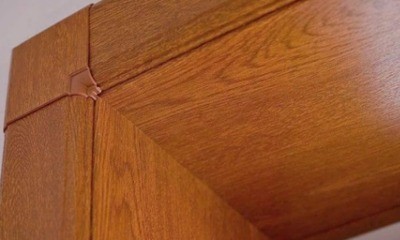
Wooden panels are sometimes fitted on aluminum windows. They are purely ornamental and do not stop heat loss.
Metal-lined wooden windows are used to give the appearance of an aluminum profile while maintaining a high level of thermal efficiency.
This combination makes it possible to:
- significantly reduce heat loss;
- install multi-chamber double-glazed windows;
- extend window service life.
Wood is shielded from the elements and outside influences by aluminum overlays.
Materials
It could be necessary for aluminum window insulation to have:
- Mineral wool. It is necessary to select the thickness, as it may not fit slopes. The average price for insulation with a thickness of 50 mm and more than 2 m/2 is from 500 RUB/roll.
- Fiberglass. You also need to select the thickness. The cost of pieces 1230x610x50 mm is from 800 RUR/pack (12 pieces.).
- Basalt wool. A problem with sizes similar to the previous options. The price for a package of 8 pieces 1200x600x50 starts from 700 rubles.
- Polyurethane foam. For insulation, you can use a regular one, but the fireproof version is of better quality. The price for 1 cylinder with regular foam is 300-400 rubles., and for fireproof – from 700 rubles.
- Penoizol. It is necessary to select such insulation of sufficient thickness, as well as with a special coating that will protect it from external influences. The price of penoizol is from 300-400 rubles / m 2, but with an increase in thickness and protective qualities it can cost from 800 rubles / m 2 .
- Penofol. Analogue of penoizol. Price from 150 rubles / m 2 .
- Heat-insulating film. You need to select a dense and high-quality material, since too thin a film will not perform its functions. You also need to pay attention to transparency. The cost is from 110 rubles / linear meter.
- Glue for expanded polystyrene. You should select a frost- and moisture-resistant option, since most often it will be used outside the building. The cost for 25 kg of dry mix is on average 450 rubles.
- Expanded polystyrene. Sheets of a certain thickness (from 30 mm) are required to create a good insulating layer. Price per sheet. 1180x580x50 mm is 200-250 rubles/piece.
- Plaster mesh. Made from fiberglass. Needed for applying plaster over polystyrene foam. Price on average 200 rubles/roll (10 m long, 1 m wide, with a 5×5 cell).
- Plaster. Costs on average 400 rubles for 30 kg of dry mixture. Needed to create a protective coating on polystyrene foam, as well as cladding the exterior of the building.
- Sealant. The most common is the silicone option, as it is well suited for sealing cracks in windows. The cost is 400-500 rubles per cylinder.
Tools
Cooking is required for window insulation.

- spray foam gun;
- putty knife;
- drill and mixing attachment;
- thermal imager;
- building level;
- gun for a sealant bottle;
- putty knife;
- stationery knife;
- construction hair dryer;
- vacuum cleaner or compressor.
Step-by-step instruction
The detailed instructions below outline the rules that should be followed in order to properly insulate aluminum windows.
Installation of polyamide inlays
Only when the profile is completely replaced can polyamide inlays be installed. It is not possible to install them in a standard "cold" profile due to design constraints. Thus, it is necessary to insulate aluminum windows.
- remove the old “cold profile” from the entire window opening;
- take a new profile, which has special grooves inside for polyamide inserts;
- if the profile is not assembled initially, then assemble it with inserts;
- install double-glazed windows;
- make a frame for windows from a similar profile;
- install windows.
Aluminum windows with this profile typically come pre-assembled and are referred to as "warm." The polyamide insert separates the two metal components, preventing the development of cold bridges.
It is advised to hire professionals to install a new profile because attempting to do it yourself (especially if you lack experience) will only make the situation worse and allow a lot of cold air to enter the window.
Before making a replacement, you should also speak with experts because in certain situations it is not practical or feasible.
Slopes
Slopes must be internally insulated, which requires:
- clean the wall of excess debris and cement;
- level the surface of the slope. This can be done using putty;
- lay a layer of insulation. If it is polystyrene foam, then it should be attached with special glue. Basalt and mineral wool, as well as fiberglass, can be simply laid, and its edges can be compacted into the cracks next to the mounting foam using a spatula;
- install a sandwich panel on top of the insulation; it can be secured with self-tapping screws, but the best option is polyurethane foam;
- the joint between the panel and the window opening should be sealed with sealant;
- Special decorative corners should be installed at the corners of the opening, as they will improve the appearance of the window and hide the insulation from external factors.
To insulate the incline outside, do the following:
- clean the surface of the window opening;
- apply a special glue to the wall;
- fix on it the plate of polystyrene foam;
- The joints between the window and the polystyrene foam are additionally smearing with glue or sealant;
- wait until everything is completely dry and hardens;
- apply a layer of plaster on top of polystyrene foam;
- While she is still wet drowning in her a reinforcing mesh of fiberglass. This can be done with a spatula;
- Leve the plaster.
Window sill and tide
It is necessary to install windowsill insulation.
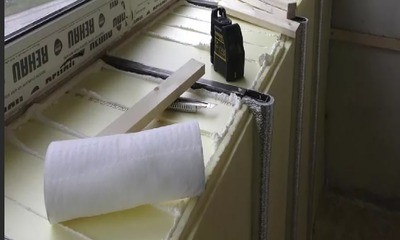
- remove the protective surface (if any);
- clean the windowsill of garbage, foam and cement;
- If foam or polystyrene foam is used for insulation, then it can simply be glued to the mounting foam or special glue;
- in the case of using mineral, basalt or glass wool, they will have to be additionally covered with a layer of plasterboard (expanded polystyrene can be used). This is because these materials shed, causing them to become airborne and deposited in the respiratory tract or on the skin;
- using a building level, constantly monitor the evenness of the window sill;
- install the protective decorative panel back.
To insulate the ebb, the following is necessary:
- remove it from the window;
- remove the waterproofing layer from the concrete;
- cut out a piece of polystyrene foam of the required size;
- cut the insulation so that on one side it is inclined;
- use glue or foam to install polystyrene foam in the desired place;
- re-fix the waterproofing after everything has dried;
- install the ebb in place.
Sealing frames and glass
In order to do that, you’ll need to seal the frame with penofol or penoizol.
- clean the surface of the window from dirt;
- degrease it with alcohol or a special product;
- glue penoizol to the window using double-sided tape or sealant;
- press it tightly or level it with a rubber spatula.
Insulating film for sealing windows:
- choose the film of the required size;
- wash the glass;
- Additionally, it can be degreased;
- After drying, apply a soap solution to the surface of the glass;
- Wearing rubber gloves, take the film and glue one edge of it on top;
- Using a special rubber spatula, gradually press the film against the glass, squeezing out water and air;
- if there are excess edges left, you can carefully cut them off with a utility knife, or if they are small, try pushing them with a spatula into the gap between the glass and the profile;
- let the film dry.
Overlays
In order to fasten specialized PVC or other plastic pads outside an aluminum window, the following is needed:
- take an overlay of a suitable size;
- cut grooves in it for imposts (vertical partitions), the grooves should be slightly smaller (1-2 mm) than the frame. This is necessary for additional stability;
- you can attach the linings simply by tightly inserting them into the required grooves or secure their edges to the sides of the window opening using corners and self-tapping screws.
If aluminum window linings are used, fasteners for these panels must be placed into unique grooves supplied by the manufacturer. These overlays are typically added as extra protection or as decorative elements during window assembly.
Bugs and difficulties
The following issues could come up when insulating aluminum windows:

- difficulties in finding the necessary materials or linings;
- dismantling and installing the window back (especially at height). This most often requires special equipment for high-altitude work;
- deterioration in the appearance of the window;
- If you work carelessly, you can damage the seal or glass.
Overestimating your abilities and strengths is one of the biggest mistakes you can make when insulating an aluminum window. Incorrect disassembly, assembly, or installation could result in the profile being improperly fastened to components or fixtures, causing diminished functionality or shattering.
Mold or mildew can grow on windows as a result of improper material selection and installation for insulating slopes and window sills.
In our comprehensive guide, "Methods of Insulating Aluminum Windows and Work Techniques," for "All about Construction and Repair," we delve into doable strategies for improving aluminum window insulation that will improve comfort and energy efficiency in homes. We explore doable methods such as caulking, thermal film application, and weatherstripping, outlining the advantages of each approach. Homeowners and professionals alike can greatly improve insulation, lower energy costs, and improve indoor comfort all year round by knowing these simple yet essential steps.
Consequences of lack of protection
Since metal and single glass have high thermal conductivity, standard "cold" aluminum windows are unable to adequately insulate rooms from the cold without insulation. As a result, the glass inside the room will fog up and frost or icicles may form on the outside of the window, increasing humidity and encouraging the growth of fungus.
The microclimate in the apartment or house will deteriorate and heating expenses will rise as a result of inadequate insulation.
Prices
The amount of work involved determines the average cost of insulating aluminum windows. As an illustration:
- Replacing the seal will cost 200-400 rubles.
- Sealing seams with silicone sealant – from 100-150 rubles,
- Sealing holes with polyurethane foam – from 300 RUR.
- Insulation of slopes, depending on the work and material, will cost from 1000-1500 rubles for 1 window.
| Method of Insulation | Work Technology |
| 1. Weatherstripping: | Installing weather seals around the window frames to prevent air leakage. |
| 2. Thermal Break: | Inserting a non-conductive material between the interior and exterior parts of the window frame to reduce heat transfer. |
Any building that wants to remain comfortable and energy-efficient has to insulate its aluminum windows. You can keep cool air inside during the warmer months and drastically cut down on heat loss during the colder ones by using the proper insulation technique.
Using foam tape or weatherstripping around the window frame is one practical solution that has been mentioned. By using this method, a tight seal is created, avoiding drafts and saving energy. It’s an easy solution that doesn’t require a lot of experience and can be implemented quickly.
The article also discusses applying insulating window films as a technique. These films offer an extra layer of insulation, lessen glare, and block UV rays. They can improve aluminum windows’ overall performance without sacrificing their visual appeal, and they are simple to install.
The article recommends taking into consideration the option of adding thermal curtains or blinds for areas that require more intensive insulation, such as in colder climates. For many homeowners, these are a sensible option because they offer flexible light and privacy control in addition to insulation.
In general, the techniques covered in this article provide a variety of choices based on your financial situation and individual requirements. For added comfort and energy efficiency in your house or building, upgrading the insulation of aluminum windows is a wise investment, regardless of whether you choose for sophisticated window films, basic weatherstripping, or thermal curtains.


