
Soundproofing your floors can make a big difference in creating a tranquil and cozy living area. Eliminating unwanted noises can improve the overall atmosphere of your home, whether it’s from conversations, footsteps, or hum from appliances. This can be accomplished, for example, by soundproofing floors beneath laminate flooring.
Many homeowners choose laminate flooring because of its easy maintenance, attractive appearance, and longevity. Nevertheless, it occasionally contributes to noise problems, particularly in apartments or multi-story houses. You can lessen these issues and have a quieter space by installing soundproofing methods underneath your laminate flooring.
There are numerous materials and techniques for soundproofing laminate floors. These solutions, which range from acoustic mats to specialty underlays, can be customized to meet your needs and budget. The secret to getting the best results is knowing the options and how to install them correctly.
This post will examine the different laminate flooring-compatible soundproofing techniques, go over their advantages, and offer helpful installation advice. Soundproofing your floors can be a wise investment in the peace and comfort of your home, whether you’re building a new home or remodeling an old one.
| Method | Description |
| Acoustic Underlay | A foam or rubber layer placed under the laminate to absorb sound and reduce noise transmission. |
| Floating Floor | Laminate planks that are not glued or nailed but instead rest on the underlay, allowing them to move slightly and reduce noise. |
| Insulating Mats | Special mats placed beneath the laminate to provide extra sound insulation, ideal for reducing impact noise. |
| Sealant | Using a sealant around the edges of the floor to prevent sound from leaking through gaps and cracks. |
| Double Layer Flooring | Installing a second layer of flooring material with an underlay between layers for enhanced soundproofing. |
- Sound insulation technologies
- "Floating screed"
- "Floating floor"
- Material options
- Isoflex and isolon
- Isopor (extruded polypropylene)
- Foam plastic (extruded polystyrene foam).
- "Tuplex"
- Polystyrene (trademark "Izoshum")
- Technical traffic jam
- Mineral wool
- Fiberglass "Shumanet 100"
- Expanded clay
- Sound insulation thickness under laminate
- Instructions for laying sound insulation under laminate
- Laying on screed
- Laying on wood
- Sound insulation without screed
Sound insulation technologies
Two technologies can be used to perform sound insulation under laminate:
- "Floating screed", when soundproofing materials are laid between the base of the floor and the screed;
- "Floating floor". Here the soundproofing layer is laid on the screed, and the laminate is placed on top of it.
Soundproofing materials must meet different requirements from different technologies.
"Floating screed"
The best way to block out different noises in the apartment is to place half-insulation beneath the laminate in the form of a "floating screed." It is feasible to guarantee the separation of interfloor concrete floors and walls from the completed floor during its implementation. No noise, no sound bridges.
One thing to consider when selecting a screed’s soundproofing material is the necessary specifications. He needs to:
- have good elastic and viscous properties;
- have a sound insulation layer density of 75-175 kg/m 3 ;
- have a dynamic elastic modulus of no more than 15 MPa;
- withstand loads up to 0.002 MPa.
These assets are entirely owned by:
- mineral wool;
- glass wool, in the form of fiberglass – trademark “Shumanet 100”;
- Styrofoam;
- expanded clay.
"Floating floor"
Sound insulation and underlay were combined into one material, which simplified and decreased the cost of installing laminate flooring.
For context, it is impossible to install laminate flooring over a "floating screed" without the use of an elastic material layer.
There is no special knowledge or skill set needed to work on the laminate floor’s sound insulation using "floating floor" technology. An apartment owner who installs laminate flooring themselves can control them. Nevertheless, there is a disadvantage to this approach: not all materials can successfully block out outside noise in an apartment.
Material options
You won’t be able to question the vendor at a building supply store or construction market about the drawbacks of a specific kind of soundproofing material. They claim that their advantages are all that they have. Let’s close this distance.
Isoflex and isolon
Materials ranging in thickness from 2 to 10 mm that have comparable properties. They are made of foamed polyethylene and covered in lavsan or foil. extensively utilized for do-it-yourself repairs and individual construction. They are advantageous in that
- low price;
- rot resistance;
- easy to install.
Maybe all of these are benefits. Drawbacks:
- noise insulation is conditional;
- Thermal insulation properties are lost after several years of operation;
- are not used in the installation of warm floors;
- easily damaged during installation;
- is compressed during use, which leads, in case of errors in leveling the base of the floor (if the screed is not poured) or the screed itself, to the creaking of the lamellas in the locks or their destruction (the problems are aggravated under high static or dynamic loads).
Carries out the primary purpose of lessening the loudness of knocking sounds.

Isopor (extruded polypropylene)
The same benefits and drawbacks as isoflex, with the minor exception of a marginally increased degree of noise absorption. Polyethylene foam materials can be used to soundproof the floor beneath the laminate, effectively attenuating internal sounds such as footsteps, slamming doors, and conversations. However, they don’t have very good external sound absorption.

Foam plastic (extruded polystyrene foam).
Here, there are a lot more advantageous qualities. Content:
- durable – its strength is maintained under heavy loads until the end of its service life;
- good sound insulator;
- has high heat and vapor insulation.
- acceptable price.
- cannot smooth out defects of the surface on which it is laid.
Because it is made in sheets of different thicknesses, this material can be used for a "floating screed" device as well as a substrate beneath a laminate. For instance, a screed of 4-6 mm and a substrate of 3 mm polystyrene foam are both appropriate.
Polystyrene foam is available for purchase at any building material store.
Important: two materials with similar names but distinct qualities are available for purchase. Extruded polystyrene foam, also known as polystyrene foam, is in charge of preserving heat and lowering the noise load in the apartment. He acts as an insulator.

"Tuplex"
There are three layers of laminate behind it. Because the bottom layer is composed of polyethylene, which only permits one direction of moisture (water molecules) passage, it can be used as an efficient waterproofing material.
The beads made of styrene make up the middle layer. There is a thick polyethylene film on top. The material does not obstruct the floor slats’ micro-movements when temperature and humidity fluctuate because of this device. Consequently, there are no broken locks and no creaking floorboards.
- durable;
- provides good sound insulation;
- has low thermal conductivity and high vapor barrier.
There are only two drawbacks, but they are quite important:
- high price;
- made from very unhealthy styrene.
It’s important to remember that styrene is an extremely toxic liquid, and breathing in its fumes can have disastrous effects. Styrene is found in polymerized granules in Tuplex, which are completely safe. The issue is that 1-2% of the granules in question contain free styrene. Because of its small amount, its release won’t result in any major health issues, but it may cause a prolonged, mild malaise.
Suggestions. When you use Tuplex laminate to soundproof an apartment’s floor, you can prevent negative effects from potential evaporation by regularly ventilating the rooms.
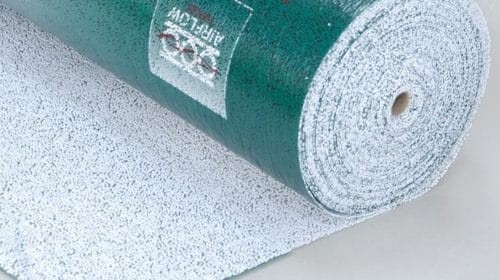
Polystyrene (trademark "Izoshum")
It is composed of foamed polystyrene. strengthened by being covered in a thick layer of aluminum foil. Among the benefits are:
- very high degree of noise protection;
- strength and durability – does not lose its consumer properties until the end of operation.
- high price;
- long technological process due to the complexity of installation.
It effectively muffles loud music, TV, clinking dishes, walking, and conversations.

Technical traffic jam
On the bark of cork trees. produced in three different styles:
- whole, when there are no additives of other materials;
- with added rubber;
- with the addition of bitumen.
Cork that is solid is made into rolls and sheets. The primary benefits consist of:
- the most effective sound insulation;
- environmentally friendly (gluing of granules occurs due to the adhesive substance subarin, secreted by the cork itself);
- unique flavoring properties;
- low thermal conductivity;
- durability;
- ability to restore shape after heavy loads, which prevents laminate locks from breaking.
- very high price;
- difficulties during installation;
- mandatory coating with antiseptic compounds;
- hygroscopicity, which does not allow installation in rooms with high humidity; this disadvantage is eliminated by treating the substrate with rubber or bitumen.
Underlay for laminate flooring with rubber-cork soundproofing. More powerful soundproofing material even. Absorbs vibrations well. withstands extremely large loads. able to be installed in any humidity level room. available for purchase in rolls and sheets.
One drawback, though, is that it is more expensive than any other kind of soundproofing material.
Rubber-and-bitumen sound-absorbing material. Also offered in sheets and rolls. Non-hygroscopic because of the combination of bitumen-impregnated kraft paper and granulated balsa wood. Bitumen gives this material its good waterproofing qualities.
Possesses the same advantages and disadvantages as rubber cork. Although sound insulation for the floor in an apartment with a cork covering allows you to completely shield the residents from outside noise, it essentially does not dampen noise within the apartment.

Mineral wool
This kind of material consists of artificial glass or basalt fibers arranged haphazardly. Glass industry waste is used to make glass wool. The byproduct of melting rocks, mostly basalt, is stone wool. Better at retaining heat than glass wool, but not as effective at isolating sound.
Among the benefits are:
- light weight;
- non-flammability;
- low price;
- environmental friendliness;
- ease of installation.
It has drawbacks and mineral wool.
- increases the height of the screed, which leads to a decrease in the volume of the room, and therefore is used mainly in wooden houses (rarely used in high-rise buildings – only in old houses with high ceilings);
- crumbles to fine dust, which requires respiratory protection during operation with a respirator;
- requires protection of exposed parts of the body, since the material causes microtrauma with hard fibers.
There is always material up for sale. We only point out that the price of stone mineral wool is marginally less than that of comparable glass material.
Fiberglass "Shumanet 100"
Currently available soundproofing materials with noise reduction indices as high as 29 dB. Fits comfortably into class A. As a result, its primary application is in the building of upscale homes. is made of fiberglass that has been impregnated with both organic resins and bitumen on opposite sides. accessible in rolls.
Possesses many advantageous qualities:
- creates very good acoustic protection of the room;
- due to its small thickness – 4 mm, it does not raise the screed and, therefore, the floor;
- ease of installation allows you to complete this process yourself;
- simultaneously performs the function of water protection – the material is capable of preventing moisture supplied under pressure from passing through for 2 hours;
- does not crumble, unlike mineral wool.
One negative is the extremely high cost (4.0–5.0 thousand rubles per roll).

Expanded clay
This kind of material is used in apartments with semi-dry or wet screeds to create a dry screed or as a layer for sound absorption. The granules’ size is the only distinction.
Because dry screed is composed of granules of varying sizes, you can lay the leveling layer at a higher density. The same-sized expanded clay is used to make both wet and semi-dry screeds. Here, more voids are produced by identical granules, improving acoustic absorption.
In contemporary apartment buildings, it is essentially non-existent because it decreases the room’s volume. One of the best options for individual construction is affordable, long-lasting, and effective at reducing noise.
Sound insulation thickness under laminate
The step of measuring the thickness of the soundproofing substrate (soundproofing layer) beneath the laminate receives very little attention. The reason for this is a long-standing misconception among builders that the substrate beneath the laminate should only be 3 mm thick. The quality attributes of the materials in use at the time provide the explanation.
The flooring’s laminates, which were at least 4 mm thick, sagged significantly, causing the floor to break and start to creak underfoot. The connecting locks were also destroyed as a result. These limits have been pushed by contemporary materials.
There are a few things to think about when determining the substrate’s thickness.
1. Several significant factors determine the soundproofing layer’s thickness, including:
- the thickness of the lamellas – the thicker they are, the more powerful the sound insulation layer should be;
- elasticity of soundproofing material;
- screed surface quality.
2. The shrinkage of polyethylene foam must be considered when laying it. Thus, it should be 4-5 mm at first.
3. Thermal insulation is further enhanced by a thicker layer.
Vital. It is strictly forbidden to lay the material in two or more layers to increase sound insulation because this will destroy the lamella locks under dynamic loads (such as walking).
When utilizing contemporary materials, the substrate’s thickness can vary from 2 to 7 mm.
2 mm. The substrate layer has a very thin layer. It should only be applied to dry screeds because wet or semi-dry technologies cannot make up for small unevenness in the screed’s lay. Fit for self-leveling floors as well. These materials are well-liked because they are inexpensive. On the other hand, insulation against heat and sound is very low.
3 mm. Three millimeters is the standard backing option, which lets you solve the following problems:
- completely compensate for unevenness of the screed;
- absorb floor loads;
- absorb impact noise.
For this layer, a second layer of 0.2 mm thick polyethylene film must be laid directly on top of the screed. Technical cork, or "Tuplex," is the best material.
4 mm. For this thickness, only bitumen and rubber cork materials are produced. Their benefits and drawbacks were covered previously.
5 mm. Schumanet 100 fiberglass, a thicker layer of sound insulation, enables you to:
- level out screed defects up to 4 mm;
- increase acoustic protection – sounds from impact and transit noise are absorbed;
- provide excellent waterproofing.
7 mm. When the thickness of the laid lamellas exceeds 10 mm or the screed surface difference is 5–6 mm, such substrates are utilized. The sound insulation layer smooths out uneven surfaces, saving money by removing the need to install plywood sheets over the screed or perform pricey work with self-leveling mixtures.
Polystyrene foam mats, which are vapor-barrier-coated with a unique aluminum film, are a common example of thick materials available for purchase.
Selecting the appropriate materials and performing their installation properly are essential for achieving effective soundproofing beneath laminate flooring. The best methods for minimizing noise transmission will be walked through in this article, including how to prepare the subfloor properly, use soundproofing mats, and choose premium underlayment. By following these steps, you can reduce noise disturbances from footsteps and other common household noises and create a more comfortable and quiet living area.
Instructions for laying sound insulation under laminate
In reality, a number of technologies are employed to protect buildings from noise. "Floating screed" and "floating floor" are the most popular ones. Without a screed, it is uncommon to find sound insulation on a wooden floor. Let’s examine each kind in more detail.
Laying on screed
A series of sequential steps are involved in installing a soundproofing layer beneath the lamellas.
1. The quantity of the material is established. In order to do this, the screed’s area is calculated after its length and width are measured. 10% is added to the final value for cutting (no material is lost) and for approaching the wall, in which case the substrate also acts as a damping tape. Since a technical plug cannot be bent to fit against the wall, it is sufficient to add 5% when making the purchase.
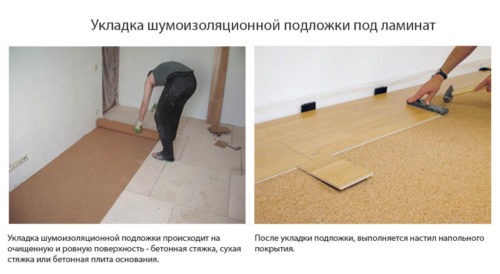
2. The particular kind of material is chosen based on a number of factors, including the amount of leftover substrate after the work is finished, gender requirements, lamella thickness, and the ratio of material being sold to what is actually needed.
Be careful: consider the amount of material in the roll when selecting the type of substrate. The remnants are always tiny when a roll of soundproofing material contains 6–8 m 2. The residues may be substantial, ranging from 10 to 18 m2, if there is 12–18 m2 of substrate. As a result, if you want to save money, you should think about buying a different kind of material that comes in smaller packaging and produces less leftovers.
3. Set up tools and supplies for the job:
- soundproofing material;
- packing tape 5 cm wide or higher;
- vacuum cleaner;
- carpenter"s square;
- construction knife (it is difficult to cut material with a kitchen knife);
- roulette
4. Polyethylene film with a minimum thickness of 0.2 mm is placed on top of the screed. Strips are laid, 20–25 centimeters apart, with 1.5–2 centimeters extending onto the room’s walls. Tape is used to secure connections.
5. The angle at which the work will start and the direction of laying are decided. Here, there are two contradictory suggestions:
- the substrate strips are laid perpendicular to the floor slats;
- It is forbidden to walk on the substrate.
Why is it contentious? The underlay must be laid completely before you can start assembling the floor, but you will still need to walk on it. In this case, installing soundproofing material parallel to the assembled lamellas is the proper course of action. After applying a laminate to one strip of the substrate, you can proceed to cover another strip, and so on.
6. If the strip’s flexibility permits, it is placed over the wall to avoid the formation of sound bridges and floor damage from the lamellas expanding in response to high humidity and temperatures.
7. A second strip of material is spread after the lamellas are laid. Not too tight joints are what you want. Allowing overlapping connections is strictly prohibited.
8. Carefully applied tape is used to seal the connection point, providing waterproofing. Allowing it to self-glue is not advised because such areas are removed. It is most practical to work in 50 cm segments.

- The night before laying the floor, a plastic film must be placed on the screed. If condensation is detected on it in the morning, the screed should dry for 3-4 days;
- The direction of laying the laminate should be perpendicular to daylight – the joints between the lamellas along the length are not so visible;
- In a narrow and long room, it is possible to lay the lamellas in the direction of natural light – otherwise the work will be delayed due to the adjustment of a large number of lamellas, and their consumption will increase significantly;
- The material is always laid with the smooth side up.
Laying on wood
It is not possible to lay underlay beneath laminate on a wooden subfloor. It is put together immediately onto plywood sheets or boards that are placed above the subfloor. Under the flooring for the lamellas, soundproofing material is installed in between the joists.

Sound insulation without screed
Sound insulation is installed directly along the floor’s base when installing flooring on a budget. However, laminate cannot be laid in such situations due to its technology, which demands at least two layers of distinct material. The floor will simply collapse rapidly as a result of the connecting locks breaking.
Making a soundproof floor beneath your laminate is a great way to improve your home’s peace and quiet. You can create a quieter living environment for you and your family by using effective soundproofing techniques to drastically reduce the noise that permeates your floors.
This can be accomplished in a number of efficient ways, one of which is by utilizing underlayment materials such as rubber, foam, or cork. You can select any of these materials according to your budget and needs; each has a unique set of advantages. Better soundproofing outcomes can also be achieved by making sure the subfloor is clean and well-prepared.
A superior underlayment can also be installed underneath your laminate to minimize noise, give your flooring a softer feel underfoot, and shield it from moisture. It is a wise investment for any homeowner wishing to enhance the acoustic and physical comfort of their floors because of its dual functionality.
In the end, soundproofing laminate flooring is a simple procedure that can make a big difference in your home’s general quietness. You can reap the long-term advantages of a soundproof floor with proper materials and installation.


