
Choosing the appropriate materials is just one of the many crucial decisions that must be made when building a house. Foam blocks are one of the options that has gained popularity the most because of its great insulating qualities, lightweight design, and ease of use.
A crucial factor to take into account when selecting foam blocks is their density. The strength, durability, and thermal insulation of your home can all be greatly impacted by the density of a foam block. It’s critical to comprehend the various densities that are available and how your building project may be affected by them.
The particular needs of your construction will determine the appropriate density for your foam blocks. The density will be important whether your priorities are cost-effectiveness, thermal insulation, or structural support. This post will discuss the different foam block densities and offer suggestions for choosing the ideal one for your requirements.
| Density (kg/m³) | Application |
| 300-400 | Used for insulation and non-load bearing walls |
| 500-600 | Ideal for interior walls and partitions |
| 700-800 | Suitable for exterior walls in low-rise buildings |
| 900-1000 | Used for load-bearing walls and structures |
| 1100-1200 | Best for foundations and heavy-duty construction |
- What does the concept mean??
- What does foam concrete blocks depend on??
- What happens?
- Requirements
- For supporting external and internal
- For unnecessary partitions
- How to choose the right indicator for wall construction?
- Consequences of the wrong choice
- Video on the topic
- Foam blocks or monolithic foam concrete, what to choose when building a house
- What density of aerated concrete to choose for building a house
- Low densities of aerated concrete D300 and D350 – a warm house from 2 to 3 floors. Myth or Reality.
What does the concept mean??
The mass to volume ratio of a foam block is known as its density. The foam block’s density value is a constant; the higher the value, the denser and stronger the block will be. The Latin letter D appears before the indicator (D200).
What does foam concrete blocks depend on??
Block density formation starts during the manufacturing phase. In essence, this indicator establishes the mass ratio of raw materials to cement. The product gets denser the more cement is used.

Density is also dependent on a number of other factors:
- Material hardening method. The density of the foam block can be increased not only naturally. Synthetic hardening technology, which is used already at the last stages of manufacturing, artificially increases the density.
- Autoclave processing (increased pressure with temperature) also makes the block stronger.
It’s crucial to remember that non-autoclave products are frequently handmade, and their quality may not always meet GOST requirements. Consequently, paying more is preferable to getting subpar materials.
It’s also important for you to understand that the block will maintain temperature more effectively the denser it is. For this reason, you must consider this when making your construction purchase.
What happens?
Foam blocks are typically categorized into four density groups:
- D100-300. They are used to make partitions inside the house. The highest density is most often used, D100 or D200 is rarely used.
- D400-500. They are used for thermal insulation, since they contain 70% air, which makes them unable to withstand heavy loads and high thermal conductivity. They can also be used to make partitions inside the house.
- D600-1000. Blocks with this density are used in the construction of external walls. This is the most optimal and also the most common type that can withstand 1-2 storey buildings. This is not the best type for cold regions, but is excellent for warm and average. They mainly use D900, but this depends on the calculations of the developers.
- D1100-1200. Houses of 3 floors are built from such blocks; this is the maximum height for buildings made of foam blocks. This type is the densest and most durable. Suitable for cold climates.
It is crucial to keep in mind that a house’s foam block density should only be chosen after all calculations have been completed; otherwise, the house may end up being drafty and having inadequate sound insulation. It’s also important to consider the chosen density and construct homes that fit it (for instance, D-600 prohibits the construction of homes taller than two stories due to the risk of collapse).
Requirements
Different types of foam blocks with varying densities are required for each type of building. For instance, blocks with an indicator of more than D600–1000 can be used to build external and supporting walls; blocks with an indicator of less than D600–1000 are best suited for use as partitions or in the building’s heat-insulating circuit.
For supporting external and internal
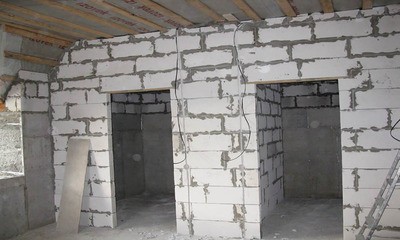
Regarding external and load-bearing walls Most frequently, they gain views:
They are thought to be ideal for construction and are not produced in an autoclave.
The ideal wall thickness for the northern region of the Russian Federation is 40 cm, so it is preferable to use an outer wall made of 600 x 300 x 400 mm blocks with a density of 600 kg. You could construct a three-story house with such proportions.
Both D-900 and D-1100 offer excellent thermal and acoustic insulation.
For unnecessary partitions
Regarding divisions Make use of a foam concrete block that has a D100–D500 indicator. In essence, the blocks measure 100 x 300 x 600 mm.
It is not possible to use material with this indicator to construct exterior walls because it is insufficiently strong and could cause the building to collapse. The house’s contour is insulated using these blocks as well.
Selecting the appropriate density of foam blocks is essential for ensuring both structural stability and energy efficiency when building a home. Densities of foam blocks vary, usually falling between 300 and 1200 kg/m³. Lower-density blocks are perfect for interior partitions and non-load-bearing walls because they are lighter and provide superior insulation. Blocks with a higher density are more durable and appropriate for use in load-bearing walls and foundations. By choosing the right density, you can make sure your home is strong and energy-efficient while also taking into account the particular requirements of your project and thermal properties.
How to choose the right indicator for wall construction?
The number of floors the building will have to be determined first. Also, there are a few considerations that must be made in each area when selecting foam blocks for walls:
- Climate, where construction will take place. It is necessary to take into account the highest and lowest temperatures, frequency of precipitation and air humidity.
- Requirements for sound insulation and heat transfer. Sound insulation depends on the thickness of the block (material 10 cm thick does not transmit noise up to 45 dB, which corresponds to GOST standards). A block 30 cm thick has optimal thermal conductivity.
You must do a technological calculation using the following information in order to ascertain the thickness of the external walls:
- regional value of GSOP (degree-daily heating period);
- thermal conductivity value;
- the value of the standard resistance of heat transfer of walls (depends on the size of the block).
In the event that you accurately estimate the wall thickness of a foam block building, you won’t need to buy more than you require.
In addition to everything else, it is essential to assess the material’s quality "by eye" using a number of criteria, including:
- The color of the concrete must be uniform over the entire surface. The lighter it is, the better the quality of the block.
- Uniformity of structure. The bubbles should not be related to each other, but should be approximately the same. This is best seen if you break the block and look at the cut.
- The larger the pores, the more air accumulates in them. Thermal, sound insulation and hardness depend on this.
- On average, the weight of the foam block should fluctuate around 20 kg, and also be the same size.
A block is considered to be of low quality if it is easily broken by hand. If your hand can penetrate it with a nail, it’s the same. It is not possible to buy such materials.
Consequences of the wrong choice
Selecting the incorrect materials can have catastrophic effects, even deadly ones. Therefore, it is essential to speak with the developer before making a purchase.
Buying the incorrect materials can have the following effects:

- Blocks with insufficient density may fall apart under their own weight. This can lead to the destruction of the building as a whole.
- Poor quality blocks can also fall apart under the weight of each other. This can be fatal.
- Purchasing blocks without taking into account the climate can lead to the fact that the house will be too hot or cold, which will also affect the properties of the walls over time.
It’s crucial to keep in mind that selecting the appropriate material can save lives in addition to money, which can then be used to rectify mistakes.
Selecting the appropriate density of foam blocks is essential for constructing a sturdy and energy-efficient dwelling. Different densities of foam blocks are appropriate for different areas of a building. Lower density blocks are perfect for non-load-bearing walls because they are lighter and offer superior insulation. Blocks with a higher density are more robust and suitable for load-bearing walls and foundations.
When choosing foam blocks, take your project’s particular needs into account. Choose medium-density blocks for exterior walls that strike a balance between strength and insulation. Lower density blocks can be a more affordable option for internal partitions. High-density blocks provide stability and durability for structural components like foundations.
It’s crucial to consider the climate and surrounding environmental factors of your construction site. Higher insulation qualities are required in colder climates, so foam blocks with the right density must be used to achieve these goals. When making your decision, don’t forget to take handling convenience and associated costs into account.
You can increase the lifespan and effectiveness of your house by choosing wisely by being aware of the various densities of foam blocks and the uses for which they are suitable. This careful approach to material selection will guarantee that your home is comfortable and strong, giving it a strong foundation for many years to come.


