
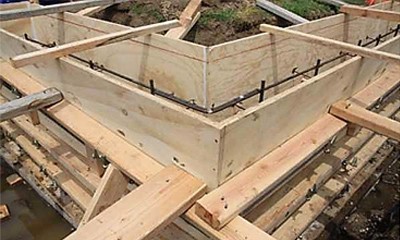
The proper formwork material selection is essential to constructing a strong foundation. Choosing the right kind of board to build the formwork is one of the most important steps in this process. For foundation formwork, the board must be strong enough to withstand the pressure of pouring concrete.
Construction-grade plywood or timber boards are typically used for foundation formwork. These boards are selected to hold the concrete in place until it hardens because of their strength and longevity. The height of the foundation and the pressure that the concrete is under will determine how thick the board is.
It’s important to search for reliable suppliers or hardware stores that specialize in building supplies when deciding where to purchase these boards. A variety of plywood and timber boards appropriate for formwork applications are frequently available from nearby building supply stores or online merchants.
The cost of foundation formwork boards can vary depending on a number of factors, including the supplier, thickness, and type of material. Generally speaking, construction-grade plywood is less expensive than timber boards, but availability and market conditions can affect costs.
Selecting the proper board for foundation formwork requires striking a balance between durability, quality, and affordability. A solid and dependable foundation for any building project can be guaranteed by builders by choosing boards that adhere to construction standards and specifications.
| Item | Details |
| Board Type for Foundation Formwork | You need plywood boards of at least 18mm thickness. They should be sturdy and able to withstand the pressure of wet concrete. |
| Where to Buy | You can buy these boards at hardware stores, construction supply outlets, or online retailers specializing in construction materials. |
| Cost | The cost varies depending on the quality and size, but expect to pay around $25 to $40 per sheet for standard 4×8 feet plywood. |
- What lumber is needed?
- Humidity and grade
- Dimensions
- Factors influencing the choice of optimal thickness
- Height of the formwork structure and spacing between posts
- Concrete load
- Purchasing: where to buy, price per cube
- Useful video
- Video on the topic
- What is cheaper formwork for rent or make boards?
- edged board for foundation formwork
- Board for formwork
- Board for formwork
What lumber is needed?
The foundation formwork requirements are outlined in GOST R 52085, a basic document that was published in 2003. It sets uniform standards for formwork types—collapsible or non-dismountable—and their features, as well as material quality. Expert builders can distinguish between over 20 different types of construction, such as panel or block.
The most common material used to construct formwork in single-family home construction is lumber, which must meet the following specifications:

- Have sufficient strength to support the concrete mass.
- Easy to assemble using simple tools.
- Be repairable in order to change parts for a specific formwork, with repeated use.
- Be light in weight; installation of formwork must be carried out independently by a team of no more than 3 people, without the use of lifting equipment.
- Refers to budget materials so as not to inflate the final cost of construction.
- Be available on the construction market.
- Have rigidity to cope with pressure from concrete mortar. When using a vibrating tool, the load additionally increases by 20%.
- Be resistant to cracking, which is possible when using hardwood and birch boards.
Experts believe that edged and semi-edged softwood boards are the best material for formwork when taking these specifications into account. However, not all softwood boards can be used for formwork; their use is limited by a number of factors, including humidity, external dimensions, and lumber grade.
Humidity and grade
Boards are separated into five grades in accordance with GOST 8486; the first row is a select grade, and the last is the fourth grade. The worst side determines the grade. The most common boards to buy are semi-edged or edged for use in building formwork panels.
The first option is less expensive and has two sides and two ends that have been processed; the edges may have bark and bevels. The second iteration of the board makes reference to premium lumber with all-around processing, accurately maintained geometric dimensions, and strong indicators.
Crucial! When selecting lumber, pay attention to the front side’s processing quality as it will be in close proximity to the concrete solution.
You can take a semi-edged board of grade 3.4 softwood if you intend to use the formwork for the foundation only once. The weight of concrete can cause soft hardwoods to crack; additionally, installing oak boards is prohibited because they produce an acidic environment where the concrete meets the board. Furthermore, only extremely alkaline concrete can produce strength.
A 25% relative humidity is ideal for edged boards. Overly dry wood will start to absorb water from the concrete; in this scenario, the outer layer of concrete will dry out before the inner layer, which will cause the foundation to crack. Wet boards can also be reused because they won’t get saturated with cement "milk."
Dimensions
The thickness of the board is the most significant dimension of the formwork structure. The majority of professionals work with 2.5 to 5 cm thick lumber. While thinner ones might not be able to support the weight, thicker ones will be heavy and pose challenges during installation.
Factors influencing the choice of optimal thickness

The height at which the solution is poured and the distance between the supports both have a direct impact on the form’s dependability. Strength calculations thus indicate that boards 3 cm thick can be supported with a support step of 70 cm – 5 cm and a step of 30 cm with a mold height of 50 cm.
In order to create dependable seams in the structure, a margin of 3 cm is added to the trench’s length, which determines the board’s length.
Counseling! The ideal width is 25 cm; the likelihood of having a base with a wavy surface increases when building materials of a different width are used.
The dimensions of the trench, as well as its perimeter and mortar height, determine how much lumber is needed. Divide the perimeter by the length of the purchased lumber to get the number of boards that are horizontal. Divide the form’s height by the board’s width to determine the vertical quantity.
Once the approximate quantity of wood has been determined, purchase it with a 10–20% margin because some of the boards will be wasted.
Height of the formwork structure and spacing between posts
The pitch of the vertical posts determines the strength of a wooden form used for pouring a foundation in addition to the board thickness; the more often the posts are inserted, the stronger the structure will be.
The load on the formwork in the case of a mixer or small concrete mixer is up to 400 kgf/cm 2, and if the condition is met that the permissible deflection of the board reaches 1/400 of the span, then the deflection should be 1-2 mm. The pitch between the racks is determined by the material that the solution will be filled with. Read on to learn about the characteristics of formwork design and installation for a hand-built board foundation.
Consequently, by varying the distance between posts, formworks of the same height for an equivalent volume of concrete can be created using a variety of boards:

- Height 70 cm and spacing 30 cm – board thickness 2 cm.
- Height 70 cm and spacing 70 cm – board thickness 4 cm
- For the base of the foundation, located 1.5 m below ground level, with an interval between posts of 60 cm – a thickness of 4 cm, and with a step of 100 cm – a board thickness of 6 cm.
Concrete load
The consistency of concrete mortar is dense and very heavy. It is subjected to 2,500 atm of pressure while inside the mold. Additionally, a dynamic load is added to this value based on the filling method:
- Concrete mixer with a volume of up to 0.8 m 3 – 400 atm.;
- concrete mixer with a volume of over 0.8 m 3 – 600 atm.;
- concrete pump – 800 atm.;
- concrete mixer – 400 kgf/m 2 .
As a result, the foundation formwork calculation needs to be done with a maximum load of 3300 kgf/m2.
Purchasing: where to buy, price per cube
Pine and spruce are the best coniferous woods for formwork. The second variety is the most widely accepted one. The Russian Federation’s construction markets have an adequate supply of this type of wood.
Suggestions. The Internet can be used to locate large suppliers who are willing to ship their products directly to the construction site and offer wholesale prices of up to 20%.
The size of the lumber determines its average price, which in the Moscow area is:
- 25x100x6000mm, 66 pcs in 1 m3., 3800 rub./m3;
- 25 x 150 x 6000 mm, 44 pcs in 1 m3., 4200 rub./m3;
- 25 x 200 x 6000 mm, 33 pcs in 1 m3., 5200 rub./m3;
- 40 x 200 x 6000 mm, 21 pcs in 1 m3., 5500 rub./m3;
- 50 x 100 x 6000 mm, 22 pcs in 1 m3., 5600 rub./m3;
- 50 x 200 x 6000 mm, 16 pcs in 1 m3., 5700 rub./m3 .
The selection of the appropriate board type is essential for foundation formwork construction. Because of their strength and resilience to concrete pressure, oriented strand board (OSB) or construction-grade plywood are typically advised. To guarantee quality and dependability, it is imperative to purchase these materials from respected building supply stores or specialized construction suppliers. To get the best deal, compare prices from several suppliers as board type, thickness, and local market conditions can affect prices. This guarantees that the formwork for your foundation is strong and dependable, providing adequate support for the concrete while it is being built.
Useful video
Watch the video below to learn what kind of board is best for formwork:
Selecting the appropriate board type for foundation formwork is essential to guarantee a strong and long-lasting building base. Construction-grade plywood or boards made of premium wood, such as spruce or fir, are usually advised for formwork. When pouring, wet concrete puts pressure on these materials, which is why they are strong and resilient.
It is advisable to check with neighborhood hardware stores or specialized suppliers of construction materials when deciding where to purchase these boards. They frequently have a wide range of choices appropriate for various project requirements. A large selection can also be obtained through industrial suppliers and online marketplaces, occasionally with the bonus of convenient delivery.
Depending on the kind and caliber of board selected, costs may change. For example, the cost of construction-grade plywood varies depending on the manufacturer and thickness. To make sure the formwork can sustain the weight and pressure of the concrete without warping or failing, it’s critical to strike a balance between cost and quality.
It is a good idea to determine the required board quantity based on the foundation’s dimensions and the formwork’s intended depth before making a purchase. If you order a little bit more than you need, you can cover any unforeseen changes or errors that may occur while building.
In conclusion, choosing the appropriate board for foundation formwork entails taking cost-effectiveness, supplier dependability, and material strength into account. Construction projects can move forward smoothly and with confidence in the stability and durability of the foundation formwork by selecting high-quality materials from reliable sources.


