
The stability and longevity of a corrugated board fence depend on selecting the proper foundation when installing it. The entire structure is supported by the foundation, which acts as an anchor against environmental factors and ground movement.
You should think about a number of things when choosing the kind of foundation for your corrugated board fence. Examine the soil in the area where the fence will be erected first. Different soil types—clay, sand, or loam, for example—can affect the foundation’s settling and stability over time.
Next, think about the fence’s intended height and length. Stronger foundations are needed for taller, longer fences in order to support wind loads and keep them from sagging or moving over time.
Additionally, assess the local weather and climate. Deeper foundations or extra drainage measures may be necessary in areas that are prone to frost heave or heavy rainfall in order to stop soil movement and erosion.
| Foundation Type | Considerations |
| Concrete Strip Foundation | Provides stability and durability; ensure proper depth and width based on fence height and soil conditions. |
| Screw Piles | Quick installation with minimal excavation; suitable for varying soil types but ensure sufficient load-bearing capacity. |
| Concrete Slab | Offers a solid base; requires careful leveling and curing; suitable for areas with stable soil. |
- Which foundation is suitable?
- Soil analysis
- Load collection
- Which one is better to choose and why?
- Designing depth, width, height
- How to make it yourself?
- Tape
- Pile
- Columnar
- Video on the topic
- Errors in the construction of a fence and their consequences. Landscape
- How and from what to build an inexpensive fence? PRICE. Build and Live
- Construction of a fence from corrugated sheet can turn into a scandal. Fence between neighbors according to the law.
- Which side to put the fence
- DIY fence Instructions Schemes Drawings Nuances
- How to make a fence on an uneven (with a slope or ravine, ditch) site
Which foundation is suitable?
Although profiled metal sailing fences are lightweight, the following are acknowledged as ideal foundations:
- Monolithic, block, brick or rubble tapes with a width of 20 cm and a depth of up to 50 cm, optimal under normal operating conditions and average loads.
- Systems from columnar spot supports with a complete or partially strengthened lower part. This type of foundation has limited bearing abilities and does not tolerate soil movements with frosty fluff. But during the construction of a fence of dry and dense soils without clay on, it will cost cheaper than the rest with equal indicators of stability and durability.
- Pile-screw foundations, chosen when conducting work in complex and flooded areas. With a large weight of the intermediate supports, such foundations are enhanced by monolithic grillages, in all other cases, the strapping is faced with a lightweight.
Regarding a note. After taking into consideration the parameters of the soil, gathering all of the loads, and figuring out the size of the basement or any vertical supports, the best option is selected.
Soil analysis
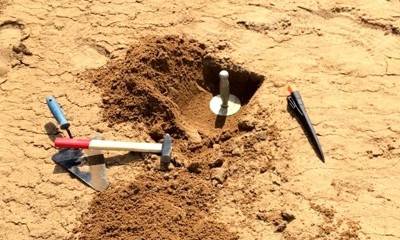
The belief that the influence of soils can be ignored when building these foundations is false; large-scale and sailing structures tend to buckle or bow in regions with weak, uneven, and heaving soils.
Errors like these can be prevented by analyzing samples collected between one and 1.5 meters below the surface and determining the groundwater level. It is not necessary to deepen the fence’s foundation on dry, stable soils with a uniform structure free of scaly clay inclusions, and vice versa.
The bases of corrugated sheet fencing are additionally shielded from erosion in locations with high groundwater levels. The hazards and height of the seasonal rise in level, the amount of precipitation, and the proximity of open wastewater should all be considered when evaluating this parameter. If the conditions are not favorable, it is worthwhile to install a corrugated sheet fence or thicken the drainage pad on a pile foundation.
When choosing a foundation for a fence made of corrugated board, it"s crucial to consider several factors to ensure stability and longevity. The type of soil on your property plays a significant role, as different soils require different foundation types to prevent sinking or shifting over time. Factors like the fence"s height and length also influence your foundation choice, affecting how deep and wide the footings need to be to support the weight and withstand environmental stresses. Additionally, local building codes and regulations should be carefully followed to ensure compliance and structural integrity. By carefully assessing these factors and choosing the right foundation type, you can ensure a sturdy and durable base for your corrugated board fence that will stand the test of time.
Load collection
The following factors impact the base:
- Weight loads, insignificant when attaching corrugated sheets to relatively light supports made of metal or timber, and significant when laying massive intermediate supports. In addition to the weight of the fence, when collecting loads, it is important to take into account the weight of the foundation itself.
- Wind currents, especially noticeable with a corrugated fence height of 2 m and above. Solid fencing of this type refers to structures with high windage, which are turned out of the ground under unfavorable climatic conditions or strong winds on the site. The problem can be solved by deepening the supports into the ground or strengthening the junction of the vertical fence posts in the lower part.
- Transport vibrations, maximum when fences are located near highways, railway tracks or parking lots.
Which one is better to choose and why?
After considering each of the previously mentioned aspects, the foundation should be chosen in order to prevent errors and needless costs.
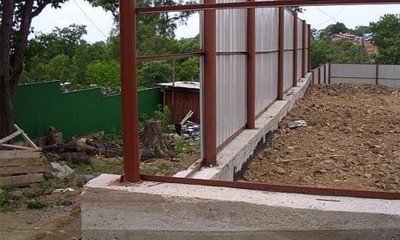
While there’s no one-size-fits-all answer,
- Under normal operating conditions, preference is given to the belt type (as the most reliable and durable).
- For complex ones – pile.
- A columnar foundation is optimal only for construction in areas with low groundwater level and dense but homogeneous soils.
Designing depth, width, height
The process of designing these types of foundations starts with gathering loads (which must take wind loads into account), creating a list of specifications for the fence’s features and appearance, and examining additional operating circumstances. The following has been chosen in light of the data:
- Type and depth of foundation (no more than 45-50 cm for strips, 20 cm below the permanent freezing line for columnar supports).
- Dimensions of supports and their spacing. The bearing capacity of the base is calculated and compared with the properties of the soil, if necessary, with adjustments to the dimensions.
- The height of raising the tape or plinth parts above the ground level, depending on groundwater level, risks of flooding and terrain on the site. In order to extend the service life, it is recommended to raise the foundation for a fence made of corrugated sheets by 10 cm or more.
- Base width, grillage or tapes. The recommended range for fences with conventional intermediate posts is 15-20 cm, with massive vertical posts made of brick or stone – 25-35.
How to make it yourself?
No matter what kind of foundation is selected, there are several necessary actions that must be taken while building, such as:
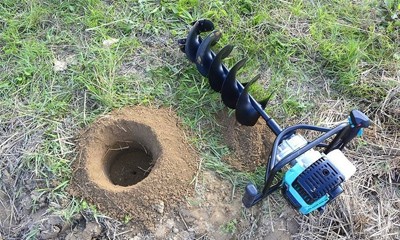
- Preparation of the site, tools and materials. At this stage, the fence line is cleared of roots and debris, leveled and marked. Marking pegs are installed at the corners of the fence, places of vertical supports (if any) and on the border with a gate or wicket.
- Removing soil from a trench or digging holes for supports using a hand drill. The main efforts are focused on strengthening the walls (if necessary), compacting the bottom (without excessive force) and checking the evenness of future structures.
- Arrangement of a drainage cushion made of crushed stone and sand at least 10 cm thick. The opinion that light fences made of corrugated sheets do not need it is wrong; bedding is poured under prefabricated or monolithic foundations of any type, with the exception of pile-screw ones. The layer is carefully compacted, if necessary, with watering.
- Installation of formwork and laying of reinforcement.
- Pouring concrete, forcing out air bubbles and leveling the upper edges of the supports.
- Insulation of the foundation with mastics or rolled materials (skip at low groundwater level).
- Backfilling and compaction of soil around structures that have gained strength.
Furthermore, the fence’s intermediate supports or their reinforced frame are tied or deepened during the foundation construction phase.
Crucial! The joint areas with vertical external pillars are further reinforced with mesh if the weight and dimensions are high.
Tape
These bases typically have a width of 15-20 cm; if the project includes large stone or brick columns, this width is increased to 30 cm. However, the latter is rarely used; corrugated board fence tape is typically made to be thin and light.
The type of soil determines how the tape should be laid:
- on sandstones, preference is given to monolithic reinforced concrete structures;
- on rocky areas – rubble concrete.
Kindly take note! The tape is laid out using solid bricks or fireclay for large vertical loads, and row reinforcement and dressing are required.
The majority of owners run the tape all the way around the fence. The structure is reinforced with a volumetric frame that has at least two rows both vertically and horizontally, despite its small depth and width.
Layers of the solution are poured into the formwork, and every 20 cm of concrete, air is released and leveled. After carefully smoothing the top layer of the tape with a trowel, a film is applied to the formwork containing the solution. After the concrete has lost its moisture and reached its grade strength, intermediate supports, tape cladding, or corrugated sheet fastening can be built.
Watch the video below to learn how to build a strip-pile foundation for a corrugated-sheet fence:
Pile
If preferred, self-tightening metal screw piles with sharp tips can be achieved through the use of a lever system or specialized electric machines such as SVAEBUR, Hercules, and their equivalents.
The piles should ideally be long enough to allow the lower portion to be buried in uniformly thick soil layers, with the remaining portion serving as an intermediate vertical support for the fence. In the event that this isn’t feasible and there are more stability and bearing capacity requirements, screw supports are fastened using a monolithic grillage that is poured similarly to a tape.
The screw piles’ pitch varies between 1.5 and 3 meters depending on the loads. The supports are screwed in at the border with the wicket and gate, in addition to the edges and main row.
Crucial! After receiving an anti-corrosion treatment, the piles are screwed in due to the increased groundwater.
You can learn how to build a fence foundation by hand using corrugated board by watching this video:
Columnar
By adding 20 cm to the level of permanent freezing, the columnar foundation’s depth is chosen based on the site’s climate. Boundary supports that hold heavy gates or wickets—which frequently have a larger cross-section and depth—are subject to different requirements.
The kind of supports determines the sequence in which things are done during construction. Completed structures composed of metal, wood, or reinforced concrete are erected in deeply excavated pits that have been previously filled with crushed stone and fortified with brick or mortar. Pipes or formwork are placed in the holes before concrete is poured as support. The poured structures are left undisturbed until the mortar has fully set, much like monolithic strips.
The stability and longevity of a corrugated board fence depend greatly on the foundation that is selected. The height of the fence and the state of the soil have a major influence on the kind of foundation you choose.
A straightforward concrete strip foundation is frequently adequate for shallow fences up to one meter in height. This entails excavating a trench, filling it with concrete, and firmly setting the corrugated board posts in place. In order to avoid shifting, make sure the concrete has sufficiently cured.
Consider a deeper foundation, like a concrete pier foundation, for areas with softer soil or taller fences. Using this technique, the fence line is dug up to a deeper depth at regular intervals, concrete piers are poured in, and posts are placed on top. More stability is produced by this, particularly in regions where soil movement is common.
No matter what kind you select, always evaluate the soil conditions in advance. Crushed stone or gravel reinforcement, or deeper foundations, may be necessary for soil that is prone to shifting or expansive clay.
In order to support the corrugated boards evenly, make sure the posts are positioned correctly and spaced apart. This guarantees a finish that is both aesthetically pleasing and strengthens the fence’s structural integrity. You can make sure your corrugated board fence is sturdy and long-lasting for many years by selecting the appropriate foundation and taking soil conditions into account.


