
Danko gas boilers have grown in popularity among homeowners seeking dependable and effective heating options. These boilers are well-liked by people looking for a hassle-free heating solution because of their reliable performance and simplicity of use. Danko boilers provide a variety of features tailored to your requirements, whether you’re replacing an outdated system or building a brand-new one.
Danko gas boilers
The Ukrainian company PJSC Agroresurs is the owner of the Danko brand. The company simultaneously produces a variety of heating equipment types, the demand for which is rising steadily among users.
The Ukrainian city of Rivne is home to the production facilities used to make Danko boilers.
The company’s objective was to develop a low-cost, dependable, long-lasting gas boiler with all the features it needed.
This task was successfully completed by Ukrainian engineers, who installed a variety of reasonably priced and effective gas units. High productivity and dependability could be attained, and extraneous or unclaimed parts and components could be removed.
High efficiency was accompanied by price reductions by the developers, opening up Danko units to a wider user base.

Kinds
Danko gas boilers are made in a variety of design styles that can be categorized based on shared traits.
According to the type of installation:
- Floor-standing. Installed on a special non-flammable stand or directly on the floor.
- Wall mounted. Wall-mounted installation, on load-bearing walls or special metal support structures (Ramps).
- Parapet. These are non-volatile units with a hinged installation type. They differ from wall-mounted ones in some features of connection to the chimney and the need to ensure a slope of the heating system pipelines, ensuring natural circulation of the coolant.
In terms of feature set:
- Single-circuit. Designed exclusively for heating the coolant and supplying it to the heating circuit.
- Dual-circuit. Capable of simultaneously heating the coolant and preparing hot water for domestic needs.
According to the kind of combustion chamber:
- Open (atmospheric). Air intake for normal combustion is carried out directly from the room in which the boiler is installed. Smoke is removed naturally using a stove-type draft.
- Closed (turbocharged). Air intake and smoke removal are performed using a turbocharger fan.
Boilers with turbochargers operate with far greater stability and are not frequently extinguished by drafts or wind gusts.
There are also versions with a heat exchanger made of cast iron or steel.
Additionally, various forms of automatic control for the gas unit’s operation can be employed in certain series of units:
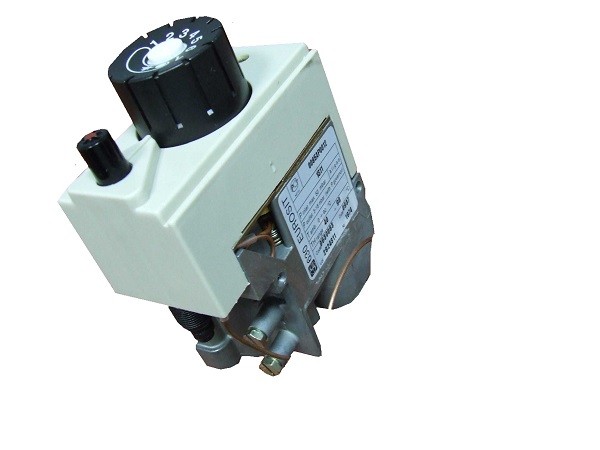
- Kare (Poland). Manufactured specifically for installation in Danko boilers. The kit includes a reducer, valves, a thermostat and pressure, draft and boiling sensors.
- Honeywell (USA). High-quality electromechanical gas supply control units, which are installed in the most advanced models of gas boilers.
- Sit (Italy). Automatic gas equipment adjustment units used in most European models of gas boilers.
Danko offers a large selection of boilers, allowing the user to select the ideal solution for any space and set of operating parameters.
Series and models
The following series comprises floor-standing boilers:
- SR or HRV — single- and double-circuit models with a power of 8, 10, 12, 15, 18, 20 and 24 kW. Equipped with a 3 mm thick steel heat exchanger.
- CH and VSN — floor-mounted units with increased power from 30 to 48 kW. Steel heat exchanger.
- Rivneterm. A series of floor-standing boilers with increased power for heating large areas. Available in single- and double-circuit models with power from 30 to 96 kW, capable of serving premises up to 900 m2. Steel heat exchanger.
Wall-mounted boiler series:
- US and UVS — single- and double-circuit boilers with a capacity of 7, 10, 12.5, 15.5, 18 kW. Equipped with a 3mm steel heat exchanger.
Furthermore, there is an independent range of floor-standing boilers with cast iron heat exchangers, ranging in power from 16 to 50 kW. Because of their larger parts, their bodies are enlarged.

Specifications
Let’s examine the features of gas boilers:
| Parameter | Meaning |
| Boiler type | Gas heating |
| Fuel type | Natural gas with the possibility of conversion to liquefied gas |
| Feature Set | Heating and hot water supply |
| Combustion chamber type | Atmospheric or turbocharged |
| Average gas consumption | 1.9-2.7 m 3 / h |
| Efficiency | 92% |
| Heating area | 70-900 m |
| Energy consumption | Non-volatile or single-phase 220 V 50 Hz |
Advantages and disadvantages
Danko gas boiler advantages consist of the following:
- The production process uses advanced technological methods and developments.
- High quality components and parts.
- Reliability, long boiler service life.
- Economical fuel consumption.
- Silent operation.
- Relatively low price.
- Compact, attractive appearance.
The following are Danko boiler drawbacks:
- The need for periodic maintenance and chimney cleaning.
- On atmospheric models, there are cases of flame extinction due to external factors.
- Wall-mounted models are limited in power, and floor-mounted ones have increased noise during operation.
Danko boilers have certain drawbacks, but these are entirely avoidable due to design elements.
Device
The general procedures used by all European businesses were followed in the design of the Danko gas boiler. The heat exchanger and gas burner are integrated into a single system, which is the main part of the boiler.
Hot water is produced when water enters the primary heat exchanger, heats up, and then flows into the secondary plate heat exchanger. The coolant then passes through the three-way valve and is finally heated to the temperature that the mode has selected.
It is combined in the necessary ratio with the colder return flow to achieve this. For the subsequent cycle of circulation, the coolant is then released into the heating circuit.
Mechanical sensors and valves (in parapet non-volatile models) or a control board (in volatile boilers) keep an eye on the system’s performance.
Either an external or built-in circulation pump or the natural upward movement of hot liquid layers are used to ensure liquid circulation.
Using a turbofan or the force of natural draft, air is supplied.

A possible main thesis statement for an article on the website "Everything about construction and renovation" titled "Advantages and disadvantages of Danko gas boilers + operating instructions and owner reviews" would be: "In this article, we explore the benefits and drawbacks of Danko gas boilers, providing clear insights for homeowners considering their heating options." We’ll go into the specifics of operation to help users use these boilers efficiently, along with owner feedback from actual use. This guide is designed to give you the practical knowledge you need to make decisions about heating solutions for your home, regardless of your preferences for efficiency, dependability, or user-friendliness.
Operation and setup
Before using the device, make sure you have carefully read the user manual, which contains detailed operating requirements.
A well-executed and superior installation is essential to successful operation. Wall-mounted boilers are mounted on brackets fastened with anchor bolts, while floor-standing models are placed on a non-combustible substrate (a layer of asbestos covered in a metal sheet).
Only sturdy load-bearing walls may be installed; hanging plasterboard partitions and temporary partitions are not allowed.
Boiler tuning is the process of modifying factory settings intended to improve operation stability and efficiency.
Only a qualified technician from the warranty workshop may install the boiler. Attempting to fix the unit yourself may cause damage.
Furthermore, it is illegal to work on gas equipment without authorization, and the gas service has the authority to prosecute such behavior.
Basic faults
The most frequent issues that both experts and regular users of Danko gas boilers encounter are burner and gas consumption issues.
Boilers that use an atmospheric burner are known to experience frequent cases of flame attenuation, or failure. Additionally, soot and other combustion products frequently clog the injectors. The primary heat exchanger develops a layer of scale that causes excessive gas consumption.
It lowers the effectiveness of heat transfer by acting as a thermal insulator. The user turns up the flame burning mode after noticing a drop in coolant temperature.
This leads to stronger heating of the heat exchanger’s exterior, which hastens the unit’s failure.
The use of softening water filters (as a preventive measure) and routine heat exchanger cleaning, which requires calling in a service center technician, are the answers to the issue.
Boilers can malfunction when attempts are made to solve any issues on their own. Furthermore, any interference with the boiler’s design renders the warranty agreement voidable.
Why does it go out??
A halt in the gas supply is the first and most basic cause of attenuation. You must shut off the gas supply and contact the relevant service to get more information in order to fix the problem. There are additional potential causes.
Danko boiler models with an open combustion chamber are known to exhibit self-extinguishing flames. Usually, when doors or windows are suddenly opened, a strong gust of wind or a draft blows off the burner flame.
Establishing an air exchange mode that precludes reverse draft and drafts is essential to solving the issue.
To prevent flame failure due to strong gusts, the chimney should be positioned on the leeward side of the roof.
A malfunction of the gas valve, regulator, or other components of the gas equipment could be another cause. In this situation, you should contact a service center technician, turn off the boiler, and cut off the gas supply.
| Advantages | Disadvantages |
| Efficient heating performance | High initial cost |
| Durable and long-lasting | Requires |
When it comes to Danko gas boilers, they offer a number of noteworthy benefits. One of the main advantages is their effective heating, which consistently distributes warmth throughout a room. As a result, energy costs may be lower than with outdated or inefficient systems. In addition, Danko boilers are frequently commended for their robust construction and longevity, both of which add to their dependability.
The relatively simple operation of Danko gas boilers is another advantage. Many users value how simple it is to use and maintain, and how the manufacturer provides clear operating instructions. They are appropriate for both residential and commercial applications where dependability and simplicity are valued because of their user-friendly design.
Notwithstanding these benefits, there are a few things to think about. Users frequently worry about the initial outlay, which can be more than for other heating options. But over time, lower operating costs frequently offset this initial investment, making it an affordable option for many households in the long run.
To sum up, Danko gas boilers present a strong choice for dependable and effective heating solutions. Customers wishing to upgrade their heating systems frequently choose them because of their energy efficiency, dependability, and simplicity of use. Danko boilers are a sensible and affordable option for many homes and businesses, even though the initial cost may be taken into account. In most cases, the long-term advantages outweigh the initial investment.


