
Selecting the appropriate putty for foam plastic can significantly impact the outcome of your project. The proper putty helps guarantee a smooth and long-lasting finish, whether you’re working on crafts or home insulation. Selecting the best option can be difficult when there are so many options available. Nonetheless, the choice may be simpler if you are aware of a few important details.
Consider the particular requirements of your project first. Does your putty need to be able to smooth out surfaces in preparation for painting, or are you just looking for something to fill in cracks and gaps? Since putties vary in strength, it’s important to know what you need.
Next, think about the setting in which the putty will be used. You’ll need a putty that can withstand weather if your project is outside. You may want to give sanding and ease of application priority for indoor projects.
Lastly, consider how well it works with foam plastic. Certain putties may cause damage to foam or cause improper adhesion. Selecting putty made especially for foam plastic can help you avoid a great deal of trouble in the future.
The best putty types for foam plastic, what to look for, and application advice will all be covered in this article. With the correct knowledge, you can select the ideal putty for your project with assurance and accomplish a polished finish.
| Criteria | Details |
| Type of Putty | Acrylic, latex, or cement-based |
| Application | Interior or exterior use |
| Flexibility | Must accommodate foam plastic"s expansion and contraction |
| Adhesion | Strong bond with foam plastic |
| Drying Time | Quick-drying for faster project completion |
| Durability | Resistant to cracking and weather conditions |
| Finish | Smooth and easy to sand |
| Tools Required | Putty knife, sanding block |
- Why do you need wall cladding with polystyrene foam?
- Foam sheet sizes
- Technology of covering walls with polymer insulation
- Preparation of putty
- Puttying foam
- Video on the topic
- Foam insulation facade. How to choose foam. How to choose a mesh for foam.
- Gypsum putty, polymer putty, what is the difference and which is better?
- Thermal insulation of the facade.Insulation of the house.Adhesive for polystyrene foam reinforcement.Facade.Thermal insulation.Ceresit
- How to plaster polystyrene foam for wall insulation
Why do you need wall cladding with polystyrene foam?
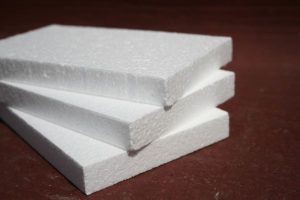
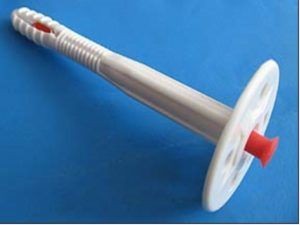
Polystyrene foam is used to finish the walls and ceilings inside buildings. It is also used to cover building facades. Umbrella dowels are used to fasten polymer sheets to brickwork and concrete. The dowels have an umbrella-shaped plastic extension radially extending from the upper part because the material is not strong enough to support even average fastener loads.
Building envelopes and structures benefit greatly from the substantial insulation provided by polystyrene foam.
Foam sheet sizes

Slabs with dimensions of 1.2 m x 0.6 m and thicknesses of 20, 30, 40, and 50 mm are used for cladding facades and interior walls. Foam plastic in thicknesses of 40 and 50 mm is used for exterior work. Slabs between twenty and thirty mm thick are used to line the interior surfaces of the walls.
Technology of covering walls with polymer insulation
As you get started, get the following supplies and tools ready:
- insulation boards;
- umbrella dowels;
- metal, fiberglass or plastic reinforcing mesh;
- perforator;
- construction knife;
- roulette.
There are no special challenges when installing foam sheets on a house’s vertical interior fences:

- mark the location of expanded polystyrene sheets on the wall;
- additional elements are made by cutting solid foam slabs;
- polymer sheets are secured with umbrella dowels in the corners and in the center of the plane.
The process of applying polymer slabs to building facades differs slightly from that of cladding interior walls:
- The bases of the facades (monolithic concrete, brickwork or wooden frame) are coated with an adhesive primer.
- Insulation sheets are installed with special glue.
- For more reliable fastening, the foam is fixed with dowels – umbrellas.
- A reinforcing mesh is glued on top. The mesh can be metal, plastic or fiberglass.
Design of the building’s interior and exterior wall decorations.

Facade insulation can occasionally be installed without the need for glue on dowels, providing dependable insulation fastening. The polymer coating of the walls needs to be puttied because the insulation’s surface has poor adhesion.
Preparation of putty
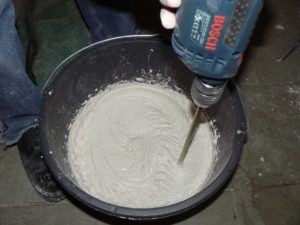
Assemble the adhesive mixture in the subsequent sequence:
- Slowly pour the dry mixture into a clean container filled with water. The solution is stirred all the time. Do this with a wooden spatula or a drill with a screw attachment.
- If the mixture is prepared using a drill, then it is turned on at lower speeds. This guarantees a homogeneous mass without lumps.
- Under no circumstances should dry powder be added to the finished putty. This will cause hard lumps to form. This putty cannot be used.
- After receiving the finished mixture, it should be allowed to stand for 5-10 minutes.
- Then the solution is finally mixed.
Picking putty for foam plastic requires choosing a product that is easy to apply, adheres well, and leaves a smooth finish. Any renovation or building project involving foam plastic needs putty because it will shield the material from harm and improve its appearance.
Puttying foam
The issue of puttying polystyrene foam is not too dissimilar from the handling of other types of surfaces. There’s always a special expanded polystyrene putty available at the retail chain. The substance is primarily offered for sale as a dry mixture. Watch this video to learn more about filling and strengthening foam:
Primers are applied to the foam before it is puttied. Polystyrene foam putty can be applied inside buildings using an adhesive formulation designed for ceramic tiles.
On the facades of buildings, this cannot be done outside. Use specialized putty on polystyrene foam intended for outdoor use to accomplish this. Leveling compounds are not interchangeable between exterior and interior applications.
The following is how the polystyrene coating is puttied:

- Apply the prepared solution with a spatula. For work, use a set of blades of different widths. Depending on the complexity of the work and the adhesive composition, metal, plastic and rubber spatulas are used.
- First, fill all the seams and joints between the foam sheets with mortar.
- A special tape is glued to the joints with a width slightly larger than the vertical and horizontal seams. The tape is a plastic fine grid.
- The width of the tool is selected for processing certain areas of the surface.
- After the joint joints have completely dried, they proceed to puttying the entire surface. Use a narrow spatula to transfer the glue onto a wide spatula.
- Apply the product in semicircular movements with a wide spatula from top to bottom. A narrow spatula is used to process hard-to-reach and inconveniently located places.
- The thickness of the adhesive layer depends on the angle of inclination of the spatula in relation to the treated surface of the polystyrene cladding. The greater the angle of inclination, the thinner the coating layer is obtained.
The worker’s experience has a direct bearing on the quality of the polystyrene foam filling. The plane’s flatness won’t need to be finished for professional work. Sandpaper can be used to remove minor finish flaws.
Choosing the appropriate putty for foam plastic can have a significant impact on the project’s longevity and appearance. With so many options available, it’s important to take compatibility, durability, and application ease into account.
Make sure the putty you select is made especially for foam plastic to prevent problems like adhesion problems or cracking. Pay close attention to the manufacturer’s instructions and look for compatibility information on the product’s label.
Remember to consider the environment in which the foam plastic will be utilized. Choose putties that are weather and UV ray resistant for outdoor applications. Think about putties that are simple to sand and provide a smooth finish for projects that are done indoors.
Finally, remember your level of expertise. Certain putties are easier to work with and more forgiving than others. Choosing a product that is easy to use at first can ensure a more seamless application process and superior outcomes if you’re new to using putty.


