
In the realm of plumbing, adaptability truly can make all the difference. An increasingly common option for both new construction and renovation projects are flexible sewer pipes. These pipes are a useful option for a range of situations because of their many benefits, which include durability and ease of installation.
There are various varieties of flexible sewer pipes available, and each has unique qualities. Selecting the appropriate pipe for your project can be facilitated by being aware of the differences. PVC, PEX, and corrugated pipes are common varieties. Various types offer distinct advantages and possible disadvantages, contingent on the particular requirements of your system.
Because of their reputation for strength and resilience against crushing, corrugated pipes are perfect for subterranean installations. PVC pipes combine strength and flexibility in a well-balanced package; they are lightweight and manageable. PEX pipes are flexible and resistant to scale and chlorine, which makes them suitable for use as sewer pipes even though they are more frequently used in water supply lines.
Selecting the appropriate flexible sewer pipe can simplify your project and save time. Flexible pipes can offer the adaptability you require, whether you are working with confined spaces, difficult angles, or are just searching for a dependable solution. You can prolong the life and effectiveness of your plumbing system by making well-informed decisions based on your understanding of the types and features of these pipes.
With a variety of types and features to meet different construction and renovation needs, flexible sewer pipes are a useful and crucial part of contemporary plumbing systems. These pipes offer benefits like easy installation, durability, and resistance to cracking. Options include PVC, corrugated, and flexible rubber. They are perfect for intricate plumbing layouts since they can squeeze into small areas and bend around obstructions. Homeowners and contractors can select the best flexible sewer pipe to guarantee a dependable and effective wastewater system by being aware of the various types and their unique characteristics.
- Varieties
- Polyethylene systems
- Polypropylene pipes
- PVC
- Double layer pipes
- Installation methods
- Adhesive compound
- Connection using a rubber ring
- Assembly with cement
- Welding pipe connection using the socket method
- Characteristics
- Connecting socketed PVC pressure risers with glue
- 7.1. Advantages of gluing
- 7.2. Installation process
- Choice
- Connecting pipes using a ring
- Laying rules
- What is a bell?
- Checking the system before use
- Dismantling the old system
- What to pay attention to when starting installation?
- Video on the topic
- Sewer pipes: varieties
- Installation of double-wall corrugated pipe.
- IKAPLAST corrugated pipe and unusual connection test
- Corrugated sewer pipes. Advantages of Polyethylene double-layer pipes – SANMIX
- Corrugated pipe for sewerage with a diameter of 110, 160, 200, 300, 315, 400, 500, 600, 630, 800, 1000
- Installation of corrugated pipes FTK ROSTR
- Corrugated pipe for sewerage?
- Types of sewer pipes
Varieties
The following materials can be used to create elastic components for a dialing system for household drains:
- Polyethylene.
- Polypropylene.
- Polyvinyl chloride.
- HDPE+LDPE.
Polyethylene systems
Polyethylene communications are inexpensive, lightweight, and pliable. They don’t lose any of their quality attributes when used at -200C. The main disadvantage of polyethylene flexible sewerage is that it cannot tolerate high temperatures. The working environment’s temperature shouldn’t go above 500C. Polyethylene products are therefore utilized in the design of external sewerage systems.
Polypropylene pipes
Wastewater with a temperature of up to 800C can be drained using polypropylene pipe products. The substance can withstand harsh conditions. But because of their relatively low degree of rigidity—especially given their large diameter—these elements are unable to support heavy loads. This makes it impossible to install a polypropylene system underground. These products are ideal for internal sewage systems and have been flawlessly operating for a century.
PVC
Because polyvinyl chloride is a durable material, internal and external wastewater disposal systems can be constructed using flexible sewer pipes. In a channel like this, the working medium’s temperature can rise to 70 degrees. PVC components are affordable, inexpensive, and resistant to corrosion and mechanical harm. They also meet environmental regulations.
Double layer pipes
A two-layer sewer channel with a cross-section of more than 100 mm would be a suitable option for a private residence or vacation home. Two materials are combined in its production:
- High-density polyethylene forms the inner wall, creating a perfectly smooth surface.
- Low-density polyethylene is the outer, corrugated surface.
This material is used to create flexible sewer pipe connections and external drainage systems.
Installation methods
It might appear that the only way to guarantee the system’s tightness is to use bell technology to join the pipeline sections. There are alternative approaches, though. They are chosen with consideration for the kind of content that is used in communications. There will be a major reduction in the dependability of the blank sewer pipe installation if this factor is ignored. will need to fix the system on a regular basis to stop the leak. If you follow the instructions during installation, you can prevent these issues.
Adhesive compound
This option is limited to the application of polymer pipes (PVC products specifically). This is because the material in question has an excellent structure compared to its metal counterparts. It is required to use specific glue for polymer communications during installation. Working with such a composition requires caution, t.To. He glues elements together instantly. Water cannot be supplied to the system for one day following installation.
Guidelines for carrying out the task:
- To increase adhesion, the smooth end of the pipe is treated with sandpaper.
- Special glue is applied at a distance of at least 2 cm from the end.
- It is necessary to immediately connect 2 parts, t.To. the composition sets quickly.
- You should hold the pipeline section for a few seconds, pressing the 2 pipes tightly against each other.
- The glue sets in 1.5 minutes.
As soon as you test the system after gluing communications, the connection quality will deteriorate. There might be a leak here very soon.
Connection using a rubber ring
It is necessary to make sure that products with sockets are tight when using them. It is challenging to meet this requirement if the rubber sealing ring is not installed. It prolongs the structure’s service life and ensures the necessary level of reliability. Usually, communications are offered with a rubber ring. In the event that you bought an incomplete product, the seal can be bought separately.
The rubber ring can be installed using a groove. It extends all the way around the communications circle. The groove needs to contain the seal. Additionally, you should closely inspect the installation quality; if waves form, the wrong element was purchased. The ring should fit snugly against the communications walls. Pipeline sections can be connected once the seal has been installed; the smooth end is inserted into the socket. It’s also advised to seal the entire circumference of the installation seam with silicone sealant.
Assembly with cement
This process, known as caulking, works well with products made of steel, cast iron, ceramics, asbestos concrete, and reinforced concrete. When there is sufficient space between the smooth communications section and the socket walls, this technology is used. Moreover, caulking is used to join items composed of various materials.
- Prepare the linen sealant. Prepare a solution of cement and water. The components are taken in a ratio of 9:1.
- Then you need to fill the gap between the socket and the smooth end with linen sealant. It is compacted using a screwdriver or a narrow spatula. The leak is filled to 2/3 of the length.
- At the last stage, the seam is sealed with cement mortar.
The system is tested within a maximum of one day.
Welding pipe connection using the socket method
It is thought of as an auxiliary measure, this technology. Cast iron product installation requires it, but only after caulking. Prior to cementing using the previously described technique, the gap at the intersection of the sewer pipe and the socket is first sealed with linen material. Additionally, you must leave 1-2 cm empty around the bell’s edge. This is where welding is done.
Characteristics
The following are some benefits of flexible sewer pipe over conventional products:
- Possibility of connecting pipe products without fittings.
- There is no need to use bends and tees on a complex or turning section.
- The flexibility of the channel makes it possible to form rather long sections into coils, which greatly facilitates their transportation and storage.
- Elastic material will not burst if deformed or accidentally hit.
- Corrugated surface provides low linear expansion.
Connecting socketed PVC pressure risers with glue
Lately, a new product has added to the variety of connections available for socketed pressure risers: glue connections. It turned out that the adhesive connection improves the operational reliability and durability of PVC pressure socket pipes and the entire structure composed of them.
7.1. Advantages of gluing
These roads aren’t the same:
- durability of operation;
- reliability;
- resistance to corrosion processes;
- the possibility of laying pipelines, including water pipelines, at great depths underground, since such systems are very durable;
- light weight of the structure, which helps reduce transportation costs and simplify the installation process;
- ease of installation;
- resistance to high temperatures (the structure can begin to melt at a temperature of 190-210⁰С, which is more than in polyethylene or polypropylene);
- thermal conductivity, the numerical value of which is close to that of thermal insulation materials;
- environmental friendliness, due to which the products are used in the installation of pipelines for drinking water;
- excellent throughput, since the parts have good hydraulic properties.
The operating pressure range at which they can operate properly is 600 kPa to 2,000 kPa.
Consequently, they are unable to function without pipes on an adhesive joint:
- industrial pipelines;
- modern irrigation systems with drip irrigation.
These risers have several advantages that allow for the construction of even the most intricate pipe structures.
7.2. Installation process
PVC pipes with sockets are stacked one on top of the other, and the joints are sealed with specialized glue. Adhesive couplings, bends, and other connecting components are used during pipeline installation, just as cast or segment fittings are used during the assembly of pipelines made of polyethylene pipes. Polyethylene pipe connections are also well-suited for Unidelta clamp fittings. Their primary advantages over other analogs are pipeline assembly speed and dependability. Modern shaped fittings from the Italian manufacturer Unidelta hold a dominant market share.
Suspension PVC, stabilizing agents, dyes, and pipe fillers are mixed together to create the shaped parts and the risers themselves.
Choice
Many factors are considered when selecting flexible sewer pipes for internal sewerage:
- Hardness index.
- Available bend angle.
- System pressure.
- Pipe length.
Depending on the equipment or device that is connected, you must select the elastic channel’s diameter for the discharge of household waste:
- For bathtubs and shower stalls, a pipeline cross-section of 43-50 mm is sufficient.
- The sink and sink can be connected to a network of 30-50 mm.
- A 110 mm channel is suitable for toilets, bidets, and central wastewater outlets.
- Bends from the central riser are mounted from pipes with a diameter of 70-80 mm.
Connecting pipes using a ring
An O-ring is a unique type of rubber band that is attached to the extension. During installation, it contracts. This component makes sure that the pipes are tightly connected.
A plastic liner is optional for the O-ring. If the axes of the two pipes being connected are not aligned, the elastic band can offer some partial compensation. It is imperative that the deviation be negligible.
A leak will happen if the ring band is distorted because the seal will be broken.
It is imperative that the curvature of the axes connecting the two pipes does not exceed the thickness of their walls. Per pipeline meter, curvature is considered. This parameter is critical to the hidden pipe installation process.

Sewer sockets are expensive and time-consuming to make.
Use elbows or tees to minimize ring deformation. In this instance, the pipe is 90 or 87 degrees when it enters the socket. By doing this, the O-ring is kept from warping.
Seven steps to inserting a pipe into a socket:
- The pipeline inserted into the funnel has a smooth surface. You need to chamfer it.
- Clean all parts.
- Then lubricate the bevel with soap, glycerin or special silicone grease.
- Check the presence of the ring and its serviceability. It is inserted into the groove
- Connect the parts, insert the pipe all the way into the funnel.
- Next, pull it out a little (about 0.9-1.1 cm). This must be done carefully so that the pipe does not come out completely.
- Wrap the seam with tape-type sealant in several layers.
Sewerage can be installed in apartments using this fastening technique, but not on public streets. It is capable of withstanding typical loads, such as air pressure and waste flow.
Laying rules
Installing soft sewerage is comparable to traditional systems. In this instance, though, there is no need to buy extra fittings in order to lay the route on turning sections. The item is highly flexible, assuming nearly any shape.
The following guidelines must be followed while installing flexible sewerage:
- The main line discharging domestic waste must have a slope, despite the ideal smoothness of the inner surface. Low hydraulic resistance does not require a large slope; it is enough to stick to 2 cm per 1 linear meter.
- Turning areas should be smooth. Bends less than 900 are not allowed in the drainage channel. This will inevitably lead to congestion.
- When laying a long straight section, do not allow the pipeline to sag. In this case, use special holders.
- The connection of elastic pipe sections is carried out using a socket or a slip-on coupling. It is not recommended to use soldering at joints, this reduces the strength of the sewer.
- The linear expansion of the flexible channel must be taken into account to reduce the risk of damage or deformation of the line.
- When arranging the outer part of the drainage system, the main characteristics of the elastic material are taken into account. This allows you to more accurately determine the maximum and minimum depth levels.
What is a bell?
This is the term for a small expansion of communications on one side. The product’s second end is consistently flat. The subtleties of installation are to blame for this. If you’re curious about the definition of a bell, you should find out more about this product’s configuration. It is shaped like a funnel. The diameter of the straight section and the socket—where the T.O. connection will be made—should be considered when selecting pipes.
There are various forms of communications that broaden at one end and differ in content:
- polymer;
- metal (cast iron, steel);
- ceramic;
- asbestos concrete;
- reinforced concrete.
The product’s smooth end is inserted into the socket during installation. There is a rubber seal included to make the connection airtight. It is positioned within a unique annular groove. The kit comes with a seal when you buy pipes. Installation is thus completed swiftly and without the need for extra funding. In contrast, special tools are needed to connect socketless sewer pipes (soldering iron for polymer material, welding machine for metal).
The simplest method for integrating polymer communications. Auxiliary means are frequently needed for products composed of different materials. These could be mixtures, sealants, or unique compounds.
Low reliability is a characteristic of socketless connections. It is advised to use shaped elements when using communications that don’t widen on one side. They slightly strengthen the pipeline because they overlap the seam connection.
A socket is a multipurpose component. It assists in solving a number of issues:
- increasing the speed of installation work;
- protection against leaks;
- simplification of the process of connecting pipeline elements;
- ensuring the possibility of joining pipes made of different materials;
- in areas where the bell is located, an additional stiffening rib is formed, which increases the reliability of the system;
- simplification of the dismantling process if it is necessary to replace old pipes or clean the pipeline.
Checking the system before use
The launch is carried out shortly after installation of the drainage pipeline elements; the PVC connection needs time to completely dry and set, if an adhesive composition or sealant was used. When using the detachable method or welding technology, control of the operation of the system according to the sewerage flow diagram is carried out immediately after installation is completed.
The pipeline is checked for leaks and bends as the temperature of the drains increases. For this purpose, water is supplied – you need to turn the valve on the water riser. As the drains move, the state of communications is monitored. For greater clarity, the pipe joints are covered with paper napkins, then you can notice the appearance of even a slight leak. To ensure that the pipeline is in a suitable condition for operation, you need to observe the movement of wastewater over a period of time.
Dismantling the old system
Frequently, issues arise not from the installation of sewer pipes but from their disassembly, so this repair step must also be carefully considered. The first thing you need to do is clear your workspace by taking out any furniture, walls, etc.
Now that you have complete access to the riser, get the tool ready for disassembly:
- Bulgarian;
- Needle file;
- Hammer;
- Hammer;
- Chisel;
- Various screwdrivers;
- Hacksaw for metal.

The following order should be followed when disassembling the object itself:
- When making repairs in an apartment building, be sure to warn your neighbors not to use the sewer system;
- Turn off the water;
- Disconnect the hose supplying water to the toilet flush tank;
- Remove the toilet by unscrewing the bolts from the floor;
- Disconnect other plumbing fixtures (bathtub, sink, etc.).d.);
- Next, all that remains is to dismantle the old pipes.
It is worthwhile to look more closely at how cast iron pipes are disassembled. These pipes are typically fastened with socket fittings, which make it simple to remove them with a hammer and chisel.
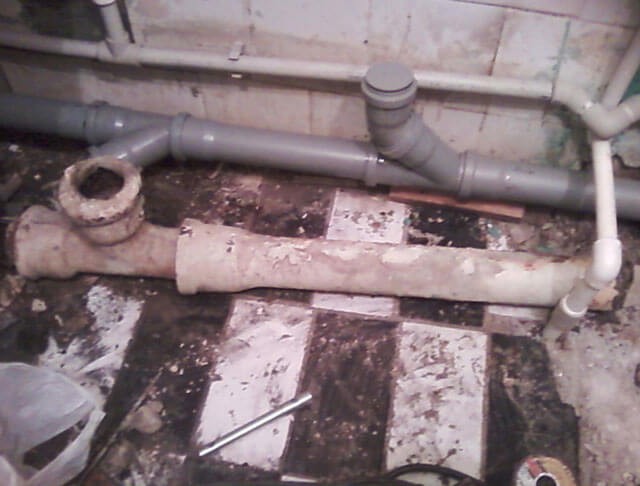
Use caution when you get to the fitting that connects the intra-apartment system to the common building riser.A hammer could damage the riser. By removing the seal, you can extract the pipe from the common riser.
What to pay attention to when starting installation?
- As mentioned above, the maximum depth for laying a system such as plastic entry of sewer pipes into a building is 10 meters, while the minimum depth is 1 meter; laying the structure higher is strictly not recommended.
- The granulometric characteristics of the drainage should not prevent it from filling the cavities between the corrugated areas.
- The connection can be made either using individual connecting parts or by soldering.
| Type | Characteristics |
| Corrugated | Flexible, easy to bend, commonly used for connections in tight spaces |
| Smooth | Allows for smoother flow, less prone to clogging, used for main lines |
| Reinforced | Extra strength, resistant to crushing, ideal for heavy-duty applications |
Modern plumbing systems can benefit from the flexible and useful solution provided by sewer pipes. They are available in several varieties, each with special advantages, such as corrugated, smooth, and reinforced choices. Because corrugated pipes are flexible and simple to install, they are perfect for areas with lots of obstacles and small spaces. Conversely, smooth pipes offer a more efficient flow and are frequently utilized in longer runs. Stronger and more resilient, reinforced pipes are appropriate for high-traffic areas and areas carrying large loads.
The flexibility of flexible sewer pipes to accommodate various topographies and layouts is one of their main benefits. They don’t require multiple fittings to easily navigate around bends and corners, which lowers the possibility of leaks and blockages. Their versatility renders them a favored option for projects involving both residential and commercial spaces. Additionally, PVC and HDPE, two sturdy materials resistant to corrosion, chemicals, and environmental conditions, are frequently used to make flexible sewer pipes.
Generally simple to install with simple tools, flexible sewer pipe installation reduces labor costs and labor time. Handling and transportation are also made easier by their lightweight nature. Compared to rigid pipes, these pipes are less likely to break or crack, making maintenance easier. A long lifespan and dependable operation can be ensured with the help of routine inspections and sporadic cleaning.
In conclusion, flexible sewer pipes offer a dependable, affordable, and adjustable solution for a variety of plumbing needs. Flexible sewer pipes are a great option if you’re working with difficult landscapes or want something sturdy and low-maintenance. Their diverse types and characteristics render them appropriate for a range of purposes, guaranteeing effective management of wastewater and enhancing the overall efficacy of plumbing systems.


