
A vital component of construction is waterproofing, particularly when it comes to shielding foundations from moisture and water damage. Coating foundation waterproofing is a common technique that entails directly applying a liquid membrane or coating to the foundation surface. With continued use, this method creates a seamless barrier that keeps water out and supports a building’s structural integrity.
The adaptability of coating foundation waterproofing is one of its main benefits. It can be applied to wood, masonry, and concrete foundations, among other types. Because of its adaptability, it’s a sensible option for both new builds and renovations where the foundation needs to be repaired or protected.
Furthermore, compared to alternative techniques like membrane systems, coating waterproofing systems are comparatively simple to implement. They usually call for less equipment and labor, which can cut down on project time and costs. The ease of application also makes it accessible to do-it-yourselfers who want to strengthen the foundation protection of their homes.
Nevertheless, coating foundation waterproofing has its limitations just like any other construction method. It might not be appropriate for foundations that are frequently subjected to harsh environmental conditions or that have serious structural problems. Applying and prepping surfaces correctly is essential to guaranteeing the waterproofing barrier’s longevity and efficacy.
This article will examine the benefits and drawbacks of coating foundation waterproofing, examine its range of applications in various construction scenarios, and offer helpful advice on how to use this technique to get the best results.
What it is?
This kind of liquid insulation is applied to the entire treated surface, sealing and covering it with a monolithic film layer that serves as a protective layer after all pores and microcracks are impregnated.
The layer shields the foundation from a variety of factors, including temperature, is resistant to moisture, and can endure mechanical damage.
Due to its elastic nature, the film is resistant to abrupt temperature changes. characteristics that are the same as rubber materials.
Coating foundation waterproofing is one of the most effective and adaptable ways to prevent water damage to buildings in the construction industry. By using this method, a seamless barrier against moisture is created on the foundation walls by directly applying liquid coatings. Its benefits include cost-effectiveness, versatility with different types of foundations, and simplicity of application. But difficulties like the need for surface prep and the possibility of application errors need to be taken into account. This article examines the advantages and drawbacks of coating foundation waterproofing, as well as appropriate uses and useful advice for efficient application.
Scope of application

The primary applications for this kind of coating are:
- foundations regardless of type;
- processing the base of the building, all surfaces (for work outside and inside);
- floor, basement walls;
- all surfaces in contact with the ground;
- door and window openings, their components;
- pools, roofs.
Every task is completed in compliance with SP 28.13330.2017, which outlines the standards for quality.
Pros and cons of coverage
The physical characteristics of the chosen materials and the manufacturing technique determine the processing parameters.
Benefits
- Affordable price.
- Large selection of different materials, depending on the type of structure and its composition.
- High adhesive properties, which ensures reliable contact between the treated surface and the material used.
- Good performance.
- Easy installation, quick foundation processing.
- The ability to do everything without hiring specialists.
Defects
- A lot of time is spent preparing the surface (cleaning, covering cracks, damage, etc.).P.).
- Treatment is possible only at positive ambient temperatures, without precipitation, which is important for waterproofing external surfaces.
- Service life no more than 6 years.
- If bitumen or mastics based on it are used, it is necessary to warm them up before work. Such work increases the period of waterproofing. The event is a fire hazard, as special burners are used for heating.
- If surface deformation occurs, the insulation may peel off.
It is necessary to waterproof the foundation if there is shallow groundwater or highly adhesive soil in the area where construction is planned or currently taking place. If not, it will be destroyed and cannot be stopped.
Materials for work
Cement, polymer materials, or special mastics containing bitumen are used to create a waterproofing layer.
Contains bitumen
Bitumen is thought to be the primary component. But it must be warmed up before use, which costs money in labor and time. New materials that use less bitumen have been developed thanks to modern technologies.
It is added to bitumen mastics as follows:
This enables you to extend their service life, enhance their technical specifications, and make installation easier.
Mastics don’t require a specific temperature to be worked with, but the surface does need to be primed with a unique primer.
A primer is a substance that
- improves adhesion;
- strengthens the foundation before waterproofing;
- fills pores;
- concrete microcracks.
The primer’s foundation is:
- alkyd;
- mineral;
- bitumen;
- acrylic components that are suitable for various types of foundation.
Mastitis are
- one-component – for use on an unprepared surface;
- two-component – for the use of which the foundation must first be prepared.
Cement-based
Among the cement-polymer mastic are:
- cement;
- mineral filler;
- polymerizing additive.
A two-component mixture made with emulsion or water is referred to as mastic.
Mixtures made by manufacturers consist of:
- various resins;
- fillers;
- organic additives.
Although these materials are more costly than bitumen mastics, they require a lot less work to use. Because waterproofing components are included in the cement, the foundation can be poured more quickly.
Polymer compositions
Artificial materials, such as rubber, plasticizers, different emulsions, and additional additives, are used to make mastics.

Although these waterproofing materials cost more, they perform technically better than other mastics by several orders of magnitude. Every year, they become more and more popular.
Benefits of these substances:
- high adhesive properties;
- formation of an elastic layer;
- moisture resistance;
- non-flammable.
Selecting layer thickness
The material selected and the kind of insulating coating applied using the coating technique determine the layer thickness:
- Bituminous. Coating layer thickness – 4-5 mm;
- Cement based. Layer dimensions – 2-4 mm;
- Polymer mastics. Thickness parameter – 1-2 mm.
Application technology
Phases involved in constructing a superior insulating layer at the structure’s base:
- Preparatory. This stage consists of preparing the surface for applying waterproofing. At the same time, the foundation is cleaned of dirt and foreign objects, sharp edges and protrusions are cleaned off, metal parts are cleaned of rust, seams are puttied;
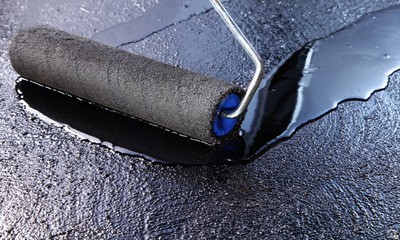
- Applying primer. All surfaces are treated with a primer, which is selected depending on the choice of base material. The primer is applied with a brush or roller.
- Preparation of mastic. The primer must be completely dry to ensure good adhesion. Therefore, while the material dries, you need to prepare mastic. If the bitumen requires heating, then it is heated to the required temperature, if two-component materials are used, it is necessary to mix in accordance with the attached operating instructions.
- Applying the 1st layer of waterproofing using a spatula, any painting tool. All corners must be carefully coated.
- Laying the mastic. The mastic must be laid evenly over the entire surface being treated. Each layer must harden well. Then the second is applied, then after hardening – the third. Allow time for hardening, absorption.
- To make the base insulation more durable, work is carried out to reinforce it. Reinforcement involves gluing fiberglass, fiberglass, to the first layer of mastic. In this way, the waterproofing layer is preserved, it is not damaged during seasonal deformations of the foundation.
- Bitumen mastic used for horizontal waterproofing when a thick insulating layer is required. It is applied with spatulas and brushes with stiff bristles.
As a different kind of treatment, coating waterproofing of the foundation provides defense against water intrusion. Additionally employed in adhesive waterproofing protection.
Price of work per m2
When constructing a waterproofing layer on a foundation with a coating type, the average cost in the estimate for work per 1 m2 is at least 550 rubles./m 2.

What will impact the overall cost of the work is:
- selected material;
- type of foundation (slab, piles, strip);
- number of layers;
- worker qualifications;
- deadlines.
It is important to remember that all work needs to be done in sunny weather and at temperatures above freezing.
The advantages of using foundation waterproofing coatings to shield your house from water damage are substantial. They establish a barrier that keeps water from penetrating the foundation, which over time may cause expensive structural problems. These coatings help preserve the integrity of the base of your home and increase its lifespan by effectively sealing the foundation.
The adaptability of foundation waterproofing coatings is one of their main benefits. They can be used on a variety of foundation materials, such as wood, masonry, and concrete. Because of their versatility, they can be used for a variety of construction projects, including both residential and commercial ones, and they offer dependable resistance to moisture intrusion.
Nonetheless, there are things to consider when using foundation waterproofing coatings, just like with any other construction product. To guarantee good adhesion and efficacy, the foundation surface must be meticulously prepared before application. Furthermore, even though these coatings are long-lasting, they might need to be periodically maintained and reapplied over time in order to keep their protective properties.
In conclusion, for builders and homeowners wishing to protect their buildings from water damage, foundation waterproofing coatings are a wise investment. They add to the building’s lifespan, provide strong protection, and have a wide range of applications. When developing and putting into practice foundation protection strategies, having a thorough understanding of their advantages and factors can help you make wise choices.


