
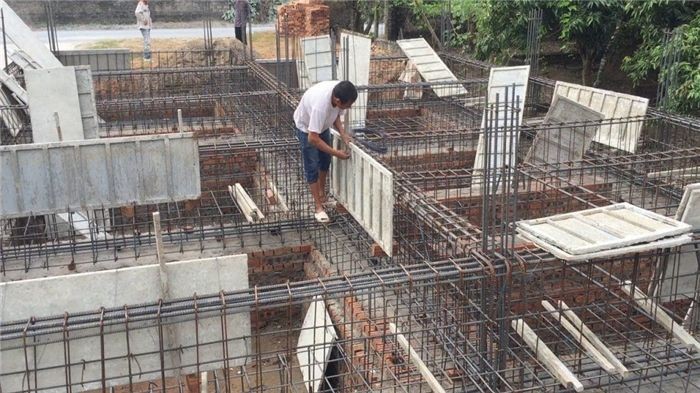
Without reinforcement, the construction of reinforced concrete structures is incomplete. It guarantees the development of a robust framework that enhances the elasticity of concrete. Builders have to figure out how much source material, including reinforcement, goes into a project. The length of the rod affects how much of it is consumed. What length is standard, what kinds of reinforcement are available, and how to figure out how many rods a foundation needs?
- Types of rod reinforcement and their features
- Length of rod reinforcement – all possible options regulated by GOST
- GOST 5781
- GOST 10884
- GOST 52544-2006
- GOST 31938
- Sizes 12 fittings
- Video on the topic
- Reinforcement dimensions (weight 1 meter)
- The secret to joining reinforcement: the ideal overlap length!
- Calculation of the weight of building reinforcement
Types of rod reinforcement and their features
There are different types of rod reinforcement depending on the material that is used to make the components. Steel and composite are both available. Based on alloy composition, intended use, and production technology, steel reinforcement is divided into three categories:
- Hot rolled – used for ordinary products, prestressed materials and reinforced concrete structures (GOST 5781-82);
- Thermo-mechanical – the manufactured rods are characterized by a high strength index and are used in reinforced concrete structures (GOST 10884-94);
- Weldable rods – suitable for reinforced concrete structures and products (GOST 52544-2006).
GOST 31938-2006, the composite type, is separated into two subtypes:
- Plastic AKS – made from glass roving compound obtained by polymerization of epoxy resin
- Basalt-plastic battery – basalt-based polymers are used in production.
The market is seeing a decline in the use of basalt plastic materials. Glass products made of polymer plastic are more popular among customers.
Unlike fiberglass components, steel reinforcement is prone to corrosion, which shortens its service life. Additionally, because of its heavier weight, customers would rather reject it.
The cost of fiberglass products is nearly equal to that of steel ones. They are lightweight and convenient to transport.
These fittings don’t react with acids, sea salt, or alkalis to form corrosive compounds. However, these components don’t bend, so welding isn’t necessary during installation.
Although steel types are more robust, they permit the rod to bend, which facilitates the arrangement of a strip foundation.
The following variables affect how big the reinforcement is:
- Standardized norms approved at the state level;
- Customer"s wishes;
- Manufacturer"s decision;
- Generally accepted dimensions of other products used in construction.
State standards are taken into consideration when producing composite materials or primary steel reinforcement. They then permit different mistakes to be made when creating separate parties.
Length of rod reinforcement – all possible options regulated by GOST
On the market, 12 m lengths are more typical. However, longer rods up to 26 meters in length can be ordered. The reinforcement’s length fluctuates within certain bounds in relation to the GOST that has been established.
GOST 5781
The 6–12 mm nominal value is stated. Deviations related to the delivery of products in batches are permitted by the standards. Three varieties are recognized:
- The rods in the entire batch have a measured length;
- The measured batch contains non-measured segments;
- Lot with non-measured length.
The length of the rod reinforcement, which is included in the segment 6–12 mm, is equal to a specific figure if the batch is measured. The length is selected by the manufacturer or the customer.
This is how the fittings are delivered to the client.
Their length is at least 2 m when unmeasured segments are present (option 2). The total amount of segments that have not been measured does not surpass 15% of the batch’s total mass.
Unmeasured batches are distinguished by the presence of three to six meter-long reinforcement. There are only 7% or less rods in the total.
The standard does not preclude the supply of rods with a length of 5 to 25 meters in situations where the supplier and customer have previously agreed on the product’s dimensions. Maximum size deviations allowed by GOST when cutting rods are as follows:
- Rods up to 6 m – deviation with normal accuracy +50 mm, and with increased accuracy +25 mm;
- Rods over 6 m – the length of the rods with normal accuracy deviates from the norm by 70 mm, and with increased accuracy by 35 mm upward.
There is an increase in accuracy when the customer requests that the product be produced to the specified length.
GOST 10884
The production of rods with a minimum diameter of 10 mm is governed by the standard. The rod reinforcement has a length ranging from 5.3 to 13.5 meters. The standards allow products up to 26 meters in length to be produced, provided that the customer agrees to the delivery terms.
Class "C" weldable reinforcement is also available in various length options. As per the regulations, lots are permitted to contain pieces of different lengths:
- Non-measured rods in measured deliveries are produced with a length of more than 2 m and in an amount of 15% of the total mass of the batch;
- Non-measured batches in which the rods correspond to a length of 6-12 m, but it is possible to have segments of 3-6 m in a percentage of no more than 7% of the total weight of the batch.
Normal and increased accuracy deviations from standard values are what define GOST. The errors match the values from the previously mentioned GOST 5781.
GOST 52544-2006
The standard’s fittings range in length from 6 to 12 meters. The two types of produced batches are as follows:
- Measuring – standard rods 6-12 m long, the length of which is agreed with the customer;
- Unmeasured – the length of the rods is selected by the manufacturer in the range of 6-12 m, the presence of shortened rods 3-6 m is allowed in an amount of no more than 7% of the total mass of the batch.
The error of deviation from the standard dimensions cannot be allowed to rise above 100 mm.
GOST 31938
Polymer-type reinforcement comes in lengths ranging from 0.5 to 12 meters. For batch sizes, this is the typical size. It has been approved to use a 0.5 m dimensional step in the production of rods with different lengths. Other variations whose length exceeds the specified value are not excluded by the standard.
Allowable variations in measuring rod length:
- 0.5-6 m – 25 mm in the larger direction;
- 6-12 m – 35 mm more;
- More than 12 m – the error is +50 mm.
Manufacturers offer delivery in coils because the plastic type is frequently used in the construction of large objects under harsh conditions.
Sizes 12 fittings
Reinforcement 12 is a popular choice for building structures composed of reinforced concrete. Its diameter is 12 mm.
Potential fiberglass reinforcement diameters
Different steel alloys are used to make it. When knitting a frame of four rods, the diameter of this type satisfies the minimal specifications for the construction of buildings on a strip foundation.
Crucial! When building a foundation, the most important requirement is to lay reinforcement along a side longer than three meters. The rods’ minimum diameter needs to be 12 mm or greater.
In terms of their mechanical qualities, rolled products are divided into the following classes:
- A1 Smooth profile – has good plasticity, which is required for elongation, providing stretching;
- A2 with a sickle-shaped pattern – due to the pattern, strength increases;
- A3 periodic profile – there is a cross-section at an angle to the axis of the whip, facilitating the weldability of parts.
Rebar A3 is widely used. One meter of the profile weighs 0.888 kg, with a diameter of 12 mm. 1.131 cm is the cross-sectional area.
You must compute the length in linear meters in order to ascertain the quantity of reinforcement. However, the material is supplied by weight on the market. In order to determine the necessary volume, you must consider that one meter weighs 0.888 kg.
Next, 1126 m of reinforcement (12 mm in diameter) were added in 1 t. You can use specific tables made accounting for the weight of one meter of rolled products for various parts for other diameters.
To ensure structural integrity and project efficiency in construction and renovation, it is essential to comprehend commonly used reinforcement length options and standard parameters. Standardized parameters offer a consistent framework for achieving quality and safety goals across various projects. In the meantime, by being aware of the common options for reinforcement length, builders can choose the best materials to meet different construction requirements, maximizing both performance and economy. This information improves the robustness and lifespan of the structures being constructed in addition to making the stages of planning and execution simpler.
But being in a different class could cause an error.


