
Choosing a range hood for your kitchen is not an easy task. There are so many models, types, and functions on the market that it's easy to get confused. Many people think that design is the most important factor, but in fact, efficiency is key. The right choice will determine whether your kitchen will have fresh air or whether the smell of fried fish will linger in the curtains for a long time.
In this article, we will break everything down step by step. We will talk about the different types of hoods, what technical characteristics to look for first, and how not to overpay for unnecessary options. You will understand what is right for your kitchen: a compact dome model or a powerful built-in one.
Our goal is to help you make an informed choice. We want your appliances to serve you for a long time, perform their tasks well, and become your reliable assistants in the kitchen. Let's start with the most important thing—how they work.
Types of kitchen hoods
This element of kitchen interior design plays an important role in the overall design. It is worth paying attention to its aesthetic design and installation method. There are the following types of hoods:
1. Wall-mounted. These are considered standard types and have a flat shape. They are fairly easy to install and can be mounted above the stove or built into a kitchen cabinet. This type of design operates on a recirculation principle, but it can also work on an extraction method if an additional air duct is installed. This model is considered the cheapest among the wide variety of designs. You can install it yourself.

2. Built-in these designs are quite compact and do not take up much space. These hoods are installed directly in the kitchen cabinet and are cube-shaped. When using a built-in design, only the grease trap grille is visible above the stove. It can be pulled out to increase the air intake surface area.

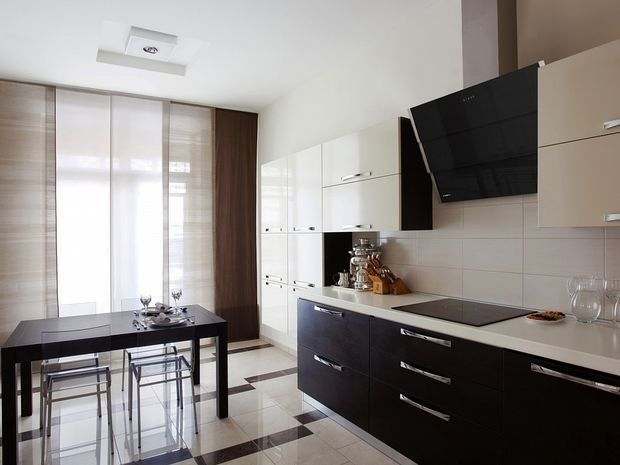
3. Wall-mounted models resemble an umbrella with a long pipe in appearance. These hoods play an important role in the kitchen interior. They should be chosen to match the color of the kitchen set to create harmony in the design. Each model is installed at an angle of 40°. An angled hood can be installed in the corner of the kitchen, in which case the structure is attached to each wall.

4. Dome hoods resemble fireplace chimneys in appearance. They differ from all other types of designs in that they can be mounted on either the wall or the ceiling. This model is made from various materials and is also available in solid wood. Designs made from stainless steel and heat-resistant glass look unusual.

5. Island hoods are mounted on the ceiling and are used when the stove is located in the center of the room. They can operate in both recirculation and exhaust modes. Their appearance should match the style of the kitchen.

6. Tabletop these designs became popular after the advent of cooktops. They are installed in the countertop and only extend when cooking. Hoods of this type are quite convenient, as they help prevent contamination of the wall or apron during cooking. They can be installed either vertically or at an angle. Despite their positive qualities, they are inferior in power to all other types.

Air purification
Various odors are constantly formed in the kitchen during cooking. They can be of a very diverse nature: some attract with their aroma, while others, on the contrary, repel and create an uncomfortable feeling. Therefore, it is important to periodically purify the air in the kitchen. Hoods are used for this purpose. They draw in all odors, making the air cleaner.
Such installations draw in small dirt particles and grease, which can stain surfaces in close proximity to the stove.
You can clean the air in the kitchen by ventilating it; to do this, simply open a window or balcony. However, the most reliable and rational method is to use an extractor hood. With this design, all the air is extracted directly above the stove, before it has time to spread throughout the room.
How to choose a kitchen hood?
To choose the right kitchen hood, you need to pay attention to certain criteria:
1. Size. The hood should not be narrower than the stove, otherwise it will not be able to capture odors effectively. The hood should be the same size as the cooking surface, but it can even be wider. This will allow it to capture all unpleasant odors without spreading them throughout the kitchen.

2. Method of work. When buying, it is worth finding out how the design works. The hood can work by extraction, in which case all the polluted air is removed from the room. But there are also models that work like filters. In this case, they take in dirty air, clean it, and the air masses return to the kitchen. When choosing this type of design, don't forget to buy additional filters, as they will need to be replaced periodically.
3. Management method. This parameter is selected individually, depending on the preferences of the kitchen owner. Some people find it convenient to use touch controls, in which case a button is pressed, while others prefer push-button controls. You can purchase a design with slider controls, in which case the hood is turned on and off using a mechanical switch.

4. Filters used. There are two types of filters: coarse and fine. Coarse filters are metal meshes that trap grease, are easy to clean, and are reusable. In addition to these, a fine mesh is purchased as an additional filter; it is disposable and must be replaced when dirty. Fine filters are carbon filters and are purchased separately from the hood. They are replaced as the hood operates in recirculation mode.

Additional functions
When buying, pay attention to additional features. The hood may have a built-in electronic timer that turns off the device after cooking. An inclined hood may have a residual fan speed, which means that after turning off, the device continues to operate for 5-10 minutes, sucking out all the dirty air. A dome hood can be equipped with an interval shut-off, which will automatically switch to minimum mode during operation.
All hoods are equipped with lighting fixtures that can be fitted with various bulbs, either halogen or incandescent. The second type often has a sloped hood, and replacing the bulb is no problem.
When choosing a range hood for your kitchen, look at photos beforehand to get at least a rough idea of the different models. You can visually assess whether the design is suitable or not, and how it will look after installation.

When choosing a hood for your kitchen, consider the size of the room, the type of stove, and the ventilation method. If the kitchen is small, a compact suspended model will suffice; for larger spaces, it is better to choose a wide or built-in hood with good power. It is important that the performance matches the volume of air that needs to be cleaned — as a rule, the more often you cook and the stronger the smoke and odors, the more powerful the hood needs to be. Also, decide whether it will vent the air outside (ducted option) or purify it inside (recirculating, with filters). And don't forget about the noise level — it is more convenient to use one that works quietly, especially if the kitchen is combined with the living room.
Hood design
Before choosing a range hood for your kitchen, you need to determine the concept and design of the room. There are different models with different design features.
However, the hood should fit into the kitchen interior, match the furniture, other appliances, as well as tiles, aprons, or the main finish. Stainless steel appliances, such as built-in models from Bosch with built-in lighting and a double filter system, will look great in kitchens of any size. They will always fit harmoniously into the kitchen design, matching the sink, cutlery, decor, and other various elements.
You can choose one of the existing hoods depending on the shape:
-
round;
-
pyramidal;
-
rectangular;
-
cone-shaped.

They also differ in the method of installation:
-
wall-mounted;
-
flat;
-
island;
-
dome-shaped;
-
built-in;
-
“domino.”
A kitchen hood with an unusual creative design can become the main detail. Many modern varieties are designer developments and the embodiment of innovative ideas. They take center stage, distracting attention from kitchen facades, bright furniture, or unusual aprons. If you manage to combine them with other household appliances and accessories, the space will look very stylish and attractive.
Some models do not immediately reveal that they are air purifiers. They may look like lamps with many small details. If there are many utilities in the kitchen, you can use a dome type and run ventilation pipes across the entire room to the outside, choosing a loft style. This concept will fit perfectly into this style.
You can choose between shiny or matte metal surfaces. In the high-tech style, island models made of chrome-plated materials will look beautiful, and in any shape: asymmetrical, oval, diamond-shaped, and others.
In kitchens where there is little free space above the work area, you can install the hood in a wide ventilation pipe. The performance of the appliance will be slightly lower, but this decorative touch will look very interesting. However, it will not fit into a classic style, of course.
Ceiling island models can be used as additional shelves in interior design and also provide optimal lighting over the entire work surface. In some rooms, designers take the risk of placing several hoods of the same type above the hob or stove. The design acquires a special originality, and the output of such devices doubles, which is relevant for large kitchens.

Lighting
The choice of a range hood for the kitchen should be made taking into account the presence of lighting fixtures, as it acts as an additional source of light. It helps to illuminate the work area and creates a special comfort in the evening for cooking. New models of range hoods have innovative features: adjustment of light brightness and intensity. Existing hood models may have the following lighting options:
-
low-power incandescent lamps are usually built into inexpensive models, are characterized by significant energy consumption, emit yellow light, and need to be replaced frequently.
-
fluorescent lamps provide bright white light, are energy efficient, and have a long service life, but they are difficult to replace.
-
halogen lamps are small spotlights that provide economical electricity consumption and brightness, have a long service life, and are used in premium and mid-range brands.
-
lEDs are very economical, modern, and durable lamps.

Kitchen hoods almost always have built-in light sources. The most popular models are those with built-in halogen lamps, which help save energy, are easy to replace, and have a long service life.
Cost
When looking for appliances, you should first focus on your budget, as you can only choose the right kitchen hood within a certain price range. The main thing is that the model performs its main function properly, has sufficient power, fits into the interior, and has various additional options that improve ergonomics.
The cost of a kitchen hood is determined not only by the brand you choose, but also by the following parameters:
-
style and design.
-
materials for manufacturing;
-
power.
-
operating principle;
-
additional functions.
Therefore, you can find models at different prices, from cheap options to premium ones. The price can range from $40 to $15,000. But when it comes to designer models, the manufacturer's name also affects the price. The cheapest hoods are not always of poor build quality and inferior to branded counterparts; sometimes they are even better. If we compare prices, a standard flow-through model will cost between 70 and 170 conventional units, while a circular model will cost between 5 and 80 conventional units.
So, choosing a range hood is primarily about finding a balance between your real needs and the capabilities of your kitchen. There is no point in chasing maximum power if you have a small apartment and do not plan to fry steaks every day. Focus on the size of your stove, the type of hob, and, very importantly, the ventilation method.
Remember that even the most expensive and powerful model will not cope with its task if there is no normal air flow into the room. Check the draft in the ventilation duct and think in advance about how you will organize air removal—to the street or through a charcoal filter.
Ultimately, the ideal hood is one that quietly and effectively deals with odors and steam in your kitchen. It fits harmoniously into the interior, is easy to care for, and is hassle-free to use. Start with these simple principles, and you are sure to find an option that will make cooking more comfortable and the air in your home clean and fresh.


