
The stability and longevity of a wooden house are greatly dependent on the selection of the foundation. Wooden houses, because of their natural material and lighter weight, have different requirements than structures made of concrete or brick. The foundation acts as the structure’s bedrock, keeping it level and sturdy over time.
Wooden houses can be built on a variety of foundation types, each with pros and cons of its own. Slab-on-grade, crawl space, and pier and beam foundations are the most popular varieties. Numerous factors, including soil type, climate, budget, and local building codes, influence the decision.
Pier and beam foundations are made up of raised concrete piers or wood posts that hold up beams, which hold up the wooden floor structure. Because it allows for flexibility and ventilation beneath the house, this type is perfect for areas with expansive soils or uneven terrain.
A solid concrete slab that is poured directly onto the ground serves as the foundation for a slab-on-grade home, offering a sturdy base for the whole structure. They are easy to build and maintain and work well on level sites with stable soil conditions.
Pier and beam and slab foundation components are combined in crawl space foundations. They create a crawl space beneath the floor by raising the house just a little above ground. This area is perfect for high humidity or flood-prone areas because it makes utility access easier and provides ventilation.
Think about things like soil stability, local climate, building codes, overall house design, and intended use when choosing a foundation for a wooden home. Every type of foundation has unique qualities that can affect the price of building, the upkeep needed, and the structure’s long-term durability.
| Foundation Type | Characteristics and Selection Criteria |
| Pile Foundation | Best for soft soil or where soil stability is an issue. Uses piles driven into the ground to support the house. |
| Strip Foundation | Suitable for stable soil with good bearing capacity. Consists of a continuous strip of concrete under load-bearing walls. |
| Screw Pile Foundation | Great for areas with sandy or clay soils. Utilizes screw-like piles twisted into the ground, providing quick installation and minimal soil disturbance. |
| Slab-on-Grade Foundation | Ideal for flat sites with stable soil. Involves a concrete slab directly on the ground, offering excellent thermal mass and easy maintenance. |
| Crawl Space Foundation | Offers access to plumbing and electrical beneath the house. Elevated above ground level with ventilation to prevent moisture buildup. |
- Varieties
- Tape
- Columnar
- Ribbon-column
- Pile
- Slab
- Criteria for choosing a good foundation
- Comparison of different types of bases
- The best option
- Useful video
- Video on the topic
- Which foundation to choose for construction? Which foundation for a frame house is better?? Analysis + Estimates
- Types of foundations for a house. Which foundation to choose? The best foundation. Review of 6 types of foundation
- Which foundation to choose??? Foundation for a FRAME house. Advantages and disadvantages!Title
Varieties
The four most common types of bases used as a foundation for a wooden house are:
The selection of each of them is primarily influenced by the building’s weight, type of soil, number of stories, and basement availability. However, because of the features of wooden houses, you can cut back on foundation costs somewhat because even a thin foundation works well for these kinds of structures. Let’s examine the various kinds of wooden house foundations and what makes them unique.
Tape
The most popular kind of foundation, strip foundation works well for both single-story homes and larger structures. There are three subtypes of belt supporting structures:
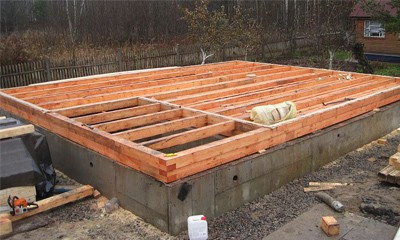
- Recessed most often used for massive structures with more than 2 tiers, in which it is planned to use the ground floor or basement. Also, this subspecies is intended for moving soils or soils with a large freezing depth (it is buried 20 cm below the freezing level). A deep foundation is made of reinforced concrete.
- Shallow used for smaller structures, and also if the soil on the site allows. It is buried 50-70 cm, which is above the freezing point, but because of this the mass of the base is reduced, as well as the amount of costs. The shallow subspecies is made of reinforced concrete.
- Non-buried foundation most often made of bricks or blocks, which is why such a base is suitable only for very light buildings, for example, bathhouses, sheds or utility rooms.
Citation. Any concrete foundation typically requires a month or so to construct because the foundation needs that time to solidify and become stronger.
Columnar
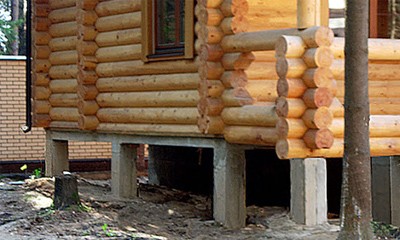
The most common situation for a columnar foundation to be used is when a house is constructed on non-heaving soil with shallow groundwater. These types of bases are used for small one-story structures because of the characteristics of load distribution.
The ground height variations at the construction site should be taken into consideration when selecting this foundation, as they shouldn’t be more than two meters.
Columnar bases come in two varieties:
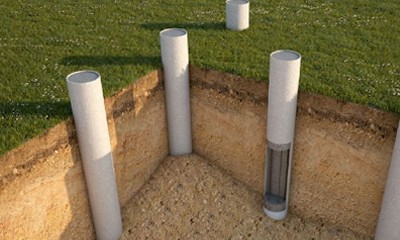
- Shallow sinks to 1/3 or 1/2 of the soil freezing depth. In this case, the soil should not heave or move (for example, like sand and gravel). The pillars at such a base can be made of brick, concrete, stone or asbestos pipes filled with concrete. The advantage of this foundation is the speed of construction and low consumption of materials.
- Bored – this is a type of columnar foundation, in which a well is made for an asbestos pipe using special equipment. The depth of such a hole should exceed the freezing level by 40 cm. After this, a reinforced concrete structure is made inside the pillar, which will hold the house. The advantage of such a base is that it can be made on any type of soil, and it is also not afraid of groundwater.
The drawback of both types of columnar foundation is that a basement cannot be created, and the building’s mass cannot be overly large, which reduces the building’s number of stories. The benefit can be regarded as ignoring melt water by the house’s walls and paying less for resources. The fact that this kind of foundation can be installed on uneven surfaces is another benefit.
Ribbon-column
Combining earlier foundation types results in a strip-column foundation. It enables the construction of a large-mass or multi-story house foundation on unstable soils, such as swampy, clayey, fine-sand, or peat-filled soils.
Crucial! It is necessary to thoroughly drain the soil before putting in such a base.
Pillars that are buried below the freezing depth of the soil and rest on solid ground provide the support. The grillage, or tape, is not supported by the ground; rather, it is made on top of the pillars. It’s necessary to tie every component of the base together and disperse the weight evenly across them.
Such a solution has the benefit of being resistant to all soil types and, in certain situations, not requiring a lot of space or specialized equipment. Among the drawbacks are that this kind of foundation cannot have a basement built into it, and because of its complex development, a project must be ordered for its construction.
Pile
The pile foundation functions essentially in the same way as a columnar foundation, with the exception that all of the base’s components are screwed or clogged rather than buried. Like that There are various subtypes of the base:
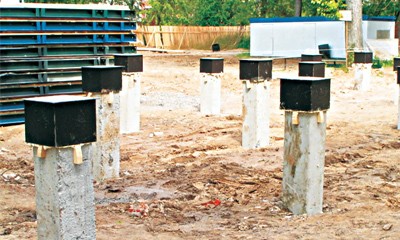
- Pile. This type of base is made of reinforced concrete or metal pillars and is installed by means of a pile. In the process of immersion, mechanical tamping of the soil under the pile occurs. Such a base is immersed in hard layers of soil (which are located under soft ones) by 30 cm, and the total depth of immersion can exceed 3 meters. Due to the increased density of the soil around the pile, this type of foundation allows you to build houses with 2-3 floors.
- Screw subspecies its characteristics are similar to a large self-tapping screw that is screwed into the ground. The work is carried out using special equipment, since it is important to maintain the angle of immersion of the screw. The advantage of such a foundation is its resistance to groundwater, the absence of complex earthworks, and low dependence on soil type. For poles up to 2.5 m, manual screwing is possible.
These techniques have the benefit of being applicable to surfaces with varying soil levels as well as unstable soils. Melt water cannot penetrate a pile foundation, just like it cannot a columnar foundation. The inability to construct a full basement is a drawback of all pile foundation designs.
Slab
An entire slab is called a monolithic slab. Because this subspecies can move with the soil, hence its name "floating," it is used to construct homes on heaving or shifting soils.
Citation. It should be noted that displacement refers to movement of a few centimeters per year (even a small amount of movement can cause foundation or wall cracks in certain situations).
Since leveling the area and filling it with concrete mixture is required for erecting a monolithic base, installation times for these bases are comparable to those of strip bases.
The high cost and resource consumption of this kind of foundation are its drawbacks. A base like this is rarely used because wooden buildings are lightweight.
Understanding the different types, their distinctive qualities, and the critical selection criteria is essential when choosing the best foundation for a wooden house. The practical differences between options such as crawlspace, basement, and slab foundations are examined in this article. Making the best decision requires careful consideration of important elements like soil type, climate, house design, and financial constraints. Homeowners and builders can confidently choose the foundation type that will guarantee stability, durability, and long-term structural integrity for their wooden home by clearly examining these factors.
Criteria for choosing a good foundation
A multitude of factors influence the choice of base type:
- soil type;
- seismic activity;
- weight and size of the building;
- required construction speed;
- limited funds;
- season;
- groundwater level;
- depth of soil freezing, as well as its heaving;
- Availability of specialized equipment and experience.
Therefore, the less bulky the foundation can be made, and vice versa, the easier the construction and the more resistant to movement the soil is.
Comparison of different types of bases
Let’s examine a comparative table of various foundation types that can be used to construct a wooden house.
| Name | Ready time (days) | Durability (years) | Suitable soil types | Price |
| Belt recessed | 40 | More than 100 | Any | 12000-16000 RUR/linear meter (p.m.) |
| Tape shallow | 40 | Up to 100 | Low mobility | 2800-5200 r/ (p.m.) |
| Tape, not recessed | thirty | 50-100 | Hard with low mobility | 1500-2000 r/p.m. |
| Columnar shallow | 2-4 | Up to 30 | Sedentary, not heaving | 2500-6200 RUR/1 post |
| Bored | 40 | More than 100 | Any | 2000-9500 r/p.m. |
| Ribbon-column | 40 | Up to 30 | Any | 10000 r/m.P. |
| Pile-driving | 1-2 | More than 100 | Any | 3800-6000 RUR/1 post |
| Screw | 1-2 | Up to 30 | No major drawdowns | 1100-6800 RUR/1 post |
| Slab | 35 | More than 100 | Any | 15000 r/m 3 |
The materials used to assemble the foundation, how the foundation is strengthened, and the weather all affect how long something will last. The depth of the foundation, the size of the piles, the materials used, and the intricacy of the structure all affect the cost.
The best option
A good option is a highly nebulous concept that depends on numerous factors when selecting a foundation for a wooden house:
- But if we take the average indicators that the structure will be small, a basement is not needed in the house, and the soil is not too heaving, then in terms of price and speed of construction, columnar or pile construction is best suited.
- For self-arrangement, the easiest way is to make a shallow strip, since it is simple in execution and you can make a basement, and a deeply buried one allows you to make a full-fledged basement.
- The use of a monolithic base is recommended only as a last resort, since it does not correspond well with the needs for wooden houses due to its excessive price and massiveness.
Useful video
The following are the most typical foundation types for building wooden houses that you will learn about from the video:
The stability and longevity of a wooden house are greatly dependent on the selection of the foundation. There are a number of frequently used foundation types, each with unique qualities and suitability depending on things like soil type, house size, and financial constraints.
The concrete strip foundation is a common choice that entails placing concrete strips beneath load-bearing walls. This variety is adaptable to different climates and home designs because it offers good stability and is appropriate for a range of soil conditions.
In regions with vast soils or elevated water tables, a pier foundation may be a better choice. For this kind, the structure is supported by posts made of treated wood or concrete that are buried deeply. It can be more affordable in some circumstances and provides flexibility in responding to changes in the ground.
Slab-on-grade foundations are another popular option; these involve pouring a concrete slab straight onto the ground. This kind of foundation is more affordable and easier to use for smaller wooden homes or in areas with stable soil. It offers a sturdy foundation, but in colder climates, insulation might be needed.
A wooden house’s ideal foundation should take local building codes, soil stability, and climate into account. Speaking with a licensed engineer or architect can help you decide which kind of foundation best meets your needs and will keep your house sturdy for many years to come.


